

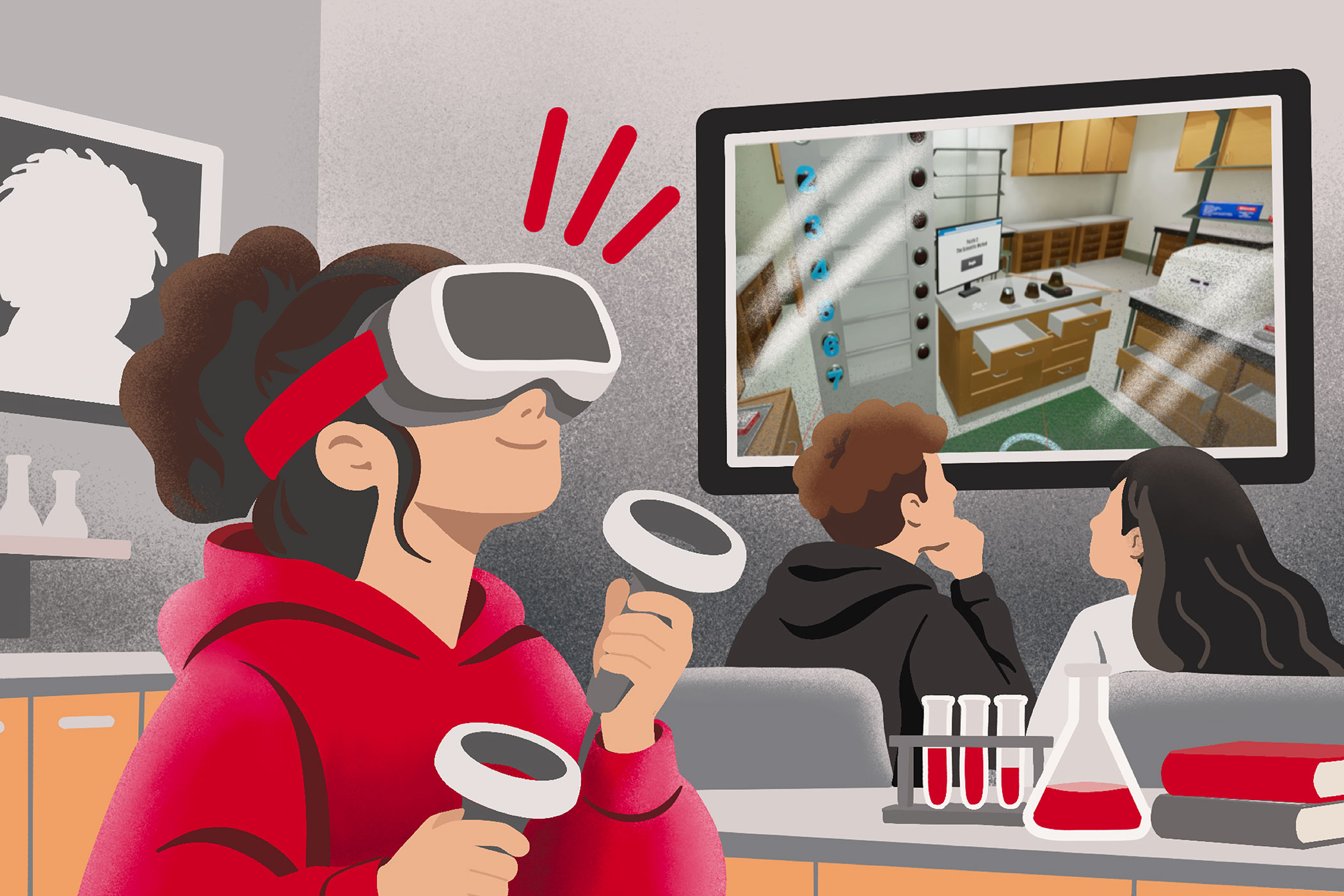
Albert Einstein’s ghost is trapped inside a science laboratory, and he needs help escaping. Fortunately, a group of seventh graders is up to the challenge.
Armed with virtual reality headsets, students search cabinets, investigate laboratory equipment and solve scientific puzzles to help the famous physicist find his way out. Along the way, they’re learning the scientific method, laboratory safety and how to conduct experiments.
It’s an unconventional approach to science education, but for University of Georgia researcher Ai-Chu Elisha Ding, the game represents something much bigger. It’s an opportunity to explore how students learn through multiple communication modes beyond language alone.

In her latest study, Ding examined how 85 seventh graders learned foundational science practices through a combination of virtual reality and traditional reading activities. Some students directly interacted with the virtual environment, manipulating objects and solving puzzles, while others observed their classmates’ experiences through a shared screen.
The researchers initially expected that observing peers would encourage collaboration and verbal communication, potentially benefiting multilingual students.
Instead, students who directly participated in VR demonstrated significantly greater gains in laboratory safety and equipment knowledge than those who observed the VR play, although the advantage was relatively small.
“We were very surprised by that because, through the literature, we know that collaborative learning should be beneficial to students,” said Ding, an associate professor in UGA’s Mary Frances Early College of Education.
The findings suggest that physically interacting with virtual environments may offer learning opportunities that observation alone cannot fully replicate.
Learning through more than words
For Ding, the results highlight an important aspect of education: Students need more than words to begin understanding a concept.
Before becoming a researcher in instructional technology, Ding taught English in Taiwan. Her background in language education helped shape her interest in how multilingual students learn scientific concepts.
Traditional instruction frequently relies on verbal communication tasks such as reading, writing and spoken explanations. But students also communicate through images, gestures, movement and interactions with their surroundings.
Virtual reality brings many of these modes of communication together.
Ding studies how learners construct understanding by connecting experiences across different modalities. For example, a student might read about a laboratory instrument, learn to manipulate it in a virtual environment and later explain its purpose aloud.
These shifts among different modes of communication may provide additional pathways for students to engage with scientific ideas instead of relying exclusively on English.
We want to make sure that multilingual learners are able to fully participate … have the tools to be able to articulate themselves
Ai-Chu Elisha Ding, College of Education
But the research also revealed that technology alone cannot overcome every learning barrier.
During collaborative activities, the researchers observed that students who primarily spoke English at home often dominated discussions while some multilingual students remained quiet or took less active roles.
Because the study included only 14 multilingual learners, findings about differences between language groups are preliminary. Still, the observations suggest that teachers must be intentional about creating opportunities for every student to contribute.
One way teachers can do that is by being thoughtful about the makeup of groups during collaborative activities.
“We want to make sure that multilingual learners are able to fully participate in these activities and that they have the tools to be able to articulate themselves,” Ding said. “You know, talking to one another, helping one another, giving these multilingual students that sort of agency to feel like they can contribute to the group. And then maybe they won’t be so worried about making mistakes or feeling like what they say was not valued.”
Making the most of virtual reality tools with limited resources
Although virtual reality offers new possibilities for science education, bringing the technology into classrooms presents practical challenges. Headsets can be expensive, and many schools lack the re
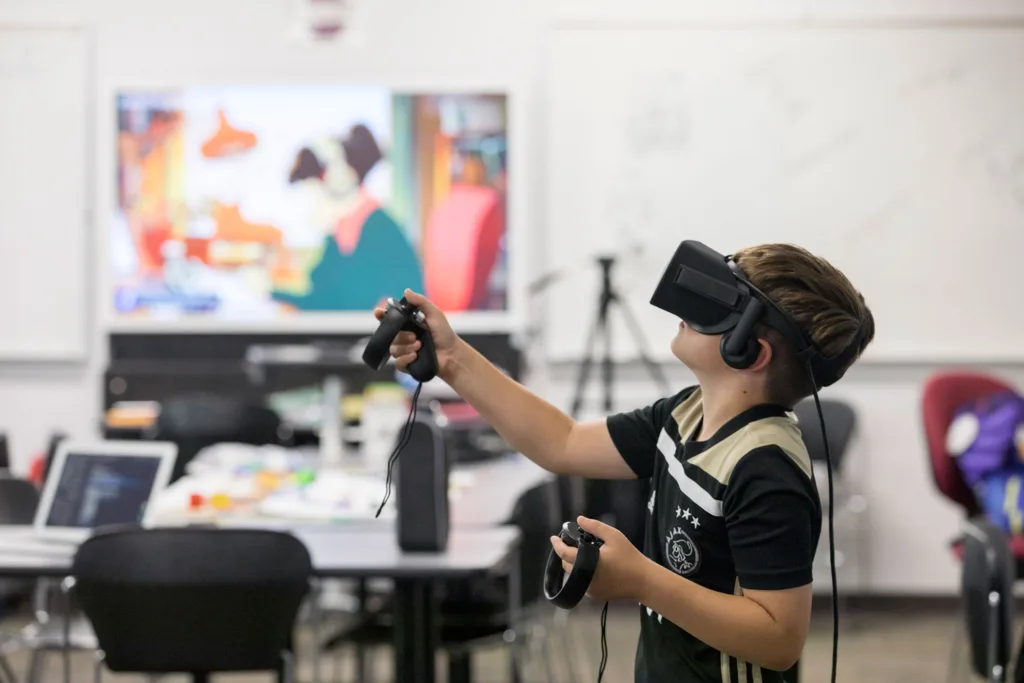
To make the technology more accessible, Ding’s research team incorporated a station rotation model. Rather than purchasing a headset for every student, schools could implement a similar practice by buying a smaller number of devices and having students rotate between virtual reality experiences and other activities, such as reading. This approach allows more students to benefit from the technology while reducing the amount of equipment schools need to purchase.
But Ding believes the lessons extend beyond classrooms equipped with virtual reality.
Teachers can encourage students to communicate scientific ideas through drawings, movement, hands-on demonstrations and verbal explanations, creating more opportunities for students with different linguistic backgrounds to participate.
The goal isn’t simply to introduce more technology into classrooms. It’s to design learning experiences that recognize the many ways students can understand and express scientific knowledge.
And sometimes that journey might begin by helping Einstein’s ghost escape a virtual laboratory.
The study was published in Education and Information Technologies.
