

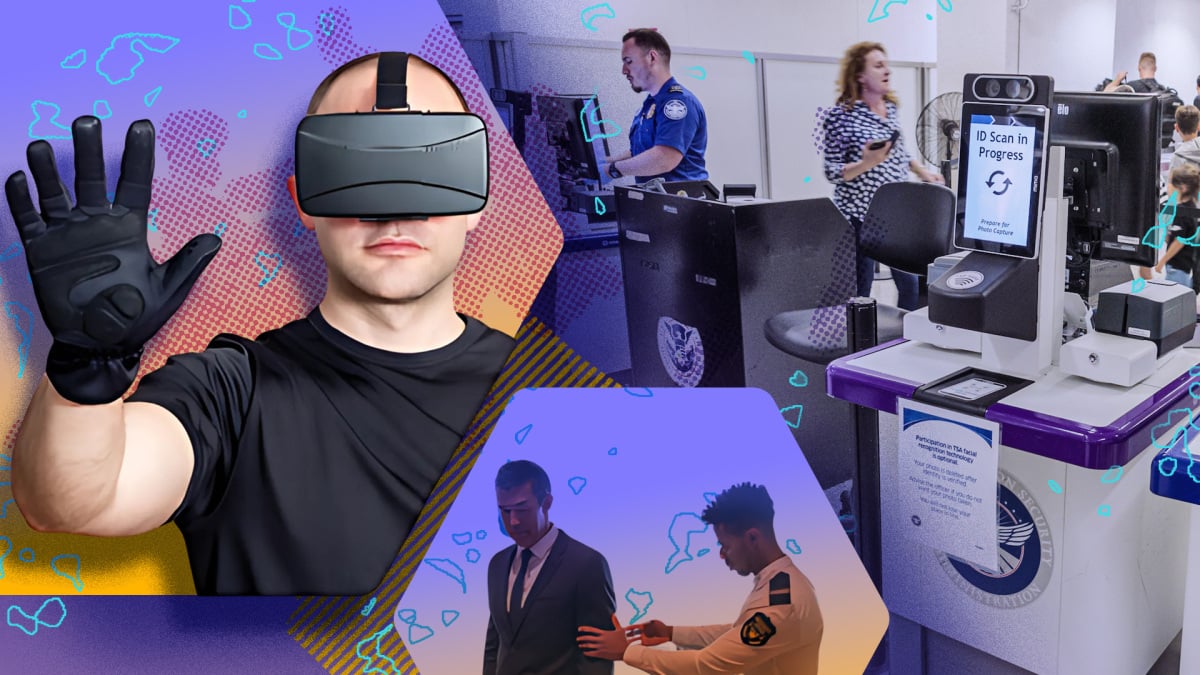
TSA pat-downs can be invasive. Could new VR technology help?Credit: Mashable composite: Department of Homeland Security; Jeff Greenberg / Universal Images Group
Researchers at the Transportation Security Administration have designed virtual reality technology to effectively pat-down a person without touching them directly, according to materials recently published online by the Department of Homeland Security.
The conceptual technology, known as a “wearable sensor for contactless physical assessment,” combines touchless sensors, cameras, and a haptic feedback pad with a virtual reality headset to “physically simulate” the “sensation” of a traditional screening. DHS has applied to patent the device, and 404 Media originally reported on the technology.
TSA researchers designed this wearable technology that could help make airport pat-downs less invasive.Credit: Department of Homeland Security
A description of the wearable device noted that the technology “can minimize potential harm when touching unsafe objects, preserve individual privacy during a security screening, or safely provide physical awareness for visually-impaired individuals.”
You May Also Like
SEE ALSO:Secure and locate your bags with this $20 TSA-approved travel lock
In 2024, TSA screened 904 million passengers, according to the federal agency. An unknown number of those passengers received a pat-down, which the agency says is used to determine whether a passenger is concealing a prohibited item, like a firearm or knife.
Such screenings have gone viral online in the past, with passengers claiming they were subject to invasive, sexual, or otherwise inappropriate touching.
Mashable Light Speed
By clicking Sign Me Up, you confirm you are 16+ and agree to our Terms of Use and Privacy Policy.
The sensor system could use millimeter wave scanning, light detection and ranging (LiDAR), or backscatter X-ray technology in order to reveal items concealed by clothing. A handheld padded device containing those sensors would detect an individual’s “contours” to ultimately produce a map that would guide the user’s hand through haptic feedback.
According to 404 Media’s review of patent documents, the display of sensitive body parts will be limited to preserve privacy.
Yet 404 Media also spoke with an anonymous, skeptical privacy expert who questioned whether the technology is truly non-invasive.
“I guess the idea is that the person being searched doesn’t feel a thing, but the TSA officer can get all up in there?,” the expert told 404 Media. “The officer can feel it … and perhaps that’s even more invasive (or inappropriate)? All while also collecting a 3D rendering of your body.”
For now, the TSA still conducts its screenings the old-fashioned way — with millimeter wave imaging, walk-through metal detectors, and yes, often-dreaded pat-downs.
Rebecca Ruiz is a Senior Reporter at Mashable. She frequently covers mental health, digital culture, and technology. Her areas of expertise include suicide prevention, screen use and mental health, parenting, youth well-being, and meditation and mindfulness. Rebecca’s experience prior to Mashable includes working as a staff writer, reporter, and editor at NBC News Digital and as a staff writer at Forbes. Rebecca has a B.A. from Sarah Lawrence College and a masters degree from U.C. Berkeley’s Graduate School of Journalism.
