

For some collectors, it’s not just about what grade a comic receives, but who issued it. <a href="https://comics.ha.com/itm/modern-age-1980-present-/superhero/x-men-266-marvel-1990-psa-mt-10-white-pages/a/7471-91179.s?ic4=GalleryView-ShortDescription-071515″ rel=”nofollow noopener” target=”_blank”>This upcoming auction for Uncanny X-Men#266, the first appearance of Gambit, is graded at a perfect 10, signifying totally mint condition. But for some collectors, the fact that this issue was certified at a 10 by the PSA (Professional Sports Authenticator) may be a flaw in this apparently perfect copy. The PSA is a respected grading authority for sports collectibles (think baseball cards, autographed memorabilia), but a relative newcomer to grading items like comic books. Many graded collectors are hesitant to invest in a comic graded by a company other than the CGC (Certified Guarantee Company), the oldest and most respected comic grading authority. Beginning in 2000, the CGC introduced the practice of grading comics on a ten-point scale for condition, as well as “slabbing” them in plastic cases. This practice has totally changed the comic book collecting market over the past twenty-five years, and the CGC’s influence is best illustrated by just how much brand loyalty some collectors have toward them.
Videos by ComicBook.com
Comic grading is lucrative, with the going fee for CGC grading starting at thirty dollars per issue. Demand spiked during the pandemic, when many new collectors entered the hobby and sought a means to objectively tell if they were getting their money’s worth for a comic. This is actually one of the reasons grading became popular in the first place: with high-value keys, where the difference between a “very good” and a “fine” copy (a previous, visual-inspection based code for condition; still used by longtime collectors) can be hundreds or thousands of dollars, an objective grading system from a third party makes it easier to assess value. Otherwise, a buyer is trusting that the seller’s idea of a “high grade” copy of an issue is the same as theirs. With the rise of online comic buying, this becomes even more critical, as the CGC’s universal criteria of what makes a 6.0 versus a 7.0 make it easier to feel good about buying sight unseen. When this gets above a 9.0, and when you are trying to judge what, exactly, makes a comic mint — again, to the tune of hundreds or thousands of dollars — even grading falls under suspicion, which is why this “10” may give some collectors pause. Other collectors might be restrained by an important technicality: this issue isn’t Gambit’s first appearance, depending on who you ask.
How a Publishing Error Turned Gambit’s First Appearance into a Decades-Long Controversy
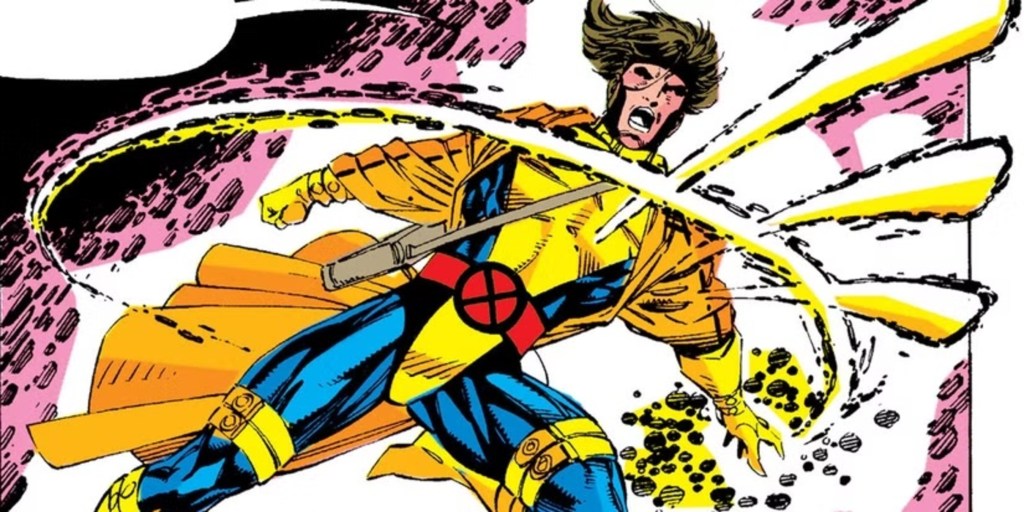
Hitting newsstands and comic stores the week of June 19th, 1990, Uncanny X-Men#266 is the first time Gambit appears in Marvel continuity. The issue would come as a relief to a dedicated X-Men reader, who would already have seen the character before three weeks prior in X-Men Annual#14 with no explanation or introduction. A scheduling error meant that, while the events of Annual#14 occur after X-Men#266, it was released almost a month prior, meaning that — by a substantial margin — X-Men Annual#14 is the technical first appearance of Gambit. Within X-Men Annual#14, Gambit is introduced alongside Storm, who he has recently rescued (in the then-unreleased X-Men#266) from the Shadow King. Arriving at the X-Mansion, Gambit and Storm are mistaken for intruders by Cable and the New Mutants before the battle is halted by Banshee and Forge, who recognize Storm. Gambit appears in eight further pages of the issue, though he is relegated to the background of its storyline. The plot is instead centered around the headache that is Rachel Summers and the Days of Future Past storyline, featuring mutant-hunter Ahab.
Some collectors have resolved this by referring to X-MenAnnual#14 as Gambit’s “first cameo appearance” and X-Men#266 as his “first full” appearance, but others contend that’s not accurate: Gambit appears in ten pages of X-Men Annual#14, is referred to by name, and even has dialogue. Despite this, X-Men#266 is the acknowledged (and more valued) of the two keys. For its part, the CGC labels the book as “Gambit cameo appearance,” with the parenthetical “predates X-Men#266,” while referring to X-Men#266 as the “1st full appearance of Gambit.” Long-time collectors suggest the controversy is relatively recent: in the early nineties, when the value of X-Men#266 was at its arguable peak, collectors had little or no access to internal publication timelines. X-Men Annual#14, as an annual, was just dated “1991.” It was therefore taken for granted that X-Men#266 was, as the intended first appearance of Gambit in-universe, also the first time the character appeared in a published comic. In recent years, the value of X-Men Annual#14 has risen, though it remains significantly less collectible than X-Men#266.
Why Fans Aren’t Going to Stop Debating Gambit’s First Appearance Any Time Soon

Both sides are right. As with the (much more expensive) controversy over Lex Luthor’s first appearance, whether X-Men#266 or X-Men Annual#14 counts as Gambit’s debut is ultimately arbitrary. For decades, X-Men#266 was accepted pretty much unequivocally, and many collectors are reluctant to embrace the change that others are pushing for. The fact that X-Men#266 was supposed to have come out first, and that X-Men Annual#14 explicitly takes place after it, gives them grounds to argue their case. But for those in the X-Men Annual#14 camp, the plain, simple fact that this issue was released first ends the debate. The problem is that collecting is hardly an exact science: different collectors prioritize different things, and efforts to standardize that can be controversial.
It’s easy for most collectors to agree on a third-party system to assess condition, but when it comes to the comics themselves, things get subjective. Even those grading systems attract varying schools of thought: while it’s true that some collectors will only buy a CGC-graded comic, others have no qualms about a comic from a different grading company. The PSA-graded 10 X-Men#266 on auction at Heritage has already attained a price of $1.5k, significantly higher than the $500-700 value of a 9.8 (the highest graded copy certified by the CGC). Newsstand (as opposed to direct sale) copies might sell for up to $2k in a 9.8, but the PSA 10 is a direct sale copy — significantly less rare and valuable than a newsstand variant. While the asterisk next to the book’s condition may deter some collectors, and while the asterisk next to its significance may deter others, it’s clearly not deterrent for others yet, and may in fact break records for the issue’s value.
Which issue do you think is Gambit’s true first appearance? Leave a comment below and join the conversation now in the ComicBook Forum!
Iron Fist #14 Is a Major Marvel Key, & Its Value Has Little to Do With Iron Fist
More Collectibles
-
Image Courtesy of Marvel Comics Collectibles
2 days agoRecord-Breaking Mego Green Goblin Has Already Blown Past Hakes Price Estimates (And There’s Still Weeks Left to Bid)
-

Collectibles
3 days agoDon’t Read This Vintage Comic If You’re Worried About Avengers: Doomsday Spoilers, Or How Spider-Man Got His Black Suit
-

Collectibles
3 days agoLEGO Leak Reveals New Star Trek Set Releasing in Early 2027
-

Collectibles
3 days agoThis X-Men Comic Ended Five Years of Reprints, But It Also Changed the Team Forever
-

Comics
3 days agoWonder Woman’s Greatest Foe Debuted in This Golden Age Key, And Few Collectors Will Ever See a Copy Like It
-

Collectibles
4 days agoThis Spaceship from a Forgotten Science Fiction TV Series Might Be the Coolest Playset of the 70s
-

Collectibles
4 days agoScarlet Witch and Quicksilver Make Their Marvel Debuts in This X-Men Comic With a Bizarre Cover Detail
-

Images Courtesy The Pokémon Company and Fanatics Collect Collectibles
4 days agoDelta Reign Hype Sees Rare Rayquaza Pokémon Card Price Soar Over 10,000% at Auction
