

Posted in: Comics, Heritage Sponsored, Vintage Paper | Tagged: Alex Blum, Fletcher Hanks, Fox Feature Syndicate, joe simon
The Stardust Story Stops the World in Fantastic Comics #7, at Auction
Fantastic Comics #7 is an example of the Fox line at its best, with an array of wild science fiction including a Stardust story that literally stops the world.
Article Summary
- Fantastic Comics #7 shows Fox in 1940 at full tilt, mixing wartime spy fears, wild science, and early superhero action.
- Alex Blum’s Samson battles Sanglor’s hypnotic ray and 200 subplanes, channeling fifth-column anxieties into pulp spectacle.
- Fletcher Hanks’ Stardust tops Fantastic Comics #7, as The Anti-Solar Ray stops Earth’s rotation in pure cosmic madness.
- With a Joe Simon cover and just 18 CGC census copies, Fantastic Comics #7 stands out as a scarce Golden Age Fox key.
Fantastic Comics #7 turns the anxieties and scientific terminology of 1940 into one of Fox’s most ambitious early anthologies. Foreign agents steal American defense secrets. Two hundred automatic aircraft wait for orders from a flying castle. A spy ring prepares poison gas in New York City. Other stories travel to Mercury and Ganymede, invoke alpha particles and atomic fuel, and allow Fletcher Hanks’s Stardust villains to stop the rotation of the Earth. These stories are not remotely an accurate or even organized forecast of the future, but they are stand-out examples of what comic books could imagine in the first months of World War II. Real places, institutions, and scientific terms give the fantasies a foothold. Then Fox’s creators push them as far as they can go. Fantastic was the correct title.
The thirteen-page Samson story, “Sanglor’s Hypnotic Ray,” begins with an enemy who has used hypnosis to control Joshua Huntington, identified as a member of the U.S. foreign service. Huntington steals American defense secrets in Washington while Sanglor watches him through a remote screen. The story appeared in a climate of mounting fear that foreign powers could compromise the United States from within. An April 5, 1940 report described allegations that a Nazi fifth column was intensifying its activity in America. Sanglor’s flying castle controls a fleet of 200 automatic “subplanes” that he intends to use to conquer the United States. Pilotless aircraft were not purely imaginary in 1940. The Smithsonian’s history of drones notes British military work with radio-controlled target planes during the 1930s and actor Reginald Denny‘s development of radio-controlled model aircraft beginning in 1935. The U.S. Army would accelerate its own target-drone program later in 1940. Sanglor’s flying castle is stationed above Mount Whitney, the highest point in the contiguous United States. Alex Blum was unusually well prepared for that mixture of larger-than-life figures, machines, and architecture. Long before joining the comic book studios, he studied at the Cincinnati Art Academy and National Academy of Design, won awards for etching, and worked in newspapers and illustration.
The Yank Wilson feature carries the same technological fear into New York City. The government learns that a foreign spy ring is manufacturing huge quantities of Noxio gas with which to flood the city. Yank traces the operation to the villain’s laboratory aboard a millionaire’s yacht, where police eventually capture the ring, and Yank destroys the equipment. The issue’s shorter science-fiction stories use familiar terminology in much the same way. Flip Falcon travels to Mercury in a dimension-sphere that protects him from the heat, then meets giant insect-men and a queen determined to breed a race of super-beings.
Space Smith’s escape through an “alpha particle tunnel,” however, is more than randomly invented pulpy scientific jargon. In 1928, George Gamow, Ronald Gurney, and Edward Condonexplained alpha decay through quantum tunneling. An alpha particle can escape an unstable nucleus by penetrating a barrier that classical physics says it cannot cross. The comic interprets that process more literally as a tunnel through which Space and Diana escape, then adds the fiction that its particles ignite explosives.
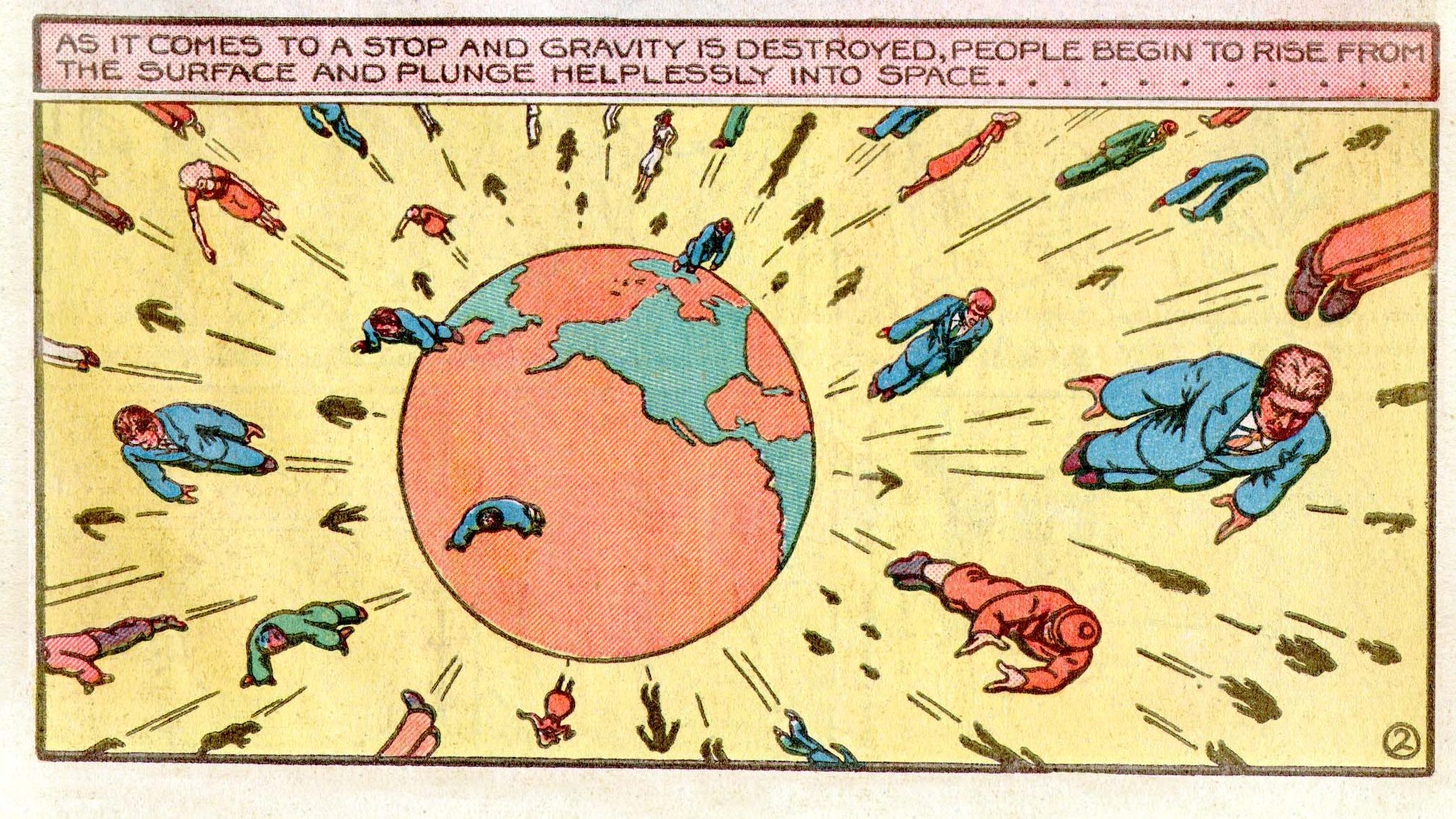
Fletcher Hanks’ Stardust Story Stops the World
The Stardust story “The Anti-Solar Ray” is another example of creative comic-book interpretation that repurposes the underlying science. Astronomers had used the phrase “anti-solar rays” decades before this comic for sunlight that appears to converge at the point opposite the Sun. Hanks turns that real term into an imaginary cosmic weapon. The story’s villains plan to stop the Earth from rotating, eliminate gravity, chain themselves to the ground, secure the water supply with machinery, and rule whatever population is left. Hanks’s villains routinely conceived crimes on an astonishing scale, and Stardust’s nearly unlimited power made conventional plots almost beside the point.
Joe Simon‘s cover is for the Samson feature, but it strikes just the right note for the entire issue. There are 18 Universal copies of this issue on the CGC Census. Fantastic Comics #7 captures Fox’s early line hitting its stride and then some, combining a Joe Simon cover, an Alex Blum Samson epic, and a stand-out example of Fletcher Hanks at his best. For collectors who want a Golden Age superhero spectacle that combines pulpy science with the best of the developing comic book era, there’s a Fantastic Comics #7 (Fox, 1940) CGC VG- 3.5 Cream to off-white pages up for auction at the 2026 August 13 Golden Age Century Comics Showcase Auction V #40377.
Enjoyed this? Please share on social media!

Stay up-to-date and support the site by following Bleeding Cool on Google News today!
