

Posted in: Comics, Heritage Sponsored | Tagged: bob powell, Harvey Comics, joe simon
The Debut of the Golden Age Black Cat in Pocket Comics #1, at Auction
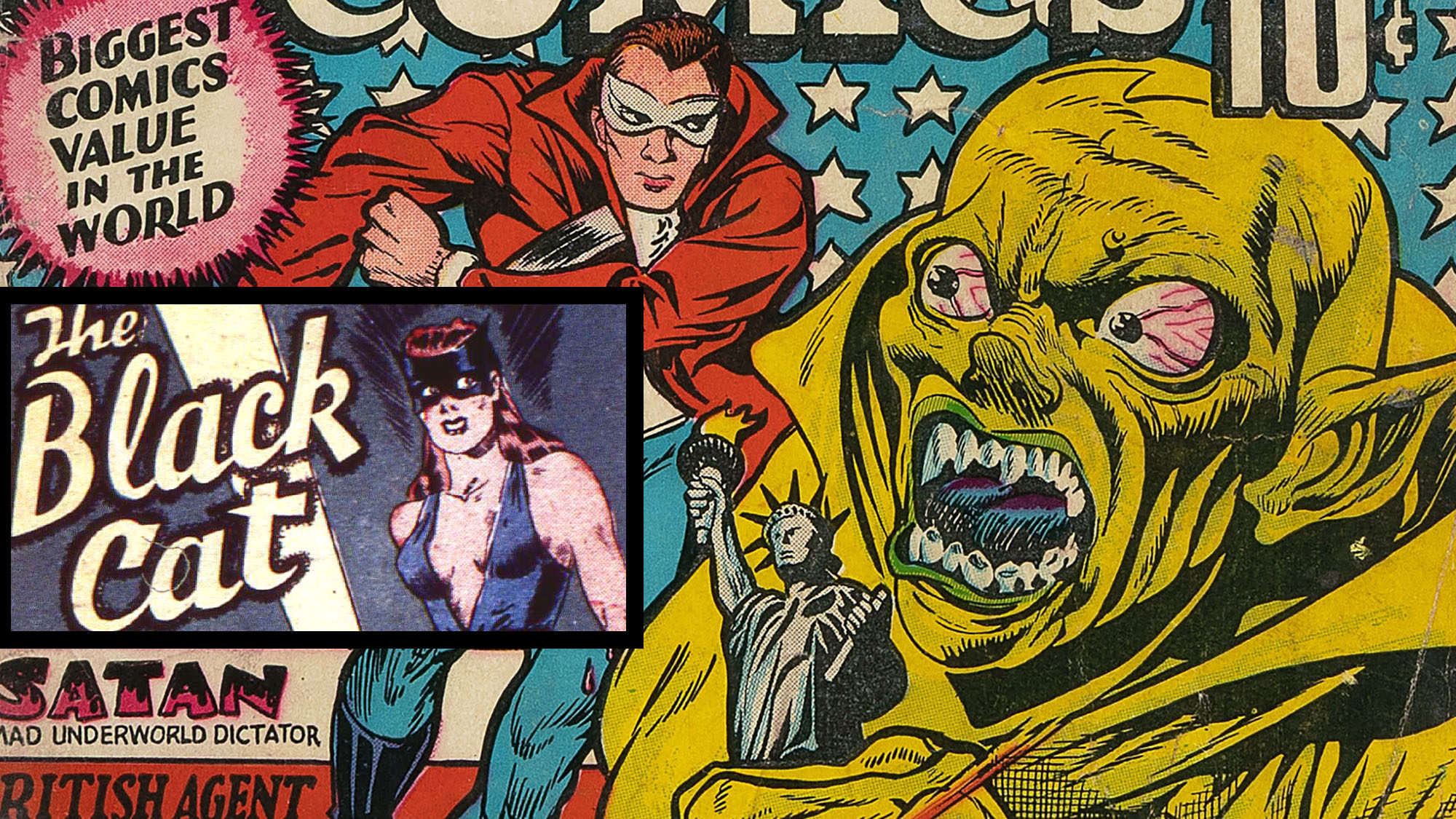
The Golden Age Black Cat debuted in Harvey’s Pocket Comics #1, which also helped launch the entire Harvey comic book empire.
Article Summary
- Black Cat debuts in Pocket Comics #1, the first comic published under the Harvey name.
- Alfred Harvey and Al Gabriele give Black Cat an origin blending Hollywood intrigue, Nazi espionage, and wartime drama.
- Pocket Comics #1 also introduces Satan, Red Blazer, Spirit of ’76, and more in an ambitious 1941 pocket-format launch.
- With just 25 copies on the census, this scarce Golden Age Black Cat key remains a notable Harvey rarity for collectors.
As the first comic book published and copyrighted using Alfred Harvey‘s own name, Pocket Comics #1 is quite a bit more important than its small size might suggest. Harvey launched his own company in August 1941 with a 100-page, 5.25-by-7.25-inch comic designed to fit in a pocket, an anthology full of new hero characters, and plans for an entire line seemingly built around the small format. He was also launching in an era already mobilizing for a war the country hadn’t yet entered.
There are two earlier titles most collectors associate with Harvey, but they had started elsewhere. Brookwood published Speed Comics #1-11 before Harvey’s run began with #12. Worth Publishing launched Champion Comics and retained the renamed Champ Comics through #11, followed by Leo Greenwald‘s Champ Publishing Company through #17. The first documented transfer of that title into Harvey’s Family Comics operation comes with #18. Harvey made both Speed and Champ important parts of his line, but Pocket Comics #1 was published before that officially happened. Near the end of this debut issue, a house ad proposes Patriotic Pocket Comics, Digest Comics, Army Pocket Comics, The Black Cat, Historic Comics, and another title built around the Spirit of ’76 and Satan. A separate back-cover advertisement promotes John F. Mahon‘s Spitfire Comics. Spitfire Comics launched as pocket sized the same month as Pocket Comics #1, with Speed Comics briefly converting to pocket sized beginning the next month.
Harvey filled this debut issue with the origins or first adventures of Satan, the Red Blazer, the Spirit of ’76, the Black Cat, the Phantom Sphinx, British Agent 99, and the Zebra, plus Spin Hawkins and a two-page MGM feature called “Meet the Stars.” The pocket-sized format experiment didn’t last, but , it’s an ambitious debut issue, best remembered for the first appearance and origin of the Black Cat.
Hollywood, Belgrade, And A Secret Space Age
The Black Cat’s origin by Harvey and Al Gabriele combines home-front espionage with Hollywood glamour. Film star Linda Turner becomes suspicious of her German director Garboil and discovers that he is stealing American defense plans for transmission to Nazi agents. Reporter and gossip columnist Rick Horne becomes involved, while cameras, publicity, studio work, radio, and espionage all get mixed into the storyline. Hollywood was already part of the political culture surrounding the war by the time this issue hit the newsstands. Filmmakers had addressed fascism, preparedness, and aid to Britain before American entry, and critics would make alleged motion-picture propaganda the subject of Senate hearings during 1941. The hearings that year provide for interesting context for this story, as Garboil’s scheme shows a film studio transformed into another strategic American asset.
In another feature drawn by Arturo Cazeneuve, British Agent 99 offers a second Hollywood connection. Former screen star Alan Douglas returns to England and enters British intelligence after learning that his father died in service. Disguised as American reporter Hal Payne, he travels through Belgrade, battles Gestapo agents, and tries to protect Sultana Zaida. Germany had invaded Yugoslavia in April 1941, and Belgrade fell during that campaign only a short time before an August cover-dated comic would have been produced. The State Department’s 1941 Yugoslavia records show just how immediate the crisis was.
The story of the Red Blazer’s origin, drawn by Al Avison, takes another direction. Dr. Morgan claims that he flew a space cruiser to Mars in 1901, then sends Jack Dawson into the Heaviside layer, where “astro-pyro rays” accelerate his evolution and give him powers. The Kennelly-Heaviside layer is a real ionized region of the upper atmosphere whose reflection of radio waves helped make long-distance radio transmission possible. The story uses that recognizable science concept in a secret alternate history in which space travel had begun four decades earlier. The Phantom Sphinx, a 6,000-year-old ruler awakened through the Star Sirius, provides a science-fantasy alternative to the real-world menace of other stories here.
Meanwile, the lead Satan story by Otto Binder and Pierce Rice combines that real-world menace with something incredible. Satan appears with Hitler and announces his intention to wreck “the American program to defend democracy.” His agents attack the fictional Camp Porter, interfere with aircraft, bomb military facilities, impersonate servicemen, and attempt to cripple the base from within.
Joe Simon remembered the Pocket Comics launch in Joe Simon: My Life in Comics. Harvey’s first office was on West 44th Street in the same building as Fawcett Comics, and Simon recalled being skeptical of little books that were half the normal size but still cost ten cents. He nevertheless did considerable work for his friend, as did Jack Kirby, and Simon supplied the covers for the first three issues of Pocket Comics. Simon said the format initially seemed to take off, but the books also fit easily into customers’ pockets and were stolen from newsstands.
The census records five Universal copies at 4.0 and only six Universal copies higher, with 23 Universal copies and 25 total across all labels. For a collector interested in Harvey’s beginnings, Golden Age origins, and a comic that caught the country in the middle of mobilization, there’s a Pocket Comics #1 (Harvey, 1941) CGC VG 4.0 Off-white to white pages up for auction at the 2026 August 13 Golden Age Century Comics Showcase Auction V #40377.
Enjoyed this? Please share on social media!

Stay up-to-date and support the site by following Bleeding Cool on Google News today!
