

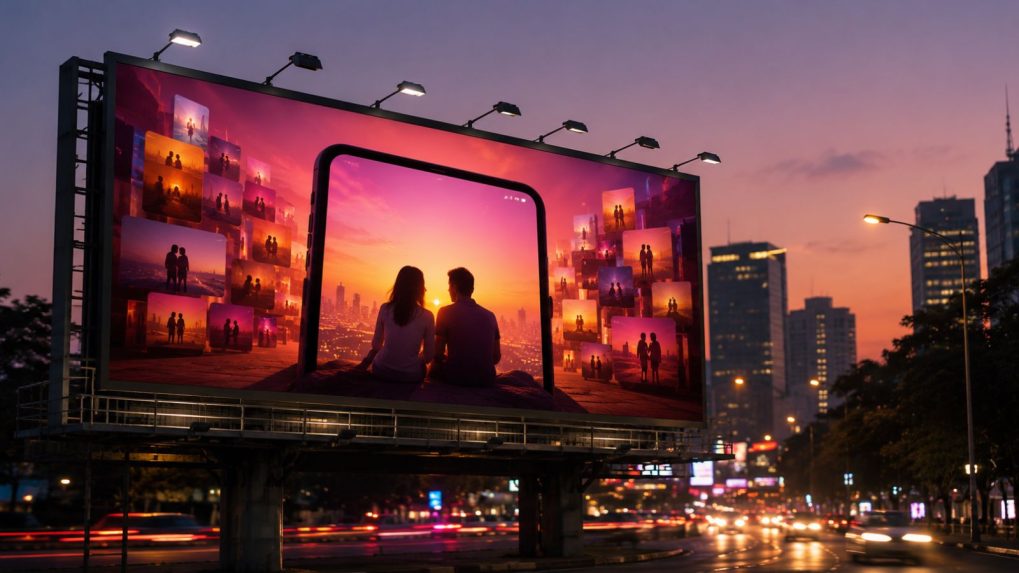
What began as a race for installs is becoming a battle for mindshare. India’s microdrama platforms are investing in branding to turn fleeting viewers into loyal audiences.
Brands are stepping into microdramas to capture attention. Now, microdrama platforms are stepping onto billboards to capture something harder: memory. Rocket Reels’ recent out-of-home (OOH) campaign in Mumbai is more than a marketing exercise. It signals a shift in how India’s emerging microdrama industry sees itself. What began as a download-driven business is increasingly turning into a brand-building game, with platforms looking beyond performance marketing and towards long-term consumer recall.
The industry’s first act was straightforward: get users to install the app.
The next act is proving far more challenging: make them come back.
“The biggest challenge in the microdrama industry today isn’t getting people to download the app. It’s getting them to stay,” says Sabarish Venkat, CEO of KadhaiShorts, Tamil Nadu’s first dedicated microdrama platform.
As competition intensifies and acquisition costs climb, platforms are beginning to realise that being downloaded is not the same as being remembered.
“The winners won’t just be the platforms with the biggest marketing budgets. It’ll be the ones people trust, remember and actively choose,” Venkat says.
The move towards OOH advertising may seem unusual for a category born on smartphones. But industry executives argue it reflects a broader maturation of the business.
“Micro-dramas have already emerged as the next frontier of advertising,” says Neha Markanda, Chief Business Officer, ShareChat and Moj.
Unlike traditional OTT platforms where audiences actively search for a title, actor or franchise, microdramas are discovered differently.
“Discovery is through social-media feeds such as ShareChat and Moj, and not based on search, word of mouth or platform browsing,” Markanda says.
That distinction matters.
Traditional OTT platforms compete for viewing intent. Microdramas compete for attention in the scroll.
As digital literacy expands and local-language content consumption deepens across the country, Markanda believes microdramas are moving from an emerging format to a mainstream entertainment category.
“With evolving content preferences and increasing digital literacy, we are witnessing microdramas move from an emerging trend to a mainstream content category deeply embedded in the daily entertainment habits of Bharat,” she says.
The rise of regional creators is expediting that shift. As storytelling becomes more localised and culturally nuanced, microdramas are becoming more and more fitting to India’s mobile-first and multilingual consumption.
For platforms, that also means building brands consumers can recognise beyond the feed.
From installs to mental availability
For media planners, the move towards OOH is neither surprising nor unique to microdramas.
“From a media-planning perspective, this is a natural progression and one that we’ve already seen,” says Vinay Hegde, CEO – Investments, Madison Media.
He believes the category is beginning to follow the same trajectory previously taken by OTT platforms, gaming apps and quick-commerce companies.
In the early stages, growth is fuelled by performance marketing, where every click, install and acquisition can be measured. But as platforms scale, the economics start to change.
“Once these platforms reach a certain scale, performance marketing starts delivering diminishing returns and brand building comes into play,” Hegde says.
That transition is particularly relevant for microdrama platforms, where content discovery is often spontaneous rather than intentional. Consumers stumble upon an episode in their social feed, get hooked by a cliffhanger and continue watching. In such an environment, recall can become as important as reach.
“For a category like microdramas, where content consumption is often impulsive, strong brand recall can significantly improve organic installs and reduce dependence on paid digital acquisition,” he says.
This is where outdoor advertising enters the picture.
While digital campaigns may continue driving downloads, OOH helps create what marketers call “mental availability” by ensuring consumers remember a brand when they are looking for something to watch.
“Using OOH basically signals a move towards creating that mental availability, to become a recognised entertainment brand that consumers remember when they have leisure time,” Hegde says.
In that sense, a billboard is no longer just an awareness tool. It becomes an acquisition multiplier.
“OOH is highly effective for awareness and here acts as an acquisition multiplier,” he adds.
For Hegde, Rocket Reels’ campaign is therefore less about one platform experimenting with outdoor media and more about an industry entering its next phase.
“This definitely reflects a broader shift rather than an isolated campaign.”
In other words, digital ads may drive the click. Billboards help build recall.
That strategy is already playing out at KadhaiShorts. The company leaned heavily on offline advertising during its launch phase before shifting focus towards performance-driven campaigns.
Early audience behaviour is also challenging some industry assumptions.
According to Venkat, consumers are willing to spend more time on episodes than conventional wisdom suggests.
“Audiences don’t come back because an episode is two minutes long. They come back because they want to know what happens next,” he says.
The audience data explains why both advertisers and investors are closely watching the category.
According to ShareChat and Moj, microdramas deliver 15-20% higher view-through rates than many other short-form video formats.
The reason lies in the format itself.
Unlike short-form videos driven by momentary virality, microdramas rely on cliffhangers, recurring characters and unfolding narratives to create repeat engagement.
“Micro-dramas create repeat engagement through cliffhangers and character arcs,” Markanda says.
Regional relevance is proving equally important.
Nearly 70% of microdrama consumption across ShareChat and Moj comes from Tier II and Tier III markets. The company says stories developed natively in regional languages consistently perform better than dubbed adaptations because audiences respond more strongly to familiar settings, cultural cues and local contexts.
Across the ShareChat-Moj ecosystem, users generate more than 800 million episodic views every day. Around 60 million monthly active users consume microdramas daily, spending between 40 and 60 minutes a day across multiple viewing sessions.
Those numbers suggest microdramas are no longer merely a content format.
They are becoming a habit.
India’s microdrama industry began with a race for installs. It is now entering a race for attention, loyalty and cultural relevance.
The first chapter was about getting onto consumers’ phones. The second is about earning a place in their entertainment routines.
Brands once entered microdramas to become part of the story. Now the platforms themselves are trying to become the characters audiences remember.
Follow Storyboard18 on Google for the latest and breaking media & entertainment news and industry updates, along with in-depth coverage of digital media and trending news. Stay informed with the latest perspectives only on Storyboard18.
Tags
First Published on July 27, 2026, 08:11:02 IST
