

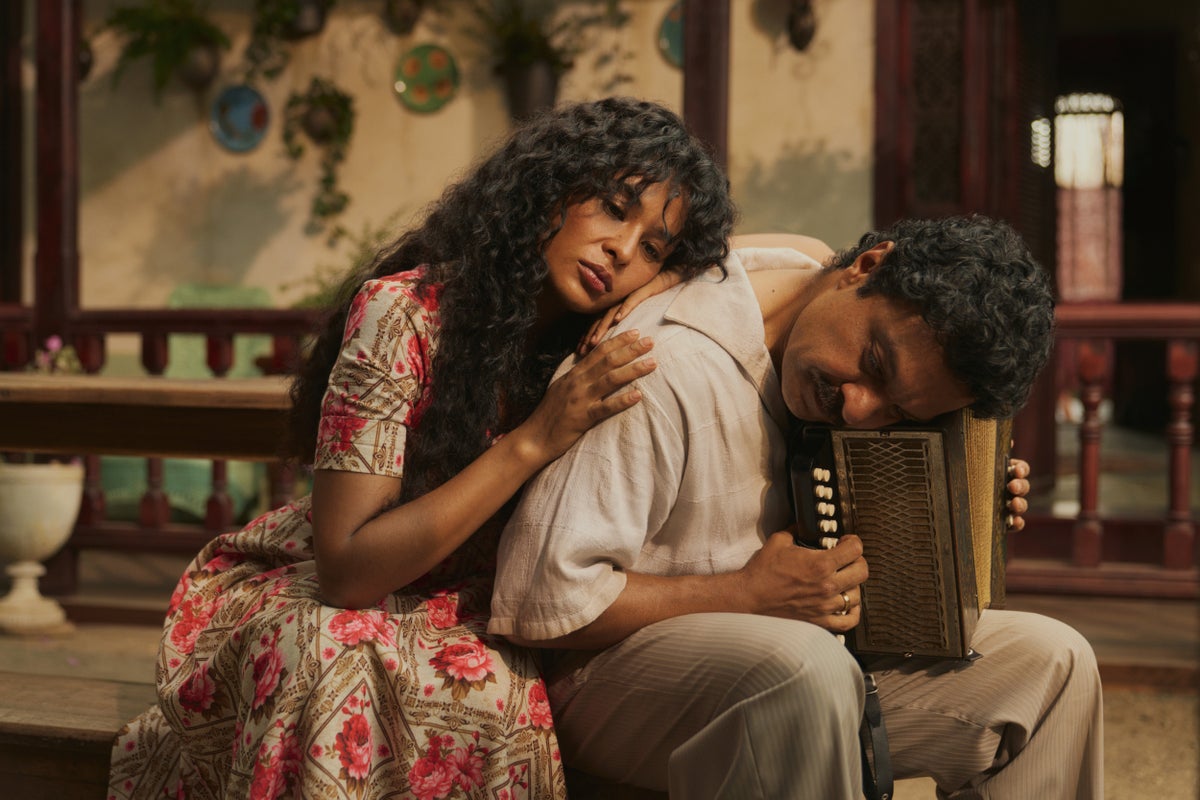
During his lifetime, the Colombian author Gabriel García Márquez, arguably the greatest ever Spanish-language writer, considered One Hundred Years of Solitude, his 1967 magnum opus, to be unfilmable. “The novel, unlike film,” he told an interviewer in the 1980s, “leaves the reader room for creativity, allowing them to imagine the characters, settings, and situations as they see them.” But after his death in 2014, his estate moved quickly to license the book for a lavish Netflix series, the second half of which arrives today ahead of a feature-length finale at the end of the month.
A fragile peace has fallen on Macondo, the settlement founded by the Buendia family’s dead patriarch, José Arcadio, yet Colonel Aureliano Buendia (Claudio Cataño) remains a feared enemy of the conservative Colombian state. While he mopes around the family home, the twins, Aureliano Segundo (Julián Román) and José Arcadio Segundo (Emmanuel Suaza), drive the Buendia dynasty forward. Aureliano marries the beautiful, aristocratic Fernanda (Laura Taylor) and slips into a loveless but fecund union. José Arcadio, meanwhile, is the driving force of innovation in Macondo. He conspires to build a railroad that will connect the town with the outside world, bringing prosperity in the form of a rapacious banana company. “Surely our sacrifices will bear fruit?” muses Aureliano. But soon enough, his father’s dream begins to rot on the branch, and Macondo is subjected to the savage violence of modernity.
One Hundred Years of Solitudeis a story that unfolds in a dreamlike haze, half history, half parable. In a way, it’s well suited to the Netflix treatment. Picking up where 2024’s first instalment left off, this second series carries the narrative forward through the fourth generation of Buendias and into the 20th century. The adaptation is devoted and granular, utilising Márquez’s own writing in the show’s elliptical frame narration (voiced by Jesús Reyes) and covering each beat of the novel’s plot in detail. “Adrift in the loneliness of his immeasurable power, [Aureliano] began to lose his way,” the narrator tells viewers, and there is a comfort in the literariness of the screenplay.
Yet Márquez’s writing is celebrated for its transcendent magical realism, moments where the lines between fantasy and reality blur. On the page this is disorienting, destabilising the relationship between the reader and their expectations. But on screen it all feels more literal. The ascension of Remedios the Beauty (Daniella Reyes), for example, lays this out starkly. She rises with beatific grace into the heavens while characters gawp and the narrator reads Márquez’s words. “She disappeared forever, into the atmosphere, where not even the highest birds of memory could reach her,” he tells us. But the strangeness of this moment – its openness to interpretation – is cauterised by the visuals, however striking. It makes the work feel more concrete, less ambiguous.
What remains is a grand endeavour to bring Latin America’s finest novel to the screen. And the show’s directors, Laura Mora and Carlos Moreno, realise the adaptation’s ambition to recreate, at glorious scale, the bustle of life in Macondo. Because the adaptation is scrupulously faithful, the novel’s strange sexual politics remain (“I did everything aside from breastfeeding you!” an incestuous aunt tells her nephew, as he gropes her) and the rutting is rather relentless. But when the show arrives at the novel’s climax – a reimagination of the Banana Massacre, where striking workers were gunned down by Colombian government forces – the cast and crew embrace the quietness. It is a striking sequence, beautifully acted and staged with genuine sensitivity.
But any adaptation of One Hundred Years of Solitudewill, ultimately, be judged on its success in conjuring the ghost of Márquez’s writing. “He could no longer tell where reality ended and where his madness began,” matriarch Úrsula (Marleyda Soto) recounts, describing the dream of her husband, José Arcadio. And while this porous border is crucial to the novel, it is something that the TV adaptation struggles to emulate. Netflix has invested in a dazzling and studiously loyal adaptation – one that, mercifully, makes little compromise for Western audiences – yet a sense persists that Márquez’s resistance might’ve been well founded. Some moments feel magical, some feel realistic, but the show can’t quite capture that alchemical moment when the two are combined.
