

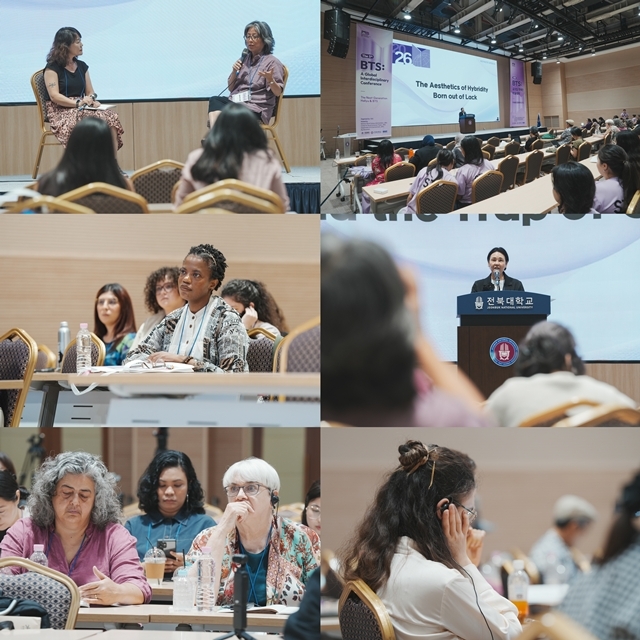
The 5th BTS: A Global Interdisciplinary Conference, attended by BTS (BTS), fandom ARMY, and related scholars, closed after finishing its schedule on July 2 and 3
The event was held at Chonbuk National University’s International Convention Center. It was hosted by the International BTS Society (ISBS), and Jeonbuk National University Namwon Glocal Campus Management Headquarters, Glocal University Business Group, K-Entertainment Department, and Big Movement participated as co-hosts. Under the theme of “Next Generation Hallyu and BTS,” 50 presenters from 10 countries, including Korea, the U.S., and Japan, held discussions for 11 sessions
The event began with a welcoming speech by Yoon Myung-sook, vice president of foreign affairs and employment at Chonbuk National University, and a congratulatory speech by Song Ki-do, chairman of the Korea Foundation (KF). Professor Lee Ji-haeng of Chonbuk National University mentioned solidarity-oriented relationships and mutual care as an alternative to Hallyu through a keynote lecture titled “The Future of Hallyu: From One-Way Export to Affective Relationship.”
Director Bao Nguyen, who directed the Netflix documentary “BTS: Return The” (2026), compared the members’ military service and return process to the “Odyssey” myth in an interview. This ‘return narrative’ led to the closing ceremony’s ‘Arirang’ performance and became a key theme penetrating the entire event
In the session, alternative K-pop discourse was exchanged. In the “Digital Technology and Fandom” session, virtual idols and AI technologies were analyzed, and various studies such as translation, authenticity, sustainability, and religious aspects were published. In the Korean session, Shakespeare’s comparative analysis, fan concert analysis, and comparative studies of lyrics before and after the military service were shared
Lee Da-yeon, an activist with the climate action group K-Pop for Planet, addressed fan activism through the announcement of the ‘Fandom Move Industry’. He stressed that “the sustainability of Hallyu cannot be separated from the sustainability of the planet,” conveying the achievements of album agencies’ eco-friendly changes and Hyundai Motor’s withdrawal of carbon emissions agreements
The next day, a special session prepared by Dongguk University’s Korean Wave Convergence Research Institute and ISBS was held. Under the theme of “But That’s Not Saturday Factory,” it analyzed the independent growth of the post-Korean Wave and dealt with specific overseas cases such as Vietnam
After the screening of a documentary on ARMY, which was screened on the first day of the event, he explored ARMY’s global solidarity through talks with director Grace Lee. Professor Ahn Byung-jin of Kyung Hee University, who is in charge of hosting the event, finished the event under the concept of “From Odyssey to Arirang as a new chapter.” Based on the five keywords: “The Power of Vulnerability and Boundary,” “Translanguage and Transnationality,” “The Jeongdong Platform of the Cheering Stick,” “The Return of the Rest,” and “The Return of BTS,” the Greek narrative was released with Korean traditional music sentiment.
Jeonju singers performed several versions of Arirang sound on stage. Following Lee Jin-do Arirang, he expressed Korean emotions on the scene with a joint stage called “Featuring Body to Body by BTS.”
After the end of the academic session, an Army tour schedule was held that included a completion tour and a Korean paper experience. Participants finished their two-day schedule enjoying the regional colors of Jeonbuk
Lee Ji-haeng, a professor at Chonbuk National University, said, “This conference highlighted BTS and the Korean Wave as a complex global phenomenon that combines technology, society, ethics, and politics beyond simple cultural contents. We hope that this discussion, which seeks the direction and sustainability of the next generation of the Korean Wave, will lead to the next journey.”
[Golden Bitna MK Sports Reporter]
