

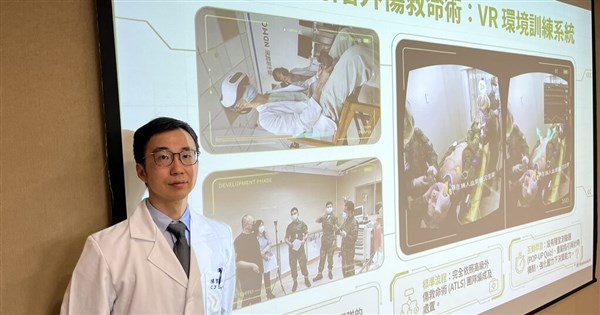
Taipei, Aug. 19 (CNA) Taiwan’s top military hospital on Wednesday highlighted its use of highly mobile surgical teams and virtual reality (VR) training to prepare medical personnel for frontline trauma care during disasters and military operations.
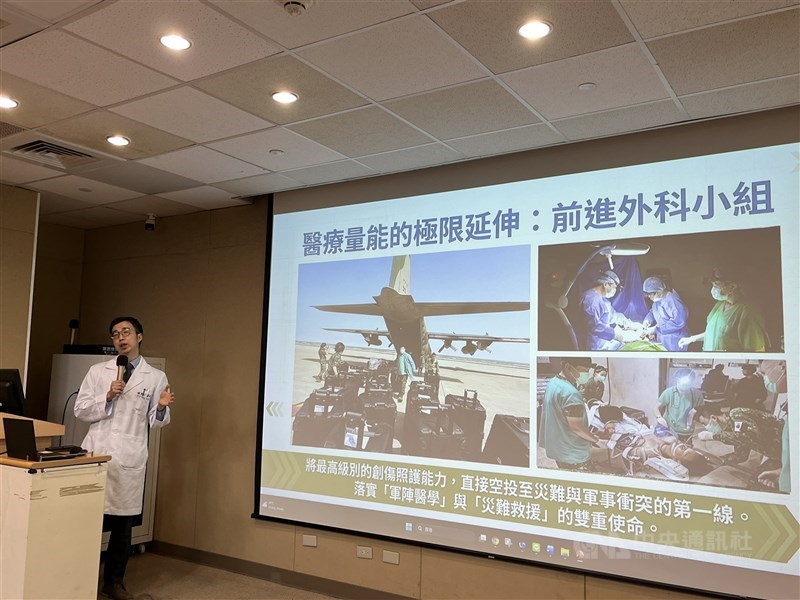
“A Forward Surgical Team (FST) is essentially a small, highly mobile surgical lifesaving team designed to deploy close to the front line,” Yang Chih-Jen (楊智仁), an attending physician in the Department of Emergency Medicine at Tri-Service General Hospital, said at a press conference in Taipei.
An FST’s core purpose is not to provide hospital-level care, Yang said, but to stabilize casualties in battlefield conditions, disaster zones or remote settings when they cannot be immediately evacuated to a major hospital.
“The teams can provide emergency hemorrhage control, resuscitation and necessary lifesaving surgery, giving patients a chance to survive until they can be evacuated for further treatment,” he said.
Yang said FST personnel currently train with the military about once a month, with exercises focusing on different objectives, while doctors specializing in areas including trauma surgery, orthopedics and cardiovascular surgery rotate through the training.
Nurses, anesthesiologists and emergency medical technicians (EMTs) also take part, along with personnel from other military hospitals around Taiwan, he added.
Asked about international cooperation in frontline trauma care, Yang said he was not aware of the details at his level but hoped Taiwan could work with countries with “more experience in the field” and learn from their expertise.
VR training
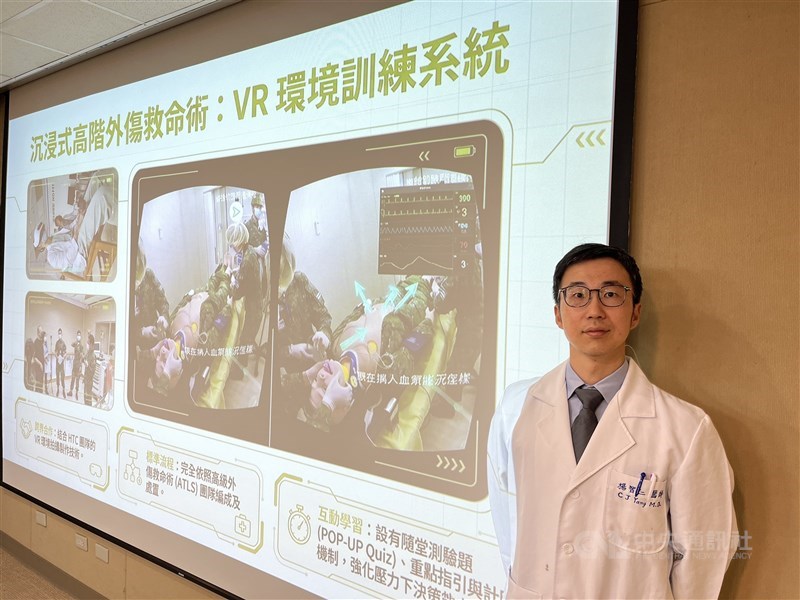
The hospital has also developed a VR-based trauma training system incorporating advanced trauma life support (ATLS) protocols in collaboration with Taiwanese technology company HTC to prepare medical personnel for mass-casualty incidents, Yang said.
The system, which Yang said is the first of its kind in Taiwan for trauma training, can simulate situations such as an earthquake that results in 15 or 16 casualties with injuries of varying severity arriving at an emergency department at once, requiring trainees to quickly assess and triage them.
“VR provides a very realistic immersive environment,” the veteran emergency physician said, adding that the technology reduces the manpower, space and costs required for conventional training.
Trainees can also repeat a scenario and review their performance, while instructors can create different settings and injury patterns rather than having participants repeatedly practice a fixed scenario, he said.
The VR training is currently used by medical students rotating through the emergency department and can also be used by resident physicians, nurses and EMTs
He said the system, introduced within roughly the past two years, currently focuses on mass-casualty triage but could be expanded to simulate more austere conditions, such as limited lighting or shortages of medical equipment, forcing trainees to work with limited re
Scenarios involving extreme conditions such as a complete loss of electricity or water supplies have not yet been incorporated into the system, Yang said, adding that he hoped such situations could be included in future training.
- Culture
Southern township prepares pole-climbing contest for Ghost Festival
08/19/2026 07:45 PM
- Society
Taipei to introduce Taiwan’s first postpartum meal allowance
08/19/2026 07:37 PM
- Society
Rain expected across Taiwan through weekend; tropical storm forms
08/19/2026 06:59 PM
- Business
MOF to announce winners of mobile tax filing lottery Friday
08/19/2026 06:52 PM
- Science & Tech
Taiwan military hospital highlights surgical teams, VR for frontline trauma care
08/19/2026 06:09 PM
