

Valve Steam Frame
Pros & Cons
- Lightweight
- Runs Steam games, in VR and 2D
- Works with PCs as a streaming wireless headset
- Eye tracking which improves VR game performance
- Can run Linux apps in desktop mode
- Short battery life
- Game support hit and miss right now
- Performance sometimes buggy
- No hand tracking yet
- Bad fit with my glasses
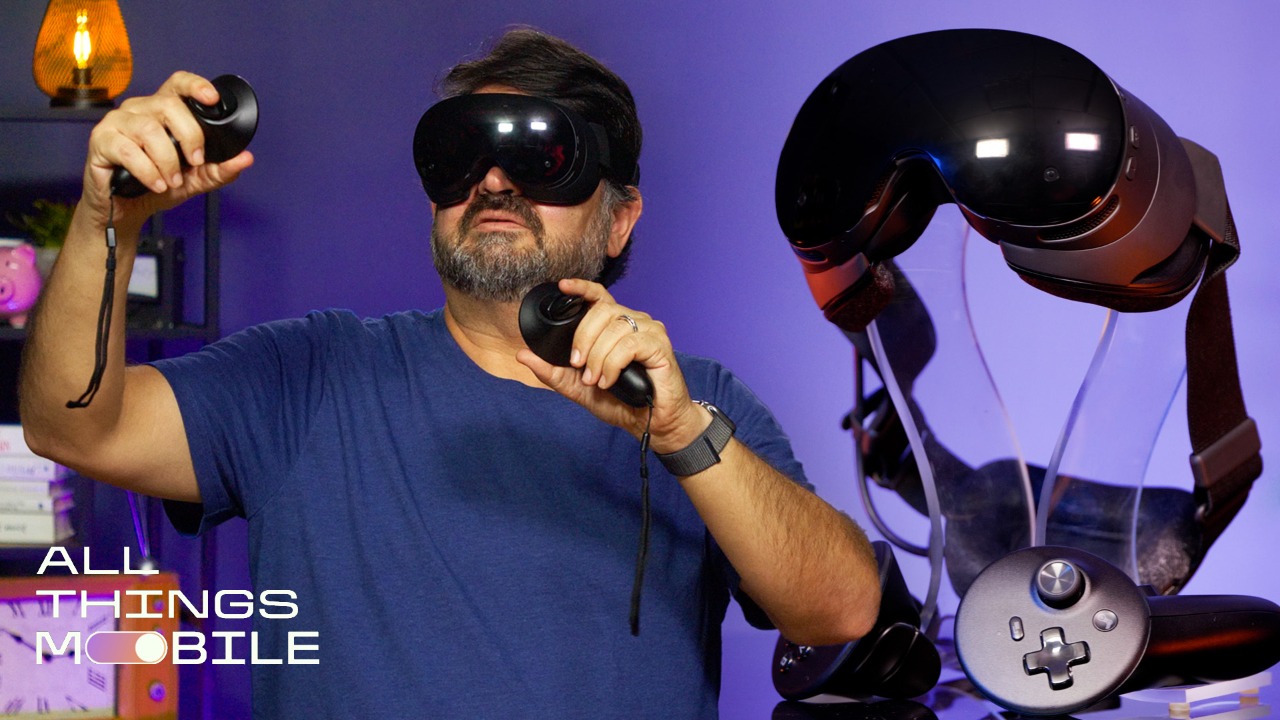
Gravity gloves on, I approach a dark passage. I can hear alien grunts. The voice on my headset tells me to watch out for “barnacles,” and I know to look up and shoot ceiling-hugging aliens with the gun in my controller-gripping hand. I’m in VR, playing Half-Life Alyx again. It’s a game I once played six years ago by rigging a VR headset to a laptop PC and installing room sensors in my pandemic home office.
Now I’m playing it on a standalone VR headset, no PC needed at all.
Yes, Valve’s fantastic 2020 game Half-Life Alyx runs in a standalone build on Valve’s first self-contained VR headset, the Steam Frame, which is now available to waitlist for $1,059 and up. It’s not always perfect, but Alyx’s standalone performance is by far the most impressive experience I’ve had on Valve’s ambitious and sometimes awkward new VR-shaped gaming console. It’s a sign of what Frame could be.
In the three weeks I’ve been living with Valve’s Steam Frame, it’s been a mixed bag of early experimentation that shows a fascinating attempt to push Steam into territories it’s never been before. A Meta Quest-like PC-free VR headset. An ARM-based chip running SteamOS that’s less powerful than the Steam Deck handheld. Yes, the Frame is a VR headset. But its philosophy, as I’ve used it, clearly points to something more hybrid, melty, invisible and modular. Could Steam blend handheld, desktop and immersive technology all in one, like Apple’s Vision Pro? The Frame pushes hard, but in these early days, the compromises and relatively small list of optimized games make it a hard system to easily enjoy.
But as a framework for the future of wearable displays, it’s another piece of a rapidly changing puzzle. And no, after three weeks, it’s not yet a replacement for the Steam Deck for me, nor is it the best VR headset I’ve ever used. But somewhere in between, it may very well be the start of something Valve builds on for more devices. And the Frame itself, if improvements to the Steam Deck and the Steam Machine released earlier this summer are indicators, may keep evolving.
I’ve even started adding modular parts myself. As Valve hinted when I tried the Frame, Machine and Steam Controller last November, this ecosystem that’s finally arrived feels like the start of a lot of flexes in new hardware directions to come, VR and otherwise. It’s a rough beta of a product right now, but it keeps getting better by degrees as I use it every week.
A VR headset that’s a Steam Deck in disguise
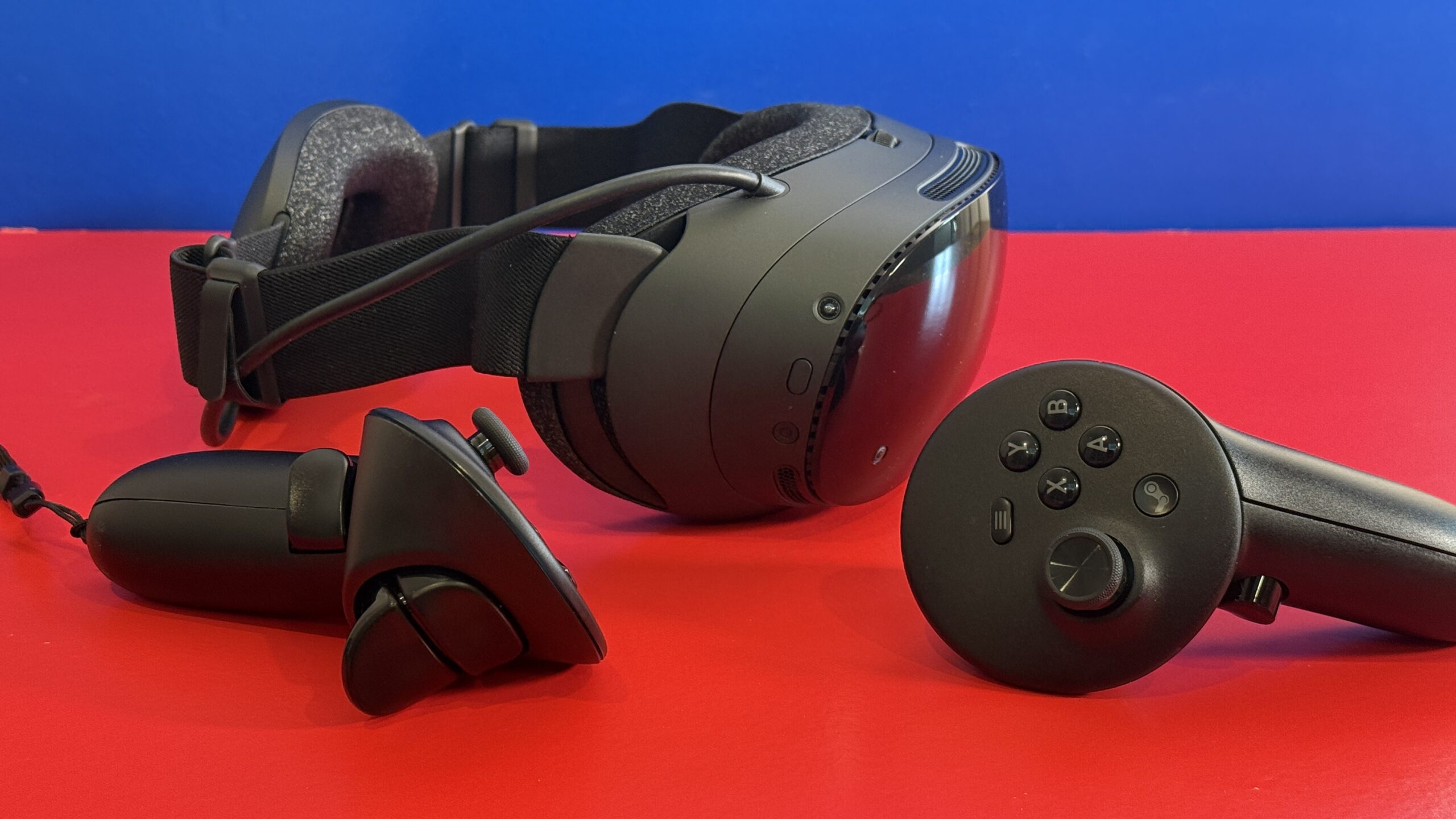
Look at the Steam Frame, and you’d probably just sigh and say, “Oh, a VR headset.” That’s what my kids, both Steam and VR fans, did. The Frame has a generic look, alas. Nothing as iconic as the cubic Steam Machine. It’s black, reasonably sleek, but also a little awkward with its rear headstrap battery pack that’s tethered with a small snaking cable. The Steam Frame’s controllers look like, well, VR controllers. Dual analog sticks, dual sets of triggers, buttons, hand straps. They run on AA batteries that last for weeks.
Look closer, though, and you’d see a d-pad on one and four buttons on the other, which makes a difference. That button layout means regular Steam games can play fine on the Frame without you needing to connect another controller.
Over my time with Steam Frame, I’ve probably split my playtime 50-50 with a mix of VR games and flat 2D games played on a floating in-headset monitor. I like the casual comfort of sit-down standard games, while many VR games mean getting up, moving around and sometimes setting up free space on the floor.
I’m fascinated by the way the Frame sort of morphs into a double-duty device. At times, it feels like a way to enjoy regular games on a big virtual screen, much like the Vision Pro’s way of handling lots of 2D apps in VR. At other times, the Frame feels like a Meta Quest alternative running SteamOS. Which is it? Well, both.
But also, at the moment, Frame is a little less than either of them. As a VR headset, the Frame lacks a lot of extras that the Quest has at a far lower price. As a handheld game system, the Frame can’t run all the games the Steam Deck can, and its battery life is far worse. This is the roughest part of the Frame’s reality: It’s caught in the middle, although it’s likely that far more games will become compatible with it over time.
I’m reviewing the Frame on beta software, weeks before the hardware’s actual release. Valve has a history of continually updating its hardware and diligently improving Steam game compatibility, something that happened for the Steam Deck and also, over the last few months, for the Steam Machine.
Will the Frame get the same benefits? How many games will work well on it? It’s a mixed bag at the moment, purely as a standalone device.
Comfort: Great without glasses, terrible with
It’s a smaller-feeling headset than Meta’s Quest 3, because the front face piece and visor are more compact. It’s actually easy to wear, to a degree, since I found that the adjustable elastic straps on the sides of the battery pack’s design, which doubles as a cushioned part of the headset’s fit, let the Frame slide over my eyes without pressing in as much as a Quest.
But, out of the box, the Frame didn’t accommodate my thick glasses well at all. It was a tight squeeze that made me force my glasses in, and they pressed on my face and fogged the lenses. Not ideal at all, even with an included glasses spacer for the Frame that’s supposed to make more eye room. My glasses fit more easily in the Quest.
Things got much better with a pair of prescription lens inserts from Zenni (an extra $68, but set up. With those in, I suddenly found the Frame much, much comfier to wear
But I’m worried about the Frame not supporting high prescriptions. Zenni’s maximum Rx range for Frame inserts is -6, while I’m a -8. This wasn’t a problem on the Vision Pro or Meta Quest. Zenni did make custom lenses that fit my prescription and work well, but apparently, it isn’t making them available for regular purchase. Glasses wearers, be warned.
In the box, you get the headset, controllers, a glasses spacer for the magnetically attaching foam face piece around the eyes, a USB-C cable and a polishing cloth. Sadly, there’s no carrying case. The Frame really needs one, especially since it feels delicate, and VR headsets should never have their lenses exposed to sunlight. I used a Waterfield Vision Pro Shield Case, which the Frame and controllers squeezed into, plus a Kiwi VR lens protector cover.
Oh, it’s not cheap
After the $1,050-and-up Steam Machine, I don’t think anyone expected the Steam Frame to be low-priced. The Frame’s $1,059 entry price has 256GB of storage onboard, while there’s a 1TB version for $1,299. It’s expensive, but honestly, with electronics prices what they are now, not surprising at all. I’d even suggest that the 1TB makes sense for $200 more, although the Steam Frame has a MicroSD card to expand onboard storage, too. And it can even swap games from a PC or Steam Deck to your Frame.
In the world of VR and AR right now, sadly, this isn’t even really that expensive. The Samsung Galaxy XR is $1,899. Apple’s Vision Pro is $3,699. Snap’s upcoming mixed-reality Spec glasses are $2,000. Valve also throws in a free download for Half-Life Alyx with the Frame.
Valve’s original Index VR headset from 2019 was about the same price ($999), but it wasn’t even standalone. It needed a PC to work, had to be tethered with a cable and had external sensor hardware that needed to be hung in your room.
In that regard, the Frame seems like a good upgrade for an aging Index. But in a landscape of ever-changing display and processor tech, where smaller glasses-like VR displays are on the verge of becoming more of a standard, the Frame finds itself in a tweener position right now. For instance, Meta might be announcing its own more glasses-like VR visor later this year, and Xreal’s almost VR-like Aura glasses can be immersive but lower field-of-view displays that could show what’s coming.
But I’m not a PC gamer, generally. The Steam Machine and Steam Deck excited me specifically as devices that enabled Steam gameplay without a Windows PC. So, how does the Frame do as a standalone console? That’s what I was most curious about: as a Steam Deck alternative, and as a VR device.
As a VR headset
The Steam Frame looks familiar, like some sort of device HTC would have made if it still made consumer VR gear. The black glossy front, the elastic headstrap. It’s got significant differences, though.
The good part: The display is crisp, clear and pretty wide. The dual LCD displays have a resolution of 2,160×2,160 pixels per eye, which is roughly in the ballpark of the Quest 3.
I particularly appreciate the big pancake lenses, which help everything look extra-clear. There’s also a dial to adjust eye distance between the lenses (IPD) for comfort.
Now the weirder stuff: Instead of a standard Qualcomm XR-optimized chip, Valve went with a Snapdragon 8 Gen 3. Performance-wise, it feels like it’s delivering about what the Quest 3 offers.
Even more interestingly, this headset has eye tracking. Valve doesn’t use it for controlling games or interfaces, as Apple and Samsung do with the Vision Pro and Galaxy XR. Instead, it’s automatically activated for “foveated rendering” and “foveated streaming.” It reduces the resolution detail in areas where your fovea, or central vision, isn’t focused, saving on processing power and bandwidth for wireless streaming from a PC.
There aren’t many games that use onboard foveated rendering yet, but Half-Life Alyx does, and so does Dungeons of Eternity, one of the better-optimized launch games on Frame. The performance improvements show up clearly.
I barely played with streaming from a PC, because I was far more interested in standalone performance. Valve does consider streaming a major part of the Frame’s positioning, though. The included wireless USB dongle, which streams over its own custom 6Ghz connection, paired pretty quickly with my nearby Steam Frame when I tried connecting using a Steam beta build. PC streaming can also work over standard Wi-Fi, skipping the dongle. In the Frame, an icon on the dashboard turns PC streaming off and on and browses the available PC-side games to launch.
Despite having eye tracking, the Frame doesn’t have hand tracking like Meta, Apple, Samsung and most other VR devices have. You have to use the controllers, or a paired keyboard, mouse or trackpad. Hand tracking is something Valve aims to add down the road, but not yet. Also: The included passthrough cameras for seeing the world around you are very low-res black and white, a throwback to the old Oculus Quest 2. There’s already a separately sold higher-res color camera for $149 that you could snap in, and it’s far better to use the Frame with the Arcturus Vision camera attached. But that’s an extra cost on top of everything else. Mixed-reality games on Frame are a rarity, although they could exist. Passthrough is mainly just to see your surroundings while wearing, or while floating a 2D game screen when playing non-VR Steam games.
There’s also an optional $59 ergonomic accessories kit that has a top headstrap, an extended nosepiece light blocker and velcro grip loops for the controllers. I didn’t absolutely need the headstrap, but adding it to reduce pressure on the eyes (and the grip loops for easier controller use without fear of dropping) is a welcome extra, along with the clearly better $149 color camera.
I reviewed the $1,299 1TB Steam Frame, and it had plenty of storage for game downloads for my needs. A microSD card slot can store games too, so you don’t necessarily need the storage upgrade. But I’d want the better color camera, improved straps and prescription lens inserts, all of which add $276 to the total cost.
You could run all sorts of Steam games on the Frame, technically, both VR and non-VR. Only the “Great on Frame” optimized titles are the ones guaranteed to run well, though. There are about 130 of those 2D and VR titles at the time of this review. Right now, the VR games are a limited subset of what’s on Steam VR, and most of them I’ve played on the Quest already: Eleven Table Tennis, Light Brigade, Beat Saber, Moss II, I Expect You To Die, Job Simulator, Walkabout Minigolf. You get the idea.
The only truly new and PC-like standalone game on the Frame is Half-Life Alyx, which I only played in a prerelease beta build. Now, it did wow me. Even though the framerate for character animations was low and hand motions were a lot choppier than on PC, and graphics are clearly stepped down a lot, it’s the best and most exciting thing I’ve done in the Frame so far.
I wonder how much the onboard processor will be strained. I felt the fan on the headset kick in a lot, pumping warm air when I played more intense games or tried opening desktop mode and playing with apps, or even when it converted recorded game clips in-headset to export to my phone. Is the processor too much of a compromise? I don’t know.
The ability to run other apps in windows can make Frame feel, at times, almost like a computer. Linux apps in desktop mode range from Chromium to Firefox to a bunch of other tools. I watched YouTube in one window while playing Portal 2 in other, and started to marvel at how flexible Frame could be. But VR games require a full immersive takeover of the headset: multi-windowed app use is available for all the other times.
The Steam Frame can convert games intended for both PC VR and even Android APK files, using a conversion tool called Lepton (Valve also has Proton, which helps convert games on Steam Deck). I haven’t sideloaded anything yet, but Steam Frame in theory could be a Rosetta Stone for VR gaming, even tapping into some Android XR titles, but not out of the box.
As a Steam Deck
You could run standalone Steam games on the Frame’s ARM chip, something Valve sees as a way to make the Frame feel like a true cross-Steam accessory and travel gadget. I love the idea of using it to play games on a plane sometimes, but there are clear drawbacks.
2D games can be projected onto a near-range or farther-off theater mode screen that can be dragged around, resized and turned into a curved or flat monitor, much like with the Apple Vision Pro, Samsung Galaxy XR or Meta Quest. You can download any game in your Steam library to test, even if it’s not technically listed as “Great on Frame” yet.
I’ve had a great time playing a bit of Brotato, Dave the Diver, Dredge and Portal 2 on a big screen. Other games ran wonderfully too, even if not officially “great on Frame” yet: the fast-paced shooter Sektori, Baby Steps, Crazy Taxi and Stray. Then there were clear fails for more demanding Deck games like Elden Ring, Ratchet and Clank and No Man’s Sky.
The Steam Frame’s controllers are clever, with a bunch of Steam-ready button, d-pad and stick controls that work in an in-headset “controller mode.” But clicking on the side grip trigger also brings up a navigational laser-like pointer, working a bit like a mouse to navigate menus (and some games). Flipping between laser-pointer mode and controller mode just means clicking that grip trigger, and I love the idea, but in execution it’s sometimes an odd juggling act. You could also just pair a Steam Controller or any other controller, mouse or keyboard.
More games are likely to be Frame-optimized over time, much like what happened with the Steam Deck and Steam Machine. I just don’t know when and how many will make the cut. Frame is a subset of Steam Deck right now, regardless.
And then there’s the battery life. The Frame gets 2 hours on a charge at best, and often I found the battery running low after just an hour. It’s a device I’d want to keep near a charger, or keep tethered and charging while playing, or play in short bursts. Valve is working on a more pro-level headstrap with a hot-swappable battery system, but I haven’t tested that yet. You could daisy-chain a larger battery pack to the Frame
A modular philosophy could help the Frame evolve
Valve’s got an unusual take on VR, and it’s been this way for a while. I called the Index a modular VR device seven years ago, and it was, since SteamVR allowed for different compatible headsets, controllers and tracking stations.
The Frame is modular, too, to a degree. The small headset and rear battery pack can be detached from each other, and other options attached (Valve is making a more pro-oriented headstrap with hot-swappable batteries). There’s also an expansion port on the bottom of the headset that already has one accessory I’ve been testing. The $149 Arcturus Vision camera module, which snaps right in, upgrades the Frame’s black-and-white cameras to full color with 5K 60fps video recording if you want to use it to make spatial videos.
Because the headset’s battery isn’t part of the front piece of the hardware, it leaves other battery possibilities on the table, too, including a sort of Vision Pro-like thick battery pack you put in your pocket.
It sounds like the Frame could be evolved, and with its Linux OS that can sideload and install other software as needed, its hardware could very well be hacked in all sorts of ways. That’s exciting, but all conceptual unless you’re an engineer. For someone who wants to buy one, I’d say the tinkering will be a mixed bag of Reddit/DIY and waiting for other possible accessories that, of course, may never come.
But the name “Frame” suggests a framework, something Valve’s team acknowledged when I spoke to them during my review process. (“Frame” also suggests a way to frame your games, in virtual windows).
“I think the device is streaming first,” Frame hardware engineer Joy Lyons said of the Frame now, but says it’s an ongoing process where the team is “learning a lot of things about how to make that a really great experience running locally.”
“We want this to be your PC, and people mod it, take it apart, make accessories for it,” says Jeremy Selan, a software developer on the Steam Frame team. “We’ll be putting out the CAD for all these [Steam Frame] systems. This is entirely based on open-source technology stacks based upon SteamOS. Our hope is that this isn’t just one device, that this would be sort of the root of a growing SteamOS ecosystem. It already encompasses gaming and Proton and SteamOS and those Linux gaming capabilities. This is going to lay the foundation for a new sort of evolutionary tree of that, to also bring it into the VR and XR space.”
The future may have bigger shifts in store
I kept wondering another thing when playing on Frame: Why not do the same idea, but tether a future Steam Deck 2 (or your gaming PC) to glasses that could offer a nearly VR immersive experience? Based on what’s coming from other companies, I wouldn’t be surprised if that’s where the Frame goes. I’ve tried the Xreal Aura, an upcoming processor puck-and-glasses system running Android XR that runs VR games in a more limited field of view, but still in a nearly VR way. Expected glasses-like visor headsets from Meta and others (including the startup URXR One, which I wore back in June) show ways to slim things down.
The Frame isn’t necessarily the future of XR, as much as it’s a framework for evolving beyond the present. I got that feeling over and over again as I kept dipping back in. Maybe someday I’ll be blending all my worlds in one, all devices melting together. The Steam Frame is a piece of that feeling in an experimental form, but it’s best to keep in mind its limitations right now, too. That being said, let’s check back in a few months and see how streaming from the Steam Machine, and game support and accessories, continue to evolve. And, if the Frame’s availability is as limited at launch as Steam Machine was, a lot of people aren’t even going to be able to get their hands on this anytime soon anyway.
So, cook away, Valve. I’ll be curious to see what happens next. But right now, it’s something most people should wait on unless they want to go on an experimental journey too.
