

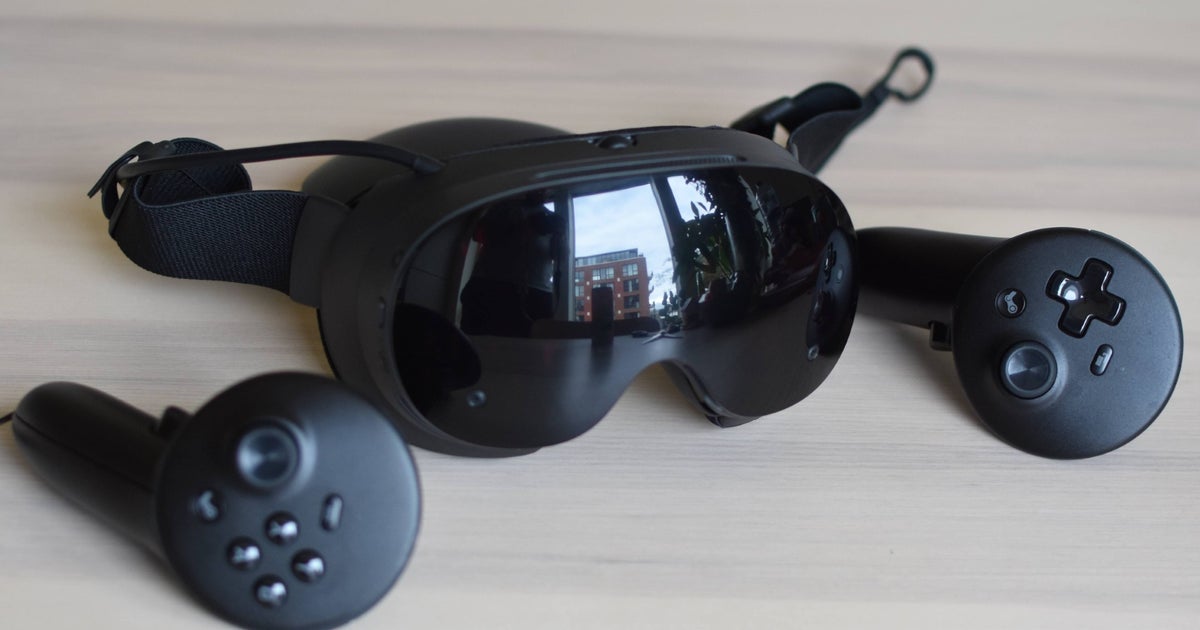
It’s a strange time to be selling a new VR headset, and maybe an even stranger time to be buying one. The supply of original virtual reality games has slowed to a dribble, and just as with Valve’s last hardware launch, the Steam Frame arrives covered in bumps and scrapes from a fight with the worst components shortage in memory. A fight which, judging by how it’ll cost ya £889 / $1,059 at minimum, it lost.
However, something else the Frame has in common with the revamped Steam Machine is that as a piece of hardware per se, it’s really quite likeable. Charismatic, even. It’s a happy marriage of core VR capability and genuinely new engineering ideas: some simple practicality boons, some with the potential to change PC games as we know them. And not just the ones you’d play with sweaty goggles on your face.
These ambitions aren’t necessarily apparent from the moment you lift the Frame (and its two controllers) from the box, but it still makes a good first impression. Despite being a fully wireless, battery-powered kit, it’s lighter, more compact, and far easier to set up than its cabled and base-stationed Valve Index ancestor. Its two 2,160×2,160 LCD lenses also make for a tidy sharpness upgrade, while narrowly edging the overall resolution of the Frame’s sworn enemy: the similarly cable-cutting Meta Quest 3. Prescription lens inserts are being made by Zenni Optical, but I can just about find a comfortable fit for my fairly hefty glasses, so fellow four-eyes – unless you’ve got Farnsworth-spec specs – probably won’t need them.
The Frame’s controllers do lack the hyper-accurate finger tracking of the Index’s, a quality their capacitive sensors are only partially successful in trying to recreate. Otherwise, though, they don’t feel like downgrades. Their inside-out tracking is plenty accurate, and although the adoption of a more gamepad-style, XYAB ‘n’ D-pad layout was done with playing ‘flat’ games in mind – more on that later – there’s something comfortable and immediate about using VR controllers with the same inputs as a conventional gamepad. Borrowing the grippy, drift-resistant tunnelling magnetoresistance (TMR) thumbsticks from the new Steam Controller was an especially wise move.
Passthrough play, where onboard cameras feed a view of your surroundings to use as game backdrops, is relatively basic. It’s fine for a few quick rounds of 3D puzzlebuilder Cubism, but the Frame’s monochrome cams represent one of the few areas where the clearer, full-colour Quest 3 has it beat. I’m not personally too fussed about this, mind – you can ask Meta themselves how well whole mixed reality Metaverse thing went, and the Frame’s video quality is fine for, say, quick trips out of the play area to retrieve a vibrating phone.
I hear that that a third-party, colour camera accessory is also in the words, though the usefulfulness of Steam Frame feature this relies on – its modularity – is difficult to assess in its earliest days. It sounds great on paper: besides staples like lens inserts, the idea is that you can swap out parts of it – the strap, the speakers, the battery, the facepad, to name a few – and replace them with more advanced or comfortable modules. Still, how valuable this will be depends on the available modules, and at the time of writing (a few hours before launch) the only add-ons to be officially confirmed are those of Valve’s own Ergonomic Accessories Kit, a pack of improved straps for the controllers and headset.
Happily, the Frame gets flexible and functional well before you’ll feel the need to start yanking bits out of it. Much of this flexibility derives from an exceptionally thoughtful balance of streaming and standalone usage, to the point where the Frame doesn’t feel as if it favours one VR style even as it excels in both.
Thus, streaming from a PC – your best bet for maximum visual fidelity – is helped along by a number of honest-to-goodness tech innovations. Foveated streaming, for one, makes use of the Frame’s eye tracking (itself an entire feature that both the Index and Quest 3 lack) to only stream a full-quality image where you’re currently looking at. Peripheral vision areas are streamed in lower quality to save bandwidth and, by extension, keep performance high. The transition between the two qualities is near enough instantaneous, so I couldn’t perceive it happening unless I stopped to look for it.
Where most wireless VR headsets also stream via a WiFi router rather than a PC, increasing latency, the Frame also takes a shortcut by streaming straight from a USB dongle. In the same room, this is as quick as any wired headset I’ve ever worn, but the Frame goes one further by combining both dongle and Wi-Fi connectivity into one consistent air tether: if you’re far enough away from your PC that the dongle and Wi-Fi are jostling for a performance lead, the headset will automatically (and, as far as I can tell, seamlessly) switch between whichever is faster in the moment. It’s a clever boost to the Frame’s stability and range alike, and while results will vary from setup to setup, I only started noticing lag when dragging the Frame two walls and two doors away from both PC and router. And even then, it was still broadly playable.
Standalone mode, meanwhile, is handled by a Qualcomm Snapdragon 8 Gen 3 processor, 16GB of that gold dust RAM, and whatever games you fancy whacking on the Frame’s 256GB or 1TB SSDs. Or, indeed, a microSD card – you can actually hot-swap Steam games installs on the same card across a Frame, Steam Machine, and Steam Deck, another nice touch.
All the same, some expectation-tempering goes a long way here; that Snapdragon is a modest upgrade on the Quest 3’s equivalent, but it’s still a smartphone chip, and standalone games often exhibit lower animation quality and/or fuzzier rendering resolutions than their streamed equivalents. Then again, there are also games where the difference, even if visible, is immaterial. Big VR hitters like SuperHot and Beat Saber still run marvellously on the Frame’s own internals, and more complex 3D fare like Dungeons of Eternity or Ghost Town can perform just fine on lowered settings. Simpler stuff, like Cubism or Google’s Tilt Brush, will bother it even less.
The crown jewel of the Frame’s standalone library, however, is Half-Life: Alyx. True, it’s seven years old now, but the erstwhile Index killer app was never originally designed to run on anything other than chunky PCs. The version that runs directly on the Frame is therefore a newly redeveloped build, native to the ARM-based processor, and it’s an impressive yardstick for what the headset can do without streaming help. Cuts are mainly limited to rendering rez and the visual smoothness of animations, leaving the original’s impeccable world detailing and breadth of interactivity untouched.
If standalone VR play has a weakness, it’s not performance but battery life. On default settings, including an automatic refresh rate drop from 120Hz to 72Hz, I only got 1h 03m out of my fully-charged Frame when playing Alyx on it. It’s more like two hours on pure PC streaming, which still isn’t outstanding, though to be frank I’m too partial to face-breathing breaks to play VR for that long anyway.
The third and, perhaps, most pioneering facet of the Frame’s games-playing power is how it runs flat/non-VR games in a virtual theatre view. Not that this is conceptually original, as VR headsets have been doing it for years, but then that’s always been over streaming; through techniques both sensible and extravagant, Valve have made the Frame the first of its ilk to run flat games from your existing Steam library in standalone mode.
The redesigned, more naturally game-agnostic controllers help with this, as does the use of SteamOS as an operating system, which effectively unifies your VR and non-VR collections on the headset itself. But, since not every developer has the re biggest deal here is FEX, a newly-added SteamOS component
Like Proton, which has made thousands of Windows games playable on the Linux-based Steam Machine and Deck, FEX – which Valve has been funding the development of for years – is a compatibility layer. It works to help software designed for chips based on the x86 architecture, like the Intel and AMD CPUs in our desktops, play nice with chips of the rival ARM achitecture. The result, put simply, is that the Frame gets all the low-profile, low-power advantages of ARM hardware with far, far fewer of the games compatibility problems, which would still exist on something like a Quest 3 even if you were to get a Windows emulator running on it.
Or, to put it even simpler: you can play Hollow Knight: Silksong on the sofa, with an effectively cinema-sized screen, and controllers that have more than two buttons apiece.
And that is very cool, at first. The more I took advantage of FEX, though, the more I wondered if its most exciting applications lay elsewhere. Alas, flat game compatibility still feels quite narrow on the Frame, even if it’s performance rather than CPU architecture that’s to blame. As adequately as Alyx runs, ultimately this Snapdragon processor has even less horsepower than that of an original Steam Deck – so while very simple games like Silksong, Signalis, and Hades 2 run fine, even less demanding 3D games can be a toss up. Big Walk is playable on Medium settings, but Wheel World’s lowest visuals can barely scrape 30fps in places where the Deck would have it hitting 60fps. Vholume, whose minimum specs list 4GB of RAM and a lowly GeForce GTX 960, struggles to get above 20fps.
I’m also not entirely convinced of its use cases. The giant-screen effect of a VR theatre is, to my understanding, often enjoyed by those without space for a honking great monitor or TV at home – which is valid. Though the focus on standalone support suggests Valve also have portability in mind, and the Frame is more cumbersome, less powerful, shorter-lasting, and more expensive than a Steam Deck OLED.
Nonetheless, in driving the creation of FEX, the Frame could well have established a legacy that stretches far beyond the plastic confines of a single VR headset. ARM chips are, right now, found in millions of devices – laptops, tablets, phones – and even Nvidia are going with ARM architecture for their first foray into combined CPU/GPU SoCs. These aren’t entirely incapable of becoming makeshift gaming PCs, but it’s still an awful lot of computers that could, in theory, be used to play an awful lot more games with FEX’s help. And more people playing more often has never been a bad thing.
As for the Steam Frame itself, it’s clearly a headset full of ideas. Some of these work better than others, but then even if you mentally slice off the flat-playing stuff and consider it purely as a VR device, it’s still pulling tricks and making improvements that no other headset has thought to do. Certainly that none have actually achieved.
These, importantly, include remedies for VR pain points that have existed for ages. Unreliable wireless connections: fixed. Tricky setups: simplified. Weird controllers: normalised. Needing a Meta account: not needing a Meta account. When the Frame can do this much, this well, I’m practically forced at inside-out sensorpoint to conclude that if I was buying a VR kit for myself, it’d be this one.
I don’t think taking that stance that means making excuses for just how expensive the Frame is; the 1TB version I tested is £1,089 / $1,299, almost double the UK price of a top-spec Quest 3. Having also used the Ergonomic Accessories Kit, I’d say too that the enhanced hand straps are essential enough – particularly for handsy shooters like Alyx – that you’d need to seriously consider factoring in a £59 / $59 set as well. The Frame is the best there is, but good lord, does it make you pay for it.
