

“He will again have compassion on us; he will tread our iniquities underfoot; you will cast all our sins into the depths of the sea” (Micah 7:19 NJKV)
Hours of listening, reading, researching, and interviewing individuals in and outside of religious, socio-religious, and contemporary musical environments, and three narrative styles begin to take shape
Three Theomusicological Narrative Styles
Pious Narrative: The narrative style that leans heavily on a legalistic, highly orthodox reading and application of scripture. A common approach is the “Turn or Burn” theme. The “Repent and Run” point of view is employed to the extent that, either verbally or subvocally, it is foundational
This narrative style can be seen in racially discriminatory theological institutions. The ideology is for a privileged community that defines itself by an insular, strict biblical reading serving their theological orthodoxy
Theomusicological expressions of the Pious Narrative are often witnessed in conservative religious institutions or contexts where the music included is set to support the orthodox perspective
The point of view of the music in the Pious Narrative will more often be considered authentic religious music or conservative religious music that authenticates a specific socio-religious theological ideology
Simulation Narrative: The narrative style that substitutes signifiers of pop culture for an essentialized perspective of contemporary Christianity. Typically seen in propserity/Mega church contexts, the focus is less on scripture knowledge, growth, and depth, but rather on how scripture influences, stimulates, and modifies pop culture to be allowed and engaged with a specific liturgical credibility
Leaning heavily on the spectacular and showmanship style of the bible, where biblical knowledge is reduced to simple language, micro-character, and essentialized narrative designed to excite a sense of enthusiasm rather than provide depth of scriptural teaching. Inverting the perspective of a personal testimony into a marketing campaign, this narrative style both influences and is influenced by pop culture, absent of any credible biblical knowledge, but hiding behind a distortion of socio-religious pop cultural psychology.
Theomusicologically, Simulation Narrative music will be pop culturally oriented, depending on the era. The style of music will replicate that of the current cultural design. The Simulation Narrative musical expression is less concerned with the genre or style of music being referenced, engaged, and ultimately produced than it is with repurposing a copy of the most popular, current musical trends
The musical ideology is focused on market influence, even if it is subvocally manufactured, audience appeal, visually stunning, and an emotionally charged musical experience. Biblical knowledge is a casualty of the experience, not a narrative focus. Yet, the Simulation Narrative will state and define itself on the platform of evangelism or discipleship, which it sees as an entry point to stimulate audience attention, drive emotions, and relate to a global, universalistic, essentialized socio-religious understanding.
Collective Narrative: The narrative style that engages whatever property, style, element, or vernacular is available to communicate biblical/scriptural knowledge to an audience. The most broad, flexible, and underrepresented narrative style, yet the narrative style that most closely aligns with core elements of theomusicology: evangelism, discipleship, personal testimony, biblical/scripture knowledge, community, and activism
Overlooked and discounted by pop culture and socio-religious ideologies because this narrative style can embrace whatever contexts and expressive agents are available. Artists working in this narrative style actively seek to bind the foundations of Hip Hop culture with theology. The directive is to use Hip Hop culture as a tool, a mechanism through which biblical truth and knowledge can be exposed, represented, and diasporically projected without limitations, borders, or restrictions
Signifiers of pop and Hip Hop culture will be present, but are not the driving identity of this narrative style. The emphasis is on how biblical knowledge is contextualized and disseminated on the largest available platform, regardless of the process, production, or audience being addressed
Putting The Narratives To Work
The limitations of the Pious Narrative style are the closure, authenticity directive, and singular demands for particular acceptance of orthodox religious culture, customs, and knowledge. The music functions as a minor release from the underlying tensions maintained in the Pious Narrative. Yet, the music is limited due to the overarching closed quarantine of the narrative style
The Simulation Narrative style employs a more open style, but retains its exposure to align with contemporary non-faith-based fashions. The music is enthusiastically performed, giving the impression of a deep personal religious or spiritual connection. However, when the lexicon (read: music, language, identity) is reviewed in detail, the inclusion of core scriptural doctrine is reduced to triithout any foundation
The music takes advantage of the current pop culture chart-topping genres against the backdrop of contemporary Christian musical staples: soul, R&B, gospel-turned-praise worship music. The music is more of a hook to gather audience attention, heighten emotions, and give the impression to audiences and the music industry market that this is accurate, credible, and the most valued music for contemporary religious expression
The involvement of the core elements of theomusicology is often minimized and not fully involved. This stands to reason, as the music is less about expanding biblical knowledge than it is about being a supporting element for choreographed dance sequences, the umbrella for highly quality music video productions, and a space-filler between the acquisition of monetary consumption in prosperity/Mega church environments
The Collective Narrative style operates musically and interpersonally with the agenda of exposing biblical knowledge to audiences, regardless of the size. Employing musical genres as a mechanism of expression, this narrative style gives liberty to the music with attention given to the direct inclusion of the core elements of theomusicology
A broad, dynamic, and inviting narrative style, yet it is due to this defining identity that both the Pious and the Simulation Narrative Styles discriminate and subtextually work to socio-religiously deconstruct the Collective Narrative Style. For the Collective Narrative style to remain present and purposeful for the contemporary Christian music market and audiences, it must dislocate itself from the subvocal temptation of the secular music environment (read: music market, chart rankings, concert and merchandise sales, etc.) and function as a liberating lexicon for biblical knowledge.
At its core, this narrative style is the most challenging to endure, as it performs against the grain of tradition seen in the Pious Narrative Style and the easily accessible diminutive approach of the Simulation Narrative Style. The Collective Narrative Style is challenged to find or create its own space, place, and time
Returning consistently to biblical knowledge, this narrative style is the one which raises to the challenge without looking at audience numbers, popularity, exposure, dominating, limiting, orthodoxy, or compartmentalized, pre-packaged market-approved biblical references
Application of the Narrative Styles
The closed apparatus and structure of the Pious Narrative Style is trite and codified. Musical examples, as stated, function as minor decompressed moments of repose from the dominating orthodoxy of the religious ideology. Simple musical examples are any of the religious works by J.S. Bach or G.F. Handel
More contemporary examples are those of the Black church traditional chorales and spirituals, or the counterpoint of modern Christian country music. The emphasis on biblical control leaves the music to be aligned similarly. These musical moments are not an artistic detour from the prominent religious discipline. Rather, these are opportunities for the insular congregation to emote a sense of weighted introspection
The conflicting narrative styles of the Simulation Narrative style and the Collective Narrative style serve an expanded profile to the Pious Narrative style. It is for this reason that both the Simulation and the Collective Narrative styles can gain attention beyond a faith-based community
To explore how these two different narrative styles, the Simulation Narrative style and the Collective Narrative style, push against each other, a short analysis of a selected work from each narrative style is useful to illustrate
Allowing space for each of these narrative styles to unfold, the comparison analysis is divided into two parts. Part one of this analysis is focused on the Simulation Narrative style. Part two of this analysis will focus on the Collective Narrative style
Two Different Musical Narratives: Part One, The Simulation Narrative Style
Elevation Church is run by Steven Furtick, who holds a Master of Divinity degree from Southern Baptist Theological Seminary. The worship team is the well-known and award-winning Elevation Rhythm
The success of Elevation Rhythm crosses socio-religious musical lines
“Elevation Worship, the music arm of Elevation Church, has a wide reach with over 2.3 billion streams of its songs across all platforms in 2024. It released an album called “When Wind Meets Fire” in 2024. It received several Dove Award nominations and took home some of the awards, including Billboard’s Christian Artist of the Year award…The Elevation Nights tour concert performances drew crowds totaling 161,243 across 16 tour locations” (Ministry Watch, March 25, 2026)
Such a skyrocketing audience and album sales success does not come without financial backing. A closer look at the background finances, the establishment of Elevation Church, Steven Furtick’s involvement, and the directive of the church codifies the prosoerity/Mega church identity
“Total revenue from tithes and offerings for the multi-campusmegachurchwas $91.35 million, and the year-end offering [2024] brought in $10 million. This represents a decrease from the $108 million in tithes and offeringsreportedthe previous year [2023]
“The church reported that thelargest portion of its budget— $31.88 million or 35% — went topersonnel expenses. The next largest expenditure was forcentral operations and ministriesat $25.29 million, or 28%
“According to its report, Elevation Church gave $12.16 million to outreach efforts in 2024 for a cumulative outreach total of $118.16 million
“Elevation Church is based in Matthews, [North Carolina]. It has 19total campuses—17 in the United States and two in Canada. The newest campus is in Columbia [South Carolina], opened in December 2024” (Ministry Watch, March 25, 2026, emphasis added)
The popularity of Elevation Church and Steven Furtick includes thousands of weekly viewers in person and online participants
“[An estimated] 450,000 people [watch] live online on Sundays and over 750,000 views of Elevation sermons onYouTubeeach week. Furtick’ssermontitled “Not Now is Not No” was his most popular, with nearly 1.3 million views onYouTube
The outline of a prosperity/Mega church identity is without question. Even with the financial decline from 2023-2024, Elevation Church continues to operate with a budget focused on personal expenses (read: Steven Furtick) and central operating ministries (read: Elevation Rhythm)
Coming into a pre-established audience base, Elevation Rhythm, which was organized by Steven Furtick to support his Elevation Church, it is no stretch of the imagination to see how and why such a band could find a level of visual and financial success unlike that of other worship teams or praise bands
Elevation Rhythm is, by argued definition, the quintessential Simulation Narrative style socio-religious band

Reading The Rhythm
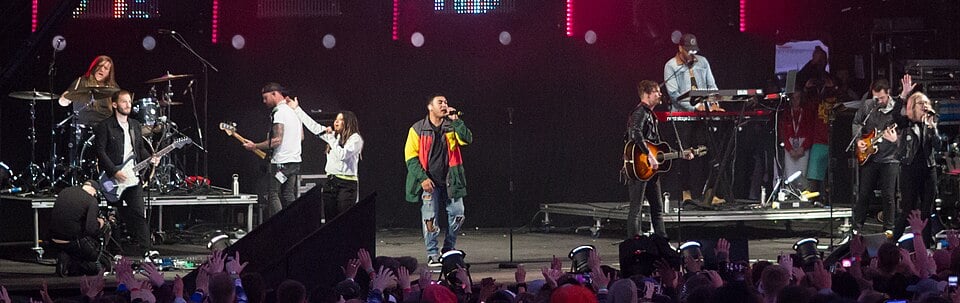
Simulation Narrative style example: Elevation Rhythm. “I Was, But God” (Official Video), May 25, 2026. Full video link
Elevation Rhythm has an impressive 405 thousand YouTube subscribers, with the track “I Was, But God” gathering 1,439,087 views as of May 25, 2026. The track is from the album “Victory Lap.” The songwriters give a bit more insight into this work
“Written by Steven Furtick, Davide Mutendji, Leeland Mooring, Sydney James
CCLI #: 7244940” (YouTube, July 2026)
A miniature review of the work by Air 1 “Worship Now”(October 27, 2025) follows the same course as an approach by reviewers of Simulation Narrative style works: widespread approval, little critique, and a celebratory tone. There is, obviously, room for such a review. Yet, those who reside predominantly in this narrative style of music are not encouraged to challenge scripture inclusion or the use of religious content in a work. Rather, this manner of reviews amplifies the copy structure foundational to the Simulation Narrative style.
Artist, audiences, and the contemporary prosperity/Mega church Christian industrial complex are granted a boastful privilege cloaked in the assumption of authenticity for their work. This breeds a distorted self-referential perspective of ownership for contemporary Christian music. When further echoed by high-ranking listings on Christian music charts, the likes of which Elevation Rhythm has accumulated through the recent release of the track “Washed.”
“ELEVATION RHYTHM is celebrating a career milestone as its hit song, “WASHED,” reaches No. 1 across Christian radio, marking the collective’s first chart-topping success on both the Billboard and Mediabase charts
“After reaching No. 1 last week on the Mediabase Christian AC and Christian Audience (Impressions) charts, “WASHED” now claims the top spot on Billboard’s Christian Airplay, Christian AC Airplay, and Hot Christian Songs charts, while also earning the distinction as this week’s greatest gainer on the Christian AC chart. This song remains in the Top 20 on Song Select and has 14 million views on YouTube” (GodTube Music, July 7, 2026)
The track, “I Was, But God,” is said to follow two central scripture verses, Isaiah 55: “My thoughts are nothing like your thoughts,” says the Lord. “And my ways are far beyond anything you could imagine. For just as the heavens are higher than the earth, so my ways are higher than your ways and my thoughts higher than your thoughts,” and Ephesians 3, where Paul wrote, “Now all glory to God, who is able, through his mighty power at work within us, to accomplish infinitely more than we might ask or think.”
Christian music critics and band members each note these verses. However, the work itself presents a different approach
Analyzing the first verse and chorus of “I Was, But God” presents the scaffolding of the entire work. The later verses involve the breaking out of bondage, calling attention to the imprisonment of the apostles throughout bible history, and a modification of the opening portion of “Amazing Grace” in the final verse. The inclusion of these agents is done to situate the importance of the work in contemporary Christian culture, speaking to different knowledgeable levels of audience listeners, from the well-informed to the general surface listeners.
Verse 1 and Chorus Lyrics
Can I give a little testimony
How l’m only here because of His hand
The enemy tried to end my story
But God had a different plan
See He took my sin and broke my bondageAnd He raised me up right outta that graveSo I can’t hold my hallelujahI’m so glad that Jesus saves
I was sinkingBut I’m singing nowI was, but GodBut God had a different planI was drowningBut I’m dancing nowI was, but GodBut God had a different plan
Who Is The “I”?
The most obvious use of the pronoun “I.” Some would see this pronoun’s prominent role as one giving emphasis to the personal relationship Christianity attests to Christ. However, when the pronoun “I” is contextualized in the video and a live performanceof the work, the “I” is transposed as an isolated, self-referential, privileged word
The pronoun “I” is shrouded behind Christian teaching but operates in a secular, non-faith-based use. “I” is selfish, indulgent, and prideful, the furthest point away from the core Christian teaching of and about the self. The video illustrates the transposition of the term, which, through the persistent use in the lyrics, compounds a dominating, singular perspective application
Backed by iconography of pop culture, materialism, fashion and style, and spectacular light displays, both the official video and live performance examples, audiences enter a voyeuristic hologram of a secular, non-faith-based music environment. The emphasis is on exciting the emotions on a personal level
The interview statement of scripture being invested is glossed over in the actual representation of the work. Elevation Rhythm exhibits a physically extraordinary, hyperbolic, biblically dislocated phenomenological experience for the audience, consistent with the prosperity/Mega church bubble in which this band was forged
Creating a copy of Christian discourse alongside a copy of contemporary pop culture, the expression is a Simulacra and Simulation as defined by the philosopher Jean Baudrillard
“Abstraction today is no longer that of the map, the double, the mirror, or the concept. Simulation is no longer that of a territory, a referential being, or a substance. It is the generation by models of a real without origin or reality: a hyperreal. The territory no longer precedes the map, nor survives it. Henceforth, it is the map that precedes the territory – precession of simulacra – it is the map that engenders the territory, and if we were to revive [this agenda] today, it would be the territory whose shreds are slowly rotting across the map. It is the real, and not the map, whose vestiges subsist here and there, in the deserts which are no longer those of the Empire, but our own. The desert of the real itself” (Stanford University Press, 1988).
Or, put more succinctly by Baudrillard
“The simulacrum is never that which conceals the truth–it is the truth which conceals that there is none…The simulacrum is true”(Stanford University Press, 1988)
Following Baudrillard’s post-modern theory, Elevation Rhythm is the simulacrum in the Simulation narrative style. The copy of modern, contemporary signifiers is the shell through which Elevation Rhythm manufactures its expressive identity. The repeated copy, the mimicking identity of pop culture, transposed through a socio-religious prosperity/Mega church model, executes a codified, self-referential identity without any valued credibility other than the exploited cultural copy; the simulacrum.
The repetition of the simulacrum without challenge from the surrounding socio-religious environment gives privilege to the copy as authority. Without challenge, the constant repeated identity has no controversy, thus making it the authorizing reality for audiences. The simulacrum becomes true. Elevation Rhythm captures the invested energy and financial backing, in-person and online attendance, and assumptive critical approval, repeats a self-referential identity, establishing power, dominance, and expressive genre authority.
Socio-religious signifiers succumb to the overarching profile of Elevation Rhythm, which is a simulacrum of itself, a vacant apparatus of a prosperity/Mega church industrial complex
Copying, mimicking, and repeating pop cultural non-faith-based norms, this process is codified by Elevation Rhythm, securing the definition of the Simulation Narrative style. Elevation Rhythm is void in theological value, yet expansive in the prosperity/Mega church components, the baseline mechanics of a Christian culture industrial complex
The pronoun “I,” when analyzed against the invested use and representation of the word, set against the backdrop of a band created by a high-ranking prosperity/Mega church pastor icon Steven Furtick, at Elevation Church, a physical definition and reference of a Mega church, signifying on pop culture iconography, media contextualized in a materialistic meta world, the “I” does not equate or support the scripture references stated and published in a contemporary Christian online magazine. Rather, the “I” is transposed as a position of privilege, socio-religious ownership, and authenticity of faith-based knowledge.
Given these points, there is no need to develop or expositionally explore the noted scriptures. In doing so, the unspoken response is twofold: 1. There is no need to progress these scriptures, and 2. There is no need to progress these scriptures, because the Mega church identity does not need to develop these scriptures, as it would take away from the operating foundational trajectory of a prosperity/Mega church, acquire finances and wealth from attendees in exchange for spiritual acquisition
This existential relationship transposes the biblical reference of “I” (read: a personal relationship with Christ and core disciplines of Christianity) to a simulacra and simulation of “I” (read: a self-ish, self-indulgent, privileged, ownership of knowledge, self-authenticating)
The pronoun “I” is the transpositional pivot from biblical knowledge to secular, non-faith-based vernacular, which is the identity of Elevation Rhythm, Elevation Church, Steven Furtick, and the global prosperity/Mega church industrial complex. The more disturbing point is that God, as included in the lyrics of “I Was, But God,” is actually a selling agent to a Christian mass market industry
Objectified as a subjective controlled element, God is truncated to a pre-packaged commodity for immediate sale, to be purchased at the nearest prosperity/Mega church complex. Careful attention would note that this operational process is that which was warned against by God to the prophets, and echoed throughout scripture thereafter:
“You shall have no other gods before Me” (Exodus 20:3)
“For the Lord your God in the midst of you is a jealous God; lest the anger of the Lord your God be aroused against you and destroy you from the face of the earth” (Deuteronomy 6:15)
“Hear, O Israel: The Lord our God, the Lord is one. You shall love the Lord your God with all your heart, with all your soul, with all your mind, and with all your strength” (Deuteronomy 6:4-5)

What’s the “Why” in the Simulation?
Being the most visible and easily accessible narrative style, the Simulation Narrative style is fraught with unsettling issues that require careful critical attention. Understanding the “why” behind the Simulation Narrative style provides a clearer understanding of the trajectory and desired outcome of the expressing agent. Absent this critical attention, audiences falsely believe they are acquiring biblical knowledge when they are being given counterfeit prosperity market-centered essentialized commercialized gospel quotes.
Replicating pop culture in a socio-religious context should raise attention. There is value in ascertaining pop culture elements as evangelistic tools. When music is in the Simulation Narrative style model, it is incumbent on the music to engage and express biblical knowledge, rather than biblical knowledge being expressed as pop culture
The Next Narrative Step
The importance of developing these three theomusicological narrative styles will continue in a short series, with the next installment to critically address the Collective Narrative style. The work and collective leading this example is Sevin/HOG MOB (Hooked On God; Ministry Over Business), with the track “So Blind” (Official Video), May 20, 2024. Full video link
