

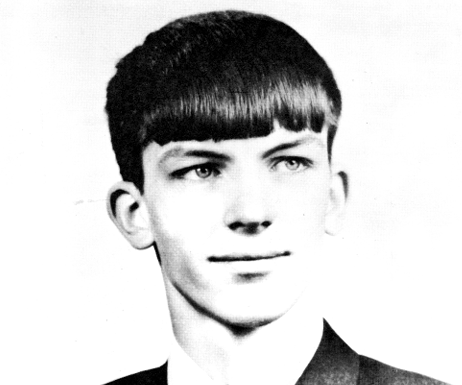
In the early summer of 1974, a Legion of Super-Heroes fan named Harry Broertjes, the editor of a homemade magazine called the Legion Outpost, made a phone call from New York to Pittsburgh to speak to Jim Shooter. Shooter was at that time a 23-year-old college dropout, living with his parents in his childhood home, and working a series of mostly odd jobs with mostly poor results. After trying and failing to get work at local advertising firms, he had just quit his position as manager of a fried chicken restaurant, and was thinking of giving school another try. There was, in short, nothing to distinguish Shooter from a thousand other discontented kids in fading rust belt towns, except for this: for a very brief moment, Jim Shooter had been a star.
At the age of 14, Shooter, just entering high school at the time, sold his first comic book scripts to National Comics editor Mort Weisinger, the formidable overseer of the publisher’s Superman comic line. Shooter’s earliest submissions, Supergirl and Superman stories for Action Comics, are solid enough first efforts from a very precocious learner: you can see that Shooter has studied closely the plot beats and dialogue patterns of a boilerplate Superman comic book, and manufactured a product to match the prototype as well as any Pittsburgh factory manager could. Shooter’s second submission, “Power of the Parasite” from Action Comics #340, is a wonderful case in point: Shooter not only wrote the script but (ignorant of the correct production process at National Comics) contributed his own layouts for Curt Swan to pencil over, and the result is a slam-bang fight scene staged dutifully and effectively through medium two shots: not a close-up or interesting angle in sight. It’s as though a superhero-worshipping cargo cult had attempted to recreate a Jack Kirby comic, and produced a genuine work of accidental art. It is enormously entertaining.
Those were Shooter’s earliest efforts, but he was a fast learner, and his finest work during those teenage wonder years at National were centered on the Superboy spinoff Legion of Super Heroes, on which Shooter was to make his reputation between 1966 and 1969. That he was able to acquire a reputation at all was impressive enough, since Weisinger did not in those years typically credit writers or artists on the stories in his magazines. But a precocious 14-year-old Superman writer wasn’t just a freelancer to be harangued, it was a story to be marketed, and Weisinger had more than enough savvy to know that. So, within a few months of his debut, Shooter’s name was not only being touted on the Adventure Comics letter page, but in syndicated newspaper stories: “Keep an Eye on Young Jim and Superman” read one headline in the Palm Beach Post above an article about “blue-eyed, 14-year-old Jimmy Shooter of Bethel Park, Pa.” In what may have been a sign of things to come, the article described some early friction between the action-oriented Shooter and the “situation plots” his editor preferred. But whatever the case was behind the scenes, the comic stories that ended up on the page really did speak for themselves.
This is not to say that the stories themselves are particularly original. Shooter would later say that, to the extent that he was a comic fan before he became a comic writer, his fandom was focused on the golden years of Kirby and Lee’s Marvel Comics, and it shows. A startling number of his Legion of Super Heroes plot lines come perilously close to copyright-dodging analogues of particularly notable Jack KirbyFantastic Four issues: thus, Kirby and Lee’s Frightful Four become shooter’s Fatal Five; the implacable devouring god Galactus becomes the Sun Eater; the deus ex machina plot device of the Ultimate Nullifier becomes the Miracle Machine.
But reducing Shooter’s stories to their component parts overlooks something about them that really was unique: a raw and sincere emotional connection to his characters that Shooter clearly meant honestly, and that other writers older than 18 simply couldn’t imitate. Shooter’s first Legion story, in which a new member named Ferro Lad (an outcast because of his unsightly, always-masked face) nobly sacrifices himself to save his untrusting teammates, had no immediate predecessor in the world of cape comics: it was born out of a very real and immediate teenage vision of heroically winning the acceptance of bullying peers.
Shooter would later say that he became a teenage comic writer out of economic necessity for his struggling household: it was a better way to make a buck after school than a steel mill. This may well have been true at first, but by the time his name was being printed in Adventure Comics, he had a more personal motivation driving him. In his interview with the Legion Outpost, Shooter told Broertje that the money “quickly lost its charm … my former neurotic, teenybopper self lived and worked for praise. Pats on the back. Recognition. The local papers ran a couple stories on the ‘boy cartoonist.’ This Week Magazine and American Youth published my picture. I loved it. This was my pay.”
You can see this in the way he pours visibly honest passion into the overwrought dialogue of his teenage characters – written, for the first time in the series’ history, as actual characters rather than costumes with expository dialogue: it is easy to imagine him drawing the personalities and secret crushes of characters like Shadow Lass and Karate Kid out of real kids sitting next to him in homeroom each day. The irony for Shooter is that the man most empowered to give him the praise he craved was the one man least likely to give it.
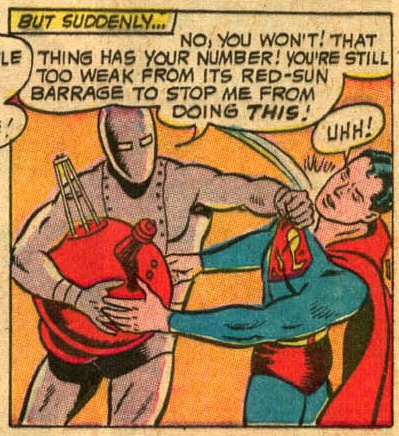
If Shooter was a wunderkind determined to be great, Mort Weisinger was an editor determined to crush greatness before it could sprout. Weisinger had been known to break more formidable backs than Shooter’s – earlier that decade, he had forced Superman writer Jerry Siegel to grovel for work on his own creation – and the verbal abuse he inflicted on Shooter was substantial, even at a distance of 300 miles
“He caused a kind of pathological fear of telephones in me,” Shooter said. “Every call from New York included liberal griping from Mort — too many words per panel … over the page limit … not on time … why can’t you write like you used to … As it progressed, our relationship became more and more strained; I felt more and more inadequate. I can’t say it was Mort’s fault. Let’s call it extenuating circumstances.”
It all came to a head after Shooter graduated from high school and enrolled at New York University. He had been offered a staff job as Weisinger’s assistant, but an attempt by Shooter to assert himself and make clear that he wouldn’t be abused in his new role was a disaster: Shooter lost the Weisinger job along with his freelance assignments, dropped out of school to take a job at Marvel, and found himself overwhelmed with life in New York. After two weeks, he had crashed out, leaving his job and his college education to go back to Pittsburgh and obscurity. By the time the Legion Outpost found him, he hadn’t read a comic book for years.
This was the first chapter of Jim Shooter’s life, and it set up two recurring dynamics. First, the shadow of Mort Weisinger would always cause Shooter to link the achievement of artistic greatness with bullying, domination, and abuse. Like the child of a broken home, he never quite shook off his love-hate relationship with Weisinger. Even as he recounted the terror of working for the editor in hisLegion Outpost interview, Shooter wistfully imagined winning his approval again: “I really feel like I’d like to go out and just see Mort,” he said. “There’d be no hassle. I really like him, and I’d like to straighten things out. Actually, he was very generous in a lot of ways.” The tension between the Jimmy Shooter who tried to win the love of Mort Weisinger and the James Shooter who tried to stand up to him would define him for the next 30 years. In the end, he would banish Mort Weisinger only by becoming him.
The second recurring dynamic that began here was Shooter’s vision of himself as a genuine artist, brought down by fate through a storm of enemies and circumstances against which he could only struggle. For the moment, the fates had won, but the interview with Broertjes got Shooter to thinking. Perhaps, in the Vaudeville Greek tragedy of Shooter’s life, there was still another act to be played
When Shooter returned to Marvel as an editor in 1976, it was in a spirit of heroic defiance. The fates had bested Jimmy Shooter, but they had not destroyed him, and now it was his turn to emerge triumphant. He would later describe the Marvel office of that time like a scene out of a Bosch triptych: copy editors sleeping under desks, pot smoke wafting through the air vents, deadline after deadline being missed. The third, at least, was demonstrably true, and Shooter immediately set about to put things in order. His reputation, even from early on, was as something of a martinet, giving far more notes and making far more demands as an editor than creators at the freewheeling Marvel of the ‘70s had been accustomed to. In reality, he wasn’t reining in unruly staffers, but the forces of primordial chaos themselves: Shooter would be to Marvel what Weisinger was to Shooter. He would bring them order, and structure, and dependable quality, and they would either love him or kill him for it.
Within two years, Shooter had maneuvered himself into becoming Marvel’s Editor-in-Chief, and his first order of business was alienating (both by design and by accident) all of those writers and artists who were either too undependable or too uncontrollable to fit into the new Weisingerian system. You could fill an entire freelance roster with the names of people who quit or were fired from Marvel during Shooter’s first years, which, indeed, is more or less what Jenette Kahn at DC did – Gerry Conway, Marv Wolfman, Roy Thomas, Steve Gerber, Gene Colan. They didn’t leave quietly, either, taking their complaints both to the emergent fan press and to actual mainstream news outlets like the New York Times, which excoriated Shooter in 1979 under the headline “Superheroes’ Creators Wrangle.”
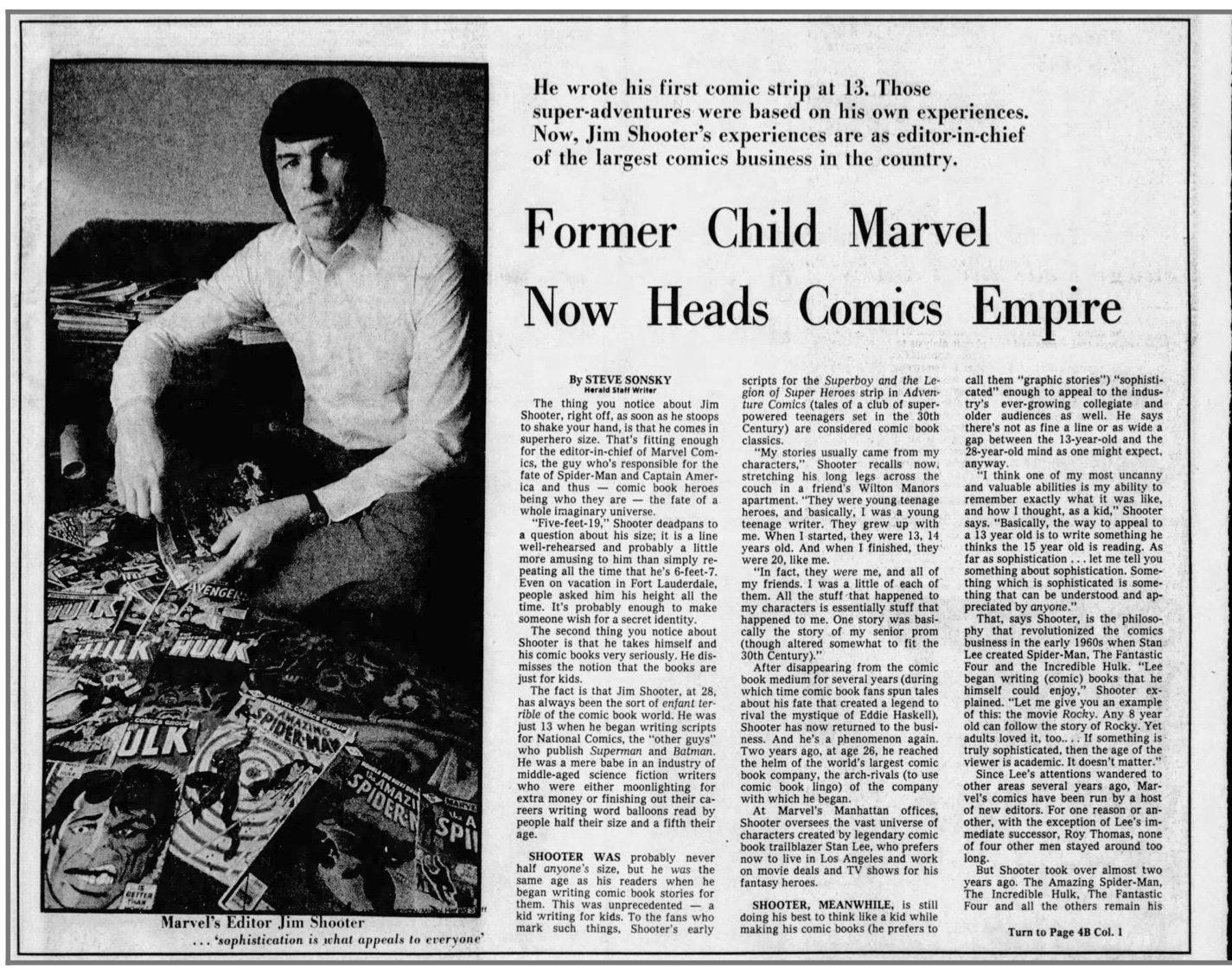
But this time, Shooter wasn’t about to take the fates’ assault lying down. He launched a media counter-offensive of his own, placing stories in newspaper syndicates across the country. Two months after the Times story, the Miami Herald ran a full-body portrait of Shooter posed next to a pile of his comics, and the headline “Former Child Marvel Now Heads Comics Empire.” Shooter the great writer was already being supplanted by Shooter the corporate titan in his own version of the myth. But not quite yet.
Shooter told the Miami Herald that his goal as editor was to publish “graphic stories” that were “‘sophisticated’ enough to appeal to the industry’s ever-growing collegiate and older audiences.” The reality was somewhat more prosaic. Shooter was fond of subjecting new freelancers and editors to two lectures on good storytelling: the Little Miss Muffet lecture (in which the children’s rhyme was used to demonstrate the three beats of setup, conflict, and resolution), and the Jack Kirby lecture, in which an otherwise unremarkable Human Torch story was used to illustrate all of the storytelling techniques Kirby did right, and which, presumably, the hapless young creator did wrong.
The result in practice was a kind of flattening-out of the wild peaks and valleys that had defined ‘70s Marvel. The company Shooter inherited was capable of the rare feat of brilliance (Jim Starlin’s Warlock, for instance, or the mad genius of Jack Kirby’s Captain America), but it was bounded by immense, unreadable piles of crap, much of which couldn’t so much as meet its own deadline. Shooter’s Marvel was as dependable as Pittsburgh steel: rarely great yet seldom unreadable. Every so often, a work of real and permanent brilliance could break through: Frank Miller’s Daredevil is the most evident example, and Shooter certainly had sense enough to champion it when it happened. But the archetypical comic of Jim Shooter’s Marvel would have to have been something like Rom: Spaceknight, written by Bill Mantlo, drawn by Sal Buscema; factory comics at their level best.
The irony is that the lone exception to these rules among Shooter’s freelancers was Shooter himself. To the extent that Shooter endures in the public memory, it will always be as an overseer more than an artist. But this is unfortunate because, especially in the early years of his return to Marvel, before he was firmly ensconced in his reigning position, his bibliography is strange, innovative, and fascinating to behold
His run on Daredevil, which lasted less than a year and is largely forgotten now, is a perfect case in point. Shooter’s issues encompass a single running plotline, in which Daredevil finds himself in the position of arresting the father of his girlfriend, Heather Glenn, for a murder he had committed under the influence of mind control. Ridden with guilt, and driven to exonerate a man whose unjust imprisonment he had caused, Daredevil is put in the position of revealing his secret identity to Heather (who is horrified), before ultimately failing to exculpate her father (who commits suicide in jail, convinced of his own guilt).
It is an extraordinarily bleak story by the standards of 1978, and it is not too much to say that the Daredevil of Roger McKenzie and Frank Miller really starts here, with Shooter himself. But the great work of Shooter’s 1970s revival, the one story that can unapologetically be called a classic, is his year-long Avengers arc typically called the Korvac Saga. It was typical Shooter: going back to his days on the Legion, he had always had a taste for the definitive epic; the grand summation of a superhero title that would both cement his own legacy as an author, and provide a template for all the lesser lights who would follow him. For the Avengers, the story looked something like this:
The entity called Korvac is a human-robot hybrid from the 30th century, with typical ambitions of world conquest. Rather than attempt to combat earth’s heroes head-on, however, he instead travels back in time to the 20th century in the form of an unassuming suburban bachelor named Michael. In this form, he attempts, subtly but pervasively, to use his effectively divine power to turn human behavior toward good, alter society for the better, and transform reality into the paradise he knows it ought to be.
But for all his subtlety and careful planning, and for all the goodness of his intentions, little parts of Michael’s plan begin to go wrong. The Avengers become aware that something in the universe is amiss, and in order to forestall their intervention until he has time to perfect the universe, Michael tries to distract them by siccing one villain after another on them. This, however, only makes the heroes more suspicious, and after 10 issues of this business, the Avengers finally confront Michael in his home, being drawn into a desperate battle that ultimately results in Michael’s death.
It is worth lingering on this climactic issue of Shooter’s run, because it is almost certainly the best and the most interpretively important comic book Jim Shooter ever wrote. The story – even under the weight of unusually slapdash art from the really quite talented David Wenzel – is shockingly brutal even 40 years later. For 13 pages, the omnipotent Michael is attacked by, and subsequently kills, each of the Avengers in turn. As he does so, he begs frantically for the heroes to stop fighting him, and to explain that he could create a better world if only they would give him time to do so. But we know, and so does Michael, that his pleading is in vain, and so the issue climaxes in a scene reminiscent of the “street of the dead” sequence from Gone With the Wind: an overhead shot of strewn corpses on a living room floor, with Michael lying in the center of the frame, his arms outstretched in imitation of Christ. In case we should miss the parallel, the hero Thor drives it home: “Can it be that Michael was just – and we were the villains? Verily, then, his innocent blood is on our hands!”
It is only then, too late, that the Avengers realize their error, and though reality is ultimately restored in its status quo ante bellum, the final, irresolute scene of the comic still lingers: Dr. Donald Blake, alter ego of Thor, leaning wild-eyed over his dead teammates, desperate to correct a mistake that can never be unmade
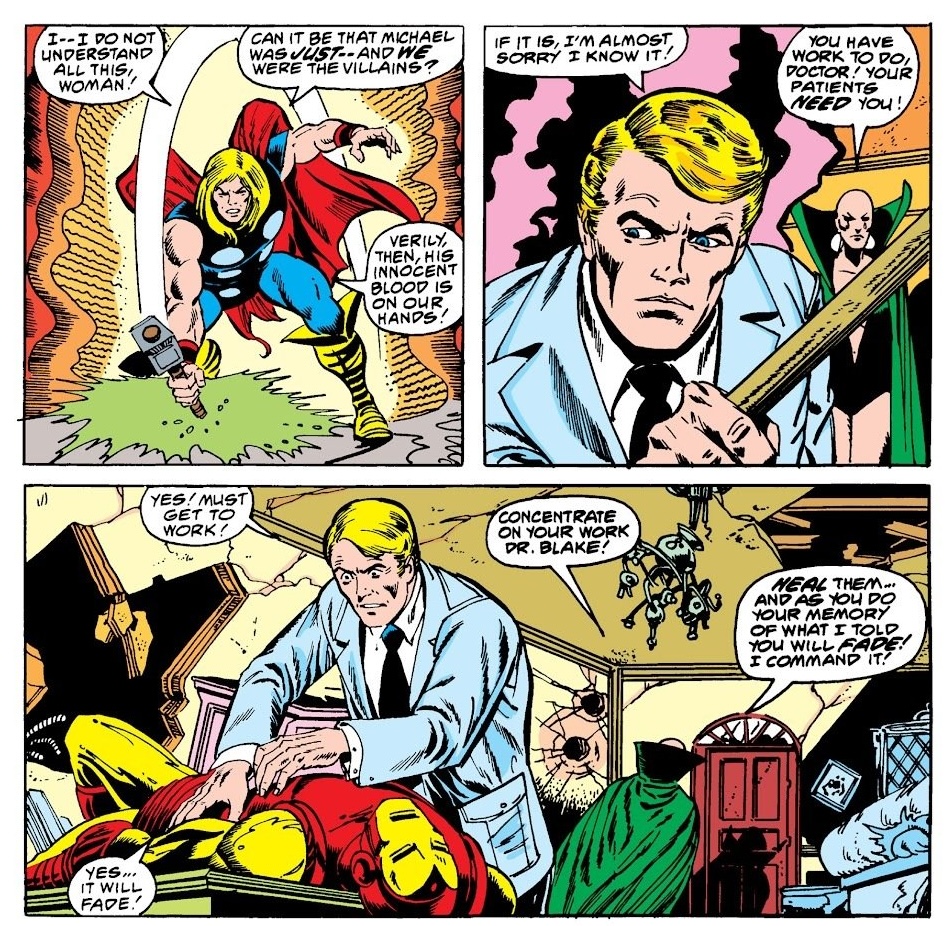
It takes no great critical effort to recognize that Michael Korvac is depicted here as Shooter’s literary self-insert, and it was not the last time Shooter would do this. The tragedy of Michael Korvac would become the template for every major work that Shooter would attempt from that point forward: the wise and powerful god-emperor, who could show the world the way to greatness if only they would listen to him, but who is inevitably brought down by the lesser lights around him who cannot understand.
What is remarkable is Shooter should have written this so early in his life and career, just as he was achieving his ambitions at the top of the comics industry. Did he know then that his life would have the shape of a tragedy? Did he recognize the irony in a Michael Korvac whose own overweening arrogance is, in the end, the cause of his defeat? If he did, there was little sign of it in the Shooter who emerged in the 1980s as the bête noir of fandom and freelancers alike
That Shooter – the mighty Ozymandias towering over commercial comics – has been the subject of most writing and commentary before and since. That was the Shooter who was famously the subject of Gary Groth’s brutally forensic editorial “Our Nixon” in 1994, and in truth there is little reason to defend or relitigate his reputation here. Shooter the editor and executive was, if not necessarily a villain, then at the very least a sworn and loyal company man, insomuch as he identified himself inseparably with his company.
His long and increasingly shambolic war to prevent the return of Jack Kirby’s art is illustrative of his approach chiefly because of how pointless it was: Marvel ought to have had every incentive to do as Warner Bros. had done for Siegel and Shuster, and simply give Kirby what he wanted so that everyone could look friendly in front of the national press. By the end, Shooter seemed to be fighting less out of necessity and more out of the general principle of the thing: Shooter had made a decision, and the decision must be enforced. He was once again Michael Korvac, fighting back the forces of ignorance and chaos to exert his way on the world.
What it amounted to was that Shooter the Boss had firmly supplanted Shooter the Artist, and so it would have remained had it not been for a quirk of commercial fate. In 1984, Marvel needed a tie-in series to promote their new Secret Wars action figure line and, Shooter being who he was, he selected himself to write the year-long event. It turned out to be the highest-selling comic of the year, and this immediately sparked in Shooter and his bosses the desire to run a sequel the following year
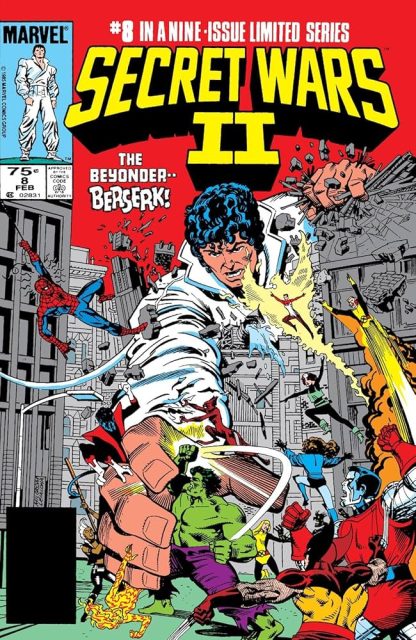
This was Secret Wars II.If the Korvac Saga was Shooter’s life told as tragedy, this was the same thing repeated as farce. Not intentionally, of course. The series starts out seriously enough, with Shooter’s alter-ego this time around, the cosmic god-being called the Beyonder, assuming carnal form on Earth and immediately causing a 20-page donnybrook with the X-Men. But by the second issue, when the Beyonder has come to Earth, donned a Michael Jackson leather suit, and bumbled his way through learning about hot dog consumption and correct bathroom habits, it is clear that Shooter was not attempting a superhero story, but something far more terrifying: a serious work of art.
What he seemed to have had in mind was a kind of picaresque bildungsroman, in which Shooter/Beyonder walked the avenues of New York, befriended streetwalkers and mafia dons, rode the rails, and sailed the cosmic skies on his road to learning about humanity and life. Like Michael, he learns in due time that he is wiser and possessed of greater capacity to manage our imperfect world than the beings he encounters. Like Michael, his attempts to do this result only in disaster and defeat
By the time it happened this time around, both Shooter and his series had become a laughing stock. “Secret Wars II? Quick – find me an oven so that I can stick my head into it,” wrote one fan to Amazing Heroes Magazine. “Jim Shooter has too much power,” wrote a reader to theComics Journal.
Sales plateaued and then fell. The final issue of Secret Wars II sold only half as many copies as the first. Meanwhile, as Shooter’s editorial strictures at Marvel tightened, his roster of star creators dwindled: Frank Miller decamped for DC, as did John Byrne, Doug Moench, George Pérez, and Denny O’Neil. It had been nearly a decade since Shooter had come to power, and it seemed even to observers at the time that the Shooter Saga might be reaching its third act
There would still be one last, strange artistic statement before that happened. For some years, there had been rumors, always denied, that Shooter planned an upheaval of the Marvel line called the “big bang,” in which the stable of Lee/Kirby/Ditko characters with which the company’s licensing bread was buttered would be replaced with new variations and modernized reimaginings
Whatever Shooter’s initial ambitions, this never came to pass, but he did manage to execute what he clearly believed to be his great and lasting legacy at Marvel in the form of the New Universe, which was exactly what it said on the tin: a brand new line of comics, created in Shooter’s image just as the original Marvel line had been created in Stan Lee’s
From the beginning, it was doomed. Marvel’s executives reacted to the notion of supplanting their most lucrative and marketable characters with all the enthusiasm you might expect, and Shooter’s requested R&D budget of $120,000 was slashed to $80,000, then $40,000, then $0 in the space of a single week. In the end, Shooter said, the total spending for character development amounted to $12,000, “Much of it on [the superhero] Speedball.”
But the New Universe did give Shooter one last chance to try and tell his story in the form of Star Brand, the superhero he created and wrote for seven issues (with art by John Romita, Jr.). A cross between Spider-Man and DC’s Green Lantern, Star Brand is the most nakedly autobiographical of Shooter’s creations: the story of Kenneth Connell, a sad-sack Pittsburgh youth with a high school education, working a dead-end job at an auto shop until he finds himself possessed of mighty alien powers.
This is a typical Stan Lee setup, but — and this is the part that is fascinating — nothing about the series happens the way it should. Kenneth Connell stumbled his way toward deciding to use his powers for the good of the world, tries it, fails, changes his mind again. His romantic drama consists of flitting without commitment between an older and thoroughly incompatible divorcee, and a heartbreakingly devoted platonic friend whose obvious affection Connell repeatedly exploits and abuses. Kenneth Connell is, in short, an asshole, and it remains remarkable that Shooter was willing to paint so frank and devastating a portrait of a character into whom he had poured so much. In its own, accidental way, Star Brand is as effective a deconstruction of superhero fiction in 1986 as Watchmen and The Dark Knight.
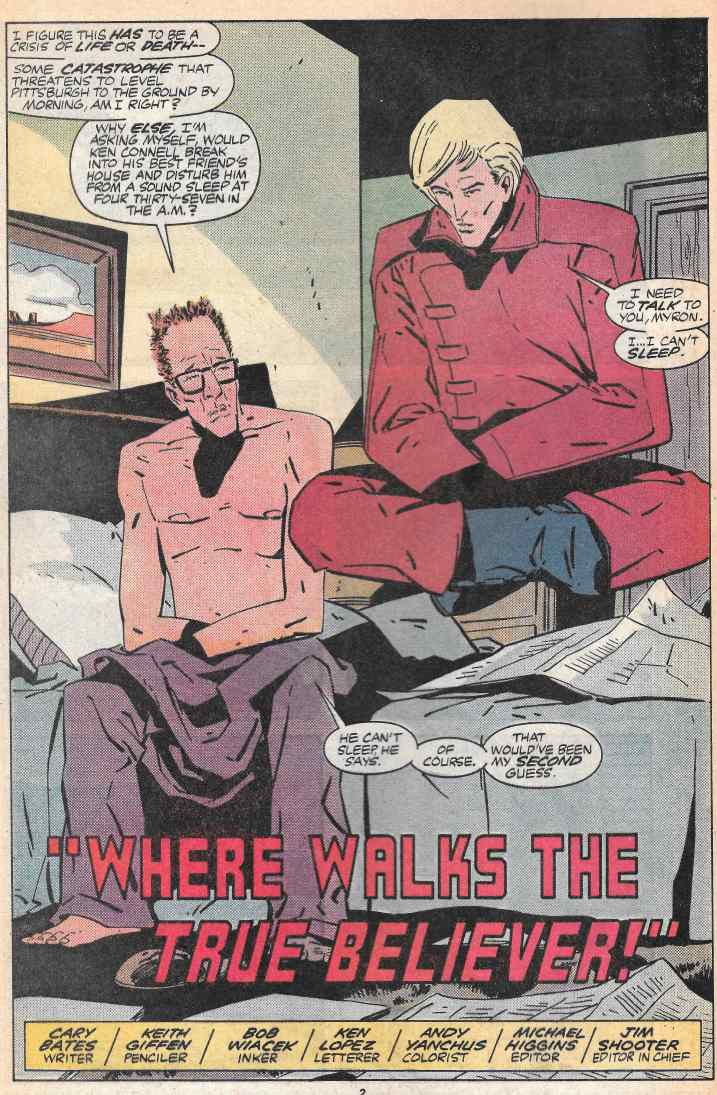
In any event,Star Brand’s run was cut short, and so was Shooter’s. His last days at Marvel were low comedy: the company was bought by new corporate owners at New World Entertainment; Shooter, seeing enemies at the gate, made a play to grab for even more authority; and when it all went sour, he was gone for good. Star Brand was taken over by writer/artist John Byrne, who promptly destroyed both the character and the city of Pittsburgh in gleeful revenge against the vanquished editor. So perhaps we must amend our statement to say that Jim Shooter’s story was enacted in fiction three times: the first as tragedy, the second as farce, and the third as a fill-in issue.
The rest of Shooter’s life was anticlimatic. Twice more he attempted redemption arcs. The first time, with some brief success, by founding Valiant Comics, and the second time, with no success at all, by founding the inevitably named Defiant. But by the time Groth wrote his editorial in 1994, Shooter really was Nixon: more-or-less resigned to defeat, a figure of bewildering history more than living power or menace
By the time I knew him, during what turned out to be the last years of his life, there wasn’t much left of the old Shooter apart from the undiminished, resonant baritone of his voice. I had called one of his associates because I was reporting a story and wanted Shooter to confirm some details. When he called me at 10 p.m. about a week later with the words, “You the reporter? This is Jim Shooter,” it was the sort of vertiginously surreal experience that Shooter must have inspired in many people before me.
We talked several times after that, or rather he did, for the most part. He would give long talks, sometimes unprompted, correcting the historical record of his time at Marvel, or complaining about the ill-advised turns the company had taken since he left. There was always a new project for him just around the corner: a future memoir he was going to write, or maybe a fictionalized series that he said was in the works at Netflix. He complained about the “woke” stories that were ruining modern comics, which he said he no longer read. He voted three times for Donald Trump.
Still, I have to say that I enjoyed those conversations. It was like speaking to Achilles in the realm of the dead, when Odysseus summons back his spirit. Odysseus tries to console Achilles by recounting how legendary his deeds must make him in the afterlife, but Achilles will have none of it. “No winning words about death to me, shining Odysseus,” he says. “By god – I’d rather slave on earth for another man — some poor tenant farmer who scrapes to keep alive — than rule down here over all the breathless dead.”
In the end, I think, the great artistic work of Jim Shooter’s life was Jim Shooter’s life. His repeated defiance of the gods, his triumph and his petty tyrannies, his ultimate antiheroic bathos: even more than the story of Siegel and Shuster, they all add up to a microcosm of what American comics were, and are, and probably will always be
At the end of his interview with Shooter in 1974, Harry Broertjes asked him about some odd rumors that had been floating through Legion fandom: that he was writing underground comics somewhere in California under a pen name, or that he’d tuned in, dropped out, and moved to Greenwich Village
“Lies,” Shooter laughed. “I’m here in Pittsburgh where I’ve always been.”
