

 Somewhere in the course of my marriage falling apart—before the need to write again returned but after the dimensions of my bed became too oppressive to remain within its confines—I reached for something on my bookshelf that could uplift my spirits.
I avoided romance narratives that involved falling in or out of love, or anything that featured macroscopic, earth-shattering stakes for the future of mankind. I wanted to engross myself within a world of comedic lightness, where humour might only occasionally touch on subjects of pressing social significance.
I originally discovered the work of American artist Frank Willard through an online auction house catalogue. A cartoonist for theChicago Heraldand King Features Syndicate, some of Willard’s original drawing boards stood a hulking 22 inches long and 16.5 inches wide. Any comic strip being produced in such gargantuan dimensions immediately catches my attention, and it was for this same reason that I grew to adore the works of Rudolph Dirks, Harry Tuthill, and Edwina Dumm.
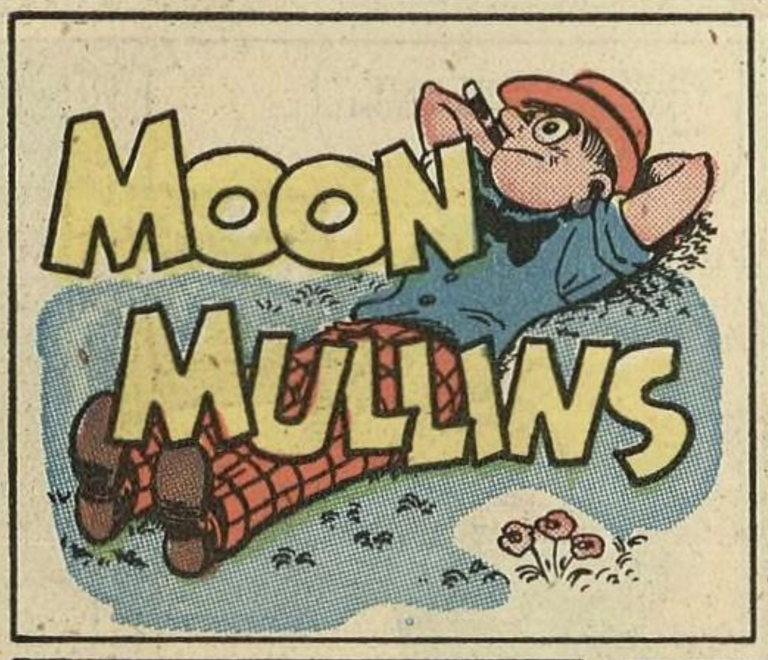
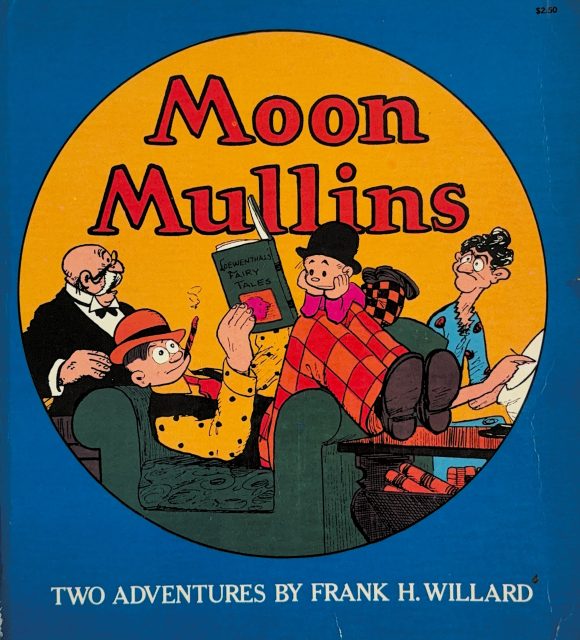
The strip Willard was most known for wasMoon Mullins, premiering in June of 1923 and running until Willard’s death in 1958; Willard’s assistant Fred Johnson took over the reigns and drew the strip until 1991 (Johnson claimed that he had been drawing the majority of the strip anyway since 1933, and writing it from 1943 onwards while Willard played golf, temporized, or drank heavily). At its peak,Mullinshad a daily circulation of 14 million copies across 350 North American newspapers.
Despite American audiences of a certain era being conversant in Moon’s exploits—it was not uncommon for men named Mullins to adopt the sobriquet of “Moon” during the strip’s heydey— the work was mostly out of print and difficult toullinsin thrift shops and online book stores, the only way that I could read the comics themselves was by scouring old auction sales that included high resolution scans of the art boards
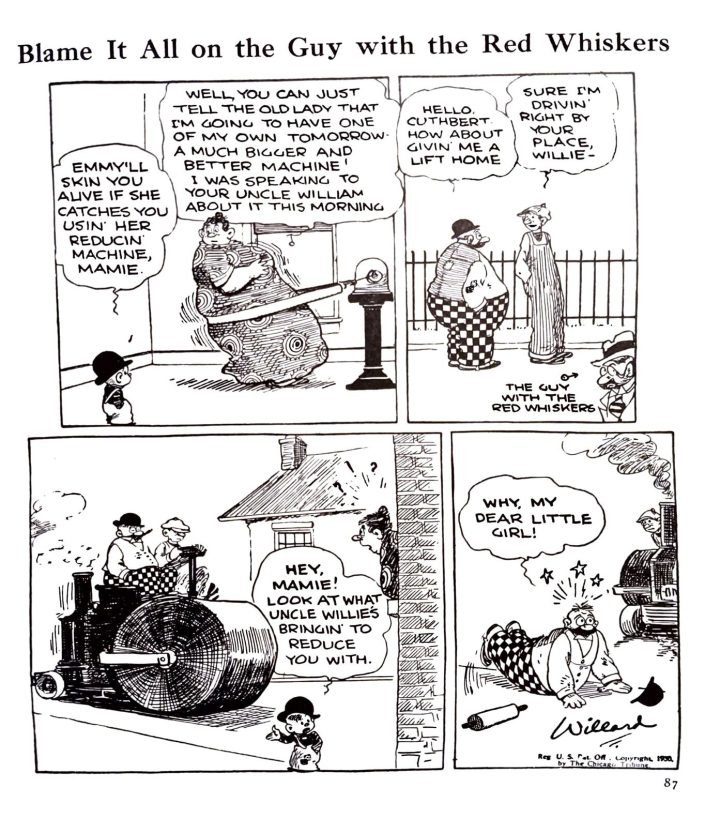
Moon Mullins’ main attraction was that it helped me forget my mounting legal troubles. The titular character was a feckless prizefighter, living in a rooming house at 1323 Wump Street with his brother Kayo (“K.O.”) and other working class “undesirables.” Rounding out the crackbrain ensemble were landlady Emmy Schmaltz, Uncle Willie and Aunt Mamie, Moon’s on-and-of girlfriend Little Egypt, and an aristocrat by the name of Lord Plushbottom who had lately fallen on hard times (my personal favourite).
Though Willard’s strip predated them, I had become enamoured with rooming house hijinks in the early 2000s after obsessing over Frank Quitely’sThe Greensin Scottish underground magazineElectric Soup(itself modelled after Low and Watkins’The Broons) and Eric Chappel’s Yorkshire Television situation comedyRising Damp.
There was something about close quarters conflict, nouveau riche pretensions, and the frank-hearted pluck of America’s poor that allowed me to savour the richness of life again post-separation—I had, after all, encountered this typology of personages all my life.
Schmaltz reminded me of my attention-starved landlord, a wannabe musician and failed artist who lived in the shadow of his father (a successful illustrator designed the logo for one of Toronto’s largest sporting franchises). Moon on the other hand, was every “banjoeyed” roughneck I encountered in the Toronto martial arts circuit who would play dice in hallways between tournament bouts, while Lord Plushbottom bore a striking resemblance to an underwitted boss I reported to while working in Hogtown’s financial district (she would put on airs about her liquidity, inviting her staff to Broadway shows while I deposited client cheques, largely in vain, offsetting her -$200,000 bank overdraft).
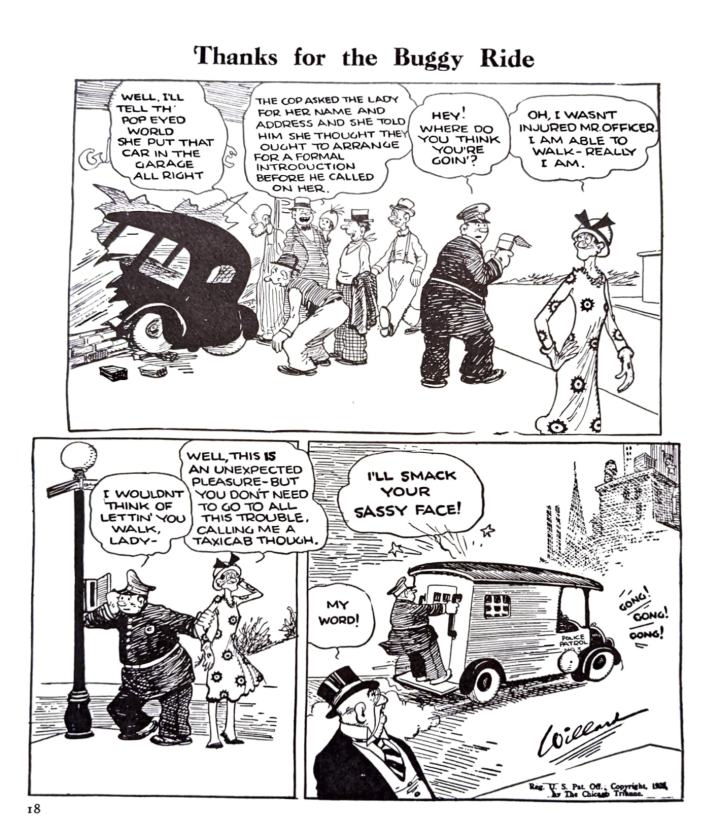
For these reasons and more,Moon Mullinswas like manna—both familiar andinconnu—to my starved soul. While modern readers encountering Emmy Schmaltz’s evasion of the police might find the strip quaint or predictably structured around overused gag lines—after Emmy crashes a stolen car into a garage, a witness reports that “The cop asked the lady for her name and address and she told him she thought they ought to arrange for a formal introduction before he called on her”—it was these hallmarks that made Willard’s work so embraceable to me.
If there can be a song for every mood, a film for every feeling, then surely there can be a comic strip for every malady; but like any other revitalizing tonic, the good tends to sit astride the bad.
In the case ofMullins, that bitter taste comes in the form of its racist minstrel show representations of minorities (Lord Plushbottom’s driver “Mushmouth” is a derisive reference to African American Vernacular English), its inflexible characterizations of women (there is nary a depiction outside of the narrow categories of floozy, shrew, and matron), and the moments when the hardships of the downtrodden begin to read a dash unsympathetically (Aunt Mamie describes her husband Willie as someone who is “Always lookin’ for a big business where he can start near the top and loaf his way up”).
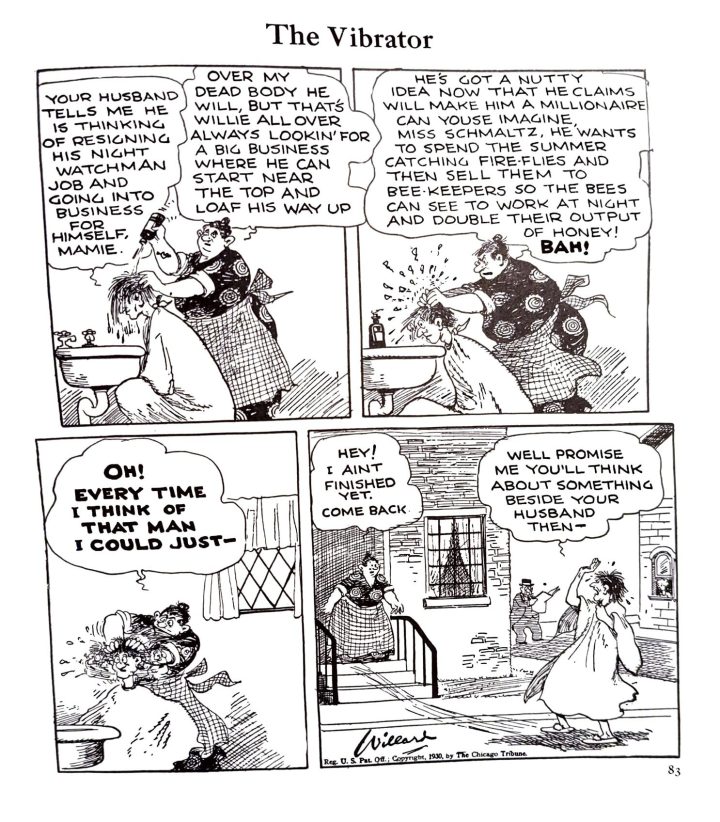
Following Willard’s death in 1958, not even Johnson’s sensible impulse to bring the cast ofMooninto the middle class or to make the comic more family friendly could ensure a generational renewal for a strip birthed in a time of Dust Bowl economic bootstrapping. Despite Kellogg’s brand cereal box prizes, a Milton Bradley board game, toys, and brief animation segments in Saturday morning Filmation cartoonArchie’s TV Funnies, this combination of unpropitious qualities seemed to relegate Moon and his compatriots to the cultural wayside.
Problematic issues aside (to say nothing of the question of whether a culture is better served by dispassionate exploration or denouncement of its flawed historical texts), the therapeutic qualities I derived from my reading also lay in the pleasure of learning about Willard himself, whose unwonted lifestyle seemed to even exceed my interest in the character Mullins.
Comic historian R.C. Harvey released a definitive history of Willard’s career activities in an article on his website entitled “Frank Willard and a Touch of Moonshine: Lowbrow Comedy for the Masses;” Harvey compiled evidence from the likes of Martin Sheridan’sComics and Their Creators, Clive Howard’sSaturday Evening Postarticle “The Magnificent Roughneck,” and Stephen Becker’sComic Art in America, painting a vivid picture of the cartoonist.
Willard once punched King Feature Syndicate editor Rudolph Bloch square in the face for surreptitiously passing along Willard’s ideas to George McManus ofBringing Up Fatherfame; Harvey also relates how on days when Willard’s truancy got the better of him, King Features would resort to the practice of “wallpapering”Mullinsstrips together—cutting and pasting old Willard or Johnson drawings together and inventing dialogue in the “inimitable” Willard style (at a punishing schedule of six dailies and one Sunday strip per week, Willard would forgo his pay when inspiration was fleeting/golfing trips took precedence over his day job).
My favourite story about the Illinois-born cartoonist concerns his parsimony; despite the strip’s popularity fattening Willard’s wallet, he was not prone to ostentatious displays of wealth. While holding interviews for a gardener to tend to his property, applicants saw someone (who turned out to be Willard) in his undershirt and threadbare pants bent over the dirt. The applicants did not even bother knocking on the door as, upon observing the scene, they became under the impression that the position had already been filled.1The Saturday Evening Post [v220 #6, August 9, 1947] The Magnificent Roughneck (Frank Willard, artist of “Moon Mullins”) by Clive Howard/efn_note]
It seemed that Willard shared more than a handful of similarities with his supertramping, slapstick-prone creation—a weakness for cigars, pool hall gambling, fisticuffs, and a nigh-permanent case of layaboutism; but this indeed might have been the final exposed layer of appeal to my lovesick mind.
Buffeted by ill-circumstance, Moon took his lumps as they came; he was “out socially,” and constantly falling afoul of his closest intimates. Whether it was jugheadedness or too many clouts to the skull that endowed Moon with his trademark hangman’s stoicism, I realized that I bore the marks of an identical temperament. Divorce can act as a wave pulling you further and further away from the shore of sanity, and the only recourse is to endure and believe in a “future when all’s well.”
This resolution is perhaps best exemplified by a SundayMullinsstrip from August of 1930. Moon is visiting his friend Brewster for dinner and upon being served a potato salad that has gone off (though it might also have been the rice pudding—not even Brewster is sure), Moon falls unconscious after a bout of “stummick” pains.
Falling asleep on the couch, Moon’s cigar accidentally sets alight a pile of discarded newspapers on the floor. He awakens to a raging inferno and, believing that he has died, Moon can only comment matter-of-factly: “So! This is where they sent me.”
