

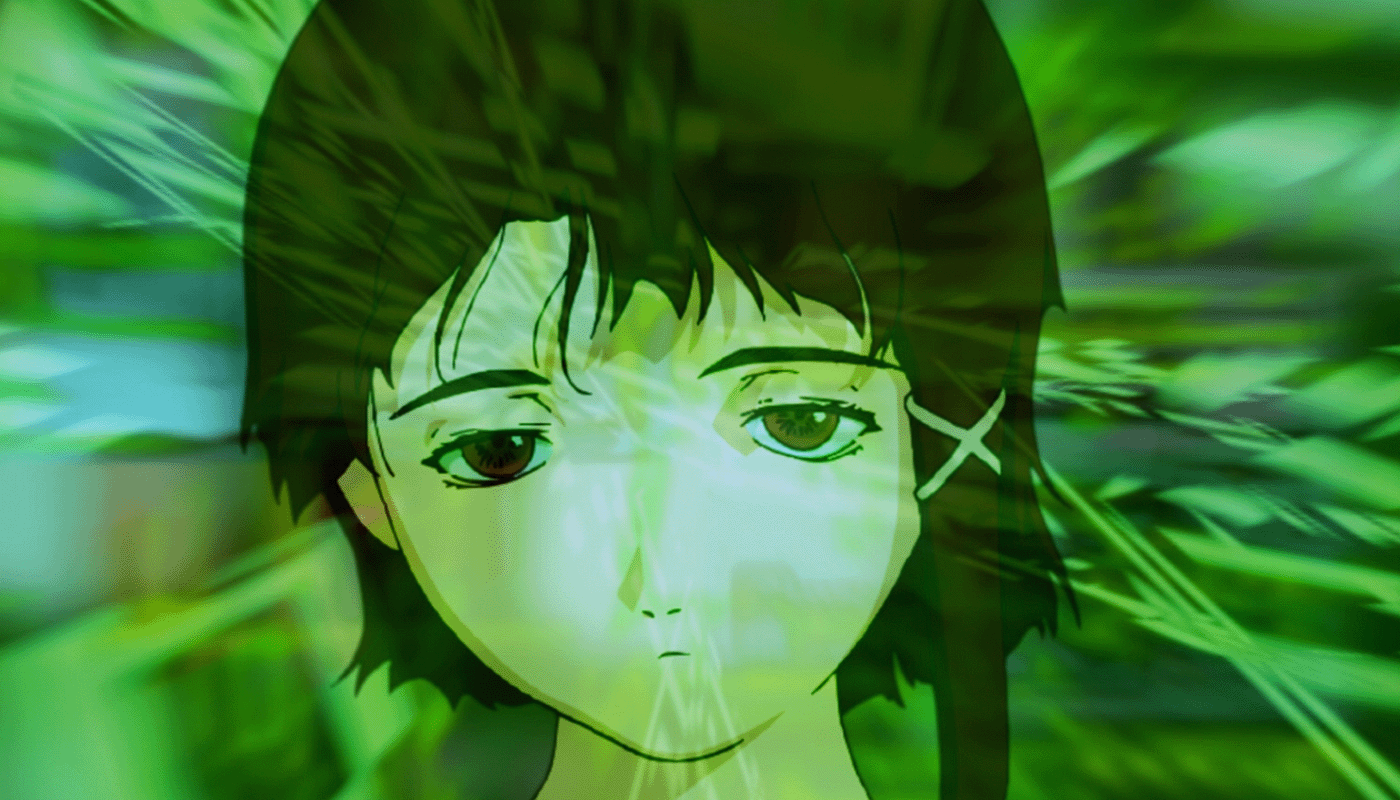
Desensitization, paranoia, loss of human connections… it’s like this show hasn’t aged a bit.
It’s no secret that despite my role as an anime columnist, I am somewhat out of the anime loop these days. I fell behind watching shows as they aired sometime during the pandemic and never quite caught back up. The backlog of current series has only grown more overwhelming.
But here at Reactor, I get to write about whichever anime I want, especially when those anime fall under the umbrella of speculative fiction. I can always turn to the classics, rewatch an old favorite and relish in its legacy. I can wax poetical about Mushishi, make yet another case for Shinji Ikari, talk about noir and Cowboy Bebop, or pay tribute to Satoshi Kon. I am writing for readers like me: aging anime fans overwhelmed by the modern accessibility of a beloved, complicated, sometimes problematic medium. We all know that revisiting a classic can be a comfort, an escape from the ever-increasing cacophony of options as we’re inundated with wave after wave of new shows. Revisiting a classic provides fresh perspective, too, and allows us to reflect on how times have changed or stayed the same.
So, I go online and onto a streaming site and set the subtitle options and press play. Between sniggers, a mocking voice, in English, reads aloud some katakana:
“Present Day. Present Time. Ahahaha!” The voice is lying, but the voice is also never wrong.
A girl’s face appears amid stripes of blue static, morose and pensive. Her name is Lain.
Godammit. This show is going to fuck me up all over again, isn’t it?
The World and the Wired
Readers of this site are accustomed to cerebral techy stories about the ominous junction between humanity and our manufactured worlds. Such stories are arguably old hat, at this point: The Matrix is decades old, and Neuromancer celebrated its 40th anniversary in 2024. Black Mirror aired its infamous pilot fifteen years ago. These works have become tied to the zeitgeist, however, and never quite leave the collective unconscious. We stare at our own black mirrors daily, terms like “red-pilled” have entered the lexicon with nefarious connotations attached, and corporations have certainly embraced using cyberspace for profit, regardless of the consequences.
It isn’t surprising that people romanticize the earlier days of the internet. I was only nine years old when Serial Experiments Lain aired in 1998, the tail-end of a generation that was not raised on computers, but alongside them. I was not online as a kid (at least not until the advent of Neopets). I used the family PC to play Math Blaster! and Oregon Trail, to learn typing via Mavis Beacon. There was still a clear divide, back then, between the online world and the real world. But to hear someone a few years older than me talk about being online in the ’90s is akin to sitting down around a fire and listening to tall tales of yore. The internet was a wild frontier! Unmoderated, creative, deep and precipitous, but well worth exploring! Forums were truly anonymous, and social media did not exist, and finding community felt like an adventure rather than a chore. This sort nostalgia for the Y2K-era (Heisei, here in Japan) is now so prevalent online that teens born in the 2010s long to return to it. They listen to vaporwave and pine for translucent purple game consoles. There’s this persistent notion that the internet was better… before.
I cannot say if this is true, but I can say that people my age similarly glamorized the 1980s. It is all too easy to pine after an era whose hardships we were exempt from, when all that is left is the sepia-tinged photos and footage documenting an old aesthetic. The pixelated grass of decades past is always greener.
Watching Serial Experiments Lain 28 years after it aired might be an antidote to this affliction, and perhaps that’s why I have avoided it. Lain doesn’t waste time viewing tech through rosy glasses—hell, this series is muted blue and green and gray, devoid of rose-tints and reds apart from the laser pointers of surveillance devices that pierce a girl’s bedroom in the night. Lain does not attempt to predict the future, but rather to foreshadow what it could be based on a troubling present. Somewhere in that online frontier of the ’90s, the seeds of unease were already sown.
Paranoia, the degradation of human connections, an inability to distinguish yourself from an online persona—all of these factors play into this cult classic. Rewatching Lain isn’t hard because it’s aged poorly; it’s hard because in many ways, it hasn’t aged a damn bit.
Lain, Alone
Lain is fourteen and lonely, a junior high school student who’s either a total space cadet or else is dissociating from her daily life. She can’t focus during lessons, and it’s clear that she’s the butt of the joke for many of her classmates—aside from one notable exception: a girl named Arisu (like Alice, likely a nod to Wonderland). When everyone in Lain’s class receives an email from a dead girl—Chisa Yomoda, who committed suicide by leaping from a roof in seedy Shibuya—Lain boots up her old childhood computer to see if she’s received one as well. Lain’s computer, called a Navi, is both alien and familiar. It is a blocky red device whose interface relies on audio input, a device that must be spoken to. Its visual output is garbled, hazy, and sometimes, depending on the scene, may be imagined by characters rather than actually tangible. This is a show that blurs all its lines, that refuses to give a straight answer about its intentions, another unseen force beyond a screen. But Chisa is plenty direct when she tells Lain, “I didn’t die. I have only given up my body.”
Oh boy. Same as it ever was. It may or may not be relevant to note that a year and change before Lain aired, the Heaven’s Gate cult committed mass suicide in San Diego, its members believing wholeheartedly that they were not dying, but leaving their earthly vessels for a greater form of being. Two years before that, the Aum Shinrikyo doomsday cult, whose core beliefs included disparagement of material objects and technology, flooded Tokyo trains with sarin gas, leading to the deaths of fourteen people.
Chisa tells Lain that god is in the machine, and it’s awesome: “Come to the Wired as soon as you can!”
Lain is tempted, because Lain is desperate for connection. She is surrounded by looping powerlines and train lines and people, people, people, but no one is connected. On her way to school, her train strikes a man and she sees blood on those cables, and people go about their day as if it did not happen. Her mother seems to resent her and her sister scoffs; their dinners are quiet affairs. Her father comes home late and goes immediately to his office to indulge in the Wired. The imagery of this fixation is reminiscent of Mildred Montag and her room of screens in Fahrenheit 451. The only time he shows an interest in his daughter is when she asks him for a new Navi. “Finally caught the bug, have you?” he asks, with a gleam in his eye. “People connect to each other. That’s how societies function.”
Her father tells Lain this, and then forgets she’s in the room, laughing at something unseen on a monitor.
Again and again, Lain’s pleas for connection go unfulfilled. After Lain and her friends witness a deadly shooting in a nightclub, Arisu is disturbed. “We’re acting like nothing happened!” she cries, in something like disbelief. Her friends tell her not to think about it too much. The man who committed the crime was high on a smart supplement, a nano device called Accela that slowed the pace of the world around him. He was out of his head. He was a stranger. Who cares?
“Everyone is connected,” we hear yet again, but more and more it sounds like a threat. Lain receives her new, top-of-the-line Navi and her father sets it up in a feverish haze. He leaves her to it, and is it any wonder that a girl like Lain falls headfirst into an online world? The Wired welcomes her, and she’s good at navigating it, and the Lain of the Wired is nothing like the meek girl who dozes off in her classes and can’t speak to her mother. In fact, she could be another person entirely.
Folks, thus far I have grazed all of three episodes… This show is a deep mine of introspection, fatalism, and existentialism, a scream from an abyss of our own making. But at its core, it’s a show about a little girl longing to be cared for, lost in the neon and wires and noise of an unfeeling world that people have come to normalize.
Desensitized and overstimulated, Lain struggles to function. And who wouldn’t seek god in the machine, when god can’t be found outside it?
Kids These Days
Lain is a child, but she’s not the youngest child in the anime. At the sketchy nightclub in Shibuya where the shooting takes place, frequent customers include not just junior high kids like Lain and Arisu, but also grade schoolers on their pocket Navis. No one ever questions why kids are in the establishment, or acknowledges that kids should not be in adult spaces. That societal line is blurring, too.
A boy named Taro can still see the divide. When he meets the plain, real-world version of Lain in the club, he asks for a date with her other self—the wild, Wired self. Lain insists she is only herself, and that the online persona in the Wired is an imposter, but Taro seems unconvinced. Kids, it seems, see through to the heart of things, at least when it comes to tech.
This is a mindset that persists in the modern world. Adults consistently bemoan younger generations’ reliance on technology. I am a teacher, and I can attest to the decimated attention spans of adolescents, as well as the general malaise that prevents them from being present in the moment. But can we blame them for doing what Lain does—for seeking connection online when the real world has destroyed their ability to connect in person? There are fewer and fewer third places, and the very devices kids are given in lieu of parental attention are the same ones they are inevitably reprimanded for relying upon. There is no winning for kids these days.
And some of it is fear. Kids are inherently better with tech than adults, especially when they are all but born with tech in their hands. We give children access to machines that alter their brain chemistry and then condemn them when changes in that chemistry make them harder for us to understand. We throw them into a virtual world we do not bother to understand and then sneer at the things they learn to value there.
While dissecting several sinister deaths, Lain discovers a dying old scientist named Hodgeson, a man on his deathbed in reality, but basking in a beautiful sunset in the Wired. “I want to relax here until my body rots in the real world,” he tells her. (That’s right: Serial Experiments Lain invented bedrotting). Hodgeson admits to conducting experiments on children fifteen years prior. He and his colleagues connected hundreds or thousands of children using headgear and wires in order to harvest their collective “psi,” the subconscious awareness possessed by kids that most often manifests as good intuition or mild ESP. That ability to see through to the heart of things is thought to be a valuable commodity.
The kids were sapped dry by his monstrous machine, screaming as their humanity is converted into energy. The children died and Hodgeson destroyed the machine, but he’s worried that someone got ahold of the machine schematics. Lain asks him, again and again, “But what about the kids?” He instead fixates on the fact that someone may have recreated and perfected his machine.
Lain, whichever version of herself she may be, is suffused with rage. She knows that no one cares for kids in her daily life, but to see it in the Wired as well is galling. But where can anyone put that amount of rage? A body is surely too small for it. And maybe the real world is, too.
Adults sneer at children’s coping mechanisms because they fear what they do not understand. Parents look at their children through the lens of one reality, and online, as in the Wired, those children may be entirely different people. Rather than seeking to connect with all their identities, it’s easier to pretend those alternate selves do not exist. How many parents, when confronted with the crimes their children commit after detailing their plans online communications, claim that their children were simply not capable of such things? They themselves are incapable of seeing their children as three-dimensional beings even as those children are handed iPads that allow them to be four-dimensional, and to be commodities, and to be alienated from each other. It’s a conundrum that I do not know how to solve.
Lain cannot solve it, either. Her rage has nowhere to go, unless it goes into the Wired.
The Haze
Serial Experiments Lain is such a layered, nuanced head trip of a series, and even if I spoiled half of it, I wouldn’t even have brushed up against the rest. It is a show that must be digested when one is in the mood for a headache. It is deliberately slow, muted, plodding, and bleak. This is a series that’s devoid of comedy and most color, a show that does not maintain a positive perspective on humanity. It throws neurological and metaphysical concepts at its audience in a dizzying slurry, referencing Vannevar Bush and John C. Lilly and Ted Nelson alongside the Roswell incident. It gives no straight answers and its obtuse approach to storytelling can be wearing.
But this is also the genius of Lain—it traps its audience in connections that don’t get made, and continually dogs us with potential explanations for what is happening without committing to a single answer. It is intentionally dense and at times incomprehensible, designed to make us feel some inkling of the overwhelm impacting Lain herself.
At first, Lain’s bedroom is a simple space. A single bed and a desk. A line of plushies on the windowsill, gazing inward at her. She sleeps in a teddy-bear kigurumi despite having outgrown it. She is alone in her private asylum.
Later, her room is a swamp of cables and bubbling coolant, tubes full of green liquid and Frankenstein-ed processors that block out the sun. At one point an explosion creates a hole in the wall through which the Navi’s cables hang like sopping vines, and no one interrupts her descent into the cavern of the Wired. Every time someone steps into her room, we hear the damp squelch of the carpet. This is no way for a child to live.
But is Lain a child? Is she even a person? Does it make a difference, either way?
Lain herself, struggling time and again to find agency, can only protest, “I am me. I am me.”
But she believes it less and less. And whether you take the show as literal or allegorical or metaphysical or avant-garde, the pain of her plea remains. No matter how many voices in the machine—some claiming to be god, others pretending to be dead children or the freakin’ Knights Templar—tell her, “You no longer need a body, Lain,” she defies them: “You’re wrong.”
She resists the idea that a vessel is meaningless. She refuses to believe that the tangible world matters less than the Wired. For all the connections she has made in the Wired, Lain has never felt anchored to any one of them. Other people therein appear as headless entities or disembodied mouths. They never feel real. Lain has only one true friend, and it’s Arisu, a girl who exists in reality.
The show is not preachy about Arisu, however. It is not the simple human warmth of Arisu’s hand on her neck that grounds Lain. It isn’t even the pounding of her friend’s heart, when Arisu braves the wreckage and rot of Lain’s family home to pull her friend from the wires drowning her on the bed. What grounds Lain and grants her empathy is Arisu’s confession: not of love, but of fear.
“Why is your heart beating like that?” Lain asks.
“I’m scared. I’m happy, but I’m scared. I’ve always been scared. I wonder why.”
Legendary character designer Yoshitoshi Abe is incapable of drawing anyone who doesn’t look permanently frightened, their eyes far apart and their irises lined with scratches. But Arisu is touching upon the most human feeling of all. Can fear exist without a body? And without fear, are we human?
My Head Hurts
Look. Serial Experiments Lain is cerebral as hell. It is cleverer than I am, more cryptic than heavy-handed, and it trusts its viewers to choose which conclusions to draw. In a sense, “enjoying” this anime is a herculean task. It’s a lot to think and worry about. Its author, Chiaki J. Konaka, a fan of the Cthulhu Mythos and The Exorcist, is acclaimed for writing stories that subvert and undermine reality. Even so, Lain is more than the sum of its parts. It has long since transcended the container of its brief 13 episodes and all too often, its most terrifying elements are mirrored in our daily lives. I can’t recommend watching Lain without knowing what you’re in for. And yet, I can’t even fully express what you’re in for. Decades after it aired, it is no less prescient than ever it was. Even the vaporwave sheen and its timeless, grungy aesthetic don’t really soften the blow of experiencing it.
Present Day. Present Time. Ahahaha.
A girl is lost in the static, her head lolling on her shoulders. Years before creepypasta or the Dark Web, when most cyber-related fears fixated on eerie chain emails and Rotten.com and an impending apocalypse hinged on a ball dropping at midnight at the end of 1999, an animated girl loses her body, but retains her mind. She never existed, or she always existed, and fears that no one will ever connect with her. For was a thing ever even real if no one remembers it? And can we learn anything from what we have forgotten?
Good thing, then, that this series and the girl at its core are unforgettable.
Leah Thomas
Leah Thomas is the author of several YA novels, including the Morris Award finalist Because You’ll Never Meet Me and the Edgar Award finalist Wild and Crooked . She currently lives and works in Tottori, Japan, surrounded by cats, students, and youkai.
Learn More About Leah
animeAnime SpotlightnostalgiaSerial Experiments Lain
