

Posted in: Comics, Heritage Sponsored | Tagged: ben thompson, Dick Briefer, Jack Binder, prize comics
Radio City Under Attack in Prize Comics #22, at Auction
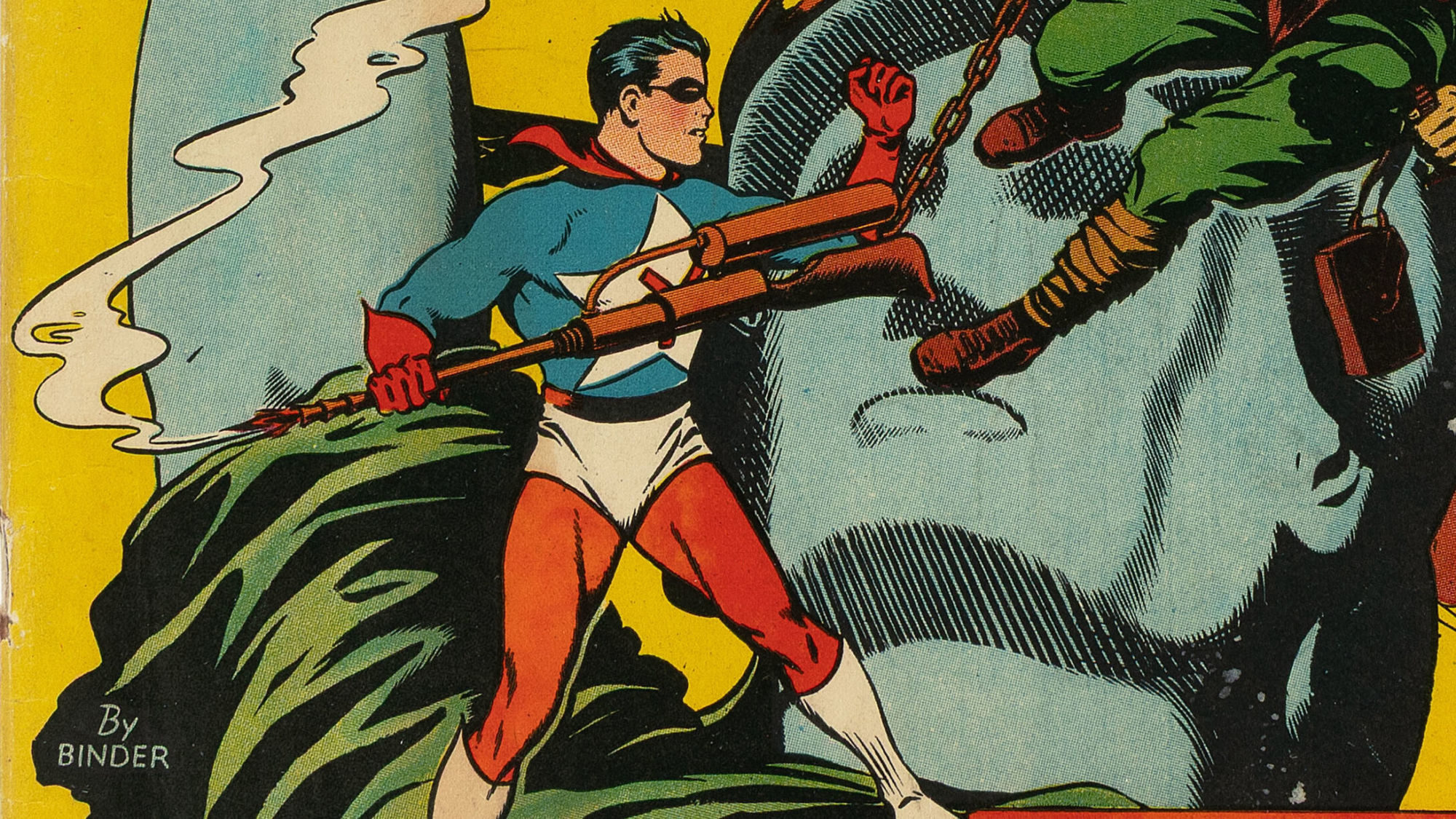
Jack Binder’s Prize Comics #22 Black Owl story centers around disrupting radio and then-emerging television broadcasts as an aspect of war.
The Black Owl story inPrize Comics #22 centers around a Japanese agent attacking American morale from inside a vast New York broadcasting complex called Radio Center. It is described as a “gigantic pile of buildings” and “a city in itself,” with radio studios, control rooms, an experimental television operation, and hundreds of families watching at home. Of course, that sounds a lot like NBC’s Radio City at Rockefeller Center. NBC had moved into the RCA Building in 1933, converting Studio 3H for experimental television soon afterward. By July 1941, New York station WNBT had received the country’s first commercial television license. The Black Owl saga here turns this historic center of American broadcasting into a wartime target less than a year later.
Radio City at War
“The Black Owl Outwits the Fox” drawn by Jack Binder begins during a popular radio broadcast. Guns concealed inside microphones kill performers while the Fox moves through the complex, threatening men who have pasts that make them vulnerable to blackmail. As is eventually made clear, he is a Japanese agent trying to disrupt programs that build American morale. The story’s last act then shifts into television. Black Owl chases the Fox through the studio while the fight is broadcast live to “hundreds of homes.” This early in the television era, that audience was plausible. According to one 1941 3,225 television sets were already in homes in the New York City. Commercial broadcasts had begun that July, although wartime restrictions had halted civilian tv set production shortly before this issue hit newsstands.
Interestingly, the broadcast technology was also central to the Power Nelson story in this issue. In “The Adventure With the Loop!,” a radio broadcaster is forced to keep his 10 p.m. program on the air during an attack on New York so enemy bombers can follow the station’s signal and come in “on the beam.” This idea was based on technology in use at the time. German bombers had already used directional systems such as Knickebein radio beams over Britain. American regulators were also treating broadcasting as wartime infrastructure. The FCC’s wartime history notes the creation of an Interceptor Section in 1942, cooperation between broadcasters and the Army to silence stations during possible attacks, and other measures intended to keep coastal transmissions from giving bearings to enemy aircraft. Binder’s cover seems to represent these two stories, with its obvious symbolism of an aerial attack of New York.
The issue also carries the propaganda war overseas in “Ted O’Neil of the R.A.F.” Nazis kidnap Saki, son of the Great Aga, and blame Britain in hopes of driving Turkey toward Hitler. Their orders are to specifically target Muslim opinion. In another feature, Spike Mason arrives at an Australian port aboard the S.S. Malibu, which is carrying Allied munitions under threat by Japanese agents. By the time of this issue’s May 13, 1942 on-sale date, Japan had bombed Darwin and attacked shipping in its harbor. The Battle of the Coral Sea had taken place on May 7 and 8, preventing an operation intended to cut communications between Australia and the United States.
Dick Briefer provides one of the highlights of the issue, with a Frankenstein story in which Doctor Devil grants the monster three wishes and tries to turn him against Bulldog Denny. The feature had begun in Prize Comics #7 as violent horror-adventure and would keep changing through wartime drama, comedy, and eventually a return to horror. This 1942 chapter catches Briefer still treating the monster as a dangerous but manipulable force rather than the comedy figure he would later become.
Ben Thompson draws the Doctor Frost story, in which a stolen ray makes criminals invisible for bank robberies. Prize was one of Thompson’s largest concentrated bodies of work, with Dr. Frost bringing occult and fantastic threats into compact adventure plots. Per copyright records, this issue went on sale May 13, 1942. Notably, Thompson enlisted in the Army three days after that date.
Prize Comics #22 turns radio, experimental television, propaganda, civil defense, and Pacific supply lines into an unusually coherent picture of America learning that modern communications were part of the battlefield. For bidders interested in a scarce wartime anthology that places superheroes inside the history of 1942, there’s a Prize Comics #22 (Prize, 1942) CGC Qualified VG+ 4.5 Off-white pages up for auction at the 2026 August 13 Golden Age Century Comics Showcase Auction V #40377.
Enjoyed this? Please share on social media!

Stay up-to-date and support the site by following Bleeding Cool on Google News today!
