

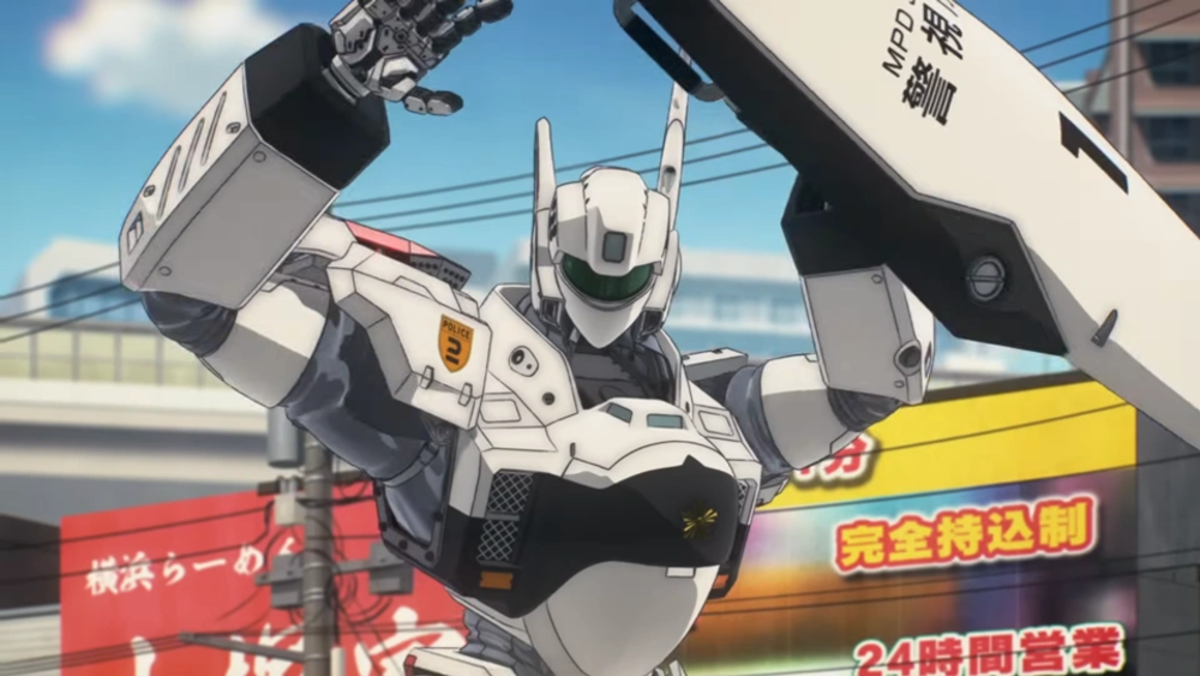
Masami Yūki — the manga artist who drew the 22-volume Patlabor franchise from 1988 to 1994 — <a href="https://www.animenewsnetwork.com/news/2026-08-02/masami-yuki-draws-2nd-new-patlabor-1-shot-manga/.240061″ rel=”nofollow noopener” target=”_blank”>announced a second one-shot story in Shogakukan’s Weekly Big Comic Spirits, set for August 17, following the first new Patlabor manga in 32 years, which appeared in May. The announcement, which came alongside a joint interview with producer Nobuyuki Sakuma and a collaborative manga with Snowball Earth creator Yuhiro Tsujitsugu, lands just days before Patlabor EZY File 2 opens in Japanese theaters on August 14. The timing is worth a closer look — not because another piece of franchise content is arriving, but because the specific problem Patlabor dramatized in 1988 is, in 2026, one of the most actively contested questions in robotics research: when you build a machine powerful enough to do a dangerous job, why is the human inside it still the thing most likely to fail?
Yuki Broke a 32-Year Silence: What He Said When He Did
Masami Yūki’s return to Patlabor manga did not begin in triumphant confidence. At a stage event celebrating EZY’s May premiere, he told the audience he had worried during pre-production that he might not be able to return to the franchise at all. According to Oricon News, Yūki said: “I wondered if I couldn’t make it anymore.” When asked why he lacked confidence, he laughed and replied: “It’s Patlabor after 30 years. Of course I’m not confident!” He added that he hoped the manga could serve as a kind of catalog showing what kinds of stories he can still tell within the universe — an unusually modest framing for the return of a franchise that won the 36th Shogakukan Manga Award in 1991.
The first one-shot, titled “Mobile Police Patlabor 2026” and published May 18, opened with explicit acknowledgment of the franchise’s unusual temporal position. The original manga was set in what was then the near future — late 1990s through early 2000s Tokyo — and the official 2026 Project website stated plainly: “Back when the series was serialized from 1988 to 1994, the story took place in near future Tokyo between 1998 and 2002. Now, in 2026, reality has finally caught up with the world the series once imagined.” The second one-shot, which will publish August 17, is designed in part to accompany EZY File 2, and the same issue contains a collaborative manga between Yūki and Tsujitsugu — a pairing that stages a generational dialogue between two distinct visions of human-machine relationships in Japanese comics.
What Patlabor Got Wrong About 2026
The franchise’s imagined future has not arrived as advertised. In 1988, HEADGEAR — the five-person collective of Yūki, director Mamoru Oshii, screenwriter Kazunori Itō, mecha designer Yutaka Izubuchi, and character designer Akemi Takada — envisioned a late-1990s Tokyo where eight-to-ten-meter-tall bipedal construction robots called Labors had become standard industrial equipment. In 2026, no such machines exist and none are expected. The reason is not a failure of engineering ambition but a failure of materials physics: the square-cube law, a structural scaling principle first described by Galileo in 1638.
First described by Galileo Galilei in 1638 in Two New Sciences, the square-cube law states that as a shape grows in size, its volume — and therefore its mass — increases as the cube of its linear dimensions, while its surface area and structural strength increase only as the square. For a bipedal robot scaled to Labor dimensions, this means the ankle and knee joints must bear loads that approach or exceed the yield strength of available high-strength steel alloys during normal walking. The largest commercially deployed bipedal humanoid robot as of 2026 — the Boston Dynamics Atlas production version unveiled at CES — stands roughly 1.9 meters (6.2 feet) tall, weighs approximately 89 to 90 kilograms (196 to 198 lbs), can lift up to 50 kilograms (110 lbs), and runs on a four-hour battery before hot-swapping. That robot is not available for public purchase — its 2026 production run is committed to Hyundai Motor Group’s manufacturing facilities and Google DeepMind’s research fleet — and represents the state of the possible after decades of research. A six-tonne, eight-meter Labor is, with current materials, not a deferred goal — it is a physics problem that has no practical solution at present.
What exists instead is exactly what Patlabor EZY depicts in its 2030s setting: smaller, increasingly autonomous robots displacing human operators from tasks once considered labor-intensive. The aesthetic gap between HEADGEAR’s giant mecha and the real-world Atlas matters less than the structural parallel: the franchise correctly predicted that automation would displace workers, that the sectors affected would be construction, logistics, and manufacturing, and that society would need new institutional frameworks to manage the consequences.
What Patlabor Got Right
The more interesting prediction is the one the franchise barely presents as a prediction at all. Throughout both the manga and the Oshii films, the story’s most consistent preoccupation is not the Labors themselves but the human beings inside them. SV-2’s Ingrams malfunction because maintenance is delayed by bureaucratic procurement processes. Officers make judgment errors when fatigued. The enemy in the first film is not a rogue robot but a software exploit — the HOS program in Patlabor: The Movie — that targets a cognitive vulnerability in the operators who rely on automated systems. The enemy in the second film is not a weapons platform but the institutional complacency of people who had grown to rely on systems they had stopped understanding.
In research terminology, this is the human-in-the-loop problem, and it is one of the most active areas of inquiry in human-robot interaction today. Human-robot interaction, or HRI, is the interdisciplinary study of interaction dynamics between humans and robots — encompassing cognitive workload, task authority, and situational awareness. Research consistently shows that in remotely operated or semi-autonomous systems — military unmanned ground vehicles, surgical robots, nuclear cleanup drones — operator cognitive load, situational awareness degradation, and communication latency are the primary sources of mission failure, more than mechanical failure. Managing that cognitive load is, in 2026, still an open engineering problem.
HEADGEAR dramatized all of this in 1988 — fifteen years before Henry Jenkins named transmedia storytelling in his 2006 book Convergence Culture and the same number of years before HRI established itself as a formal academic conference discipline (the ACM/IEEE Annual HRI Conference was founded in 2006). What Yūki’s manga supplied — and what the Oshii films amplified into something philosophically dense — was a sustained, procedurally detailed account of what it costs a human being to be the operator of a system that is both more capable and less morally accountable than they are.
Patlabor EZY’s premise — that the new SV-2 must prove its continued relevance against autonomous systems that do not need operators at all — is not a nostalgic update of that question. It is the most current version of it. In defense and industrial robotics research, human-in-the-loop removal trade-offs — when to remove the operator and what is lost when you do — remain actively contested. EZY is arriving at exactly the moment when the engineering community has no settled answer.
Japan’s Labor Shortage Is EZY’s Real-World Engine
The other dimension of Patlabor EZY’s premise that has stopped being speculative is the demographic one. The anime is set in a 2030s Japan where AI-driven automation has become widespread partly because the country is running out of workers. In real-world 2026, this is not a scenario — it is a structural condition.
Japan’s working-age population (ages 15 to 64) peaked in 1995 and has declined continuously since. Japan’s Ministry of Health, Labour and Welfare projected the working-age population would fall to 60.82 million in 2025 (down from 65.3 million in 2017) and to 52.45 million by 2040 — a roughly 20 percent decline over that span. As of the second quarter of 2025, the Bank of Japan’s Tankan survey reported a diffusion index for employment conditions of -35 across all industries, described by the OECD as one of the lowest points in three decades. The Recruit Works Institute, in a 2023 forecast, described the coming situation not as a temporary shortage but as a “limited labor-supply society” — a structural deficit in the labor force needed to maintain essential services.
The sectors that would be most affected, the Recruit Works Institute found, include transportation, construction, manufacturing, and caregiving. Those are, with minor variation, exactly the industries Patlabor imagined being transformed by Labor deployment. The franchise’s economy of robot-assisted construction in Tokyo Bay was a specific extrapolation from observed 1980s industrialization trends; EZY’s economy of autonomous systems replacing aging piloted machines is a specific extrapolation from observed 2020s demographic trends. HEADGEAR was not prophetic about the form automation would take. They were structurally correct about why it would happen.
How HEADGEAR Built a World Before the Theory Existed
The production structure of Patlabor is itself an object worth examining in 2026. HEADGEAR was formed around 1987 by a producer’s request to formalize a creative collective for copyright management purposes, according to research by Animétudes. The group assigned medium-specific creative mandates from the start: Yūki’s manga would supply the franchise’s warmth, slice-of-life character detail, and procedural grounding; Oshii’s films would carry the philosophical and political weight; the OVA and TV series, produced with other studios, would provide character-episodic development. Each medium was a distinct creative contribution to a shared world, not a repackaging of the same story.
Henry Jenkins, whose 2006 book Convergence Culture named and theorized transmedia storytelling, defined it as a story that “unfolds across multiple media platforms, with each new text making a distinctive and valuable contribution to the whole.” By that definition, HEADGEAR had been doing transmedia storytelling for 18 years before Jenkins named it. What makes that history relevant in August 2026 is the crossover manga in the same Weekly Big Comic Spirits issue as the second one-shot: Yūki collaborating with Snowball Earth creator Yuhiro Tsujitsugu. Patlabor’s mecha are tools — industrial machines that carry human operators; Snowball Earth’s Yukio is an autonomous robot that refused a self-destruct order on grounds of self-preservation. The crossover manga stages, in Shogakukan’s pages, the exact handoff question that EZY dramatizes in theaters: what is the human operator’s role when the machine has developed its own claim on existence?
The Snowball Earth hypothesis itself — after which Tsujitsugu’s manga is titled — describes a geological scenario in which ice-albedo feedback locks the planet into full glaciation from pole to equator, with escape eventually driven by volcanic carbon dioxide accumulation. The geobiologist Joseph Kirschvink named it in 1992; Paul Hoffman and Daniel Schrag’s landmark 1998 paper in Science populated the hypothesis with field evidence from Namibia and Australia. The thematic resonance with Patlabor is cleaner than coincidence: both deal with systems locked into apparently terminal states that nonetheless find pathways to persistence.
EZY File 2 and the Week That Validates All of This
Patlabor EZY File 2 will open in Japanese theaters on August 14, presenting episodes four through six of the eight-episode series in omnibus anthology format. File 1 opened May 15 and opened at #8 nationally in its opening week at the Japanese box office. File 2’s three episode titles for File 2 — translated from Japanese as “Wine and Bullets,” “A Shallow Dream,” and “Love Survival” — suggest the anthology’s continued emphasis on character-driven procedural stories rather than a continuous narrative; the two-part conclusion in File 3, scheduled for March 2027, will carry the sustained storyline. The series is directed by Yutaka Izubuchi, scored by Kenji Kawai, and features the opening theme “Reimei Compass” by virtual YouTuber Mori Calliope — a combination that keeps one foot in the franchise’s founding personnel and one foot in 2026 cultural context.
The second Yūki one-shot will follow three days after EZY File 2 opens. The issue containing it also includes the joint interview between Yūki and producer Sakuma, the Yūki-Tsujitsugu crossover manga and sticker bonus — a dense concentration of Patlabor material in a single week that makes the questions the franchise raises harder to ignore than usual.
For readers who want to join the conversation before August 17: the first one-shot, the first EZY film (File 1), and the full original manga and film series are all currently accessible through Maiden Japan’s North American licenses and streaming services. Viz Media’s two-volume English-language release, published in 1998, represents the only officially localized English edition of the manga — which is to say, most of it has not been officially translated.
Frequently Asked Questions
What is Masami Yūki’s second Patlabor one-shot, and when does it come out?
Masami Yūki, the manga artist who created the 22-volume Mobile Police Patlabor manga (1988–1994), will publish a second new standalone one-shot story in Shogakukan’s Weekly Big Comic Spirits on August 17, 2026. The announcement came in the magazine‘s combined 36th/37th issue, published August 2. It is the second new Patlabor manga Yūki has published in 2026, following a first one-shot in May — the first new Patlabor manga in 32 years. Both one-shots are set in the franchise’s original continuity and were developed alongside the Patlabor EZY anime film series. Anime News Network confirmed the August 17 publication date and the combined issue’s full contents on August 2, 2026.
What is the human-operator bottleneck in robotics, and why does Patlabor matter to it?
The human-operator bottleneck refers to the finding, well-documented in human-robot interaction (HRI) research, that in systems where a human controls or supervises a robot, the primary source of mission failure is not mechanical breakdown but the cognitive limits of the operator: fatigue, attention degradation, latency, and the difficulty of maintaining situational awareness across a complex, fast-moving system. The Springer Nature HRI encyclopedia defines HRI as the interdisciplinary study of interaction dynamics between humans and robots, and research consistently confirms operator cognitive load as the central challenge in direct-control and semi-autonomous systems. Patlabor’s narrative, across both Yūki’s manga and the Oshii films, repeatedly made this the central dramatic tension of its stories — the Ingrams fail because their pilots are human, not because the machines are deficient. HRI did not become a formal academic discipline with its own conference until 2006. HEADGEAR was dramatizing the field’s core question in 1988.
Why is Japan’s labor shortage relevant to an anime about giant robots?
Patlabor EZY, the new 2026 anime film series, is explicitly set in a 2030s Japan where a severe labor shortage has accelerated the adoption of autonomous AI-driven automation — and where the piloted Labors that SV-2 operate are increasingly seen as legacy hardware being displaced by machines that don’t require human operators. That scenario is not speculative: Japan’s working-age population has been in decline since 1995, the OECD Employment Outlook 2025 described its employment conditions as showing one of the lowest diffusion index values in three decades as of Q2 2025, and independent forecasters project a roughly 20 percent decline in Japan’s available workforce by 2040. The EZY anime’s dramatic stakes — whether human-operated robots remain relevant when autonomous ones exist — mirror the real policy debates Japanese industry is currently having.
What is the Snowball Earth hypothesis, and what does it have to do with Patlabor?
The Snowball Earth hypothesis, named by geobiologist Joseph Kirschvink in 1992 and supported by Paul Hoffman and Daniel Schrag’s landmark 1998 Science paper, proposes that Earth experienced at least two periods during the Cryogenian era (roughly 720–635 million years ago) when the oceans were almost entirely frozen from pole to equator, driven by an ice-albedo feedback loop. The escape mechanism was volcanic CO₂ accumulation — the very process that normally regulates climate was halted by the ice, allowing carbon dioxide to build to levels that eventually shattered the freeze. Yuhiro Tsujitsugu’s manga Snowball Earth takes the hypothesis as the premise for a post-glaciation survival story featuring an autonomous robot. The collaborative manga with Masami Yūki appearing in the August 17 issue of Weekly Big Comic Spirits stages a meeting between Patlabor’s “mecha as civil infrastructure” philosophy and Snowball Earth’s “AI as moral agent” premise — a generational conversation about what robotic machines owe the humans who built them, running in exactly the week that question is most pressingly alive in the real world.
ⓒ 2026 TECHTIMES.com All rights reserved. Do not reproduce without permission.
