

TL;DR: Retail GeForce RTX 5090 gaming cards are being bought in bulk for AI servers, driving US prices above $5,000 and European prices past €5,200. Companies prefer cheaper RTX 5090s over $16,000 RTX PRO 6000 workstations, pushing high-end consumer GPUs out of reach for gamers.
Voice: Hassam NasirSpeed
0:00 / 3:37
Use left and right arrow keys to seek audio.
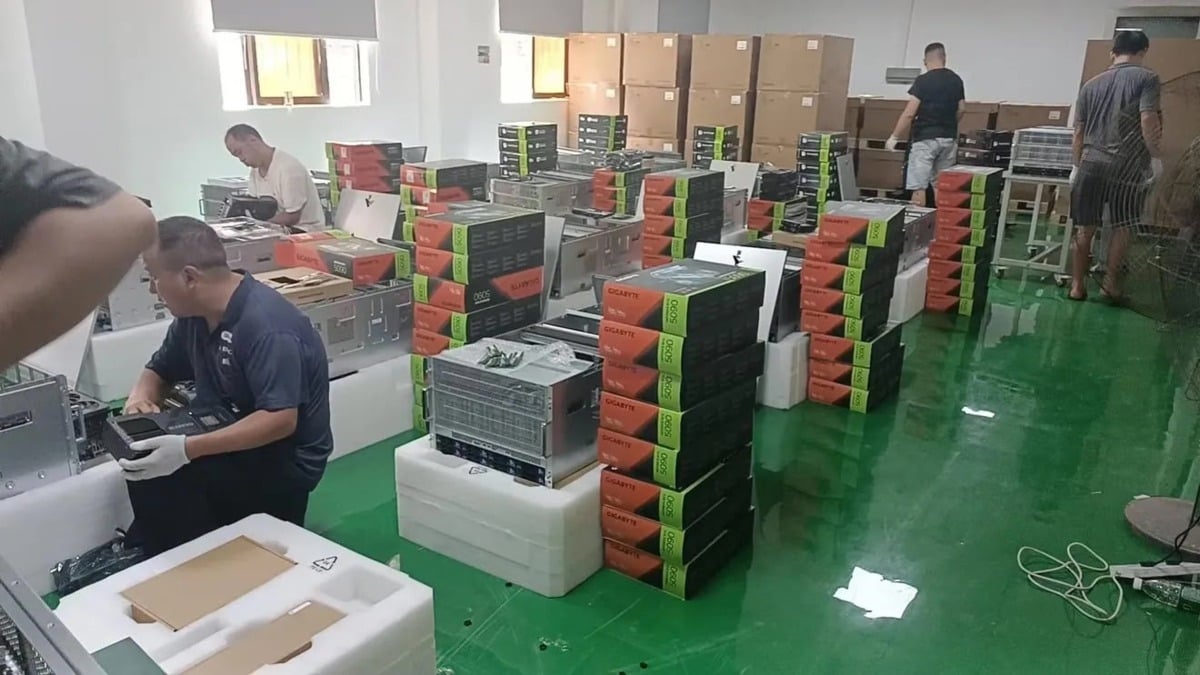
Photos shared by HKEPC on X show pallets of brand-new retail GeForce RTX 5090 cards being unpacked and slotted into multi-GPU AI servers. These aren’t NVIDIA’s workstation RTX PRO 6000 cards built for AI servers, but rather the same MSI and GIGABYTE RTX 5090 cards you’d find on Newegg under the “gaming graphics card” category, that is, if you could find them at anything resembling a reasonable price.
The cheapest RTX 5090 listings in the US have crossed $5,000, more than double the $1,999 launch price. European pricing has already cleared €5,200, and now we have a clearer picture of what’s behind these skyrocketing prices.
Interestingly, the cards in these pictures aren’t even the RTX 5090 D, the China-specific variant, which was deliberately nerfed for AI workloads at 2,375 AI TOPS compared to the standard model’s 3,352, while keeping gaming performance largely intact.
- Read more: 7 x GeForce RTX 5090s power custom AI servers in Vietnam: 28 x 8-pin power cables, 4000W power
- Read more: RTX 5090 prices in Europe have blown past €5,000, more than double the MSRP
- Read more: NVIDIA’s monster RTX PRO 6000 workstation GPU with 96GB GDDR7 drops to $7999, down from $10K
Back in 2021, when miners swept up RTX 30-series cards, NVIDIA responded with Lite Hash Rate versions that cut mining performance while leaving gaming performance intact. The restriction was eventually bypassed, but it worked well enough for long enough to matter. This time, NVIDIA has not done the equivalent.
NVIDIA is no longer primarily a gaming company. The word “gaming” appears third in the metadata of NVIDIA’s own homepage, behind AI and HPC. CEO Jensen Huang recently joined X and shared a letter from NVIDIA and 24 other companies urging US policymakers not to restrict open-weight AI.
Some elements of the HKEPC photos appear to have been edited or altered, so treat the images with some caution. We covered a Vietnamese system builder installing seven RTX 5090s into custom AI servers back in April 2025. While $5,000 prices might make it impossible for even premium rig builders to invest, it seems to work just fine for the ravenous AI scene, largely because the RTX 5090 is a bargain compared with an AI workstation GPU.
NVIDIA wants $16,000 for an RTX PRO 6000, and while that card packs 96GB of VRAM, many companies scrambling to build servers can make do with far less. Some companies might look to the newly debuted RTX PRO 5500 Blackwell workstation GPU with its GDDR7 memory, but it ultimately comes down to whether it can beat that $5,000 mark, which doesn’t seem likely.
Why are RTX 5090 cards being used in AI servers instead of NVIDIA’s RTX PRO 6000 cards?
RTX 5090 cards are ending up in AI servers because they are much cheaper than NVIDIA’s RTX PRO 6000 cards, even at the inflated market prices. The piece says an RTX PRO 6000 costs $16,000 and has 96GB of VRAM, while many companies building servers can make do with far less memory, so the RTX 5090 is still seen as a bargain for that use. It also notes that NVIDIA has not added an RTX 30 series style limiter for this generation, so the consumer card can be put to work in AI deployments.
Question #2
What makes the RTX 5090 attractive for AI workloads despite being a gaming GPU?
It offers strong AI capability in a consumer card, with the standard RTX 5090 listed at 3,352 AI TOPS, and it is not the nerfed China-specific RTX 5090 D. It is also far cheaper than NVIDIA’s RTX PRO 6000, which the piece says costs $16,000, so companies building AI servers can use the 5090 as a bargain option even with much less VRAM.
Question #3
How does the RTX 5090 compare with the China-specific RTX 5090 D for AI use?
The standard RTX 5090 is the one showing up in bulk in AI servers in this story, and it is described as a bargain for AI use compared with workstation GPUs. The China-specific RTX 5090 D is explicitly different because it was deliberately reduced for AI workloads, at 2,375 AI TOPS versus 3,352 for the standard model, while keeping gaming performance largely intact. Separate coverage in NVIDIA’s new GeForce RTX 5090D for China has restricted AI, crypto-mining performance says that China-tuned card is intended to stop AI use and cryptomining.
Question #4
Did NVIDIA do anything this generation to limit the RTX 5090 from being used for AI like it did with Lite Hash Rate cards?
NVIDIA did not do the same kind of broad consumer restriction for the RTX 5090 that it did with Lite Hash Rate cards. This story says there is no RTX 5090 equivalent of those mining-limited models, though the China-only RTX 5090D was deliberately nerfed for AI workloads while keeping gaming performance largely intact.
Have a question that isn’t listed here? Ask below, and TweakBot will answer it.
That said, the RTX 5080 is not safe either. Plenty of AI deployments will happily make do with 16GB of VRAM, which effectively pushes the realistic ceiling for consumer GPU buyers down to the RTX 5070 Ti and below. You’re still looking at over $1,000 for those on current market listings. The top end of consumer GPU gaming has been quietly cordoned off, and nothing on the horizon suggests that changes anytime soon.
