

Myths are the stories we tell ourselves. They help us to make sense of our world. They’re the ideological scaffold on which we build the narrative of our lives.
Robert Anton Wilson said: “Humans live through their myths and only endure their realities.” (The Widow’s Son: The Historical Illuminatus Chronicles, Vol 2.)
There are different kinds of myth: personal, national and world myths. All humans—unless they’re brought up in complete isolation—are subject to a combination of these three mythic forms.
The word is from the Greek, mythos, meaning word, speech, tale or story. It referred to the legendary tales the Greeks told themselves, about their origins and their place in the world. Every nation has its mythos. For the British, the story of King Arthur is central to our sense of identity.
In the Middle Ages, the Arthurian corpus had a name. It was called The Matter of Britain. The stories were hugely popular, not only in Britain, but across Europe. The stories were told and retold in a number of different languages, from Latin, to Norman French, to High German, to Middle English, and by a variety of authors: Geoffrey of Monmouth, Chrétien de Troyes, Wolfram von Eschenbach and Sir Thomas Mallory, to name just a few.
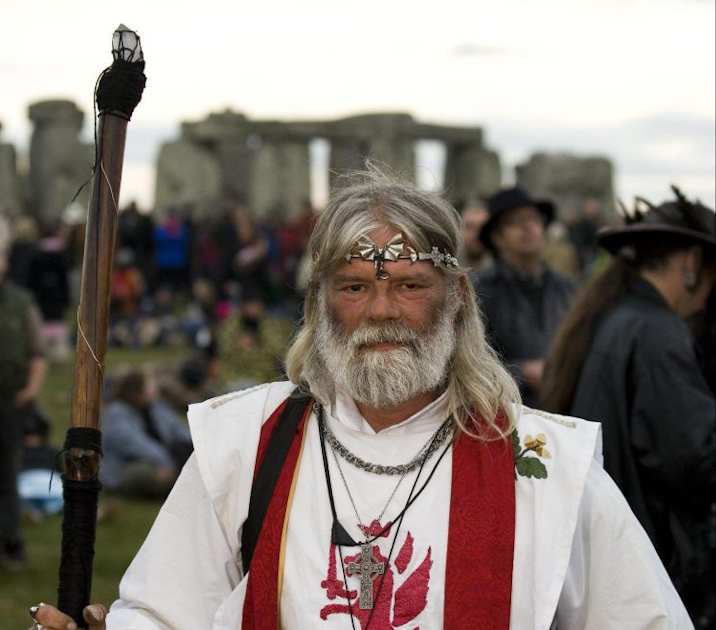
Add two new names to that list: Arthur Pendragon and CJ Stone. On July 23 2026, Maybe Day, Hilaritas Press will publish a new version of the story. Called The Trials of Arthur: The Biker Who Would Be King, it’s the tale of a British biker who, on one crazed night of intense speculation with a friend, in June 1986, decided he was the reincarnation of the mythical King. “John the Hat,” president of an outlaw biker gang based in Hampshire, England, changed his name to “Arthur Uther Pendragon” and has been living the role ever since.
Maybe Day was called by Emily Reilly, the Mayor of Santa Cruz, California, on July 23 2003 in celebration of the life and work of the great mystic-sceptic, Robert Anton Wilson. It’s the perfect day for the release of this book. It’s a “Maybe Book,” meaning that the authors make no attempt to convince the readers of their case. Instead there’s a series of maybes. Maybe Arthur is a title and, by adopting it as a name, our own Arthur has taken on the mantle to fulfil the role. Or maybe Arthur’s a spirit, the personification of the land of Britain, who’s inhabiting the body of our current biker-king. Or maybe Arthur’s a lunatic, meaning influenced by the moon: an idea he’s happy to accept, having followed the full-moon cycle all his adult life. Or maybe it’s magic, and by invoking the name, Arthur has brought it into reality. Or maybe it’s all just a fantasy, the product of an overheated brain. But then, we ask, what’s wrong with that? It’s fantasy that adds color to our lives and by living out a fantasy, aren’t we making it real?
Because this is one of the lessons of this book. As children we were all the heroes of our own fantastical adventure tale. It takes growing up to be made to “face reality” as the saying goes: meaning that we’re forced into the roles that late-stage capitalism has defined for us, as cogs in the wheels of commerce, as factotums in the machinery of production, making money for other people. What Arthur did, on that fateful day in 1986, was to throw off the persona of a working-class biker, destined to a life of purposeless rebellion (or an early death) and to take on the role of a mythical King, and by doing that, to remake his life, to raise himself to another level. No longer purposeless: purposeful. No longer playing a role given to him by other people: creating a new role, all his own.
Don’t we all wish we had that opportunity, to rip up the script and to start again? To make ourselves in our own image, rather than the one that’s imposed upon us by some impersonal outside force?
Not that Arthur was making it up entirely. He was working from an archetype: that of the outlaw biker. That was the image he started with: bikers as warriors on their iron steeds. He simply adapted it to fit in with a chivalric ideal, fighting for Truth, Honor and Justice. And having taken on the mantle of a mythical symbol of British identity, he was inevitably drawn to conducting his battles on the national rather than the tribal scale.
The Trials of Arthur is exactly that. It’s a series of trials-by-combat, starting with the battle to access Stonehenge which, from 1985 to 1999, was subject to an exclusion zone over the summer solstice period: meaning that the British government employed police officers to stop members of the public from accessing it. The story of how that came about is told in the book.
Also, around the same time, in the mid-to-late 1990s, there was a massive road-building program taking place throughout the British Isles. This created a backlash as people rose up spontaneously to defend the sacredness of the landscape. As a Pagan, Arthur identified the land as his Goddess, and in the spirit of holy warfare, decided to take this issue on as well. Much of the action in this book is set on or around protest sites, where wild-looking eco-warriors fought the establishment to stop the destruction of green spaces.
Finally there were the trials with the law. Arthur’s a Druid, Chosen Chief and Titular Head of the Loyal Arthurian Warband (LAW), a name picked specifically for its acronym. Arthur was fighting the law in the name of the LAW. People were arrested on protest sites on the basis that an individual policeman was able to identify a crime that hadn’t yet taken place, picking people off for potential Breach of the Peace, and then bailing them out on the condition they shouldn’t go back to the site. The law was used as a weapon to stifle people’s legitimate right to protest. To counter this Arthur would get himself arrested, refusing bail until the conditions were lifted, at which point the other protesters could seek leave to appeal.
There are battles in prisons, inside on remand, awaiting court hearings, while the prison authorities refused to allow him to wear his Druid robes. We’ll leave you to read the book to find out why. There are battles in police cells and in courtrooms, with one particular courtroom drama—the so-called Trial of the Druid Newbury Three—the subject of a chapter. It’s possibly the most important chapter in the book. The symbols of the British state are brought into direct confrontation with the symbols of militant Druidry. It’s a “magical battle of symbols,” as we describe it in the text, and it shows how magic can be deployed in protest as an aid to our ongoing struggle with the forces of privilege and repression.
All of which makes the book sound very serious. It isn’t. It’s brimming with surreal good humor. You can’t go around claiming you’re the reincarnation of a possibly non-existent King and not have a sense of humor about it: otherwise you’d be sure to drown in your own sense of self-importance. Arthur often refers to himself as “the nutter who thinks he’s King Arthur,” and in his confrontations with the police and the authorities is careful to maintain an air of friendly mischief rather than aggressive confrontation. Look out for the tale of Arthur arresting the arresting officer as an example of that.
Also woven throughout the text are a number of histories giving the bigger picture. There’s a history of the British biker movement, a history of British counterculture, a history of Stonehenge and a history of the British free festival movement. Also a history of what happens when all these various strands come together, as they did around Stonehenge in the last quarter of the 20th century, with King Arthur at their head.
Stonehenge lies at the heart of this book. Arthur’s dedicated his life to it: to preserving its rituals and customs and to maintaining the right of the people to worship there freely, regardless of their religious affiliation. Stonehenge is a symbol. No one really knows what it was built for, although everyone has an opinion. Obviously it’s attached to the solstices and to the equinoxes, which it shows in its alignments, but it’s also a place of the dead, where successive generations were buried, as shown by the burial mounds that dot the landscape, and the bones that were found in the pits that encircle it.
It’s a place of science and measurement, an observatory that reflects the ancient people’s fascination with the architecture of the cosmos, while at the same time it’s also a Temple, a place of worship, which people have visited for millennia to meditate upon their place in the tumult of being. It shows what we’ve lost, and also what we have yet to find. The people who built it didn’t divide up their lives as we do now. They were astronomer-poets, architect-magicians, scientist-priests. They measured the world and adored it. They built Stonehenge to observe and to worship. To see the stars from Stonehenge is to partake of the universe’s unfolding. To watch the sunrise on the morning of the longest day is to be reminded of the circle of time. The days grow shorter, the days grow longer, but the sun always returns. It’s one of the few certainties in this world.
Stonehenge unites us. It’s made up of stones gathered from all over the British Isles: from Aberdeenshire in the North, to Presili in the West. The people who came here, and who brought their pigs for slaughter, were also from all over the country. Some must have traveled for months to get here in time for the celebrations. And in the modern world too: people come from all corners of the United Kingdom, and from around the world. We’re from all faiths and none. You meet Druids, Wiccans, Heathen, Buddhists, Christians, Muslims, Jews and Hindus. Even the odd Discordian or two. It’s an ecumenical gathering, come to watch a sunrise, which is extraordinary in itself. It’s an everyday event and yet, at the same time, a cosmic event. It shows the alignment of the Earth with the Sun. It marks the turning of the seasons.
Stonehenge is a place of gathering, a place of celebration, a place of remembrance and contemplation. Everyone should visit, at least once in their lives. It’s one of the wonders of the world.
Buy the book. You’ll enjoy it. It’s the next best thing to being at Stonehenge over the solstice.
