

CULTUREStudio Ghibli Anime: The Inspiration Behind the Imagination
“My Neighbor Totoro”: Miyazaki Hayao’s Forest Journey Back to Japan
Studio Ghibli’s iconic early work My Neighbor Totoro marked a turning point for Miyazaki Hayao, who had previously steered clear of Japanese settings, in which he expressed his newfound appreciation for his native land through the film’s lush, sacred forest.
A Slow-Burn Classic
Miyazaki Hayao’s My Neighbor Totoro was released on April 16, 1988, in a double bill alongside Takahata Isao’s Grave of the Fireflies. It was Miyazaki’s fourth animated feature after The Castle of Cagliostro (1979) and Nausicaä of the Valley of the Wind (1984) from the pre-Ghibli era, and Castle in the Sky (1986), released the year after Studio Ghibli was founded.
Set in Tokorozawa, Saitama, in the 1950s, the film is a fantasy depicting the interactions between the sisters Satsuki and Mei, whose family has just moved to the area, and mysterious creatures called Totoro that only children can see. Originally conceived as running for about 60 minutes, the project struggled to get off the ground due to its low-key premise, and it was ultimately paired with Grave of the Fireflies in a joint theatrical release.
Although it was only a modest box-office success upon its initial release, the film swept Japan’s domestic movie awards that year. It became the first animated film ever to be named as the best Japanese film in the Kinema Junpō annual rankings and was also chosen as best film in the Mainichi Film Awards, as well as receiving the Minister of Education Award for Fine Arts.
The film steadily established its status as a beloved national treasure through television broadcasts, home video releases, and the sale of plush toys and other merchandise. Its opening theme song “Sanpo” (“Hey, Let’s Go”) has become a perennial favorite with children in Japan, and 38 years after its release, the film is generally recognized as a masterpiece for both Miyazaki and Studio Ghibli. Totoro has also become the logo for the studio.
In the US animation house Pixar’s Toy Story 3 (2010), a plush toy of the big Totoro appears in a homage to Miyazaki, and since November 2020, Tokorozawa Station has played melodies based on “Sanpo” and the film’s main theme to indicate that trains are shortly to depart. In such ways, Totoro has transcended his original film to become a pop culture icon recognized by people of all ages.
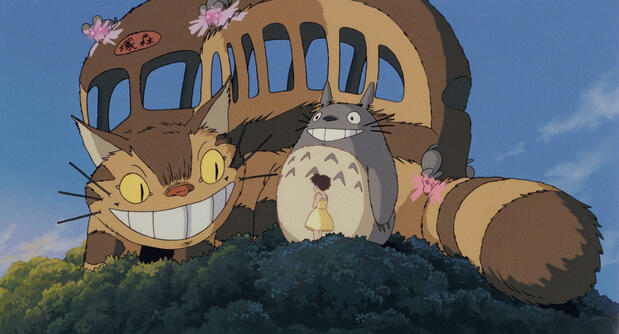
After Mei goes missing, Totoro calls the Catbus to help with the search. (
In Totoro’s Forest
The film captures the essence of Miyazaki’s natural world. Indeed, Totoro’s forest recurs in different forms in other works by the director, including especially Princess Mononoke (1997).
Miyazaki’s frequent renderings of Japanese nature are famously influenced by laurel forest culture theory, which is a hypothesis concerning the origins of the country’s culture that gained widespread traction in Japanese cultural anthropology from the 1970s onward. A laurel forest (also known as broadleaf evergreen forest) refers to temperate woodland vegetation consisting of broadleaf trees that do not shed their leaves in winter, characterized by glossy, lustrous leaves. Specific examples include oak, shii (chinquapin), and camellia, as well as camphor, like the huge tree where Totoro lives in the film. Also within this zone are the forests of Yakushima in Kagoshima Prefecture, which were the real-world model for the habitat of the Forest Spirit in Princess Mononoke. Basically, laurel forests can be thought of as consisting of the kinds of trees that produce acorns.
Advocated by scholars such as the botanist Nakao Sasuke (1916–1993) and ethnologist and cultural anthropologist Sasaki Kōmei (1929–2013), the laurel forest culture theory hypothesizes that foundational elements of everyday Japanese life and culture, including slash-and-burn agriculture and consumption of sticky rice and fermented foods like nattō, are similar to cultural practices elsewhere in a laurel forest belt stretching across East Asia, due to a common origin. This belt stretches from Tibet through Bhutan, China, and Taiwan before reaching southwestern Japan, and is known as the “East Asian Crescent.”
While the theory once received major media coverage, and was highly influential, it also faced considerable skepticism and criticism, and by no means represents an academic consensus. Even so, Miyazaki took great inspiration from this framework.
In a 1988 essay, Miyazaki recalled reading a work by Nakao introducing laurel forest culture theory. As a boy in postwar Japan, he said he had come to hate his country. “I was torn and conflicted, insisting I needed roots while simultaneously despising the Japanese state, its people, and its history, and yearning instead for the culture and literature of Western Europe, Eastern Europe, and Russia. Even after I began working in the animation industry, I preferred to set my works in foreign countries. If I thought of creating something set in Japan, I was still unable to warm to Japanese folktales, legends, or myths.”
Having long disliked his homeland, in Totoro Miyazaki embraced laurel forest culture theory, came to appreciate Japan for the first time, and set out to capture its nature on screen.
Lost Ancient Forests
In his later masterpiece Princess Mononoke, Miyazaki once again depicted laurel forest culture. For example, the protagonist Ashitaka is presented as a member of the Emishi from northern Tōhoku, who live by hunting and gathering rather than rice farming. The clothing of this group is also based on the traditional attire of Bhutan, which lies within the laurel forest zone.
Around the time of the release of Princess Mononoke, Miyazaki commented in public discussions how the initial impact of the laurel forest culture theory remained within him. “Long ago, the western half of [Japan’s main island of] Honshū was covered in laurel forests, and I was always haunted by the question of when and how they vanished.”
From the seed planted in Totoro, the massive success of Princess Mononoke in the 1990s brought the laurel forest culture theory, by then largely forgotten, back into the public eye.
(Originally published in Japanese on October 16, 2026. Banner photo: Mei chases the smaller Totoro creatures inMy Neighbor Totoro

Studio Ghibli Anime: The Inspiration Behind the Imagination
Studio Ghibli has won global renown for its classic anime, created by directors including Miyazaki Hayao and Takahata Isao. Film historian Watanabe Daisuke reexamines the studio’s output and delves into the philosophies and historical theories that shaped it.
(Photo

Sacred Ground: Anime’s Nagano HeartlandCULTURE | Oct 29, 2026
Miyazaki Hayao’s Animism: The Historical Theories That Shaped “Princess Mononoke”CULTURE | Oct 20, 2026

A Short History of Studio Ghibli: Four Decades of Anime ClassicsCULTURE | Oct 20, 2026
Related Articles

Mysteries and Complexity: The Genius of Miyazaki HayaoCULTURE | Jun 13, 2024
Chihiro Leads the Way: A Box Office Ranking of Studio Ghibli FilmsCULTURE | Jul 13, 2023

Miyazaki Hayao and His Mentor Ōtsuka Yasuo: Learning the Fascination of AnimationCULTURE | Oct 7, 2021

The Bathhouse of the Gods: “Spirited Away” and Japan’s Religious TraditionsCULTURE | Jul 19, 2021

The Joy of Imagination: Kadono Eiko, Creator of Kiki’s Delivery ServiceJAPAN LIFE | Dec 24, 2019Sacred Ground: Anime’s Nagano HeartlandCULTURE | Oct 29, 2026

The Magazine Culture that Nurtured Shōjo MangaCULTURE | Oct 28, 2026

Takahata Isao and “Grave of the Fireflies”: Japanese Book Explores the Making of an Anime ClassicCULTURE | Oct 21, 2026
