

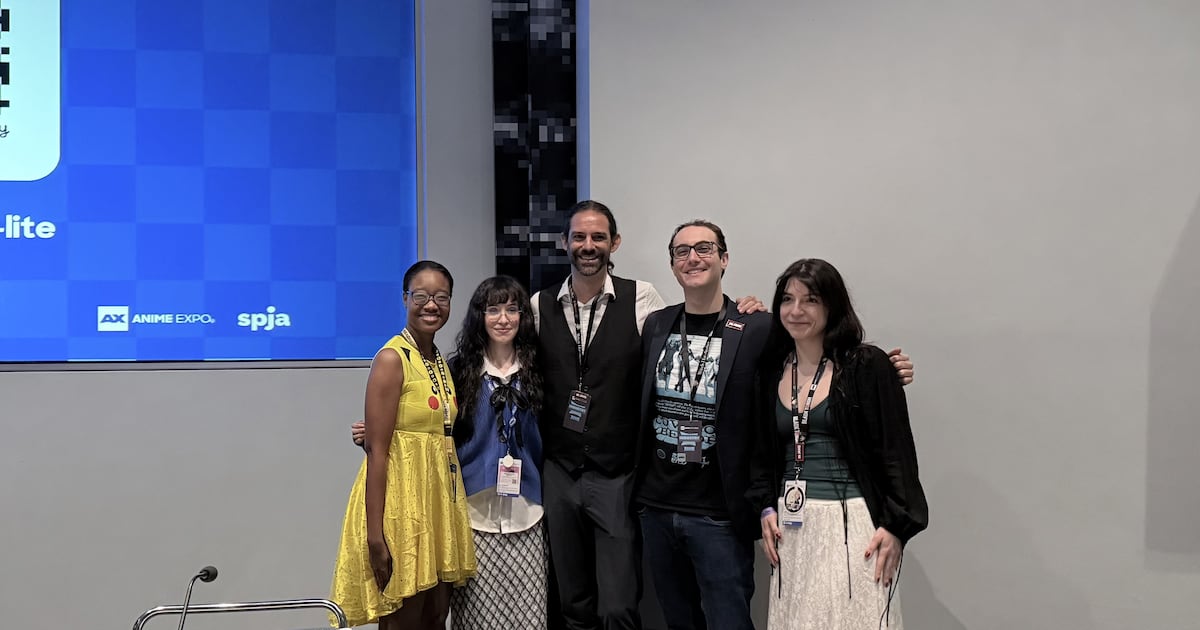
Tucked between trailer premieres and merch booths, Anime Expo’s JAMS@AX Academic Symposium has been bringing attendees, anime research, and educational professionals together since 2023. This year’s symposium, hosted on July 3rd, was a rumination on the human condition.
Elves, Robots, and the Invisible Man: Exploring Otherness in Anime
The panel brought together four media studies scholars to examine how anime constructs the “Other.” The guests were Revna Altiok, Dr. Ted Gournelos, Lillian Marie Martinez, and Dr. Ashley Smalls.
Western University PhD candidate Revna Altiok opened her lecture (“Exploitation and Othering in Urasawa’s Pluto: AI, Robots, and Capitalism”) with the first scene of “Pluto”(2003, Naoki Urasawa). In an automated world, Doctor Hiroshi Ochanomizu discovers a damaged robot dog. Failing to restore it, he cries and tells it, “Rest. You’ve done enough.”
Altiok then addresses the impossible problem of labor — the paradox of exploitation and the cycle of power. What happens when people create something whose purpose is to work?
Altiok said Pluto’s bots serve as an allegory for man. These robots are stronger, smarter, and kinder than their creators, challenging the notion that humans are special for exhibiting these traits.
Altiok posits that it’s power structures —not the physical body that differentiates us. In fact, “robot” derives from the Czech word meaning “servitude.” Robots are the new working class, reflecting how oppressive politics flattens individuals into products, valuable only when they’re usable.
Returning to the drying robot dog, “Pluto” ultimately says that caring for the “Other” beings society has deemed “inferior” –might be the most human thing of all.
Ted Gournelos, University of Virginia, took another angle, framing humanity as a choice — with his “Other” being Frieren, the immortal elf in “Frieren: Beyond Journey’s End”.
He opened “Exploring (Im)mortality: the Humanity of Frieren”by asserting that Frieren’s story is an inversion of the hero’s journey. The Demon King is defeated, and after ten long years, the party goes their separate ways. Decades after her companions’ death, Frieren sets out on the same journey again, intent on rediscovering the memories she hadn’t appreciated before.
Gournelos highlighted the show’s focus on the “quiet life” and interpersonal connections, drawing parallels between Frieren’s old and new parties. He also highlighted the show’s rapid fights, which diverge from the typical fantasy anime that focuses on these sequences.
This inversion situates humanity as a decision. In reality, Frieren isn’t so different from the series’ main antagonists — demons who have learned human speech to wreak havoc. She’s fairly apathetic, struggles to communicate, and is heralded as “The Slayer” for her vicious power. What sets her apart is her drive to deconstructthese labels.
Gournelos described this choice as a fantasy monster: the mimic–which camouflages as a chest to ambush adventurers. Indeed, Frieren doesn’t “feel” like a normal person. However, she decides to treasure important moments: birthdays, memories, and mealtimes, even if she knows her lifespan will cause her to be left behind. Again and again, Frieren opens the box, chooses potential hurt and the intimacy of human connection over a painless, yet stagnant, immortal life.
The final presenters addressed the “Other” slightly differently —asking how the human body shapes one’s understanding of identity.
In “The Sound of Love: Disability & Romance in Manga,” Lillian Marie Martinez, aPhD candidate at the University of Florida, posits that manga makes romantic desire hypervisible through intimate moments of communication, love and sex. Storytellers also purposefully limit or enhance readers’ understanding of sign language, allowing able-bodied readers access to its deaf characters’ lived experiences.
Romance manga with disabled characters asks readers to reframe how we might view “difference” –each person has an agentic right to love and to live on their own terms.
Ashley Smalls, a professor of media at Johnson and Wales University, took the othered human body in a different direction, questioning monstrosity in “Becoming the Monster: Fear and Identity” in “Jujutsu Kaisen,” “Tokyo Ghoul” and “Demon Slayer.” Using critical theory from Freud, bell hooks and Jung, she covered the meaning of when a character stops being human — and why people identify with those whose bodies are warped and whose identities are uncertain. Most importantly–where does the self end, and the monster begin?
Her theory combined three parts, theories, and characters–Yuji Itadori, Ken Kaneki, and Nezuko Kamado.
- It’s internal. Like Jung’s “shadow self”, the monster isn’t forced upon someone–it’s a repressed personality of the unconscious human being.
- It deconstructs binaries. Like Freud’s “the uncanny”, the dread of something familiar turning strange coincides with the unknown–like how the monster-human line exists in an uneasy space.
- Finally, identity as practice: we negotiate identity via our surroundings. Like bell hooks’ “Eating the Other”, do we truly relate to suffering characters, or do we simply enjoy their pain as <a href="https://comicvibe.com/a-decade-of-client-first-service-in-music-sports-and-<a href="https://comicvibe.com/fifa-merges-football-gaming-and-entertainment-for-the-world-cup/” title=”FIFA Merges Football, Gaming and Entertainment for the World Cup”>entertainment-at-first-horizon-bank/” title=”A Decade of Client-first Service in Music, Sports and Entertainment at First Horizon Bank”>entertainment?
Smalls suggested that the monster, the “Other,” is a cultural mirror. When Yuji chooses to accept Sukuna in his body in “Jujutsu Kaisen”, when Kaneki accepts his ghoul side in “Tokyo Ghoul”, when Tanjiro accepts his sister as a demon–these decisions affirm the main character’s humanity regardless of their physical form. Smalls said these characters are symbolic spaces to explore the audience’s personal anxieties. The monster-human boundary is a constant negotiation that forces viewers to consider and accept their own flaws.
A Psychiatrist on Anime Culture: How Your Favorite Anime Could Save Your Life
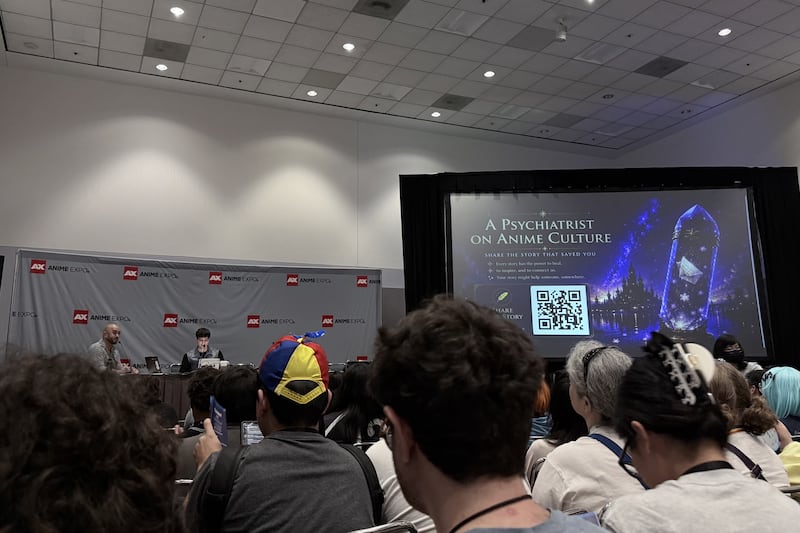
In this panel hosted on Day 4, Dr. Francesco Pantò offered answers to how to apply the lessons found in anime to real life.
Pantò argued that fiction is a tool for patients suffering from daily stress. While watching anime (which often features an ordinary person, rather than the Western hero archetype), patients experience how relatable figures overcome obstacles.
In fact, psychologists have proven that humans learn through observation, regardless of whether this is fiction or reality.
Additionally, Pantò shared his current work —“character counseling”, a part of his anime therapy treatment. He said he aims to create fictional characters to act as intermediaries between mental health professionals and patients.
All in all, Anime Expo’s academic programming demonstrated that anime isn’t just entertainment. These panels answer what makes us human through tales of societal belief and exploitation, memory and morality, intimacy and disability, and monstrosity and acceptance. Anime, in turn, reminds us that even the smallest stories can illuminate these very real complexities.
