

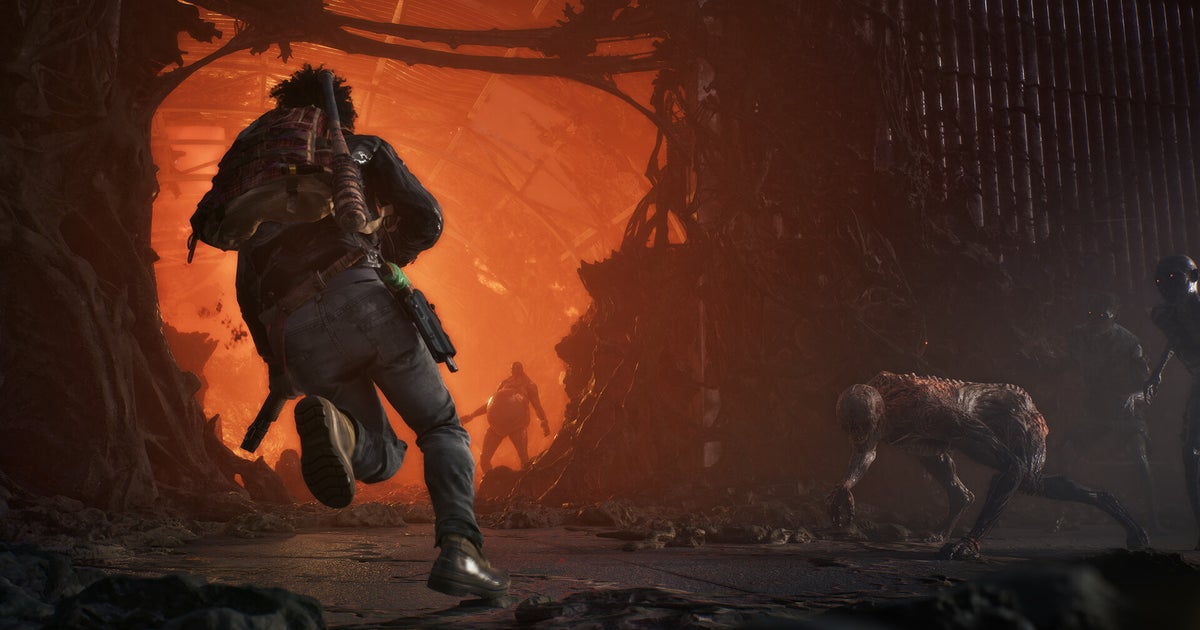
Back in July, Xbox announced plans to divest five studios. Among them was State of Decay maker Undead Labs, which Microsoft had acquired back in 2018.
Undead Labs CEO Philip Holt tells GamesIndustry.biz that he had a small amount of warning before the public announcement, but it still came as a shock. It led to a “deeply unsettling” atmosphere for the employees at the studio, who dwelt on the “fear of what would happen if we all became unemployed,” says Holt, as well as worrying they might not have a chance to ship State of Decay 3, a game they’ve been working on for years.
To take away some of the uncertainty, he made a decision to be fully transparent with Undead’s employees about what was happening with the studio in the months that followed. “There was a period of time where it was a weekly update to the whole company,” he says, adding that he had some “pretty direct and candid conversations” with employees. “I think it settled people down, and I think it strengthened the bonds of trust that we have with each other.”
At first, there was hope of securing a buyer. “I think initially Microsoft was interested in finding an acquirer for the studio, and that could have been a great outcome for us,” says Holt. “I also believed that, because we were so close to shipping the game, we could put together an offer that would be pretty credible, and it would allow the employees to control and own the company.”
“So yes, we talked to investors, both Microsoft shopping the studio and us, not necessarily looking for a buyer, but looking for an investor to come in with cash. But because we’re pre-revenue, I think a lot of those investors were really looking for control of a company, a majority position, and then I’m working for a financier. So we shifted gears to looking for publishing money.”
That was slightly easier to come by, although not by much. “There was a period where I was almost like, if State of Decay 3 can’t find its way to finishing, there’s something really deeply wrong with the industry,” says Holt. “But that was not a very helpful frame to hold, so I didn’t hold it for very long.”
“I was almost like, if State of Decay 3 can’t find its way to finishing, there’s something really deeply wrong with the industry”
It helped that State of Decay 3 is so close to launch, currently with a 2027 release window. The studio was eventually able to land an agreement with an as-yet-unnamed publisher for the game. “And so between the cash balance that we had on hand and publishing money, we’re able to finish the game on our own without any investors coming in,” says Holt. “We have taken no outside investors, which I think is pretty remarkable, honestly.”
Most importantly, Undead Labs is now employee-owned. “It’s so rare, I think, to be in a spot where the creators have commercial and operational control of their own business and it could be rewarded by the success or failure of their work,” he says. “We’re just so grateful to be in that spot.”
But getting here has taken an almighty effort. “It’s a serious act of will to navigate a path to an outcome like this. It was a pretty harrowing three months.”
Undead 2.0
In terms of the corporate structure of the newly independent firm, Holt says they registered a new company – “basically a Delaware C corporation” – which then acquired Undead Labs, and now they are in the process of issuing equity to all employees of the company.
He stresses the importance of employees owning shares in the firm. “I think it increases the motivation. It makes the realities of the economics of the industry just more present in daily work. People are working for themselves. They’re not really working for a taskmaster that sits somewhere else.”
Some employees own more shares than others, something that Holt says is determined by “a lot of factors”. But he says he doesn’t have a majority stake. “It is typical that a CEO owns a majority equity in the company. I didn’t want to be a majority owner, but I did want to have control. So we created multiple classes of stock that allow for super voting rights, so I can be in a minority ownership position and still have voting control of the company.”
The bonus of this is that there are more shares to go around for everyone else, so Undead can be “more generous in the equity distribution that we can do with our employees,” Holt says.
“You can’t command commitment. You earn it, you can only earn it”
There’s not much employees can do with those shares right now, other than sell them back to the company – but Holt notes that if someone ever bought the firm, the employees would be due for a windfall. And there might be the possibility of dividends in the future. “If we were generating enough profit that we wanted to return some of it to employees, that would be a good way to do it,” says Holt. “Thinking through the economic rewards of making a great game that is attached to a big audience and returning that to the creators of the game itself – I’m just so grateful to be in a spot where we’re able to do that.”
Above all though, he thinks the new structure is an excellent motivator. “Great games are made by teams that are absolutely dedicated, committed to the game itself. You can’t command commitment. You earn it, you can only earn it. And I think once I made that realisation, I realised that that becomes the objective of the corporation itself – to earn the commitment of the employees in service of the game that we’re making.”
Downsizing
Not everyone at Undead Labs made it through the past three months. “A key decision that we had to make coming out of Microsoft was, what is the size of the company that feels sustainable and durable?” says Holt. The studio made a “significant number” of layoffs in September, but Holt has been reluctant to say exactly how many employees were let go.
“The reason why is just… I mean, it’s just a brutally difficult thing to do, and to witness people who have done nothing wrong, they’ve been good employees, they’ve been good teammates, they do good work. And then because of some decisions made way upstream from them, they’re now out of work. And so just out of a sense of respect to those… I just don’t want the headline to ever be Undead laid off this many people. It feels like reducing it to a statistic sort of dehumanises the impact of it.”
“We’ve always been kind of lean for the level of ambition that we have”
Undead Labs currently has three offices in Seattle, Washington; Champaign, Illinois; and Orlando, Florida, as well as a handful of employees working remotely in places like California and North Carolina. “We’ve always been kind of lean for the level of ambition that we have,” says Holt. “We were just over a hundred employees before all of this happened, and we’re less than that now.”
The company also works with various co-development partners, including Wushu Studios in the UK, which Holt calls a “great team”. We ask what Holt thinks about the relatively new model we’re seeing in the games industry – as employed on Star Wars: Galactic Racer – whereby a tiny full-time team directs and coordinates a range of external partners to develop the bulk of the game.
“I mean, I think in principle, it’s sort of what we’re doing,” he says. “The question is: how tiny is the tiny central team? I don’t have any magical answer, and I think it depends an awful lot on the kind of game you’re making. So from our perspective, what we try to have is an owner, somebody that holds institutional knowledge and expertise around the core things that make our game. That is an internal position, and then they become in effect a director that works with a team that might be remote.”
He says that the ways in which an internal team works together and builds relationships is what makes a team special. “The institutional knowledge that you gain by building something is, I think, a huge part of the value of the team, because none of this stuff’s written down. Documentation always trails, so it sits in somebody’s head. So all that tribal and institutional knowledge is part of it.”
“[Xbox chief content officer] Matt Booty always has this saying that the number one predictor of success is whether a team has shipped together before. And so when you have a really tiny team and you’re reliant on these external teams, you’re giving that expertise away.”
“Or another way to think of it is – at least the way I think of it is – we’re making an investment in external partners, not only in the cash that we pay them to do the work, but in the expertise that we’re building with them. And so we want those relationships to be long term.”
Years of work
State of Decay 3 has been a long time coming. A trailer for it was released in 2020, but Holt says only a handful of people were working on the game at that time, while much of the team was providing support for State of Decay 2 up until 2024. “And there was a pretty significant pivot creatively on State of Decay 3’s development. So I would say the game that’s present today has really been built probably since ’23, maybe late ’22.”
That pivot was away from an MMO structure. “When the founder was here [Jeff Strain, who left in 2019], I think he always had a vision of making an MMO and the ultimate global scale of a zombie apocalypse. And so there was just a different set of creative objectives the team was trying to pursue at that time.”
Having previously worked at Guild Wars maker ArenaNet, Holt knows just how difficult it is to make an MMO. “One of the things I learned is just how much respect I have for teams that make successful MMOs, because I’ve seen them swallow people whole.”
“We basically rewrote the entire State of Decay game”
The pivot set Undead Labs back significantly. “We basically rewrote the entire State of Decay game, and we will not do that again,” says Holt. “We have the benefit now of this pretty significant investment in software that we got to figure out how to make the most of. We hope that State of Decay 3 has a long and successful life and becomes a live and evolving game. But yeah, I think it’s highly unlikely that we spend as much time on the next game as we did on State of Decay 3.”
Undead Labs currently has around 8,000 players testing out State of Decay 3, and is working on a post-launch roadmap. But why make a sequel at all? Why not simply keep updating State of Decay 2, which – as Holt notes – did “exceptionally well” on Game Pass? Holt says it comes down to the fact that the second game had technical limitations that the studio wanted to address. “And we have a creative vision for what we think the ultimate State of Decay experience is that I don’t know that we’ll ever achieve. I don’t know that anybody ever achieves their ultimate creative vision, but you get a little closer.”
State of Decay 3 Official Gameplay Reveal | XBOX Games Showcase 2026
Yet the trend these days is more towards wider compatibility rather than next-gen technical marvels. State of Decay 3 is being birthed into an uncertain world where $1,000+ consoles look set to be the new normal, and Holt is aware that many players will stick with older, less-powerful consoles and PCs, so the studio is ensuring that “our minimum spec is as broad as we can make it”.
He notes that State of Decay has never been a game that sells hardware. “We don’t need to be on the cutting edge. That’s not really what we’re about. We have a different sort of offering, and so being where the players are matters to us.”
No looking back
When asked what he thinks of what’s happening over at Xbox right now, Holt has a simple reply: “I don’t really spend a lot of time thinking about them.”
“It’s not like I’m taking my toys and going home because you don’t want to play with me any more,” he continues. “It’s more of a… I’m not inside of the company. I’m not getting the briefings. I don’t know what their strategy is.
“I haven’t really spent much time thinking about Microsoft”
“It would be easy to be righteous about whether they made the right decision or not, and it’s super unproductive to spend calories having that argument with yourself. It’s like, okay, so what if you’re right or wrong? It doesn’t matter. I mean, really, once the news was delivered to me, because we were under pretty tremendous time pressure to get a deal done, I spent 100% of my time thinking about how to get a deal done. I mean, there’s plenty to figure out about State of Decay 3 and our path to launch and what success is going to look like once we’re live. I haven’t really spent much time thinking about Microsoft. I mean, it appears that they are coalescing around their mega franchises.”
Microsoft may have discarded Undead Labs in the end, but they did offer protection for a while. Now, the studio has to fend for itself – and the West Coast of the US remains one of the most expensive places to make games in the world. The fact that games can be made much more cheaply in other parts of the globe is something Holt is all too aware of.
“We talked to a lot of publishers, and I heard a story of a game that start-to-finish was something like $10 million to build. A very ambitious game, very high quality. And I found the conversation to be utterly depressing. I was just like, ‘Okay, we’re never going to win the race to the bottom on labour cost’. Seattle is a very expensive place to make games, and I was feeling just like, ‘We’re doomed’.
“Then I woke up the next day, and I realised I’m not in the unit cost business, I’m in the entertaining an audience business, and we have a fantastic community around State of Decay, and we hope that we’re going to grow it with State of Decay 3. And our job is to make sure that we entertain them and give them a reason to stick with us. If we do that, the audience will support this team.
“So then it’s my job to make sure that we size the team to the opportunity that’s present, and to make smart investments about growing the team if we think we can grow the audience. I think that relationship, that sort of directness between an independent studio and a community of players is, to me, the model that I want to pursue. I can’t say that this is the model for the industry – that would, I think, be arrogant – but for us, this is the path that we think can lead to success.”
“It’s my job to make sure that we size the team to the opportunity that’s present”
He recalls a story about Iron Maiden’s manager responding to a question about the music business. “And the guy’s like, ‘The music business? We’re not in the music business. We’re in the Iron fucking Maiden business’.” Undead Labs’ primary concern is making games, not profits. “We serve our audience, and that is our job,” says Holt. “And if we do that, they will support us.”
That job is helped, he says, by being employee-owned rather than being in the pocket of investors who demand constant growth. “The job then becomes about generating profit,” he says, providing “several multiples” of return on invested capital.
“I don’t need a multiple on capital. I need to generate a return, I need to be able to pay our employees and give them a good standard of living and opportunity for upside, I need to make sure that my publisher is making money. But I don’t need a four or five X on invested capital. That’s not the thing that drives us. The thing that drives us is entertaining our players.”
