

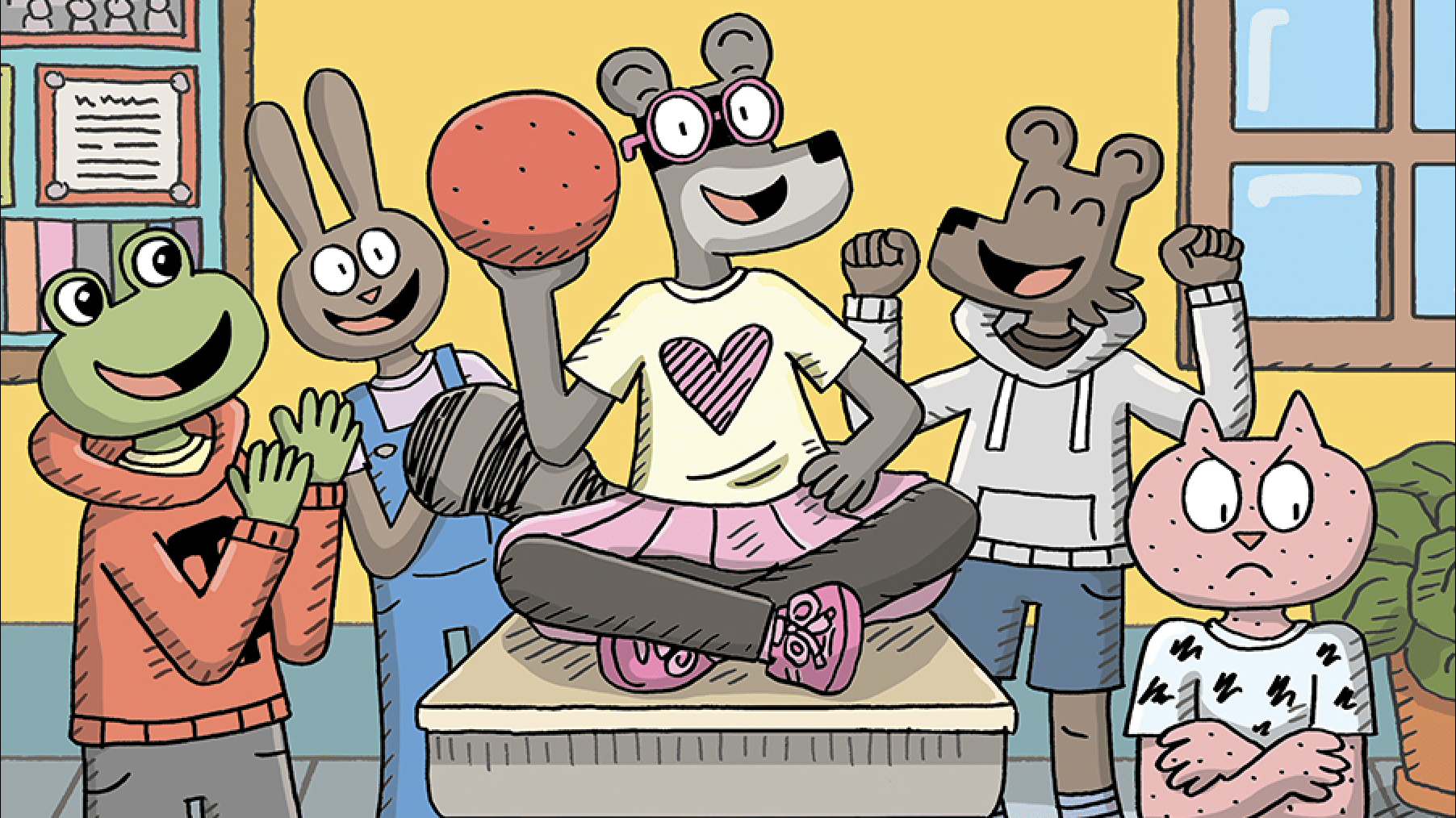
Eisner Award-winning authorAron Nels Steinke has built his oeuvre around noticing what many adults forget: how strange, funny, and layered childhood really is. He taught elementary school himself, and that experience runs through every page of theMr. Wolf’s Classseries published by Scholastic’s Graphiximprint. The graphic novels capture grade school from the inside, with all its travails and triumphs, through the eyes of someone who watched it firsthand for years before ever putting pencil to paper.
InThe New Student, the recently released sixth installment of the series, Steinke introduces a newcomer named Zora who navigates the challenges of making friends at Hazelwood Elementary, under the watchful eye of Mr. Wolf and his retinue of students. Zora quickly finds herself unexpectedly at the center of her classmates’ interest. The relatable themes of this book–finding oneself, being silly, and accepting others–is well-trodden ground for Steinke, who has consistently chosen to highlight the more complex interactions that characterize childhood social dynamics.
The release follows Speechless, Steinke’s moving, personal standalone graphic novel about anxiety that came out last year. As Steinke he told me during a recent interview, going back to the Mr. Wolf’s Class series felt less like a shift and more like catching up with old friends. But he’s noticed a change too. Because he’s not teaching anymore, and his son is getting close to high school, the kid voices that used to be all around him now take a little more effort to find.
AJ FROST: Thank you for taking the time to chat with me, Aron.
Your last graphic novel,Speechless, was a much more personal, standalone story with a mature perspective of overcoming anxiety in a middle school setting. Now you’ve brought readers back toMr. Wolf’s Class. What was it like to return to those hallowed halls, and did the time away change how you approached these characters? Was there anything about writing a more personal, serious book that snuck back into how you write these kids?
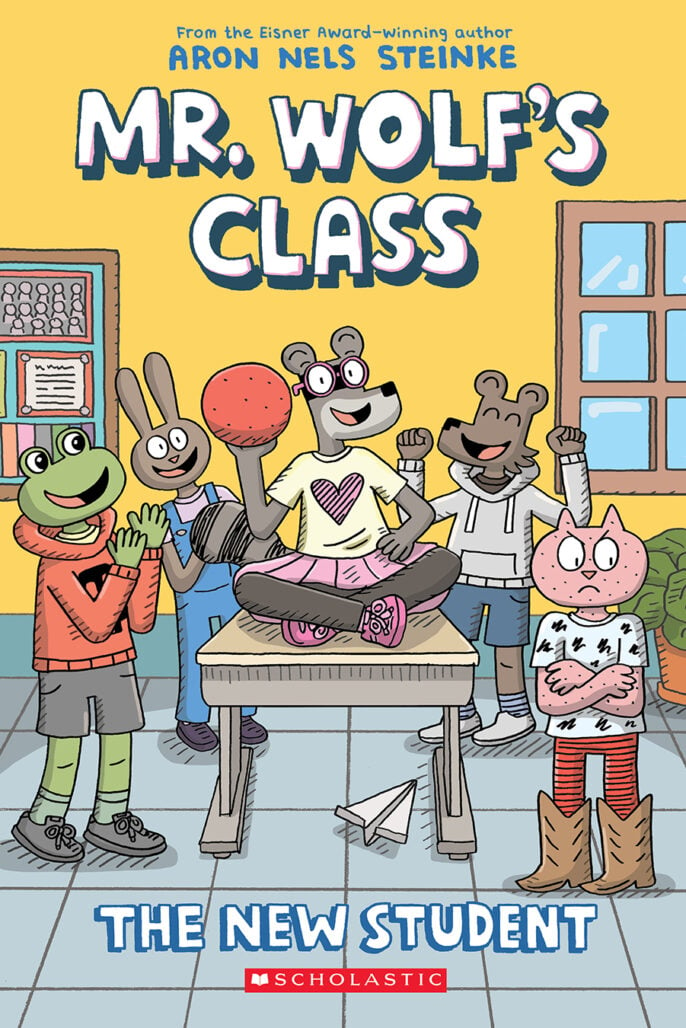
ARON NELS STEINKE:Speechlesstook me so long to make that when I started writing and drawingMr. Wolf’s Class: The New Student, I did worry that maybe I had forgotten how to write those characters. But once I began immersing myself in that world, it came right back. They’re old friends. It’s so much fun, and there is a light tone that makes the process a little easier for me. I don’t think I snuck anything too serious back in there, but maybe it feels more serious because it’s more focused on one main story. The Mr. Wolf’s Class stories are starting to get more plot-driven. Maybe that’s it. That started with book five [Snow Day]… I think.
FROST: As I’m sure you know from your years as an educator, children have pretty distinct, often unspoken rules for how they size up and welcome (or don’t) a new student. What aspects of that social dynamic were you aiming to highlight, and how did you ensure it accurately reflected kids’ behavior rather than the idealized version adults often envision?
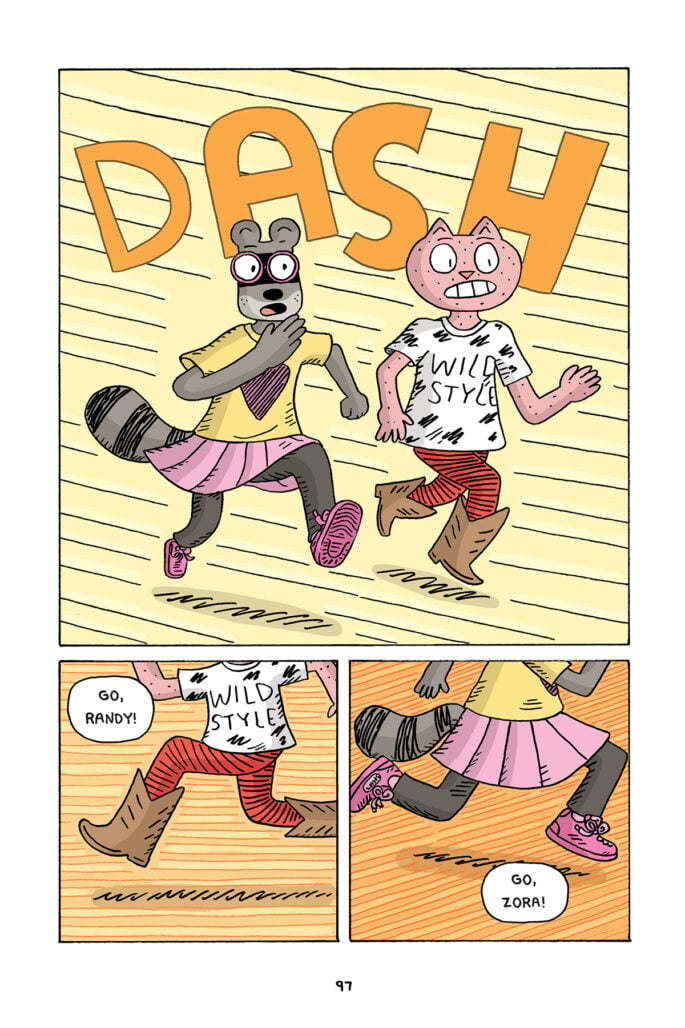
STEINKE:I just tried to imagine what would really happen if a new student came into Mr. Wolf’s Class. How does each character feel and then how do they respond? For example, inThe New Student, Zora has a lot of anxiety about starting at a new school. She’s desperate to make friends quickly, so she starts by giving everyone candy, and then she makes up stories to try and impress them. She starts showing off and quickly becomes the center of attention. A lot of kids are thrilled. They want to be her friend. Then I think,how does Randy, who also craves attention, respond to this new kid?That’s the tension.
Through Mr. Wolf, I get to show the teacher’s perspective. He has to help Randy and Zora resolve their conflict, but he’s also got lots of other stuff going on—math, social studies, writing, and reading instruction. How does he respond? What about if another student all of a sudden needs his attention? He’s pulled in so many different directions. How does he keep a cool head?
FROST: Six books in, what’s something about writing for this age group, or about classrooms themselves, that you understand now that you didn’t when you started the series? Has your own sense of what counts as a “big” problem for a kid changed at all along the way?
STEINKE:I actually feel like I’m still the same person that I’ve always been. I really do remember what it was like to be a kid. And all the things that I noticed and cared about. And that’s the perspective I take when I write for kids. That hasn’t really changed for me. My work as a teacher was what inspired me to first create these characters and to invest so much time with them. And that experience in the classroom made me an expert in kid behavior. But I’m no longer teaching, and my son is going into high school, so that is a world that is getting further and further away from me. I don’t think I can rely on my own feelings and memories alone, so as I move forward, I’ll need to try harder to get those kids’ voices back in my life. Kids are awesome! I love their earnestness and their play, and their frustrations over the hypocrisy of adults. I’m trying to honor their voices as best I can.
FROST: Schools have become a flashpoint in public discourse: curriculum brawls, campaigns to ban books, and even what teachers are allowed to say in the classroom have turned ordinary school days into contested political territory. Does this increasingly negative shift change how you thought about writing this story? Or do you try to tune that noise out and just write as earnestly as you can?
STEINKE:I honestly just have to tune it out and try my best to make the best book that I can. I am aware of the bigger issues and discourse, and if I think I can add something to the book that comments on it, I’ll do it, but I’ll never force anything.
Book bans are real and something that requires our full attention to push back against. I believe groups likeAuthors Against Book Bansare doing great work, and I’m in awe of all the authors, educators, and community members who helped get the Freedom to Read Law signed in Massachusetts, a law that essentially stops book banning from happening in schools and libraries. I know one of my books has appeared on at least one book banning list. It’s really sad, but that’s not going to change the kind of books I make. I want to make great books that kids from all backgrounds can read and see their own lives reflected in them. Mr. Wolf’s Class is a welcoming place.
FROST: Now thatThe New Studentis out, what are you working on next? Is it moreMr. Wolf’s Class, something closer to a standalone book likeSpeechless, or something new and unexplored entirely?
STEINKE:My next book is going to be a really fun one. I’m working on it right now, but I can’t publicly announce it yet. It’s slated for a spring 2028 publication date.
FROST: Last question, and it’s a fun one (I promise!): after six books, are you grateful for your copyeditors? Any memorable catch they made in this book–or any of your works–that saved you from an embarrassing need for a second print run?
STEINKE:You must be referring to a scene inThe New Studentwhere Mr. Wolf has a mini-meta moment when he first thanks one of his students for correcting his spelling mistake, and then goes on to talk about copyeditors, and then has the class say thank you to all the copyeditors out in the world.
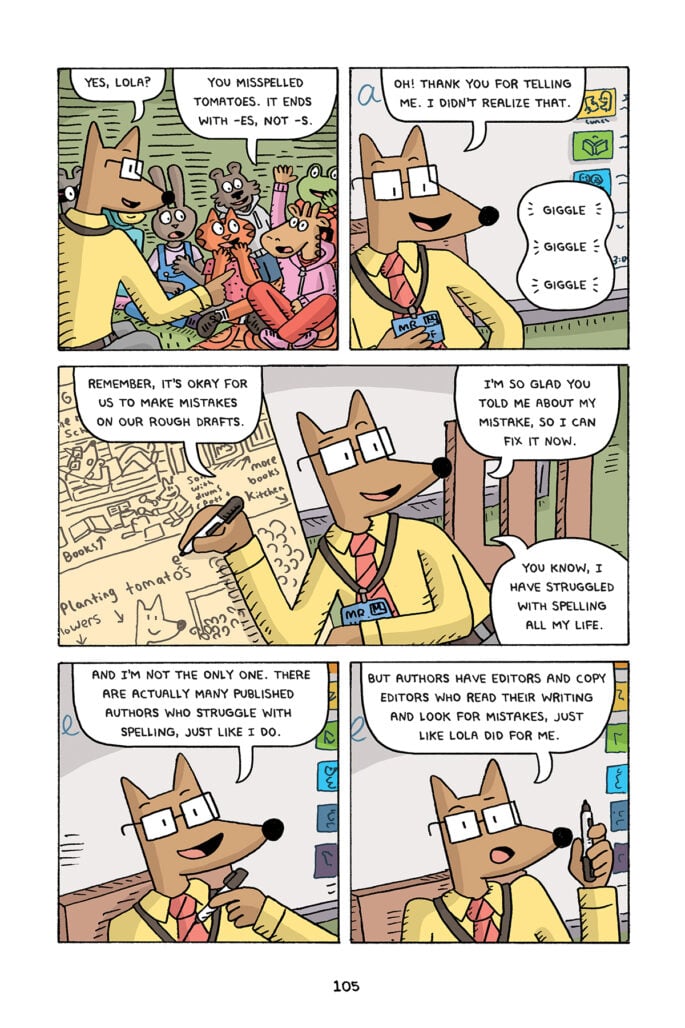
Copyeditors are crucial in the editorial process, and they have saved me from the embarrassment of having many mistakes in my books. Both my editor, Emily Nguyen, and I would read each draft at various stages of the process over and over, looking for as many mistakes as we could catch, but it was inevitable that some mistakes slipped through. For example, inThe New Student,there is a scene where Penny leaves class to show Zora to the bathroom. And while they’re in the hallway, the focus shifts back to the classroom where the rest of the class is working on an art project. And I had initially drawn Penny in the background in that back in the classroom, but she was really supposed to be in the hallway. It was our copyeditor who noticed that continuity error, and then I fixed it. It’s a team effort! My books are so much better for it.
Mr. Wolf’s Class: The New Student is available now from Graphix. You can follow Aron on social media, including Instagram and Bluesky. Updates can also be found on his website.
