

Two hours a day, 19 books, 48 shows, and the work that happens after the credits roll.
ByJinPublished 15 minutes ago•7 min read
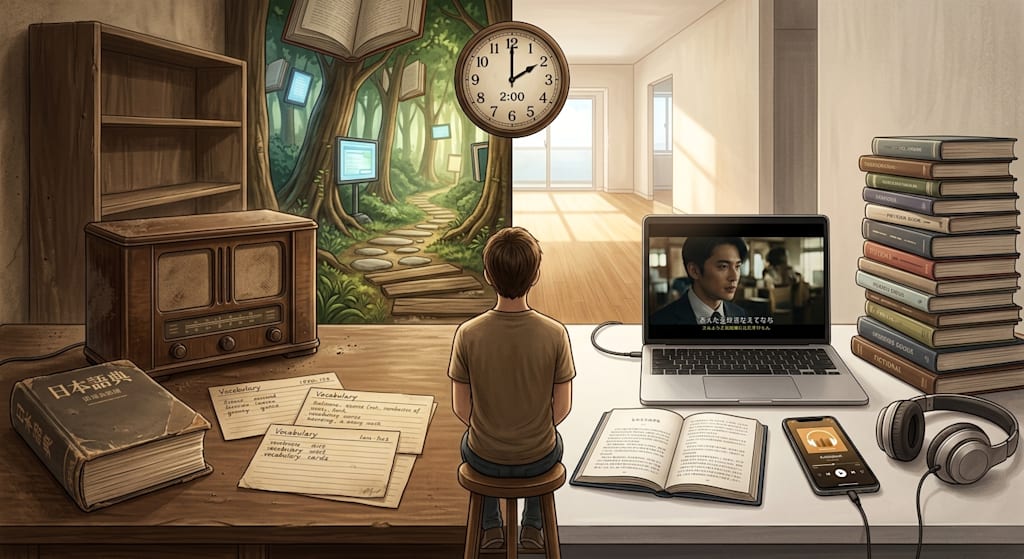
A hundred years ago, learning Japanese started with stuff. A dictionary with yellow pages. Half a minute to find one word. A novel you asked someone to bring back from Japan. A radio you tuned through static for NHK. Anime? Nowhere. The only break was less katakana.
I started in late August last year. Two hours a day, give or take. I memorized words, watched anime, read light novels, and listened to audiobooks. In March I finished my first light novel. Now I have finished 19, close to two million characters. I have watched 48 anime. In July I passed N2.
The numbers are not a boast. They show that self-study out of interest can work today.
The old problem was scarcity. The new problem is choice.
In the past, reYou flipped through a thick dictionary. You figured out how to buy original books. You messed with a radio for Japanese audio. Anime was mostly out of reach. Learning Japanese belonged to people with teachers, textbooks, a language environment, and stubbornness
Now the shelves never end. Anime, Japanese dramas, light novels, audiobooks, YouTube, podcasts, Japanese Twitter. The tools are good too. Jiten finds material by difficulty. Asbplayer plus Yomitan lets me look up words while watching. Jimaku finds subtitles. Hoshi Reader lets me read and look up words in the same window. Anki and FSRS handle review. There are anime decks and beginner listening and grammar courses. There are self-study guides for Chinese speakers.
The old complaint was “there is nothing to study.” The new complaint is “there is too much, and I do not know what to pick.” Looking up words used to be slow. Now it is so fast that you can click around for ten minutes and mistake that for study.
The barrier is gone. What remains is sitting down every day and doing a little, then a little more.
My 13 months: kana, light novels, N2
I did not study Japanese in school. I have never lived in Japan. I started in late August last year, about two hours a day. I memorized words, watched anime, read light novels, and listened to audiobooks. Audiobooks came last, to fix my listening.
In March I read my first light novel. I looked up words constantly. Sentence patterns felt loose and unfamiliar. Then my speed rose. I have now finished 19 books, close to two million characters. I have watched 48 anime. In July I passed N2. On score day I was still memorizing words. The page refreshed. I took a screenshot and went back to the show.
None of this is magic. Anime, novels, and audiobooks were already things I liked. I was not “studying Japanese.” I was using Japanese to watch, read, and listen, and learning Japanese along the way.
Interest does not make you fast. It makes you hard to stop. Language learning does not die from difficulty. It dies from pauses.
Tools cut friction. They are not the point.
Some people hear “learn Japanese out of interest” and picture anime plus songs plus automatic fluency. No. Watching anime is immersion. Looking up words, making cards, reviewing, doing intensive listening, and checking your errors is study. Without that second part, anime is just entertainment. With it, entertainment becomes the textbook.
I use Jiten to find material at my level. Asbplayer and Yomitan let me look up words while watching. Jimaku finds subtitles. Hoshi Reader lets me read and look up words in light novels and audiobooks. Anki and FSRS handle memory. I also use anime decks and beginner listening and grammar courses.
These tools cut friction.
Before, a new word in anime meant pause, dictionary, notebook, later review. Watching became a vocabulary drill. Now Yomitan gives meaning, reading, and examples in one click, and I can make a card. Before, novel reading meant lookup pain. Now Hoshi Reader keeps the page moving. Before, I could not find material at my level. It was either too easy or too hard. Now Jiten sorts by difficulty, so I can stay near i+1: mostly understood, with a little new material.
A lever can also hit you. If you spend the evening configuring tools, you are not learning Japanese.
Interest starts the engine. Method steers.
Interest answers “do I want to learn?” Method answers “am I learning correctly?” Tools answer “is this smooth?” Habit answers “can I keep going?”
Interest alone turns into “I watched anime for years and still know five phrases.” Method alone turns into “I passed N1 and never want to see a textbook again.” Tools alone turn into “I bookmarked forty tutorials and studied for three days.”
What I do: a fixed input block each day. Material close to my level. When I meet new words, I look up some, not all. Important words go into spaced repetition. I check reading volume, listening time, and vocabulary now and then. When it is time to output, I output, even badly.
Interest gets you moving. A system keeps you moving.
Getting in is easy. Output and depth are not.
If “learn Japanese well” means watching anime without subtitles, reading light novels, passing N2 or N1, and following podcasts, interest can carry you. It is easier now than at any time I know.
If it means business Japanese, academic writing, translation, or native-level speaking, you need training and a lot of output. Interest only buys the ticket.
Input and output are separate skills. Anime and novels can build listening and reading. They do not automatically build speaking and writing. You can understand and still not say it. You can read and still not write it correctly. Keigo, conversation rhythm, register changes, and cultural context are hard to absorb from input alone.
After N2, the bottlenecks show up. Grammar breaks into pieces. You know each piece and still react slowly when they connect. Vocabulary lacks depth. Abstract words, technical words, and idioms lag. You still lean on Chinese translations instead of monolingual definitions. You miss implication. Your reading and listening run ahead of your speaking and writing.
So interest is strongest at the start and in immersion. It is weakest at output and depth. If you only want Japanese for entertainment, fine. If you want it for work, creation, or conversation, then at some point you practice output: shadowing, retelling, writing, conversation partners, recording yourself and listening back.
N2 is a way station.
In July I passed N2. I was happy. N2 does not prove I can chat for thirty minutes, write a proper email, or understand rakugo. A test is a ruler. It is not the goal.
I have read 19 light novels, close to two million characters. In the Japanese reading world, that is a start. I have watched 48 anime. My listening is better. I still do not understand everything. I started audiobooks recently. The weak spot is still there.
The more I learn, the less Japanese looks like a mountain to summit. It looks like a forest you can walk into for years. N2 is a sign at the entrance.
A path for self-study out of interest
Start with kana, basic grammar, core vocabulary, and simple listening. Do not open a hard novel on day one. Do not memorize words without sentences. Use Anki or something similar for core words. Add easy anime and NHK Easy.
Then use Yomitan for lookup, Asbplayer for anime plus lookup, and Jiten to find material at your level. Get 30 to 60 minutes of input a day. Subtitles are fine. Chinese subtitles alone are not. Get used to Japanese subtitles and looking things up.
Next, read light novels. Listen to audiobooks. Watch harder anime and Japanese dramas. Use Hoshi Reader to read and look up words. Try Japanese definitions. Move from bilingual to monolingual dictionaries. This is the stage for N2 or N1.
After that, add shadowing, retelling, writing, conversation partners, newspaper editorials, and books in your field. Output even when it is bad. Without output, input stays as “I understand.” It does not become “I can use it.”
Long term, make Japanese part of your life. Watch anime. Read books. Listen to podcasts. Post in Japanese. Look things up in Japanese. Let Japanese stop being homework and become a door to information.
You do not need eight hours a day. Two hours a day for a year will change you. Consistency beats bursts.
Best time, hardest test
So, is it easy to learn Japanese well out of interest?
Easy to start. Hard to continue. Easy to immerse. Hard to output. Easy to reach N2. Hard to reach native level.
If you turn interest into habit, tools into levers, and immersion into daily life, this is a good time to learn.
A hundred years ago, the problem was no reraction. Then, nothing to study. Now, too much to finish
Technology dropped the barrier. The community put up signposts. Tools smoothed lookup, memory, reading, and listening. The rest is yours.
Will you sit down today and learn a little, then a little more?
Will you look up one more word, make one more card, shadow one more sentence?
Will you turn “I like Japanese” into “I use Japanese every day”?
Tomorrow I have 80 cards. I want to read chapter 3 of light novel 20. I have two chapters of an audiobook left. That is enough for now.

1 Comment
Pingback: Where to Watch: Patriots vs. Jaguars, Week 3 of 2026 NFL Season - Comic Vibe