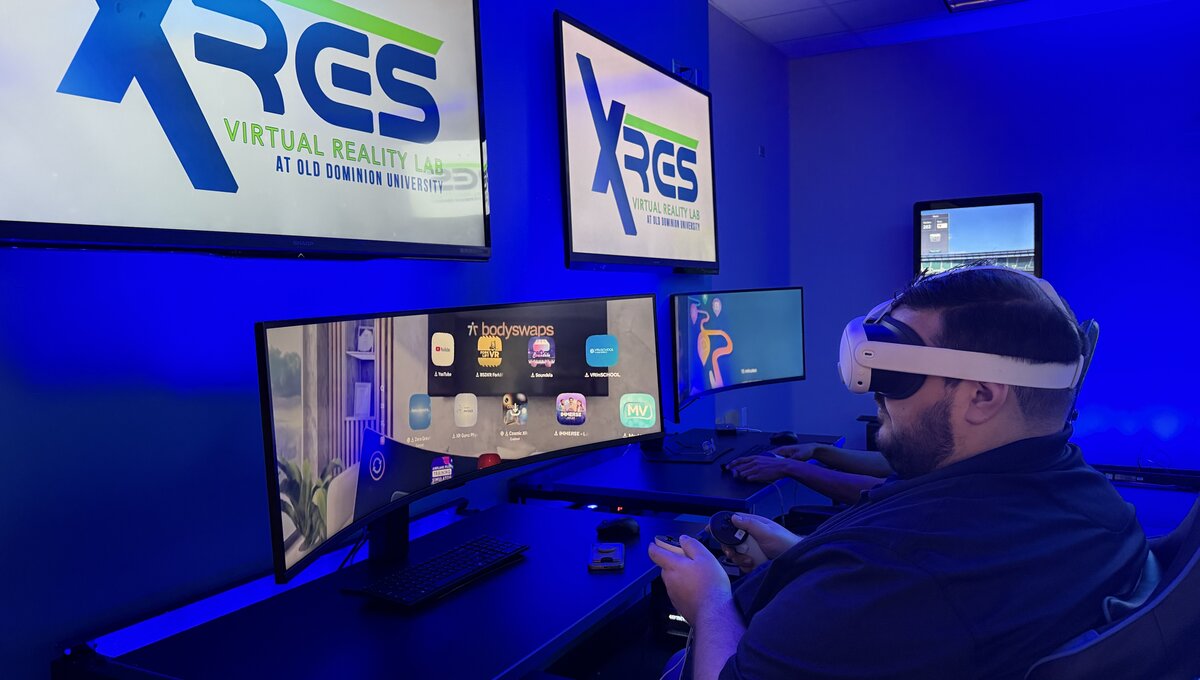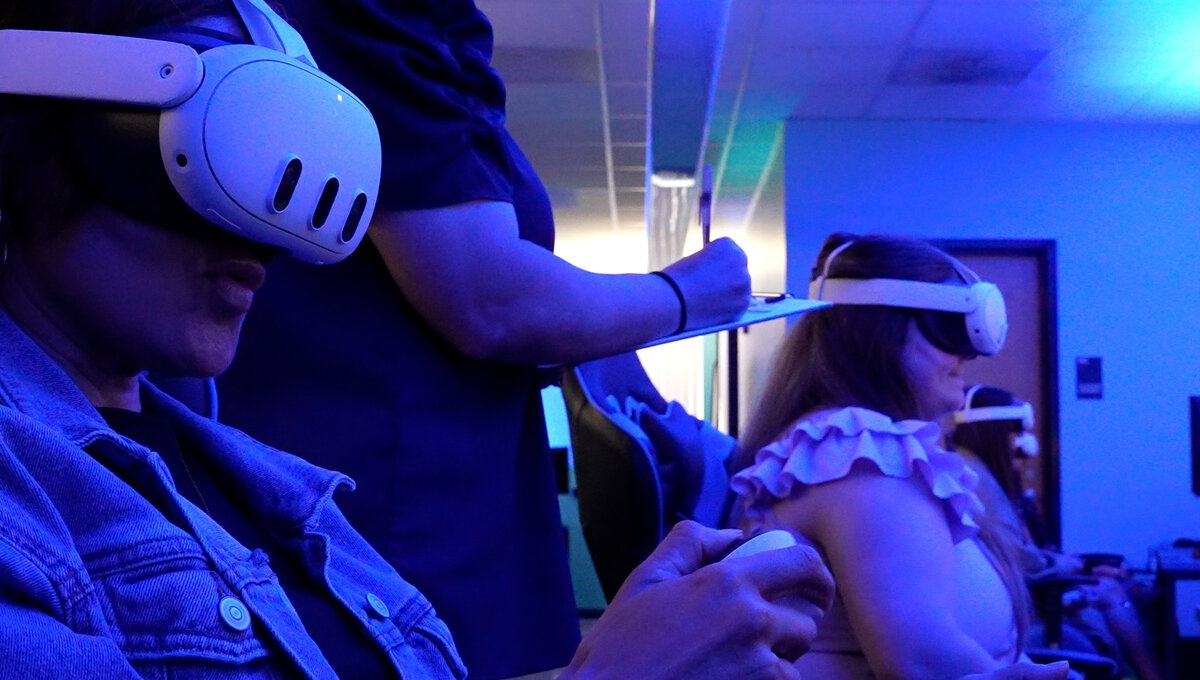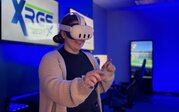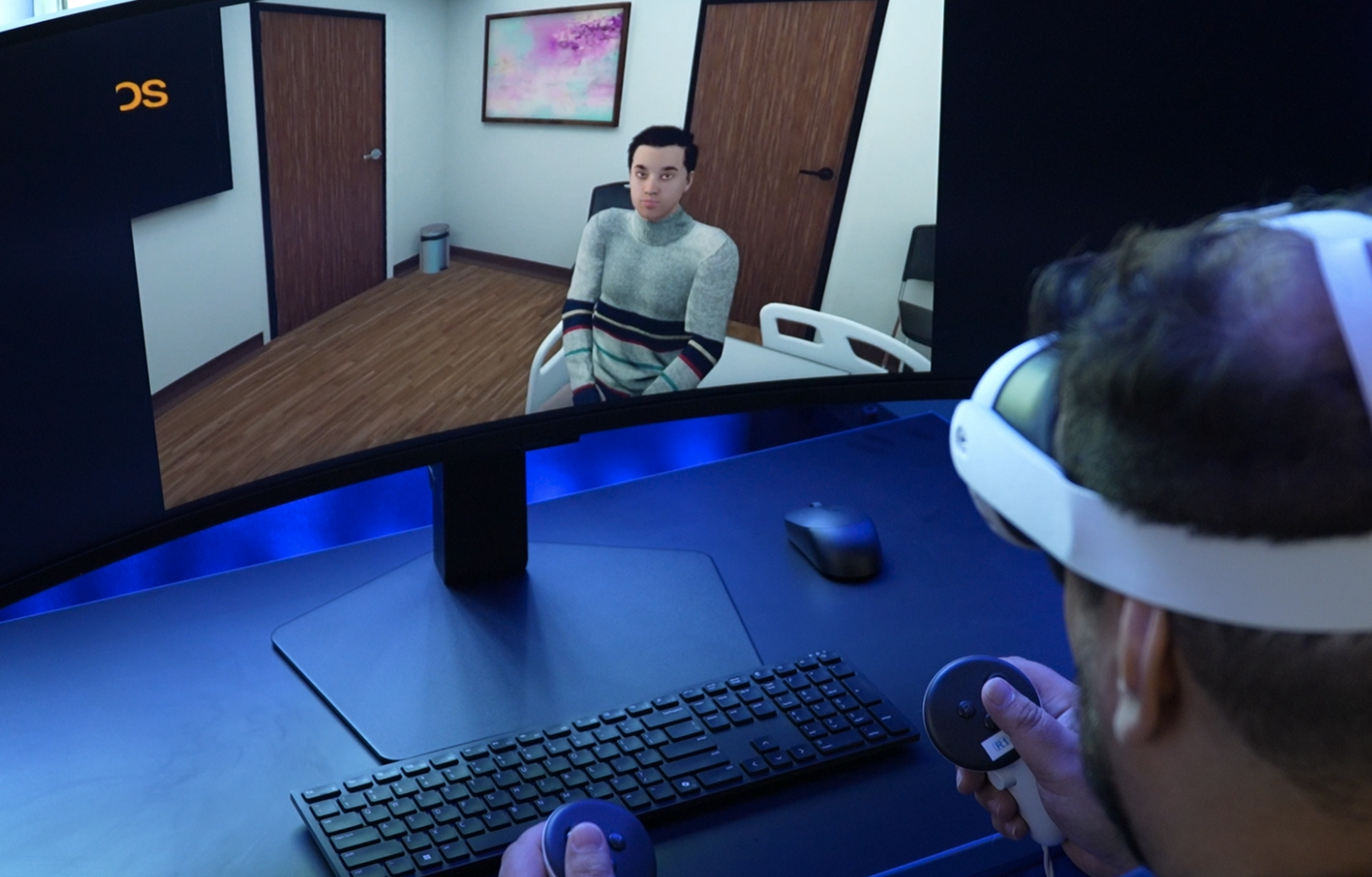
A headset settles over counseling graduate student Lindsey Rodil’s eyes. In a moment, she will find herself across from a client named Santiago, an anxious-looking man sitting on a couch in a brightly lit counseling office. The conversation begins with introductions, small talk and tentative, cautious questions — the kind of exchange that happens every day in counseling offices around the world.
But, this encounter is different. Lindsey isn’t sitting in a room with Santiago. In fact, he isn’t even real. Santiago is a Bodyswaps avatar, and exists only in a virtual world, where every question, pause and moment of connection shapes what happens next. If Lindsey earns his trust, he will reveal more of his story. If she doesn’t, the conversation will stall.
Just like it would in real life.
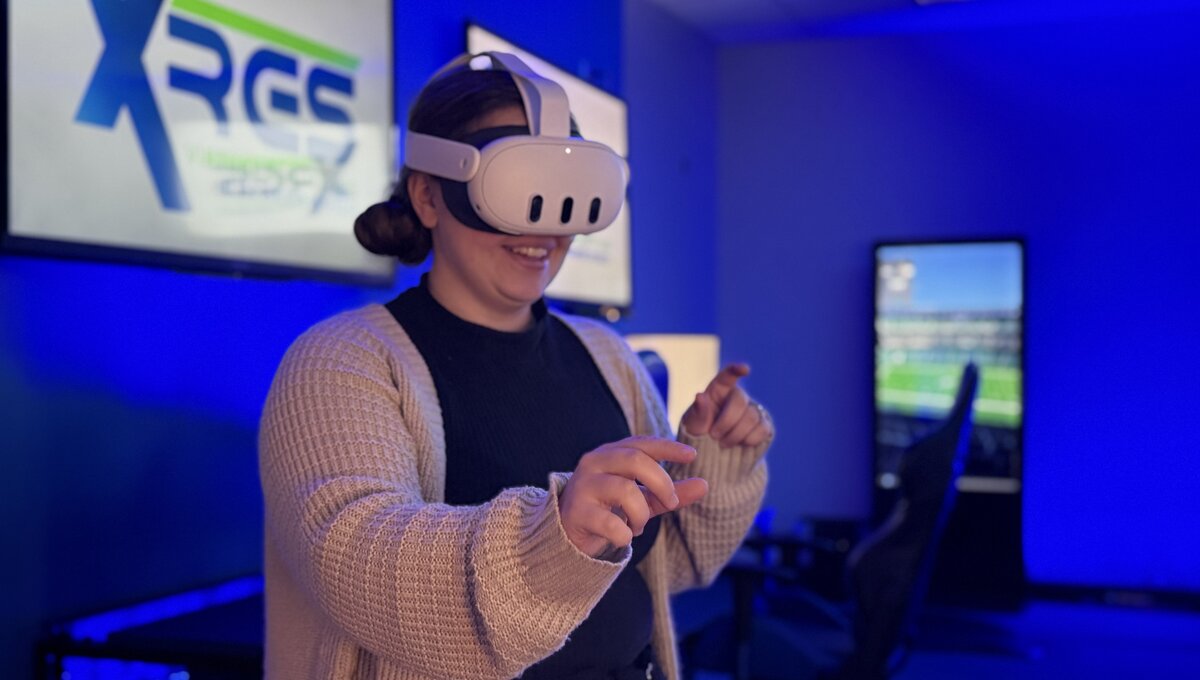
Inside Old Dominion University’s XR Lab in Albert Brooks Gornto, Jr. Hall, that simple interaction is driving a larger question. Can future counselors learn one of the profession’s most difficult skills — not simply diagnosing problems, but understanding another person’s lived experience — before they ever meet a real client?
For Lauren Robins, Ph.D., an assistant professor in the Darden College of Education and Professional Studies’ Department of Counseling and Human Services, the answer may lie at the intersection of counseling, technology and something decidedly human: rapport.
“Cultural competence isn’t a checklist,” she said. “It’s learning to see the whole person and approaching them with empathy.”
That philosophy has become the foundation of a research project Dr. Robins is leading, alongside doctoral student in counseling Chukwuebuka Onyia. The project didn’t begin with a grant proposal or a new piece of technology. It began with a challenge Chukwuebuka experienced himself.
When he arrived at the University to pursue his doctorate, he quickly realized that, while he had spent years studying counseling, clinical experience was something else entirely. There were techniques to learn, conversations to navigate and, perhaps most daunting of all, the quiet fear shared by many beginning counselors: saying the wrong thing when another person is counting on you.
“I wasn’t that strong clinically,” Chukwuebuka said. “How do I give other students like me an opportunity to practice and catch up?”
His idea was simple. What if students could practice difficult counseling conversations in a realistic environment before stepping into practicum? What if they could make mistakes, receive feedback and try again without the risk of harming a real client?
That question followed him to a conference presentation where he shared an early vision for using virtual reality in counselor education.
Among those listening was Dr. Robins.
“This is brilliant,” she remembers thinking. “Let’s do this.”
The project also reflects ODU’s growing approach to learning innovation: pairing faculty expertise and student ideas with emerging technologies, instructional innovation and spaces designed for experimentation. Through this approach and with support from the XR Lab, the research team was able to move the concept from an idea into an experience students could actually use.
Soon, Dr. Robins and Chukwuebuka began building the experience from the ground up — brainstorming case studies, writing grant proposals, developing virtual client profiles and deciding what they wanted students to learn from each interaction. With support from the University’s Division of Enrollment, Transformation and Technology, the idea expanded beyond the counseling classroom, giving Dr. Robins and Chukwuebuka the relife
The project is now part of the learning experience for graduate students in the University’s counseling program. Through virtual simulations, students step into counseling sessions with AI-powered virtual clients before they begin working with real ones.
The research team developed a growing cast of virtual clients, each with their own background, personality and concerns.
Santiago is an engineering student struggling with anxiety, panic attacks and the pressure to succeed. Maya, another avatar, is navigating burnout, physical exhaustion and institutional mistrust, which requires students to practice cultural humility, while building rapport.
The technology gives students something difficult to replicate in a traditional classroom: the opportunity to experience how their choices can change the direction of a counseling session and then learn from those choices before the stakes become real.
For Chukwuebuka, the project has become a defining part of his doctoral journey.
“I had an idea, and my professors and the University helped me shape it,” he said.
That idea is now giving other counseling students something Chukwuebuka once wished he had himself: a place to practice difficult conversations, make mistakes and build confidence before a real client is counting on them.
It also demonstrates what can happen when students are given opportunities to help shape their own education. By bringing together Chukwuebuka’s experience, Dr. Robins’ expertise and emerging technology, the project is creating a new way for future counselors to prepare for the deeply human work ahead of them.