

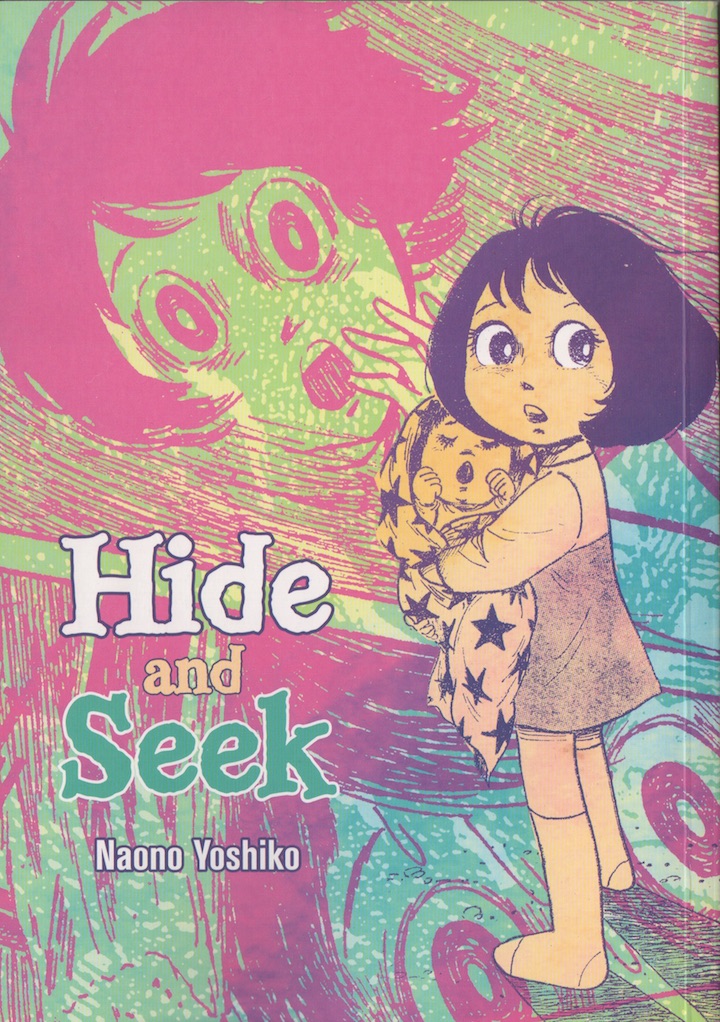
Children are always screaming, or so it seems, from the Drifting Classroom of Kazuo Umezz, or the sounds of a schoolyard. But it is not the case. Sometimes things are quite quiet, and it is in this quiet where despair lies, the cousin to the melancholy of childhood that so much of the best art about childhood touches on. The feelings evoked by Naono Yoshiko’s manga — dubbed “trauma shojo,” a genre designation I had never seen before, and collected in the volume Hide And Seek from the Smudge imprint of historic horror manga — are upsetting to behold, the silence offered up in the stead of cries for help. While Umezz’s mood is one of hysteria, Naono’s is one of desperation. Her art, comparatively amateurish, conveys a sense that she felt psychologically compelled to tell these stories; her retrospective essay recalling much back-and-forth with editors to make work of professional standards. You can see it in her characters’ eyes: The rough-hewn linework of the pupils, suggesting the gleam of suppressed tears in marks that don’t accumulate into a solid black.
Umezz’s characters find themselves in horrible circumstances, but Naono’s hells are of their protagonists’ own making, acting out poorly when faced with problems that from an adult perspective border on non-existent. One kid loses her shit when she loses the diary that contains her secrets. The kid in “Wool Overalls” has his grandma making homemade clothes for him, which he’s embarrassed by, though everyone compliments him on them and says they look nice. The resolution of the story is very much a spoiler, but it’s important that you know it so you understand how these stories work: He kills his grandma.
It’s a very particular strain of children’s horror found in these tales. It’s a far cry from Shigeru Mizuki’s tales of Kitaro and the Yokai, which are understandably beloved. I don’t know how safe it is to state, as if it were a universal truism, that kids love monsters. Certainly many do, embracing Halloween, delighted by its masks even more than they are addicted to the attendant sweets. Many more, possibly all, will find themselves spooked in that hypnogogic space of the darkened room, where shadows and any sounds suggest all that is unknown. This psychology isn’t the fear of the dark, but it’s the sort of constant terror you live with when you fundamentally don’t understand the world and how consequences work. I like to intellectualize that the reason I love horror has little to do with the gore or kills, these things to which a certain camp value can be attached to, and more to do with how it’s in touch with these deep wells of emotion, like dread, which cannot otherwise be articulated, and can only be mediated through a mixture of deep technical ability and avant-garde tendencies towards dissonance to communicate feelings of wrongness. Naono’s avant-garde pedigree is attested to by her past as a Garo contributor, prior to the stories in this volume, which appeared in more mainstream shojo publications. Not for Naono is the elegance ofKuniko Tsurita. Instead there is this naiveté which suits the subject matter perfectly. Still, in its lack of mastery we find an echo of the “not for everyone” caveat you’d say to acknowledge that these comics are pretty upsetting.
There are typos and errors of translation from Smudge editor Ryan Holmberg. I was taken out by a line in “Wool Overalls” where clothes are called “nice digs,” an attempt at era-appropriate slang that fails because “digs” would refer to a place of residence. (Presumably “duds” was the word that was intended.) The image quality is not great, sourced from copies of the early seventies shojo magazines where they initially appeared rather than the artist’s originals, the latter having been lost to an earthquake. Better captured are illustrations produced for an art show, predating the comics, which will likely be for many readers the highlight of the book, with their penciled shading and forthrightly gruesome imagery. Some are gross, but others come close to fantasy imagery, of a different world entirely than the realism of her stories.
Carlos Saura’s 1976 film Cria Cuervos also examines the internal world of children from their perspective, as they arrive at decisions to kill their elders quite casually. That film positions this child’s attitude to killing in the context of Franco’s Spain; its title a reference to an aphorism which translates to “Raise ravens and they’ll peck your eyes out.” A child raised against a backdrop of fascism, that sees enemies everywhere and then aims to eliminate them, will be inculcated with a system of thought that will think nothing of killing parental figures in turn.Hide And Seek doesn’t see a political valence to its children’s attitudes; Naono’s authorial voice is closer to the perspective of the film’s young star, Ana Torrent, unaware of the film’s political messaging, than that of its director.
These comics were originally presented to children, though that was fifty years ago, and their author admits many plot points would not fly these days for that audience. In encountering them now, we have the gift of a better understanding of what they were dealing with, because we know the adults they grew into. Recently I have been ruminating on North American alternative cartoonists of the 1990s, whose work feels out of step with contemporary trends in publishing, or how publishers perceive the younger audience who would constitute the audience for fresh printings, and whose work is now mostly out of print. A book like the David Wojnarowicz/James Romberger/Marguerite Van Cook collaboration Seven Miles A Second, like the work of Renee French, Jess Johnson, Dave Cooper, Chester Brown, Phoebe Gloeckner, and Debbie Drechsler, feels marked by a parental inattention that in retrospect feels distinctly Generation X, a sort of freedom that passed into terror, and was often not even treated as terrifying so much as it was just the makeup of the world.
Much of America’s current move towards fascism is understandable as the death throes of an aging population seeing the way the world has moved beyond them and tried to improve upon the mistakes that were made. One sign of younger people’s rejection of the casual ideology of their forebears is that parents today are far more physically and emotionally present in the lives of their children than what they experienced as children growing up themselves. Data shows fathers today, in particular, spend more time with their children than men of previous generations did with theirs. The death drive of fascism depends on being fucked up psychologically, and so right-wing efforts to mitigate the stabilizing power of parental love are mediated through technology: misinformation, propaganda, and thought-terminating AI are all laundered through the tablet, the wire mother a child might learn to love. The best efforts to redact the presence of President Trump from the Epstein files belie how much of fascist thought is motivated by a desire to molest children, which, let’s not be coy, is what much of the alt-cartoonists I enumerated made work about being subjected to.
Kazuo Umezz’s My Name Is Shingo culminates by presenting the threat of sexual predation against a backdrop of nuclear annihilation, tapping into a vein of true emotional reality, but Hide And Seek is safe-for-kids enough to not taunt them with such extreme dangers. As we work our way through the book’s chronologically-presented stories, we do eventually end on a story depicting a society built around child sacrifice to a snake god. This is not a sin-eater, the karmic payment for the evils done by children earlier in the book. Rather, a society based on child sacrifice seems rooted in the same violent overreaction to momentary discomfort which led an emotionally immature protagonist to off their baby sibling.
The story, and the book as a whole, ends on a sequence of panels which feels very Garo. A hand, isolated in black space, trembles and the pointing finger, that accuses and damns, points out towards the reader. Naono’s storytelling never feels as assured and seamless as it is in the hands of masters like Yoshiharu Tsuge, but you are able to follow her stories always, and in a moment like this, the plot implications are clear, unless you are so obtuse you refuse you admit to a total identification with the story’s main character. Mutely, we accept our fate, feeling we’ve deserved it. But imagine the kid, reading these stories, so freaked out they’ve gotta walk around for a while, not talking about it. That sort of freaked-out reaction is a rejection of the basic premise, and an explanation of why Umezz was so much more popular he became an icon: Children have every right to scream.
