

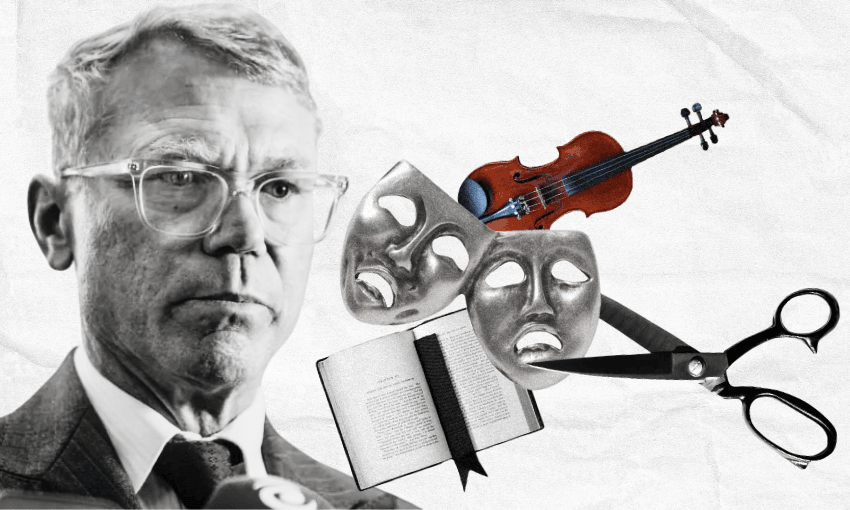
Arts, culture and heritage minister Paul Goldsmith (Photo: . Compilation: The Spinoff)
We asked arts industry representatives what funding cuts and political indifference is doing to the arts. The answer? ‘This is really fucked.’
About two weeks ago, Carrie Rae Cunningham received an invitation to a one-on-one meeting with Creative NZ. “I thought, ‘Oh no, this can’t be good news,’” said Cunningham. She’s the CEO of Massive, a Tāmaki Makaurau theatre company celebrating its 35th anniversary. So many people have come through Massive’s doors that Cunningham and her staff play a game called Spot the Massive.“You’re like, ‘Oh, there’s so-and-so,’” she told me.“They’re directing, they’re acting…they’re in international films.”
The news wasn’t good. Massive has received an average of $231,000 each year for the past four years from Creative NZ, a government organisation designed to “encourage, promote and support New Zealand arts”. That money goes towards Massive’s free workshops, education programmes and live productions. After a $27m reduction in arts funding over four years was confirmed in this year’s budget, Cunningham expected a small decrease in the money it receives, perhaps 10-15%. “We could manage that,” she said.
But Cunningham was stunned to learn its funding would be cut to just $90,000. “A 60% cut is fucking huge for us,” she told me. When we talked earlier this week, she admitted the shock “still hasn’t worn off”. Cunningham was busy planning, pivoting and thinking ahead, trying to work out how Massive will survive and keep offering opportunities to anyone who wants a career in the arts. “Tohave this huge blow delivered to us while we’re celebrating our 35th [anniversary], it’s like, ‘Oh, wow, happy birthday, and here you go, we’re taking a big chunk out of your budget’.”
Massive isn’t the only one suffering. Across multiple interviews, industry representatives for theatre companies, dance studios, writers festivals and more expressed dismay about the impact of the latest funding decisions. Some were restructuring their companies, figuring out how to move forward. Others were considering giving up. When I asked Jo Randerson, who runs Te Whanganui-a-Tara’s Barbarian Theatre, if her cut would be existential, she paused, then agreed. “[Closing] is definitely one of the possibilities for us,” she said. Then she told me she’d just talked to an older colleague with 45 years of experience.“He’s never seen it as bad as this.”
You don’t have to look far to find others struggling with the paucity of funding. Zanetti, the artistic producer for Tāmaki Makaurau’s Tempo Dance Festival, should be focusing on this year’s 25th anniversary celebration in October, with an entire week of shows. Dance is something more are turning to as a coping mechanism for life in 2026, Zanetti told me. “Being in a space with real bodies, doing real things… is really transformative,” they said. Tempo’s Creative NZ application for 2027 was rejected. “It’s really gutting for everybody. It’s going to be very hard for us, as a team.”
Others are reeling too. Just 10% of Creative NZ’s funding went to the South Island, a statistic multiple people recounted to me with surprise. “Shocked, devastated and confused,” wrote the Dunedin Arts Festival on Facebook about its unsuccessful application. Michael Bell, who runs Ōtautahi Christchurch’s beloved Little Andromeda theatre, had its application denied too. All his energy was now focused on trying to stay open until Christmas. “We didn’t budget to be in this situation,” he wrote on Facebook. “Just come down and enjoy the theatre while it’s here because, yet again, who knows what the future holds.”
Sometimes, emotions boiled over. After our interview, Cunningham emailed me his opinion of the National Party’s Amplify arts strategy, implemented when it won the 2023 election. “Here we are three years later looking at obliterated arts funding and investment,” she wrote. “The strategy was doomed from the beginning and [paid] lip service to the industry. They do not give a shit. [Arts, culture and heritage minister] Paul Goldsmith has no fucks to give about the portfolio he holds and has actively worked to decimate our entire industry.” Then she wrote: “So, yeah, we’re pretty upset about it.”
Goldsmith did not respond to two requests for comment for this story. Is this just the National Party being the National Party? Erin Harrington, an arts critic and senior lecturer at the University of Canterbury, said arts funding has stayed stagnant or declined over successive governments for the past 20 years. She pointed to Helen Clark’s 1999 strategy as the last time a proper, well-thought-through policy was implemented by a sitting government. She was exasperated. “Why does it have to be this hard?Why do people have to struggle this much?” Creatives should just be able to do the job that they’re really good at.”
Like everyone, Harrington agreed these cuts feel different.“We’re in a situation where the cuts have gone down to the bone,” she told me. She pointed to a 2024 Massey Universityresearchpaper that showed every $1 spent on live performance returned $3.20. “You onlyhave to look at the GDP contribution of the arts to go, ‘This needs investment, and if we invest more, we’re going to get more out of it.’” Instead, it’s gone the other way. Now,she worried there were long-lasting ramifications.“It’s beyond going, ‘We’d like a little bit more, please.’There’s this critical mass at the moment of people going, ‘This is really fucked’.”
It’s an issue across the arts. Music venues are closing across the country. This year, Hide in Christchurch, Nivara Lounge in Hamilton and Underworld Tavern in Wellington, have closed, or will close soon. Auckland venue Neck of the Woods recently announced its own closure,, but a last-minute community rally saw $150,000 fundraised through Givealittle.At a community hui held to find a way to make his K’ Rd venue sustainable, ownerJonah Merchant admitted he felt guilty for “sucking all the oxygen out of the room for others who need community fundraising”. “We need to come up with answers quickly,” he said.
Creative NZ didn’t respond to requests for comment by deadline, but no one blamed the entity for the decisions it was forced to make. “They’re in a tough position,” Zanetti, from Tempo, said. ”They are doing their best to advocate for more money coming into the arts… there just isn’t enough pūtea in the mix.” The organisation is suffering its own cuts, recently announcing its team of 84 would be reduced to 55. “What the government has put into Creative NZ has remained static for 20 years,” said Harrington. Some organisations were reliant on gaming trusts and Lotto grants to make up funding shortfalls. “I feel really gross that Pokies fund a lot of this stuff.”
If anyone’s holding out hope that this year’s election could change things, it seems unlikely. With voters focused on the cost of living, and the economy still struggling to lift off, politicians have other priorities. The Spinoff scoured the websites for each major political party, but only one, the Greens, had anything resembling an arts strategy. We then reached out to each party’s arts spokesperson. Just three replied. Act’s Todd Stephenson said an arts policy was “unlikely”. “Astronger economy and more money in New Zealanders’ pockets will benefit the arts,” he said. Labour’s Rachel Boyack said an arts policy was coming shortly, but couldn’t discuss the details. She warned: “We’re not going to be able to reverse all of the cuts immediately.”
Kahu Carter, the arts spokesperson for the Greens, had a different idea. She sent through a link to the party’s just-publishedarts policy document,which runs to five pages and calls the arts “essential social infrastructure”. It discusses funding increases and the need for the industry to be “properly resourced”. Carter then texted me a link to a video of her questioning Paul Goldsmith about his arts funding cuts. “Well… ahh… umm… I mean, obviously… ahh… umm,” Goldsmith replies. She captioned it: “Might be a Goldsmith but not a wordsmith.”
Over the phone from her home inŌtautahi Christchurch, Carter lamented the state of things. “Creativity is part of the human experience,” she said. “We need to look at creativity as [being] as important as eating and exercising and good health care because it is part of who we are.” She sounded like a frustrated schoolteacher trying to find new ways to say the same thing. “It would be such a grey world without our storytellers… If we are not our stories, who are we?”
So what happens next? Everyone spoken to this piece was scrambling, working their way through that question, worried about the ripple effects. Randerson had been in meetings all day, attempting to stretch budgets and hold things together. Everyone was worried about the future, how they’d survive, keep the dream alive, hold on for better days. “We’re creative people and creative people are really good at solving problems,” Cunningham said. Then she paused and corrected herself. “I’m not entirely sure that finding money is a creative problem.”
Art can, and does, endure. Harrington pointed to Vincent Andrew-Scammell’s recent production Oceania’s 11 as evidence of what can be done with very little. It was inspired by a $17,000 funding application denied by Creative NZ. “Everything was made out of cardboard,” she said. “He’d made the soundtrack, was operating things on stage himself. He was playing 24 characters… It was a masterclass in innovation.”
Harrington’s first thought was, “This is incredible.” Yet her next thought was more troubling. What if someone involved in arts funding decisions saw Andrew-Scammell’s show and got the wrong idea? “This is part of the problem,” she said. “People will innovate and create by any means. And that means the people who make some of these decisions might look at it and go, ‘They’re fine,’ you know? ‘They’ll find a way.’”
