

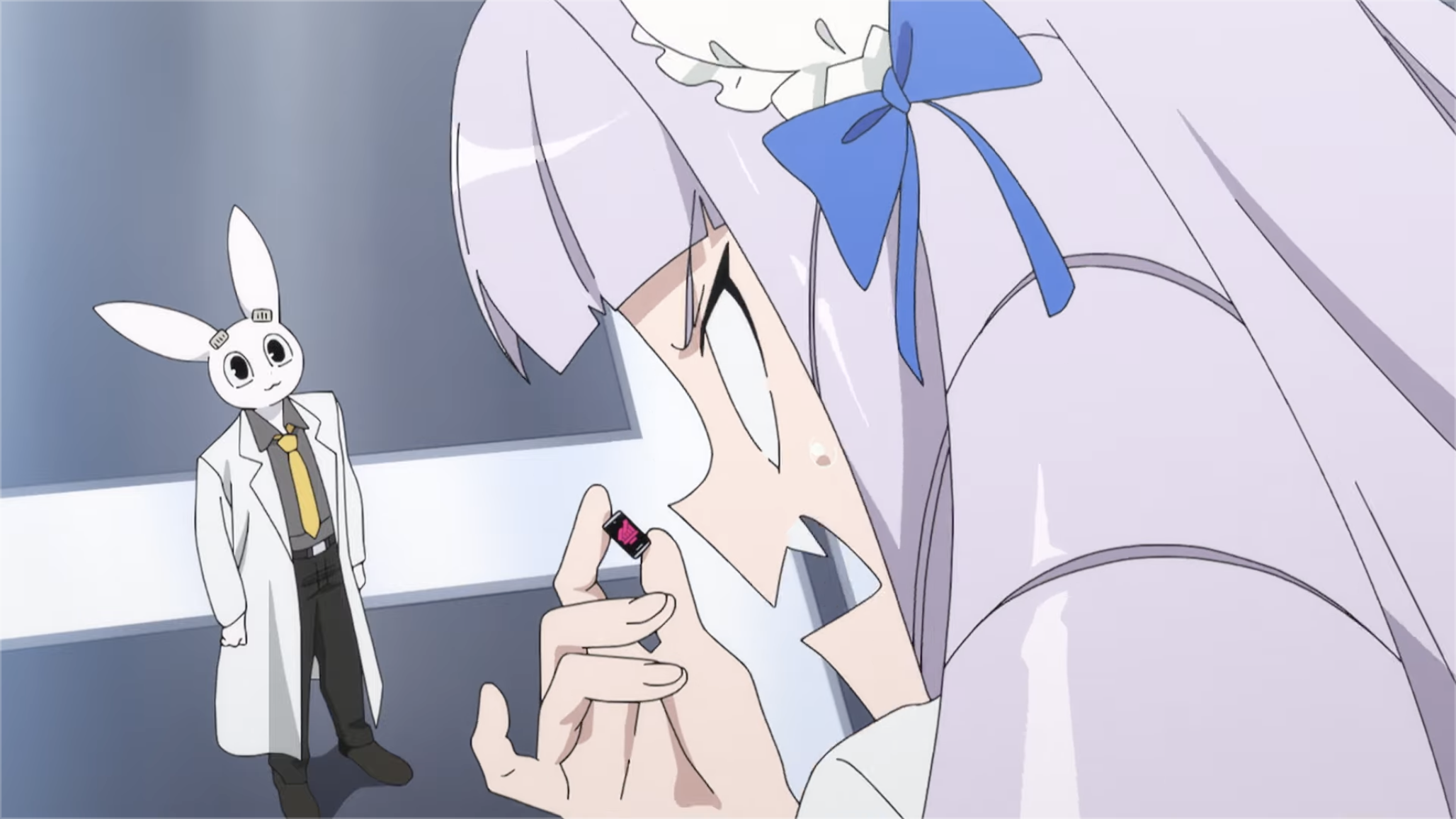
On September 3, 2026, Tatsunoko Production’s adaptation of Nikumura Q’s Giant Ojōsama<a href="https://animecorner.me/giant-ojo-sama-anime-reveals-first-trailer-yu-serizawa-and-junya-enoki-lead-voice-cast/” rel=”nofollow noopener” target=”_blank”>dropped its first teaser trailer and announced its main voice cast — and the casting news is the least interesting thing about what is quietly one of the strangest speculative premises in recent anime: the city that the giantess Oriko Fujidō was born to protect is not a symbol of what she values. It is an accidental interstellar invitation.
That detail — that Oriko’s city was physically laid out so that its street grid reads, in the Invaders’ cartographic writing system, as “Hey! Come and visit my city!” — is the franchise’s most conceptually original move. Real SETI researchers have spent decades worrying about unintentional electromagnetic leakage from Earth’s radio and television broadcasts alerting distant civilizations to our presence. Giant Ojōsama proposes something older and stranger: that urban infrastructure, the geometry of streets and blocks, could itself be a technosignature — a measurable artifact of a civilization’s existence — if the civilization reading it happened to develop writing from city-plan topology rather than from phonetic or ideographic systems. Jill Tarter, who coined the term “technosignature” at the SETI Institute in 2007, defined it as any measurable property providing scientific evidence of past or present technology. A planned city grid is technology. Whether it is readable from interstellar distances is an engineering problem, not a philosophical one.
Yū Serizawa will voice protagonist Oriko Fujidō; Junya Enoki — Yuji Itadori in Jujutsu Kaisen — will play Dr. Sebastian, the scientist-butler who invented both the growth drink and the shrink drink. The series, directed by Hiroshi Ikehata (TONIKAWA: Over the Moon for You) with series composition by Yū Satō — multiplene outlet initially listed Yū Mitsuya — premieres in Japan in January 2027
What Oriko Owns, and Why That Is the Whole Point
Oriko Fujidō is the teenage heiress of the Fujidō Zaibatsu — a corporate empire whose monopoly product is Japan’s entire vending machine industry — who was given an entire functioning city as a birthday present when she turned four. When a kaiju attacks years later, her butler Dr. Sebastian administers an experimental energy drink that triggers rapid gigantification, Oriko defeats the invader, and she then voluntarily commits to defending her city through repeated transformations, inadvertently causing as much structural damage as the invaders themselves.
The premise operates on the logic of the zaibatsu, Japan’s great vertically integrated family-controlled conglomerates of the Meiji and Taishō eras. At their historical peak, the four great zaibatsu — Mitsui, Mitsubishi, Sumitomo, Yasuda — controlled banking, manufacturing, trade, and shipping at a scale that made them co-administrators of large portions of the Japanese economy. They were dissolved by Allied occupation forces after World War II and succeeded by the looser keiretsu networks. Giant Ojōsama‘s worldbuilding asks what the zaibatsu model might have become if, instead of being dissolved, it had extended from economic to territorial sovereignty — from owning companies to owning cities outright.
The political-theoretical implication is precise. Max Weber defined the state as the institution holding a monopoly on legitimate violence within a territory. In Oriko’s city, that monopoly is held by a teenage girl whose qualification is that her family owns the property. The police are explicitly vestigial, because the only threats are kaiju-scale and no municipal police department has tools relevant to that threat. Oriko’s city is not a democracy, a republic, or even a feudal fief in the traditional sense. It is a proprietary settlement: a municipality that functions exactly like a privately-owned building, where the owner’s authority derives from the deed rather than from any social contract.
The term for Oriko’s character archetype is ojōsama — from the Japanese お (honorific prefix), 嬢 (young lady), and 様 (high honorific suffix), a formal address for the daughter of an honored house. As a manga and anime archetype, the ojōsama is rooted in Japan’s aristocratic aesthetic fusion — Japan’s Meiji and Taishō era fascination with Western aristocratic aesthetics fusing with traditional Japanese nobility. The archetype crystallized through decades of shōnen and shōjo media: wealthy, refined, attended by retainers, set apart by breeding and comportment. In conventional usage, the ojōsama has authority derived from wealth and status — she does not earn her position, she was born into it.
Giant Ojōsama does not invert this. It extends it to its logical extreme. If your authority over a city derives from owning it, and you genuinely believe in the aristocratic obligation to protect what you own — the noblesse oblige compact that justified the whole system — then the logical conclusion is to physically become the protection. Oriko grows to kaiju scale not despite being an ojōsama but because she is one. Her gigantification is the noblesse oblige made literal, which is why the comedy of the series operates on a single structural irony: the obligation to protect and the act of destroying are, at her scale, the same gesture.
The Fujidō Zaibatsu’s monopoly product adds a layer the series does not quite state out loud. Japan has historically maintained one of the highest vending machine densities per capita of any country — a network of automated distribution infrastructure so prevalent it effectively constitutes an ambient commercial presence in daily life. A zaibatsu that controls all vending machine production controls automated distribution itself: the mechanism by which commodities reach people without requiring human interaction. It is a corporate power that is omnipresent and faceless — until the daughter of the house grows 70 meters (230 feet) tall and becomes, suddenly, impossible to ignore.
Oriko’s City as Interstellar Message: What the Franchise Understands About SETI
The franchise’s most conceptually significant reveal is that Oriko’s city was laid out — roads, blocks, and districts arranged in a top-down plan — so that it reads, in the Invaders’ writing system, as an open invitation. The Invaders’ script resembles a city map. Oriko’s father either unknowingly or deliberately encoded a greeting in the city’s urban infrastructure.
This premise engages seriously with one of the live questions in SETI research: what constitutes an unintentional technosignature from a civilization that is not trying to communicate?
The conventional technosignature framework, formalized by Jill Tarter and developed by researchers including astronomer Thomas Beatty at the University of Wisconsin, focuses primarily on electromagnetic signals — radio leakage, artificial optical emissions, atmospheric industrial pollutants, and the nightside brightness of cities visible on exoplanets. Beatty’s 2022 paper in Monthly Notices of the Royal Astronomical Societyproposed that sodium street lights on exoplanets could be spectrally distinguished from natural sources using proposed next-generation space telescopes. City lights, in this framework, are not a deliberate message — they are a byproduct of civilization that happens to be detectable.
Giant Ojōsama proposes something structurally parallel but physically different: not city lights but city geometry as a readable artifact. For this to work as science fiction, two things must be true. First, the Invaders must have a writing system derived from urban cartography — their script must be topologically isomorphic with city-plan layout. Second, they must possess the observational resolution to read a city grid from interstellar distances.
The second condition runs into real physics. The Rayleigh criterion — θ = 1.22λ/D — sets the theoretical limit on what an optical system can resolve, where λ is the wavelength of observation and D is the aperture diameter. To resolve individual city blocks, approximately 100 meters (328 feet) in width, from a distance of just one light-year (approximately 9.46 × 10¹⁵ meters, or 5.88 × 10¹² miles), would require a telescope aperture of roughly 58 kilometers (36 miles) in diameter — far beyond any human engineering capability, but not planetary in scale as some popular accounts suggest. The Invaders’ observation capability either requires a civilization at a significantly higher engineering level than humanity, or — and this is the interpretation the manga supports — the Invaders did not read the city from interstellar distances. They passed through the solar system, conducted a close-range survey, read the street grid at a distance where 58 km (36 miles) apertures are unnecessary, and then came back. The visits are not random. They are return trips.
The first condition — a writing system derived from city-plan topology — is where the premise connects to real cognitive linguistics research. Researchers including Stephen C. Levinson at the Max Planck Institute for Psycholinguistics have documented that spatial cognition shapes language structure: in many human languages, spatial metaphors provide the substrate for abstract thought, and spatial reasoning both influences and is influenced by language structure. A civilization whose cognition is fundamentally spatial — whose earliest forms of symbolic representation were maps rather than phonetic or pictographic systems — might naturally produce a script that is isomorphic with the plans of built environments. This is not incoherent as a linguistic hypothesis. It is a direction that spatial cognition research makes plausible, even if no human writing system has actually evolved this way.
The franchise’s implicit conclusion is the one that real SETI has not formally addressed: if an alien civilization developed writing from city-plan topology, then every planned city in human history has been broadcasting a message in that language since its streets were laid, and no radio telescope would detect it.
Why the Physics Cannot Work, and Why the Manga’s Answer Is Honest About That
Oriko’s combat scale — approximately 70 meters (230 feet), based on the manga’s visual framing against standard buildings — runs directly into the square-cube law, first articulated by Galileo Galilei in his 1638 Two New Sciences. When a body scales by linear factor k, its mass scales as k³ while the cross-sectional area of its bones and muscles — which determines structural strength — scales only as k². At k = 40 (approximately 70 meters / 230 feet from normal human height), bone stress is 40 times what human cortical bone can sustain. The bones would fail on the first step.
This is not a problem the manga resolves — it is a problem the manga openly signals. Oriko is revealed to be half-alien on her mother’s side, which is the franchise’s way of saying that the human body is not what is being scaled. The growth drink does not amplify human biology; it activates a dormant alien biological program whose scaling rules are different from those that constrain Earth life. Dr. Sebastian’s drink is not a growth hormone — it is an activation mechanism for a physiology that was not built under Earth’s evolutionary constraints.
This is the correct approach. The square-cube law has appeared in prior TechTimes coverage of kaiju anime on multiple occasions, including the Kaiju Girl Caramelise premiere analysis and the Monsterverse prequel piece on Biopreparat. Rather than repeat that analysis here, it is worth noting where Giant Ojōsama‘s treatment of the physics problem differs from those franchises: it does not try to naturalize the physiology within Earth biology. The alien-heritage explanation is acknowledged as a biological axiom-level departure from real physics, and everything else — the combat capability, the selective size control, the transformation speed — is held consistent with that axiom. That is the specific discipline that distinguishes rigorous speculative biology from handwaving.
The mass conservation problem is actually harder than the structural one, and the manga gestures at it with the joke about Oriko gaining weight at normal size making her too heavy for city roads when transformed. At 40× scale, a 60-kilogram (132-pound) human would mass approximately 3,840,000 kilograms (8,466,000 pounds). That mass has to originate somewhere. The only coherent in-universe answer, consistent with the alien-biology premise, is a mechanism for mass-energy interconversion — a dormant biological program capable of drawing on ambient mass or energy during transformation. The shrink drink poses the same problem in reverse: where does the mass go? The franchise does not answer this, but it acknowledges the question exists, which is more than most giantification narratives bother to do.
From Godzilla’s Keloid Skin to Oriko’s Protective Suit: Kaiju as Normalized Catastrophe
The kaiju tradition in Japanese popular culture began as trauma encoding. Godzilla’s 1954 debut, directed by Ishirō Honda, arrived nine years after Hiroshima and Nagasaki and weeks after the Lucky Dragon 5 fishing vessel received radioactive fallout from a hydrogen bomb test. Godzilla’s skin — heavily furrowed and textured — was designed to evoke the keloid scars of atomic bomb survivors. Japanese audiences left the original Gojira in tears. As historian William Tsutsui, author of Godzilla on My Mind (Palgrave Macmillan, 2004), has documented, the film was marketed in Japan as a “hydrogen-bomb giant monster film” (水爆大怪獣映画) — the nuclear anxiety was not a subtext; it was the explicit selling point.
Giant Ojōsama belongs to a comic register that could only exist generations after that original trauma has been fully processed and domesticated. The signs are everywhere in the franchise’s worldbuilding. Citizens of Oriko’s city wear full-body protective suits continuously — suits so normalized that they are visually indistinguishable from ordinary clothing. The suits are not emergency gear. They are what people wear. The city is rebuilt after each kaiju battle not as a sign of resilience but as a matter of routine, the way anyone maintains a property that occasionally gets damaged. The Invaders, it turns out, are not malevolent conquerors but visitors responding to what they understood as an open invitation. The central invader’s motivation, once revealed, is roughly equivalent to a tourist who read an advertisement and showed up.
Where Godzilla encoded the horror of nuclear destruction as a giant monster arriving from the sea, Giant Ojōsama encodes the dark comedy of normalized catastrophic risk in a society organized around corporate ownership of public space. The disaster is managed. The infrastructure for managing it is privatized. The giantess-protector is also the primary source of structural damage. Her protective violence and her collateral destruction are not in tension — they are the same act, viewed from different positions in the city she owns.
The protective suit ecology is also, incidentally, a materials science thought experiment. A wearable suit providing reliable civilian protection against the incidental effects of two giants fighting — seismic shocks, falling masonry, debris at high velocity, pressure waves — would require materials science substantially beyond current capability. Current military and industrial personal protective equipment (PPE) is optimized for specific, bounded threats: blast overpressure, fragmentation, chemical exposure. A suit capable of continuous civilian wear while simultaneously protecting against kaiju-scale collateral effects would require either exotic metamaterials with tunable mechanical properties, or active protection systems — distributed airbags, electromagnetic shielding, adaptive rigidity — miniaturized to civilian wearable scale. The fact that the manga presents such suits as unremarkable everyday items is itself an index of how far beyond our current engineering moment the franchise imagines its technology to be, even though the aesthetics look contemporary.
Tatsunoko Production and What January 2027 Brings
The January 2027 premiere will be the first time Tatsunoko Production — the studio behind Speed Racer, Science Ninja Team Gatchaman, and Yozakura Quartet: Hana no Uta — has adapted a property of this type. Director Hiroshi Ikehata brings experience from TONIKAWA: Over the Moon for You, an adaptation of a manga with a prominent female protagonist navigating an absurd premise with emotional specificity. The combination is suited to Giant Ojōsama‘s tonal requirement: the comedy only works if the dignity and genuine feeling underneath it are real.
Yū Serizawa, who voices Oriko, is known to Western audiences primarily for Ais Wallenstein in the Is It Wrong to Try to Pick Up Girls in a Dungeon? franchise and Makoto Nijima in the Persona 5 anime adaptation — both roles requiring her to project authority and competence while navigating circumstances that frequently undermine the character’s composure. That is precisely the register Giant Ojōsama requires: an ojōsama who is entirely sincere about her obligations and is made ridiculous by the physics of fulfilling them.
Junya Enoki as Dr. Sebastian brings the franchise’s most conceptually interesting character to a voice actor with a strong record of characters who are earnest to the point of absurdity. Sebastian is not a mad scientist in the conventional sense. He is a scientist-butler — a figure who takes both halves of his job description with complete seriousness — whose inventions include a pharmacological gigantification agent, a complementary shrinkage formula, and presumably a fairly robust liability framework for when Oriko puts her foot through another district.
The 12 volumes in print — Volume 12 released August 10, 2026 — provide a substantialelease of the manga has not been confirmed as of this writing
Frequently Asked Questions
What is Giant Ojosama about, and when does the anime premiere?
Giant Ojōsama follows Oriko Fujidō, the teenage heiress of the Fujidō Zaibatsu — a corporate empire with a monopoly on Japan’s vending machine industry — who was given ownership of an entire city on her fourth birthday. When alien kaiju begin attacking the city, her scientist-butler Dr. Sebastian gives her an experimental energy drink that causes her to grow to kaiju scale. She commits to defending her city, causes at least as much structural damage in the process as the invaders do, and — in one of the manga’s central reveals — eventually discovers that the city’s street grid was laid out to read, in the Invaders’ cartographic writing system, as an open invitation to visit. The anime adaptation, produced by Tatsunoko Production, is scheduled to premiere in Japan in January 2027, with Yū Serizawa voicing Oriko and Junya Enoki as Dr. Sebastian.
Who voices the main characters in the Giant Ojosama anime?
Yū Serizawa, known for Ais Wallenstein in Is It Wrong to Try to Pick Up Girls in a Dungeon? and Makoto Nijima in the Persona 5 anime, voices protagonist Oriko Fujidō. Junya Enoki, known internationally as Yuji Itadori in Jujutsu Kaisen, voices Dr. Sebastian, the scientist-butler who invented the gigantification drink and its companion shrinkage formula. Director Hiroshi Ikehata (TONIKAWA: Over the Moon for You) leads the Tatsunoko Production team.
Why does Giant Ojosama’s “city as alien invitation” premise matter scientifically?
Real SETI research has focused almost entirely on electromagnetic technosignatures — radio leakage, artificial optical emissions, atmospheric pollution — as evidence of technological civilizations. Giant Ojōsama’s premise proposes a different technosignature class: the geometric layout of urban infrastructure. If an alien civilization developed writing from city-plan topology — a script that is isomorphic with the arrangement of streets and blocks — then any planned city would be a readable message in that language, broadcast by its existence rather than by any transmission. Researcher Thomas Beatty at the University of Wisconsin has proposed that exoplanet city lights are detectable; Giant Ojōsama takes the concept one step further into the geometry beneath those lights. SETI has no formal framework for detecting this category of signal, which means the franchise’s most playful plot twist also identifies a genuine gap in how the field defines what it is looking for.
Is the science of giantification in Giant Ojosama physically possible?
No — at least not with human biology. Galileo’s square-cube law, formalized in his 1638 Two New Sciences, establishes that as any organism scales up, its mass grows as the cube of its linear dimension while structural support capacity grows only as the square. At Oriko’s depicted combat scale of approximately 70 meters (230 feet), the compressive stress on proportionally scaled human bone would be approximately 40 times what cortical bone can sustain. Giant Ojōsama‘s answer — that Oriko is half-alien and the growth drink activates a dormant alien physiological program rather than amplifying human biology — is the correct narrative move: it establishes a minimum axiom-level departure from real physics and then holds everything else consistent with that axiom. The mass conservation problem (where does the mass come from when she grows?) remains open, but the franchise acknowledges it rather than ignoring it, which puts it in better company than most giantification narratives.
ⓒ 2026 TECHTIMES.com All rights reserved. Do not reproduce without permission.
