

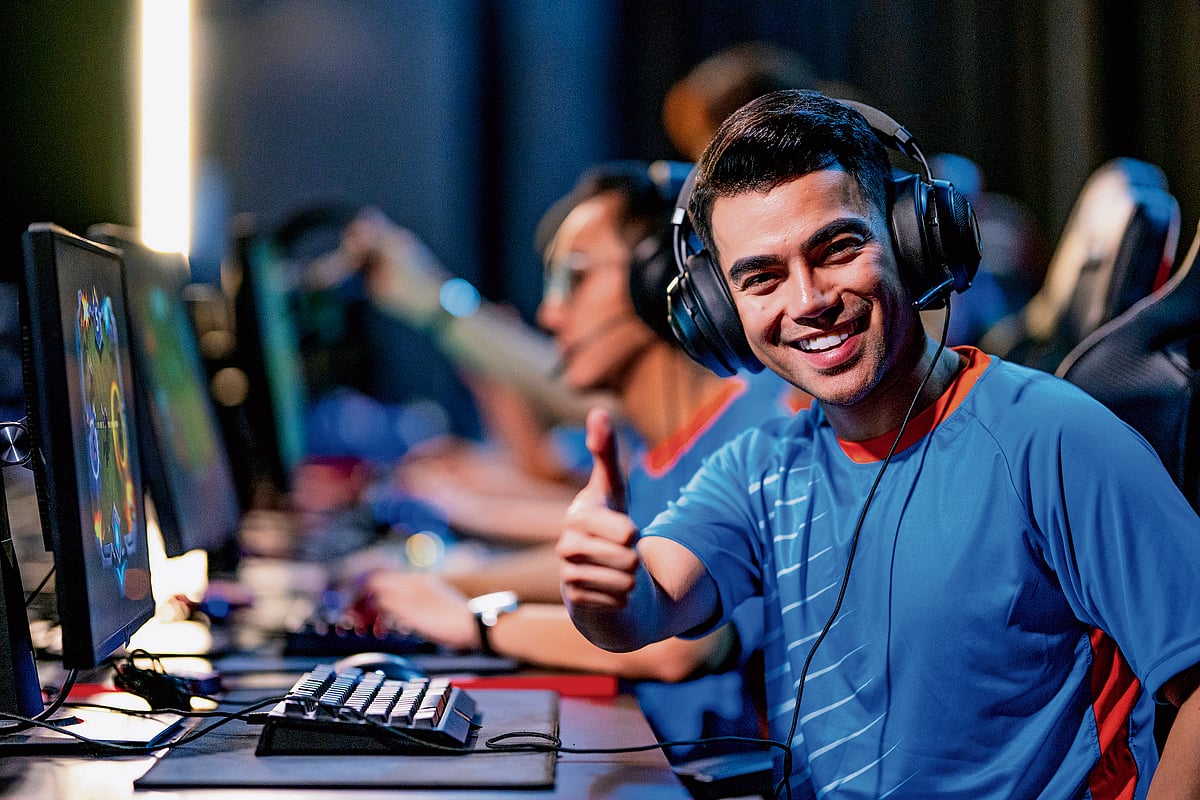
66 per cent of Indian gamers who come from non-metro cities
Updated on: 12 Jul 2026, 12:35 am
On a humid evening in Mumbai, inside an esports café glowing with RGB lights and high-performance gaming rigs, players dissect tactics with the intensity of cricket pundits analysing an IPL final. What stands out is not the noise or the screens. It is the women—a third of the room—gaming with the same focus as everyone else. Nobody is staring. Nobody is surprised. That quiet normalcy says more about Indian gaming’s evolution than any market report
A decade ago, most parents dismissed gaming as a distraction. Today, many are asking a very different question: can it be a career? The answer is increasingly yes. The turning point came during the pandemic. As lockdowns pushed millions indoors, gaming became more than a way to pass time. Young Indians, particularly Gen Z, spent hours online playing with friends, discovering global gaming communities, and watching professional streamers and esports tournaments. What began as entertainment soon revealed an ecosystem of opportunities—from competitive esports and live streaming to game development, content creation, casting, coaching and event management. For many, gaming transformed from a hobby into a viable profession. The boom extended far beyond playing games.
Naman Mathur: He helped legitimise gaming as a career for millions of young Indians. He says long-term success now depends on discipline, and reinvention
Gaming content exploded across YouTube and streaming platforms as audiences flocked to watch professional gamers, esports tournaments and live creators. Brands, advertisers, smartphone companies and gaming studios quickly followed the audience, investing in what had been a relatively small sector before 2020. Today, gaming sits at the intersection of technology, entertainment and creativity, bringing together software development, animation, storytelling, design, artificial intelligence and digital content creation. It is also helping diversify India’s digital economy beyond IT services. More importantly, it is challenging conventional ideas of what constitutes a profession.
For Gen Z, the appeal is as much financial as it is creative. Unlike traditional careers tied to a single employer, gaming offers multiple revenue streams. Professional esports players earn prize money, team salaries, sponsorships, and coaching fees. Successful streamers and gaming influencers generate income through platform monetisation, brand partnerships, subscriptions, and fan donations. Skilled freelancers are finding work in game art, animation, coding, sound design, quality testing, video editing, community management, and game localisation. The earning potential is no longer insignificant. Entry-level esports professionals may earn Rs 20,000 to Rs 60,000 a month through team contracts and tournaments, while established players can command annual salaries running into several lakhs, supplemented by sponsorships. Behind the scenes, experienced game developers, designers and technical specialists can also command salaries comparable to those in mainstream technology companies.
Payal Dhare: The first Indian woman to win a global esports award, she has helped break gender stereotypes while proving gaming can be a serious career
The shift mirrors the evolution of sport itself in India. There was a time when pursuing cricket professionally seemed unrealistic, before icons transformed it into a respected career. The same journey unfolded later with badminton, chess, tennis, and other disciplines. As India’s digital economy matures, gaming is undergoing a similar transition
For years, Indian gamers grew up hearing the same refrain: “Beta, ye sab band karo.” What slowly dismantled that consensus was not a single tournament or blockbuster title, but a steady accumulation of proof. PUBG Mobile, affordable internet, and the creator economy did something transformative: they made gaming visible. “Gaming communities today are not just playing spaces; they are identity spaces. Young people are choosing their tribe, their aesthetic, their social world through gaming,” says Divya Kholakiya, Founder of Gamingaza. That sense of belonging is a recurring theme. “Young people today are going into gaming because it gives them an identity—not just that, it strengthens their bond with their friends,” says Omkar Joshi, a Mumbai-based gaming content creator who is now planning to launch his own merchandise line and card game.
When Naman Mathur, better known as Mortal and Co-founder of S8UL Esports, built a community of millions on YouTube, he offered something Indian parents could not easily dismiss: evidence. Brij Vishal Rajput, gaming and tech creator known as @bvrbreezy, says, “When I started creating content and saw people genuinely engaging with it, I realised there was real potential to turn this into a career. That moment completely changed how I viewed gaming.” For others, gaming opened doors they never knew existed. Satva Moliya, a Pearl Academy Videogame Production alumnus from its Bengaluru campus, traces his journey to a single discovery while playing GTA. “I discovered these were called mods,” he says. “I started learning how to install them, and over time became interested in creating my own.” Today, known as SA09 in modding circles, he is working towards creating original games, even if the financial rewards remain uncertain.
Himanshu Rana: Coming from a small town, he proved that online audiences value talent over geography
Ridit Sharma, an aspiring gamer, describes a similar evolution. “Gaming was always something I enjoyed, but over time it changed,” he says. “I started feeling it in my nerves—curious about how games are made, designed, who does all of this.” Income remains modest for now, but his ambitions are not. His family’s attitude has shifted too. The wider culture is beginning to catch up. “Creators like Anshul Bisht, Piyush Joshi, and Payal Dhare have built massive audiences and successful careers,” says Samarth Kulshreshtha, Founder and Creative Director of Samarth Adworks Studio. “The child playing games today could become India’s next big gamer tomorrow.”
The proof arrived in bank accounts. Raj Varma was working at a diamond factory in Surat when PUBG Mobile changed the trajectory of his life. “At that time, even Rs 10,000 felt huge for me,” says Raj, better known as Snax, now 26. “Then suddenly we were seeing tournaments where teams could win lakhs.” His team reached the Delhi finals and finished fifth. The payout was life-changing. “Each player earned around one lakh rupees,” he says. That single transaction did more to convince his family that gaming was real than any explanation ever could.
Persistence, it turns out, is a recurring theme in Indian gaming. Gulrez Khan, better known as Joker Ki Haveli, now has 1.81 million YouTube subscribers, but came close to abandoning the industry altogether. He was seriously considering returning to Qatar for a conventional job when a conversation with Lokesh Jain, co-founder of S8UL, changed his mind. “That discussion made me rethink what I was building,” he says. “I realised this was not just gameplay or entertainment.” Today his work extends far beyond playing games. It involves scripting, production, audience engagement and building narratives across BGMI streams and vlogs. “Gaming does not have a fixed structure in the beginning,” he says. “You have to build everything from scratch—your audience, your consistency, your identity. That unpredictability is what makes it both challenging and rewarding.”
Veterans of the ecosystem have learned the same lesson. “You cannot depend on one role forever. The career is what you build around it,” says Salman Ahmad, better known as Mamba. Harsh Paudwal, known as Goblin, is equally blunt. “There is much more structure involved than people realise—strategy, content planning, reviewing mistakes, maintaining discipline across a schedule that does not have an off-day. The moment you treat it like a hobby, someone else who is treating it like a profession overtakes you.”
Animesh Agarwal: According to him, professional gaming today is as much about content, business strategy, and brand-building as it is about playing games
Power Players
Nearly 66 per cent of Indian gamers now come from non-metro cities, shattering the notion that gaming is a metro phenomenon. “Tier II and III is the market. They are playing to change their lives. The hunger there is different from anything you see in a metro,” says Shreyas Verma, Founder, Battlebucks. The trend is visible across the industry. STAN, a gaming creator discovery and fan engagement platform with 45 million users, finds much of its growth is coming from small cities. “Cities like Lucknow, Patna, Indore, Coimbatore, Visakhapatnam, and Guwahati are giving the industry fresh talent,” says Nauman Mulla, Co-Founder and COO, STAN. For creators outside the big cities, success has often meant building careers without an ecosystem. “You are figuring everything out alone,” says Himanshu Rana. “But the internet did not care where I was from. The audience just cared whether I was good.”
The shift is visible even in hardware demand. “People are prioritising a gaming PC the way an earlier generation prioritised a motorcycle,” says Vishal Parekh, COO, CyberPowerPC India. Esports cafés are also becoming launchpads for ambition. “This is a platform where people can play real games together and start taking themselves seriously as gamers,” says Chetan Makwan, Founder, Ozone Gaming. Women, though, remain underrepresented, with Sensor Tower data for FY25 showing they account for just 14 per cent of India’s mobile gaming audience. “There were judgments before there was evidence,” says Krutika Ojha, esports player.
Payal Dhare, better known as PayalGaming and the first Indian woman to win a global esports award, says the challenge was bigger than gameplay. “It was about proving this could be a real career, regardless of gender. The assumption was always that you were there by accident, not by choice.” For Monika Jeph, the scepticism became motivation. “At some point you realise that proving people wrong is excellent fuel. You stop wanting their approval and start wanting their attention on the scoreboard,” she says.
Level Up
The future of India’s gaming economy may be built around games, but it no longer belongs primarily to players. It belongs to the builders. “Gaming today is a serious career ecosystem spanning product development, analytics, design, engineering, community management, payments, compliance and marketing,” says Prateek Gupta, Founder of RNGx.gg. “The mistake young people make is assuming that if they cannot become the next Mortal, there is no place for them.” Gupta argues that gaming develops skills increasingly prized across industries. “Gaming teaches product thinking, retention science, customer psychology and execution pressure simultaneously.”
Krutika Ojha: She says women in gaming have long had to overcome bias and prove their abilities in a male-dominated industry
The jobs boom is happening largely behind the screen. “The visible part of the industry is the player on stream. The invisible part is the 10-15-person ecosystem behind every one of them—and that’s where most of the hiring is happening,” says Mulla. Demand is rising for UI/UX designers, product managers, esports coaches, performance psychologists and IP lawyers. “Gaming is becoming a full-stack technology, entertainment and media industry,” says Sagar Nair, Head of Incubation at LVL Zero Incubator. Animesh Agarwal, Founder and CEO of 8Bit Creatives and Co-Founder of S8UL Esports, agrees: “A significant part of every day goes into content strategy, brand discussions, talent management and investor conversations.”
The opportunities stretch far beyond gaming itself. Soumyadip Biswas, a Pearl Academy Videogame Production alumnus, now creates real-time 3D AR broadcast graphics for cricket leagues. “The turning point was seeing how Unreal Engine could be applied to live television,” he says. Fellow alumnus Satva points to India’s growing role in global production pipelines. “India is one of the top outsourcing countries for game assets and VFX,” he says, while noting that building globally successful original IP remains a challenge. The next hurdle is talent recognition. “Students do not always know how to articulate what they can do, and companies do not always know how to evaluate what gaming-trained talent brings to a role,” says Anurag Narayan Reddy, Associate Professor at Pearl Academy. Sonica Aron, Founder and Managing Partner at Marching Sheep, sees a retention problem. “People burn out partly because there is no structured growth path after the first three or four years.”
Ridit Sharma: He sees gaming as a long-term creative career, despite the uncertainties of earning a steady income
As the industry matures, so do its legal and commercial complexities. “Player rights, team agreements, IP ownership, prize money structures—these need proper legal framing,” says Riya Rajkumar Sharma, Counsel at AM Sports Law and Management. “The players who signed without legal counsel five years ago are only now beginning to understand what they gave up.” India’s gaming revolution, in other words, is no longer just creating players. It is creating an entire economy around them
Pressure Points
But building a career in gaming means living under constant public scrutiny, relentless competition, and deep uncertainty. “Gaming is a career, a community, and an identity, simultaneously,” says Jasmine Arora, Clinical Psychologist at Artemis Hospitals. “Losing is not just a professional setback—it is a public one, visible to your audience in real time.” At the same time, the difference between a professional gamer and an addicted gamer is control. Dr Sujit Paul, Mental Health Expert, says, “Addiction is compulsive repetition driven by avoidance rather than aspiration.” That distinction matters because gaming’s emotional volatility is unlike most professions. “Failure in gaming is instant, public and quantified,” says Nimit Saxena, founder of LURK. The result is burnout. “When you play repetitively for a longer period of time, you feel burnt out,” says Omkar.
Yet the biggest battle often happens at home. Almost every gaming professional interviewed for this story describes the same journey with family: doubt, evidence, pride. For Snax, acceptance arrived when tournament winnings began reaching his mother’s bank account. For Soumyadip, it came when his family saw his work on television. “When my family turns on the TV and actually sees the 3D graphics and AR structures I built running on screen, that initial worry turns into immense pride,” he says.
The numbers, however, demand realism. “Only about one to five per cent of people who pursue gaming professionally will make a sustainable income,” says Kumar Rajagopalan, Vice President of Strategic Initiatives and Country Head India at Dexian. “The responsible conversation is about helping young people understand the full ecosystem.”
That ecosystem is far larger than competitive gaming. “Once families see GST invoices, brand contracts and predictable monthly income, the conversation stops being ‘is this a career’ and starts being ‘how do we help our child do this seriously’,” says Mulla of STAN. Government investment, industry expansion and rising employment have pushed gaming into the mainstream. “Suddenly, the parent who was dismissing it has to reckon with the possibility that their objection is the one that is out of step, not their child’s ambition,” says Samarth.
Gaming Gold
India is already the world’s biggest gaming audience by downloads. BGMI has crossed 240 million downloads, while Ludo King—built in India—has surpassed 1.25 billion downloads globally. The next challenge is bigger: can India move from consuming gaming IP to creating it? Sagar Nair, Founder, LVL Zero, believes the opportunity is clear. “We have the engineering talent, the storytelling traditions—mythology, folklore, history—that the rest of the world finds genuinely compelling.”
Esports gaming tournaments are becoming more popular today
Prateek Gupta, Founder, RNGx.gg, frames it as a strategic choice. “India is building one of the world’s greatest talent pools for the gaming industry. The question is whether we monetise that talent by working for foreign studios or by building our own.” From the outside looking in, Shigeo Ogata, Producer, Strike World, sees enormous potential. After two years researching Indian players, he says, “The Indian audience has an interesting competitive spirit. That makes it a very relevant place for esports.” He also points to India’s collaborative streak. “The ability to play together as a team, that is something we notice.” Ogata even sees a future where India develops esports schools similar to those already operating in Japan.
For Mortal, the next phase of growth demands more than raw skill. “Success in this industry is about discipline, longevity, and the ability to keep reinventing yourself.” Animesh sees institution-building as the decade’s defining task. “The Indian gaming ecosystem does not lack talent or passion. It is learning, right now, how to convert those things into durable institutions.” The clearest sign gaming has entered the mainstream is cultural, not financial. In May 2026, Mumbai Comic Con drew more than 55,000 fans over two days, with gaming zones among the busiest attractions. Just a day earlier, Mortal Kombat II had arrived in Indian theatres, triggering cosplay tributes, tournament tie-ins, and packed fan events. The line between gaming and mainstream culture has effectively disappeared.
Gulrez’s answer to the longevity question may be the most revealing. “My strength is not just gaming—it is storytelling and connecting with people,” says the creator. The easiest way to misunderstand gaming is to reduce it to screen time—hours in front of a monitor instead of something supposedly more real. But for millions of young Indians, gaming has become a space for identity, ambition, and community. As the 2023 film Kho Gaye Hum Kahan suggested, digital life is no longer separate from real life. For many players, gaming was the first thing they were genuinely good at in front of other people. The first community they chose. The first identity that felt entirely their own. That is not ‘timepass’. That is a foundation.
Across India, the evidence is everywhere. In a Tier-II city esports café, a teenager spends six hours perfecting aim mechanics before college. In Chhindwara, a young woman streams to thousands despite being told gaming is not for girls. At S8UL’s offices, creators discuss content calendars with the precision of a startup boardroom. In Mumbai, a former factory worker explains his profession to his parents and watches confusion slowly turn into pride
Goblin puts it simply. “People from outside always think they understand what this is,” says the 22-year-old. “But from the inside, it looks completely different. It looks like play from the outside. From the inside, it feels like building something.” That may be the most accurate description of Indian gaming today. At its core, this is a story about legitimacy—and how a generation fought for it without waiting for permission. They built careers in an industry with no established pathways, little institutional support and almost no cultural vocabulary to explain what they were doing. They did it anyway.
The questions now are bigger. Can India build gaming IP that travels the world? Can the ecosystem grow without burning out the people who created it? Will the next generation from Chhindwara, Aligarh, or Palampur find a path that is more structured than the one their predecessors carved out alone?
The uncertainty that defined Indian gaming’s first chapter has not disappeared. But for the first time, it has been joined by something else: belief
