

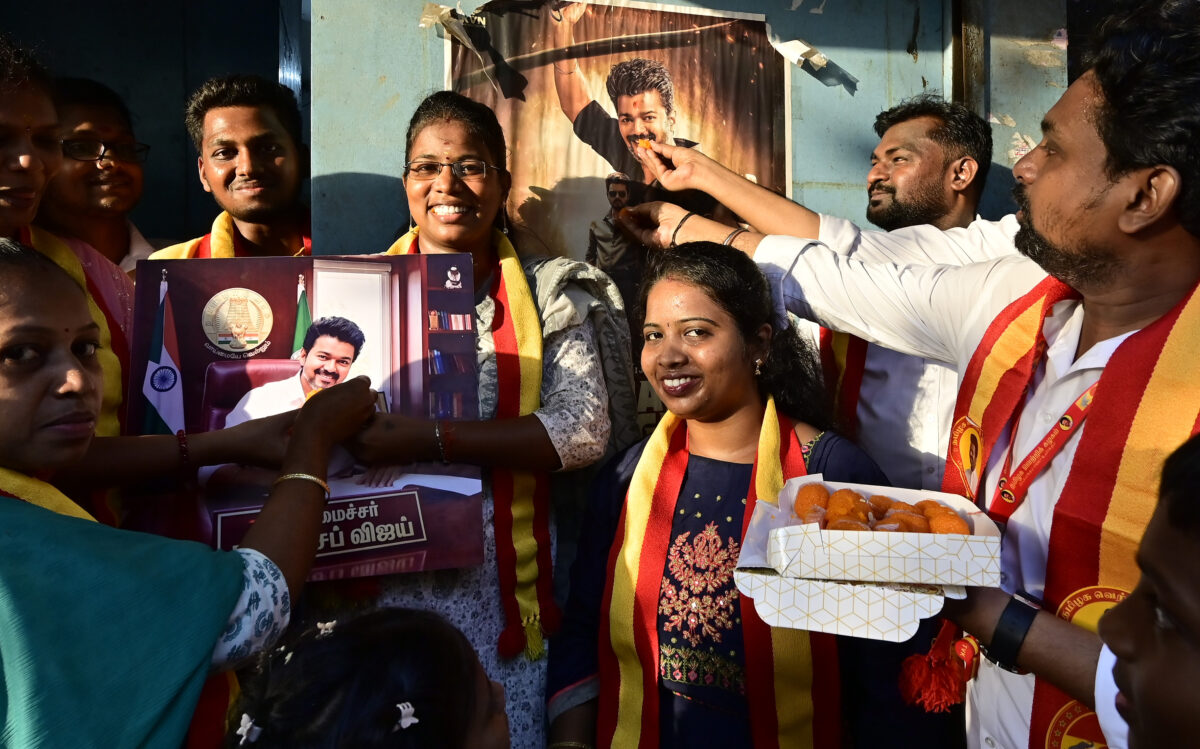
On 23 April 2026, actor-turned-politician Joseph Vijay Chandrasekhar’s Tamilaga Vettri Kazhagam (TVK) party won 108 of 234 seats in the Tamil Nadu Legislative Assembly in an election that recorded the highest voter turnout in state history at 85.1 per cent. This was the first time a party with no prior seats in the state assembly had won outright in its debut contest, ending 59 years of unbroken alternation between the All India Anna Dravida Munnetra Kazhagam (AIADMK) and the Dravida Munnetra Kazhagam (DMK).
The conversion of fandom into political power is not new in Tamil Nadu. The AIADMK was founded in 1972 by film star MG Ramachandran, who became chief minister of Tamil Nadu in 1977 and held the post until his death in 1987. Leading actress Jayaram Jayalalithaa sat as AIADMK chief minister six times between 1991 and 2016. The academic literature on this lineage describes a political culture in which loyalty to a leader’s screen personasubstitutes for engagement with the actual mechanics of governance.
A generation that had kept its distance from formal democratic politics found its way into the 2026 state election through devotion, with fan identity converting into political mobilisation. But the groundwork was set in 2009 — 15 years before TVK existed as a party — when Vijay formalised his fan clubs into a welfare organisation, Vijay Makkal Iyakkam. Through blood donation drives, flood relief and local philanthropy efforts, Vijay leveraged his fandom to build durable district-level organisational capacity which transcended transient celebrity appeal.
TVK’s organisational capacity was tested electorally in 2021, when Vijay-linked candidates won 115 of 169 contested seats in Tamil Nadu’s local body elections, three years before TVK was registered as a party
Research on celebrity political influence has established that emotional attachment to public figures can generate political engagement among previously disinterested populations, particularly younger voters. In Tamil Nadu, this mechanism operated at an unanticipated scale. On 13 May, Vijay’s new government won a confidence vote — a test of whether it commanded a majority in the Legislative Assembly — with 144 votes in favour and just 22 against. At least 25 AIADMK legislators supported the government in defiance of their party leadership’s instructions, potentially exposing them to disqualification from the Assembly under India’s anti-defection law.
A day earlier, a separate dispute had placed another vote in doubt. The Madras High Courtbarred a TVK legislator from voting because of a contested postal ballot in his own election, but the Supreme Court stayed that order hours before the confidence vote, allowing him to take part. For many young voters, these disputes made the mechanics of parliamentary government in India newly immediate and consequential
Social media collapsed the generational barrier maintained by newspapers and television, with this procedural drama documented in the short-form formats used by young people for entertainment. Youth and first-time voter engagement during the campaign itself was well documented and carried into the post-election proceedings. The confidence vote and surrounding disputes reached voters who had not previously followed legislative processes this closely
Vijay’s early governing record offers signals of how this attention might influence decision-making. When the appointment of Vijay’s personal astrologer as Officer on Special Duty drew immediate backlash, Vijay told the Assembly he would ‘rethink’ the appointment and withdrew it on the same day. Tamil Nadu also became the second Indian state after Kerala to create a dedicated AI ministry, fulfilling a manifesto pledge to build AI-linked employment hubs
As authority to regulate AI sits with the central government rather than the states, the ministry’s function is administrative and symbolic rather than regulatory. Even so, a party that converted an existing digital fan network into political infrastructure has continued to signal in office that its administrative priorities run in the same direction. Whether this will become a durable model of delivery-focused governance distinct from the patronage structures of the major DMK and AIADMK parties remains an open and longer-term question.
The implications of TVK’s victory extend beyond Tamil Nadu. The state holds 39 Lok Sabha seats, yet India’s ruling Bharatiya Janata Party (BJP) remains unable to establish a parliamentary foothold in Tamil Nadu. Given that the BJP won decisively in West Bengal in the same 2026 election cycle, a national anti-establishment mood cannot explain TVK’s victory. Rather, the result points to growing geographic polarisation in India, with a southern counterweight built over 15 years standing against a ruling party that continues to consolidate its strength across northern and eastern India.
Whether TVK can convert this position into a national presence remains uncertain. Though Vijay contested the 2026 election alone, TVK has since begun building outwards — two Congress ministers joined the cabinet in May and Vijay coordinated a formal electoral alliance with friendly parties — including Congress — in July, which will be which will be tested by upcoming Assembly by-elections triggered by a wave of AIADMK defections. But this state-level realignment will only go so far, since Congress’s alliance calculus for the 2029 general election will be shaped by commitments well beyond Tamil Nadu.
What sits more squarely within Vijay’s control is the model of governance he signals at home. Unlike Tamil Nadu’s earlier celebrity-turned-chief ministers, Vijay’s base was built on 15 years of fandom mobilisation and sustained by both material pledges and real-time electoral intrigue on social media. To what extent TVK’s fusion of fandom and organisational capacity signals an alternative to patronage politics will depend on what this government does with the attention it has generated
Arun Nagore Jayaraman Shyam is an ALM Candidate in International Relations at Harvard University
