

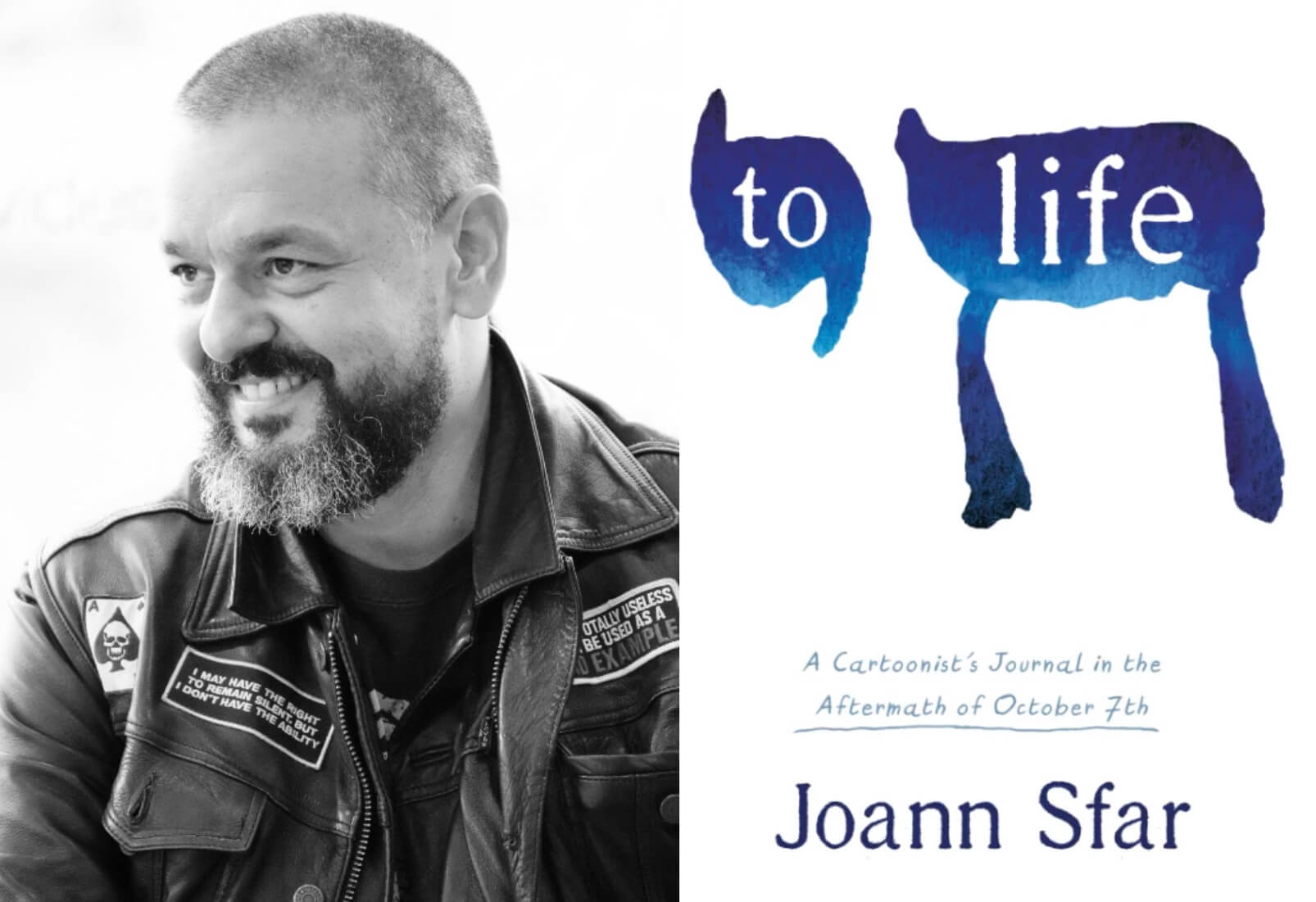
Graphic novelist Joann Sfar, alongside the cover image of “To Life”Courtesy of Joann Sfar
For many Jews, the morning of Oct. 7 remains seared into memory. In Joann Sfar’s case, it was also the day of his birthday party, which included “as many Muslims as Jews,” he told me. Amidst tragedy, Sfar felt a profound gratitude for life, which seemed especially precious. It was a day of fear and uncertainty, followed by many more over the following months. For Sfar, drawing was the only way out.
To Life is Sfar’s illustrated journal of his experience after Oct. 7, a reflection of his fierce peace advocacy coupled with a profound connection to Israel. It follows several previous books by Sfar, who is a French Jewish graphic novelist best known for The Rabbi’s Cat. His works touch on his Sephardic heritage, highlighting a history of friendship and brotherhood between Arabs and Jews.
To Lifeis the English translation of Nous Vivrons, which was published in June 2024 as the first of a three-part series. It was followed by Que Faire Des Juifs?(What To Do with the Jews?), a nearly 600-page graphic novel that chronicles the history of the Jewish people. Sfar concluded the series with Terre de Sang: Le Temps du Désespoir (Land of Blood: The Time of Despair), which shares Palestinian voices and which Sfar describes as the “saddest” volume of the trilogy.
I spoke with Sfar in July after reading To Life, which will be officially released on September 8. At present, the translations of the second and third volumes are not yet scheduled to be published. Our conversation has been edited for length and clarity.
Now that you’re expandingTo Life’s audience to English speakers, what do you expect non-French audiences to learn? What do you hope that they take from your piece?
What I would really love is a new vision on the Middle East. I’m really surprised how New York has made the Middle East American, using it in the Trump and Mamdani debate, which I have to say has very little interest from Europe. What I would love is for people to see real lives from the Middle East to see how similar people are. I come from a part Ukrainian and part Algerian Jewish family. When I went to Palestinian cities, I was surprised how many Palestinian seniors look like my father, and how many Moroccan Jews from Israel look Palestinian.
These are people who are very similar and who are trapped in a conflict which is older than them. I really would love readers to dig into personal experience, rather than abstractions. I think embracing this region is really putting hope into individuals, because if you start to put faith into narrative, you’re lost.
In your work, you make an interesting distinction between individuals denying each other’s peoplehood on both sides — Israelis saying there was never a Palestine, anti-Zionists saying Israel never existed — and your emphasis on interviews in your piece. Why was it important for you to have such a connection to real humans throughout the process?
It’s a very strange thing to say because there was real tragedy, but it made me happy because I love these people. I’ve been lucky enough to spend a lot of time in Palestinian and Israeli cities. If you take it from an individual level, I believe in them and I have a hope for them. Something beautiful is that even if they don’t want it, they are interconnected. Their economies are interconnected; no one is going to exterminate anyone. They’ll be there still.
In this region, no one ever talks to me about Zionism. People deal with their everyday issues; they have no idea what’s going to occur in two months. I know people who are smarter than me have a big political essay about this region, but that’s not my job. My job is to do what I love, like an adventure novel, where you go to the place, you meet the people, and you bring back a story.
Were there any illustrations in the book that you found particularly interesting or meaningful?
There are some photographs that are so shocking you cannot see them in the news, and making a drawing makes it more acceptable. One picture that blew me away is the burial of a father who was killed during October 7. His kid is crying on the grave, and there are the small stones you put on Jewish Ashkenazi tombs. This kid is a Jew, but he could be an Arab, and he mourns his father with a stone. I did a very simple drawing, and somehow that’s what war is about. War is not about heroism, it’s not about glory, it’s not about victory, it’s about kids who are going to mourn their fathers or mothers or family.
This reminds me of a quote from the book where you say that your writing “is like putting little rocks on top of Jewish graves.” Are there any moments in the book that you feel are the most important to hear and remember?
In some fields of France today, and especially among artists, it’s almost forbidden to recall October 7 because of the mass murder of Gaza. But my feeling is you need to be able to cry for both. October 7 was the worst murdering of Jews after WWII, and the mass massacre in Gaza is something we shall remember in 100 years. We should be able not only to cry for both, but also to consider the situation as a whole and to say, okay, what’s next? Are we waiting for the next slaughter or can we do better than this?
As an American, I know about the Jewish experience in the U.S. over the past few years, but I didn’t know exactly what was going on in France and the antisemitism there that you described in your book. Can you tell me more about your experience?
I’m more worried about America because for French Jews, we never let people harass us without responding. We still have a very strong connection to the Arab world, so when people try to oppose Jews and Arabs in France, it somehow doesn’t work. I would love to say that in an optimistic way, but there’s also a lot of violence and harassment. The minute a Jewish artist starts to work, there’s a threat of boycott and everyone starts to treat him like a ‘genocidal Zionist.’
I’ve been talking of Palestine for 30 years, doing reporting in Palestinian towns for two years, but somehow it’s not enough. But we really fight back, because violence here is very often. I had a performance in Marseille, and people gathered at the front to prevent me from drawing on stage. Luckily, many people showed up to defend me, because they knew my show was humane, about peace. At some point, it’s because I’m a Jew that pisses them off. But we know it’s a fight, and we’re ready for it.
What were people’s reactions to your book when it first came out in France? I’m especially curious about the non-Jewish and anti-Zionist population, and whether they read your work.
Everything online is hell. In bookstores, it’s heaven. For To Life, it’s been two years of performing in huge bookstores. I also went to all the universities in France which were blocked by the pro-Gaza crowd, like Columbia, but in France I went to talk in front of them and they were very nice talks. The book sold more than 60,000 copies in France, which is huge. It has a very mainstream audience, not just a Jewish audience. When you go to bookstores, people are very okay to talk, and especially when you go to my meetings, it’s okay to disagree. At my meetings, you can be pro-Palestine — you’re welcome. You can be pro-Israel — you’re welcome, and you can know nothing and you’re welcome also.
I’ve been dealing with Arab and Jewish topics for more than 30 years, and I have a huge amount of readers in France. The Arabs and Jews of my age know what they lost, in the real brotherhood and friendship we had fighting against the extreme right party. We have political history together, and many people remember that. I have a lot of hope, but we need to stay vocal.
Since the book was written in 2023, are there any moments that feel surprising or strange for you to read today?
One thing which is really surprising is that October 7 is less than three years ago, and it’s almost as if everyone forgot. Somehow, people have made political use of this slaughter by any means. The historical moment is almost forgotten. If my book is worth something, it is as an immediate report on the immediate aftermath of October 7 on site. I was in the south of Israel, I was with kibbutzniks, I was with the military, I was with Arab people. One thing we risk is to forget what occurred on October 7, and then forget what occurred during the Shoah, because in France today all the memory sites for WWII are being attacked as pro-Israel. So, we need to keep our memory. Without memory, there’ll be no peace.
One moment in your book that I found very powerful was when you parallel a famous image of Jews being shot in the Holocaust to one of two teenagers being killed on October 7. I’d love to hear more about your thoughts connecting October 7 to previous tragedies, especially with how you refer to the events as a pogrom.
In France, most of the people don’t know about the Jewish oppression in the Arab world, how many of us had to leave the Arab countries after the fall of the Ottoman Empire. When October 7 occurred, in many Sephardic families and Jewish families from Israel, it recalled what occurred in many oriental countries. There’s a history of killing Jews in the Arab world, and it’s as if people awake to that. We have memories — nothing is the same — but we have a history. Amongst the things that really terrify me today is the dislocation of the link between Israeli Jews, American Jews, and European Jews. I was sad to see how many young American Jewish readers have no connection at all to Israel. You can criticize Israel, it’s okay, but pretending you have no connection to Israel is a lie to the face of your family.
In your opinion, why do you feel like this is the case for so many American Jews? Is there a way that you feel like this changes?
I would say Israel is also to blame because Israel has taught the diaspora Jews that it should be a constant exchange. You cannot raise a child making him guilty about not being pro-Israel enough. I’m not asking anyone to be pro-Israel — it’s a very dysfunctional country with an extreme right government. But the connection exists through your parents, your grandparents, their history. Pretending there is no connection is a lie. In the Jewish story, every moment a Jew tries to pretend he’s not part of the Jewry is going to be the first to be slaughtered. I’m not an Israeli, but I’m part of this history and I’m really proud to be part of this history.
Throughout the book, you imagine many conversations with your late grandfather, and I was interested in why this was something that felt so connected to you at this time. Why did you want to include this dialogue in your book?
He really raised me, and everything I do or say is considering what my grandfather would have said. He did not believe in any narrative. He was not a nationalist; he would not believe in all the right wing crap about pride, country, anything. It was only about survival. Regarding Europe, he was very pessimistic. He was saying that we’ll have some decades of peace after Auschwitz, and then it’s going to go back to normal Jew hatred. I’m afraid to say he was right.
