

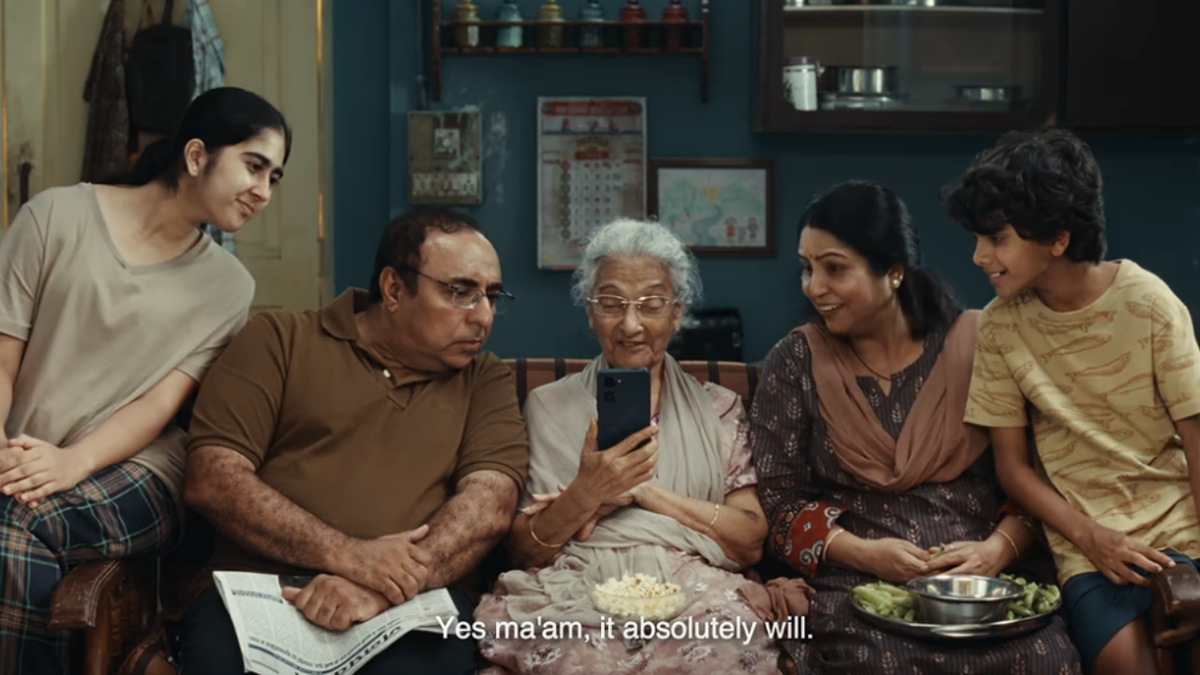
Flipkart and Netflix’s campaign uses an arranged marriage meeting and neighbours watching from across the window to promote Netflix access with eligible Flipkart orders.
Payal Navarkar25 Aug 2026
16:42IST
New Update
In most Indian neighbourhoods, homes sit close enough that privacy is more an idea than a fact. A balcony faces another balcony. A kitchen window looks straight into someone else’s drawing room. Sound carries, doors stay half open, and over time, watching a neighbour’s life unfold becomes a habit nobody quite admits to but everybody quietly practices. A raised voice during a family argument, a delivery van parked outside for too long, guests arriving in their best clothes on an ordinary Tuesday evening – all of it gets noticed, discussed and often narrated among neighbours the way people talk about a television show.
This habit finds a particular occasion in the arranged marriage meeting. When a family sits down to consider a prospective bride or groom, word tends to travel before the guests arrive. Neighbours know the schedule; they probably know which family is visiting, and they know, more or less, what is at stake. The meeting itself follows a familiar shape: ‘chai and samosa’ are served, the prospective bride and groom exchange a few words, and the two families take stock of each other. Somewhere outside, a window offers a view of all of it, and for some, that view is entertainment enough to justify a long evening of watching, guessing and discussing.
Flipkart and Netflix have built their latest campaign around exactly this scene. To announce that shopping on Flipkart now comes with Netflix access, the two brands worked with creative agency Talented on a campaign titled “Entertainment Ka Pardah”. The film was directed by Chalees Chor and produced with SUPRVLLN Films.
The film opens on a household preparing for an arranged marriage meeting. A prospective groom’s family arrives to meet a prospective bride’s family, and the usual rituals of such an evening begin. Across the way, a neighbouring household has settled in behind its own window, watching the meeting the way one might watch a serial, with the same anticipation and the same running commentary. As the evening progresses, the neighbours speculate about how things are going, react to small developments, and wait to see whether the match will succeed. When it does not, they are visibly disappointed, having invested an entire evening in a story that ends without a resolution they wanted. Inside, the prospective bride draws her curtain shut, ending the neighbours’ view and, with it, their evening’s entertainment.
The film then makes its point: for viewers watching from the other side of the curtain, Flipkart and Netflix offer an actual alternative, in the form of a <a href="https://comicvibe.com/reacher-season-4-episode-5-is-nonstop-action-and-streaming-very-soon/” title=”'Reacher' Season 4, Episode 5 Is Nonstop Action and Streaming Very Soon”>streaming subscription that comes bundled with eligible orders.
While the campaign is humorous, it draws on a familiar reality of arranged marriage in India, where a prospective bride or groom can be assessed on factors ranging from education, income and family background to appearance, mannerisms and personal history. The film brings this scrutiny into the neighbours’ running commentary, with the prospective groom’s looks and earnings becoming points of discussion and the bride’s past relationship also emerging as a factor in how the match is viewed.
It is the latter that gives the film’s humour a more complicated edge. A woman’s past relationship can still be treated in some Indian households as a reflection of her suitability or character, making it a longstanding and often gendered aspect of arranged-marriage conversations. By using that attitude as part of the neighbours’ comic commentary, the campaign does more than depict the tendency to scrutinise prospective matches; it also turns a familiar social bias into a punchline.
netflixFlipkartflipkart x Netflix
