

Industry UpdatesLatest Stories
FICCI Frmaes 2026: Saurabh Pandey calls microdrama the Q-comm moment for entertainment
At FICCI FRAMES 2026, Saurabh Pandey noted that microdrama is India’s fastest-growing entertainment format, while AI is helping scale production and could reach $3 billion within three to four years.
Social Samosa29 Sep 2026
19:00IST
New Update
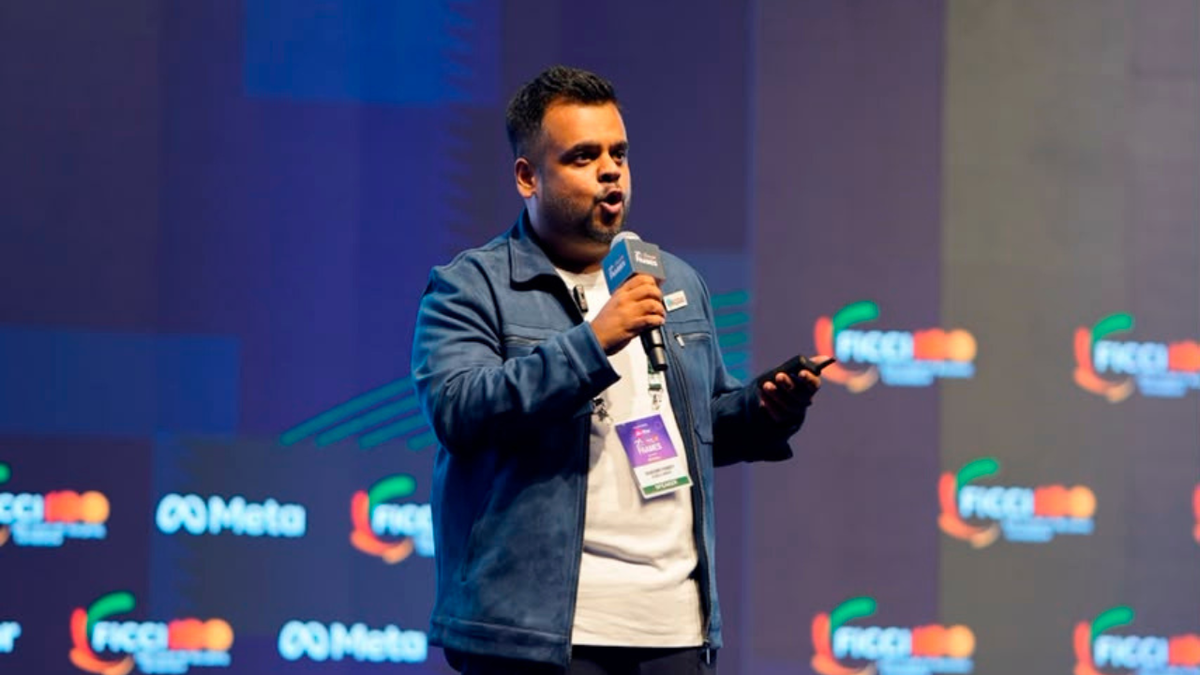
At FICCI FRAMES, Saurabh Pandey, founder and CEO of Eloelo, outlined how changing content formats and AI are shaping the entertainment industry, highlighting the growth of microdrama and AI-led video production.
Speaking at a keynote session titled “The Future of Entertainment: AI, Scale, Storytelling,” Pandey outlined how entertainment formats have evolved from cinema and television to OTT, short-form video and microdrama. He compared the shift toward shorter formats with the evolution of cricket from Tests to ODIs and T20s and the growth of quick commerce.
“Microdrama is the quick-commerce moment for entertainment,” Pandey said, adding that each time a format becomes faster in India, the category has grown bigger.
Pandey said microdrama is a $15 billion category globally, led by China and followed by the U.S., with India now the fastest-growing market. He said microdrama downloads in India have reached roughly 60% to 65% of OTT downloads, while users spend 60 to 70 minutes a day on these apps.
Citing Redseer and Lumikai, Pandey put the current Indian microdrama market at $600 million to $700 million and said it is on track to reach $3 billion within three to four years. He said the category could potentially overtake the Indian film industry.
Pandey also pointed to language expansion as a driver of the category. Story TV, which began with Hindi content, has expanded into Tamil, Telugu, Bhojpuri, Kannada and Malayalam. He said the platform has built a library of more than 5,000 microdramas and crossed 120 million users, who watch for more than 100 minutes a day.
According to Pandey, production capacity initially lagged behind demand, with Story TV producing about 100 shows a month when audiences required 200 to 250. AI was subsequently used to reduce production costs and production timelines and test new ideas.
“AI closed that gap by cutting production costs and shortening the time taken to test new ideas,” Pandey said.
He added that AI has enabled hybrid formats combining live actors with AI-generated backdrops and made genres such as period drama month
Pandey also introduced Dolphin AI, a video-generation platform developed to address issues such as lost context between shots, inconsistent locations and changing props. Before its public launch, the Eloelo team had generated about 48,000 videos on the platform internally.
The platform includes presets for UGC, social and tutorial videos; a chat-based agent that converts a brief into a finished video; and a studio workflow suite for professionals producing long-form content and drama series. The professional workflow can work alongside tools such as Claude and n8n.
Pandey also discussed the potential for AI video to expand India’s entertainment exports. He said Indian creators could produce content in other markets and languages without requiring large production teams.
“AI video could make entertainment the next major export from India, much as IT services became in the 1990s,” Pandey said. He positioned this as part of India’s “Orange Economy,” with creators remaining at the centre of the process.
aiFICCI FramesmicrodramaEloelo GroupStory TV

1 Comment
Pingback: Canvas brings 30 Indian animators together for 'Project Maya', its first short - Comic Vibe