

This adaptation of the classic manga may just be for devotees only
The Standard’s journalism is supported by our readers. When you purchase through links on our site, we may earn an affiliate commission.
Allow Exco Player content
This content is provided by Exco Player and may use cookies or similar technologies. Please click ‘Allow and Continue’ below to load the content.
Nick Curtis, Theatre Critic@nickcurtis34 minutes ago
It’s taken 11 years for this childish musicalmanga adaptation to reach a full production at the Barbican – a tester for a wider commercial life – and it’s baffling that in all that time no one noticed its deficiencies in plot and score. The story of a Tokyo cop chasing a vigilante who is supernaturally killing criminals, it’s a mixture of mumbo-jumbo, crime-story cliche and anodyne teen wish-fulfilment.
Frank Wildhorn’s compositions alternate between pop-rock anthems and mopey ballads. Stephen Whitson’s heavy-handed production is full of brutish air-clawing choreography and wooden exposition.
Admittedly, Death Note carves out novel territory, stylistically and thematically, for a London musical, and is unusual in featuring a large and young cast of Asian heritage, some of whom have fine voices. The enthusiastic audience at the performance I saw – several of them in cosplay – were also more youthful and far less homogeneous than most UK audiences.
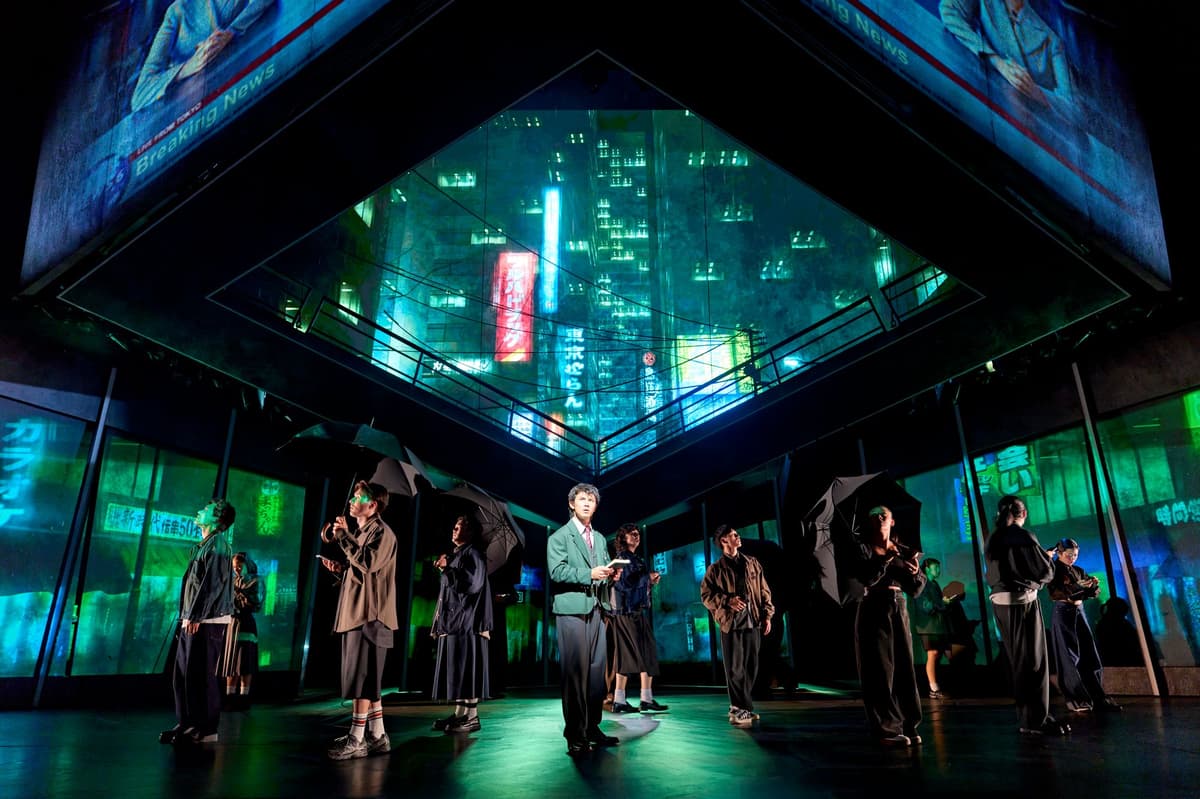
Xander Pang (Light) and Cast of Death Note The Musical
Manuel Harlan
Book tickets now
The original Death Note manga series by Tsugumi Ohba and Takeshi Obata has shifted over 30m units worldwide, and as a recovering comics nerd myself I know how passionate such pop-culture fandoms can be. Hardcore devotees in the UK will probably lap up this new iteration, while the rest of us look on, perplexed.
The title refers to notebooks in which the Shinagami, capricious gods of death, write the names of humans whose lives they choose to curtail. One of them is bored Ryuk (US musical theatre star Telly Leung, having a ball and dressed as a fire-damaged Edward Scissorhands). He lets his book fall into the possession of high school student Light (Xander Pang), a police chief’s son full of rage about rampant criminality and injustice. Uh-oh, can you see where this is going…?
Sure enough, Light – also a tennis star and a “brilliant” student who scores 100% on all his tests – embarks on a scribbling killing spree with the obsessively apple-noshing Ryuk as his mocking Mephistopheles. He becomes a folk hero nicknamed “Kira”. The helpless police turn to a bug-eyed, neurodiverse, college-age sleuth known only as L (Colin Ryan) who decodes Kira’s identity from scrolling green streams of Matrix-style data.
Meanwhile pop star Misa (Stephanie Zaharis), a child of murdered parents, platonically worships Kira: not one but two Shinagawa fall soulfully in love with her, at the cost of their own lives, and she acquires a death notebook of her own. There’s all sorts of nonsense here about how far these spirit beings interfere in human affairs and the nuanced amount of power they can bestow: this “lore” was clearly made up on the spot to keep the story going.
There’s no psychological depth to any of the characters, no real attempt to explore the morality in the tale or its parable of populism. Wildhorn, a New York-born writer of pop hits, Broadway shows and symphonic works who has somehow become the go-to guy for musical manga adaptations, here pens a bunch of samey guitar-driven songs that lend themselves to open-mouthed yowling. Jack Murphy’s lyrics are terrible (“think of the crime I’d abate/the justice I’d instate”), but not as hackneyed as Ivan Menchell’s dialogue.
It’s mounted by Whitson on a largely bare stage, with bland office sets shunted on from the sides, a gantry above patrolled by the three gods, and screens showing news reports and a rainy Tokyo skyscape. With an ensemble of 26 and a ten-strong band there’s a teeming liveliness to the evening, and a distinctive, flat, comic-book sensibility. Fabian Aloise’s choreography has striking moments but it’s a pale shadow of the movement he created for Jamie Lloyd shows including Evita and Sunset Blvd.
Pang is arrogantly bland as Light while Ryan at least sings charismatically as the extravagantly strange L. Relative newcomer Zaharis impresses as the love interest in a wilfully sexless show. Grace Mouat as the Shinagawa Rem powerfully holds the stage for When Love Comes, the only song that stayed with me.
