

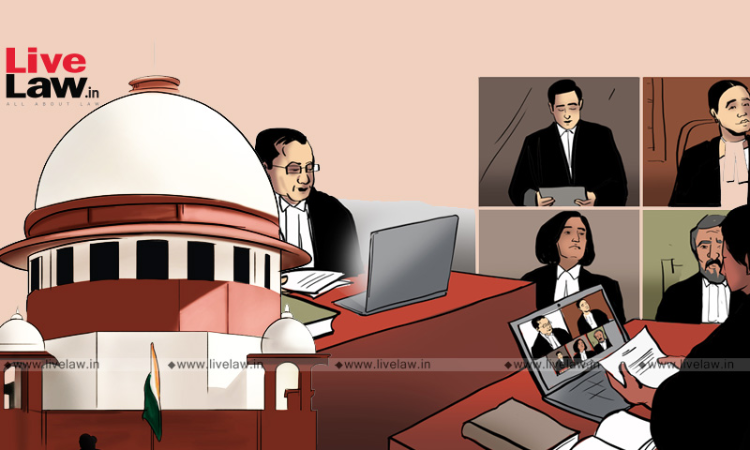
<img src="https://www.livelaw.in/images/placeholder.svg" alt="Courts Cant Be 24/7 Entertainment Channel: Supreme Court Rethinks Livestreaming, Seeks Reports From HCs On Its Impact”>
Justice Bagchi orally commented that livestreaming should be an exception rather than the norm.
“Courts cannot be 24×7 entertainment channel”, the Supreme Court today orally expressed, as it expressed a need to rethink continuous livestreaming of the proceedings.
Hearing a petition against the unauthorised circulation of Court clips, the Court passed an interim order restraining the uploading and circulation of audio-visual recordings of Court proceedings on social media.
The Court also called for reports from the High Courts on their adoption of the Supreme Court ‘Model Rules for Live-Streaming and Recording of Court Proceedings’ and the impact and feasibility of continuous livestreaming.
A bench of CJI Surya Kant, Justice Joymalya Bagchi and Justice V Mohana,through an interim order, imposed a prohibition on the extraction, editing, dissemination, reposting, uploading, monetization, transmission, storage and hosting of audio-video recordings of judicial proceedings without prior permission from the Secretary General of the Supreme Court or the Registrar General of the concerned High Court (as the case may be).
It was in 2018 that the Supreme Court paved way for livestreaming of cases of constitutional or national importance. In Swapnil Tripathi v. Supreme Court of India, a 3-judge bench led by then CJI Dipak Misra laid down elaborate guidelines and modalities for live-streaming and held that the Supreme Court Rules, 2013 would have to be suitably amended to provide for the regulatory framework for holistic live streaming.
However, live-streaming of important matters by the Supreme Court actually commenced in 2022.
As per the Supreme Court’s Model Rules for Live-Streaming, no person/entity (including print and electronic media, and social media platforms) other than an authorized person/entity shall record, share and/or disseminate live streamed proceedings or archival data. Further, any unauthorized usage of the live stream shall be punishable as an offence under the Indian Copyright Act, 1957, Information Technology Act, 2000, and other provisions of law, including the law of Contempt.
Despite that, audio-visual recordings of judicial proceedings have been doing rounds over social media for a while now. In this backdrop, the petitioner submitted before the Court that the clips, when circulated by digital means without context, tend to put the judiciary in a bad light.
On the issue of livestreaming, Justice Bagchi noted that livestreaming is to be done only in cases of public importance where the Court expressly provides and/or where parties request jointly. “[No] party [can] really envisage a continuous livestreaming of all proceedings for all times”, the judge said.
Senior Advocate Vikas Singh, for the petitioner, differed from the judge’s take, remarking, “I believe sunlight is the best disinfectant…livestreaming per se I don’t see any problem”. Singh said that his objection is not to livestreaming but to the extraction of clips from the feed, and its circulation on social meida for monetisation, as they present a distorted picture about the proceedings. He said that videos are extracted, and taglines and background music are often added.
CJI Kant, on his part, commented that the recent incidents of misuse of livestream are “forcing everyone” to “rethink”. Singh however asserted that passing an order banning online circulation of court proceeding clips would be a better solution.
Unconvinced, Justice Bagchi highlighted that regulating data in cyberspace is one of the biggest challenges. The Judge opined that the Court “should ensure limited access of data in public domain and thereby restrict public streaming itself”,, emphasizing that live-streaming “should be an exception.”
In this regard, Singh urged that sometimes parties may not be able to attend court but wish to see what is happening in their matter. The judge replied that in such cases, they must seek express permission (so they can be provided a link to watch). “But it cannot be a 24/7 entertainment channel from the Court…this is tri
In the context of misuse of court proceeding videos, Singh even flagged the ruckus that took place in Justice KV Viswanathan’s court and the shoe-throwing incident involving ex-CJI BR Gavai. The senior counsel claimed that a short clip of the former has now become a joke over the internet. “It’s a joke as if showing that our judiciary is like that”, Singh lamented.
Solicitor General of India Tushar Mehtaalso backed Singh’s request to regulate circulation of clips from hearings, saying that they are often selectively taken from livestream feeds to present a distorted narrative. The SG also raised the apprehension over the use of AI tools to manipulate the clips to insert fake statements.
Case : Harshita Grover v. Union of India and others | W.P.(C) No. 751/2026
Tags
Supreme CourtsCJI Surya KantJustice Joymalya BagchiJustice V MohanaLive StreamCourt Proceedingaudio video recordingJudiciary

