

ByContributor Content
September 15, 2026
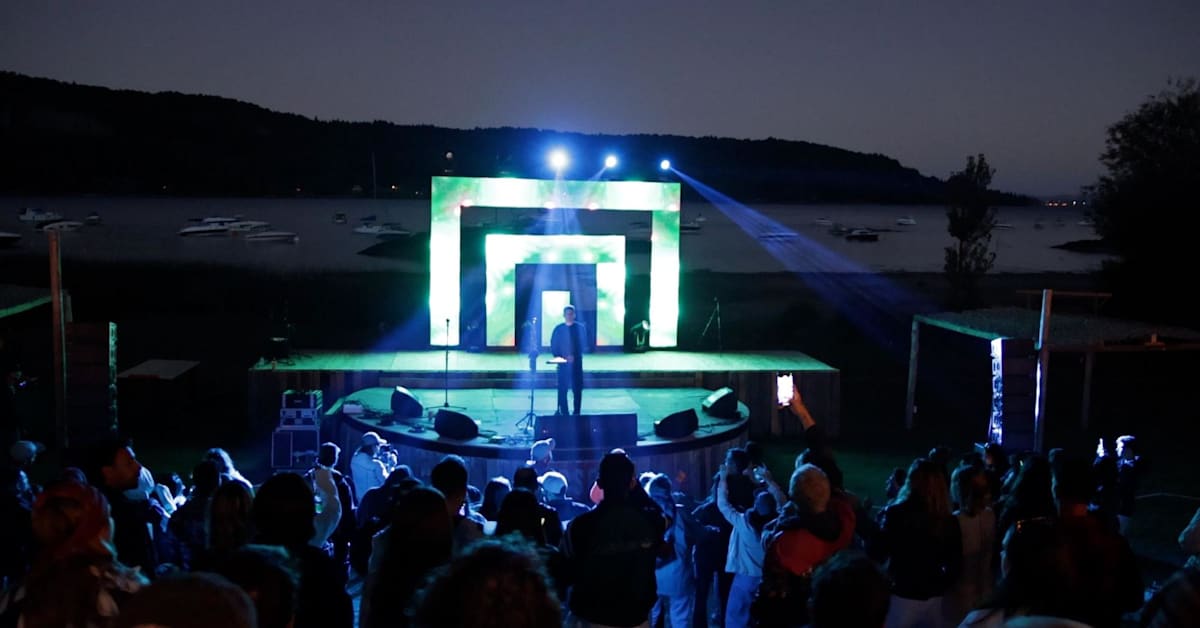
A bright red full moon hung low over Nahuel Huapi Lake one night in 2026, as hundreds gathered beneath Patagonia’s stars for the second Conectando Dreamers festival in San Carlos de Bariloche, Argentina. At the center of the night was Ross Mintzer, a producer and saxophonist who grew up in New York. He recalled looking out from the stage at the crowd and thinking how magical and special the moment was. Mostly, he said, he remembered feeling lucky to be alive.
That night is one point on a longer line, one that starts in a New York rehearsal studio, runs through a performing arts center in Eau Claire, Wisconsin, and now stretches toward Patagonia. As Mintzer looks toward a slate of shows planned for 2027, the pattern that connects them has become easier to see: each city entered his life through a person, and each show carries the mark of the people he builds it with.
It is a path that runs against the grain of an industry organized around labels, agencies, and algorithmic playlists. Mintzer has neither a label nor a booking agency; the infrastructure of his career is, almost entirely, other people. In that, his story is a small window on a larger shift, as independent artists assemble international audiences out of personal relationships rather than institutional ones.
Mintzer, who lived in New York for most of his life, began as a saxophonist. But in his early twenties he came to a quiet conclusion: the saxophone was not going to be his path, and he came close to walking away from music completely. Instead, he went looking for a different life. He taught music in the United Arab Emirates and in Pakistan, and rode his bicycle from New York City to Needles, California. Somewhere in those years he began listening to electronic music, and something turned over: he did love music, and he wanted it to be his life. In 2015, he began producing. What followed was not a rapid ascent. For roughly five years he played only in New York, mostly to audiences of fifty or fewer, often in rehearsal studios rather than venues.
During the pandemic, Mintzer met Max Koehler, a visual artist now working under the name Visual Sidekick. Koehler designed stages, built video content, and programmed lasers, the visual counterpart to what Mintzer was doing in sound.
Koehler was based in Eau Claire, Wisconsin, so that is where the shows went. Over four years of near-annual performances at the Pablo Center at the Confluence, a riverside performing arts center, and The 410, the audiences grew into the hundreds. One of the people drawn to the Eau Claire shows was Nicolás Merono, a filmmaker from Argentina who flew north to document them. Merono and Mintzer visited Bariloche, in Argentine Patagonia, to film a video for his song “magician.” Inspired by the setting, Mintzer later envisioned bringing a show to the city. In January 2025, that inspiration became a festival: Mintzer and the local production company Plug Producciones co-founded the first Conectando Dreamers at Cirse Club de Lago, performed on a stage designed by Koehler. The event drew 750 people, according to organizers.
While all of this was building, Mintzer kept playing New York. In the summer of 2025, he organized a benefit concert at Racket NYC for Code to Inspire, the first coding school for women and girls in Afghanistan. Its founder and chief executive, Fereshteh Forough, spoke that night. “Everyone is inspired by Fereshteh’s life story,” Mintzer said. “She’s a very powerful speaker.” Watching the crowd listen, he said, he and his collaborators began to rethink what their shows were for. Not everyone was going to create a coding school for girls in Afghanistan. But they began to wonder whether attending a show could itself be a form of contribution, whether making a change could be as simple as showing up. “In reality, that’s all transformation takes,” Mintzer said. “The act of showing up.”
The idea carried forward. In 2026, the second Conectando Dreamers festival, the night of the red moon, drew more than 700 people, organizers said. But the deeper pattern was never the causes. It was the collaborators. In Eau Claire the shows have always been built around Koehler’s production; in Bariloche, around Merono’s filmmaking and the Argentine team; in New York, around Forough’s mission. Each city sounds different because each partnership is different.
The next points on the line are already being sketched. No dates are confirmed, and Mintzer is careful to frame the year ahead as plans rather than announcements. But the intended shape of 2027 follows the pattern. He hopes to return to Eau Claire, to Bariloche for a third Conectando Dreamers, and to a future Code to Inspire benefit.
A decade in, Mintzer resists the usual scorekeeping. There is no metric, he said, for meaningful relationships or for an honest and authentic journey. “I’m not comparing myself to anyone. I do my best to send love out into the world through music. The rest is out of my control.” Along the way he became a pilot, too, earning a private license and an instrument rating: progress counted in things learned rather than rankings climbed. The credit, he said, belongs to the people around him and to the audiences who kept showing up. The line from a New York rehearsal studio to a festival crowd in Patagonia was drawn by a filmmaker’s invitation, a designer’s stage, and a school founder’s cause. Wherever the 2027 shows land, they will be points on that same line.
Complex newsroom and editorial staff were not involved in the creation of this content.
