Airing from 1990-96, Captain Planet and the Planeteers— a show where a planet-Earth-themed superhero appeared from the combined power of five magic rings created by the Spirit of Earth and given to a pointedly diverse cast of teenagers so that they could fight baddies such as oil drillers, radioactive men, and corrupt business moguls— is widely known, for better or for worse, as a show comprised entirely of absurdly unsubtle 22-minute PSAs. However, while Captain Planet‘s hitting-you-over-the-head-with-the-point storytelling is best remembered for its coverage of environmental issues, the show also applied its PSA format to other topical issues of the decade such as drug abuse, overpopulation, and the war profiteering in the Middle East. One of these non-environmentally focused Captain Planet episodes would carve out a space for itself in collective cultural memory by choosing to cover a topic that was not only dark and mature, but that was a source of ongoing social division at the time of the episode’s airing.
Videos by ComicBook.com
When “A Formula for Hate” premiered in November of 1992, the AIDS crisis was at its most deadly, killing tens, if not hundreds, of thousands a year. In what was a bold move even for the golden age of PSA cartoons, Captain Planet decided to step into the fray with an episode attempting to explain HIV/AIDS— or at least, the public discourse around AIDS that young viewers may have heard from the adults around them. This choice to focus on perceptions around the disease rather than disease itself— or even the cause of its negative associations— would create an episode that conveys truly kind and thoughtful messaging on a difficult and somber topic while also trying its hardest to, in an unusual occurrence for a Captain Planet episode, not mention the actual core of the problem.
“A Formula for Hate” Brought the Planeteers Face-to-Face with the AIDS Crisis
The episode follows an all-American high schooler, basketball star Todd (voiced by the prolific actor and Halloween-costume king Neil Patrick Harris), who discovers that he is HIV-positive— i.e., he had contracted the Human Immunodeficiency Virus that, if left untreated, can cause the late-stage infection known as Acquired Immunodeficiency Syndrome (AIDS). Notably, doctor clearly and pointedly states that while HIV can be contracted through intravenous drugs or unprotected sex, Todd was most likely infected through a blood transfusion that he received before hospitals started screening blood for AIDS in 1985. Remember this detail, as what it says— and what it doesn’t say— points at something that becomes far more noticeable as the episode goes on.
The origin of Todd’s infection is of no concern to Verminous Skumm, the half-rat half-man member of Captain Planet’s rogue’s gallery, as he sneaks into the hospital to page through private medical records in search of something he can use to get the local community riled up. Todd’s HIV diagnosis is perfect for his plan, with Skumm exclaiming that AIDS is “the best thing to come along since the Black Plague”. Count that as Weird Moment #2 in this episode, as again, at time of airing, AIDS had killed at least 136,837 people in the United States alone. Weird Moment #3 immediately afterwards comes as Skumm’s henchrat says “I didn’t know rats spread AIDS”, only for Skumm to assure him that they aren’t going to spread AIDS themselves— according to the rodent, all he has to do is spread panic, because panicked and uniformed people will act rashly and end up inadvertently transmitting the virus (so, yes, the villain’s end goal here is still to spread actual AIDS).
The Real Villain isn’t AIDS, it’s fear and hatred.
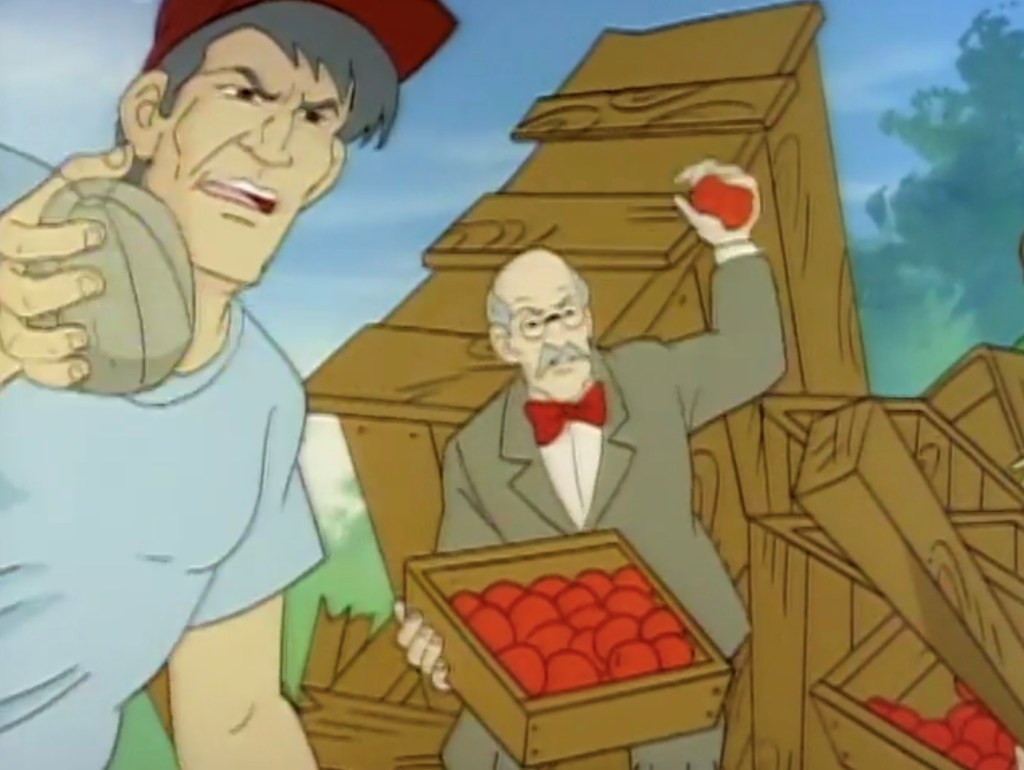
Skumm’s words here serve as the core of this episode’s plot, as the Rat-Man’s efforts to make the local community fearful of Todd’s HIV diagnosis meet with wild success. Todd is met with disgust and fear everywhere he goes, his younger brother is beat up, his mother’s produce stand is overturned by a violent mob, his friend Jeff faces none-too-subtle accusations of having engaged in Homosexual relations with Todd (and thus being HIV-positive himself, also, count this as the episode’s third Weird Moment), and, of course, the whole uproar threatens to get Todd banned from his school’s big upcoming basketball game.
Throughout all this, it is made consistently and repeatedly clear that it is the fear and hatred caused by the stigma around HIV and AIDS— not the virus itself— is not the villain of this episode, a narrative choice made all the more obvious as Todd is never portrayed as sick or weak and never shows any symptoms. Eventually, Captain Planet is summoned, and, with the help of Todd’s basketball coach, delivers a speech to a packed gymnasium about the differences between HIV and AIDS, the actual transmission risks (although, once again, sexuality and relationships are mentioned, despite Todd having a steady girlfriend in the episode), and the need for empathy and support rather than fear and hatred around those who have contracted the disease. The speech works, Todd is allowed to play in the big game and leads the team to glorious victory, Skumm is arrested, and all’s well that ends well. However, sharp-eyed viewers may have noted some alarming patterns in this episode that undermine the very message it claims to send.
“A Formula for Hate” Sidesteps the Real Root of AIDS Stigma
While the stigma around AIDS in the early 1990s was a real and genuine issue in need of addressing, it also didn’t come from nowhere. Skyrocketing to major outbreak status in the early 1980s after decades of slow, undetected spread, the devastating disease spread most heavily— by a huge margin— among marginalized populations including LGBT, black, and addict communities, with gay and otherwise queer men being the most horrifically impacted. Called “Gay Plague” by conservatives, AIDS was considered by many to be a punishment from God— or, if not something that extreme, then a public-health crisis that would conveniently remove what many saw the less desirable members of American society and thus was not an especially urgent matter to deal with.
However, while White was a real person whose legacy saved countless lives, Todd isn’t real. The choices made in his design, characterization, and struggles in the show served to erase and replace those of the real-life people that were primary targets— at great loss of life— of AIDS-based discrimination. Captain Planet, being a fictional animated series, had a unique opportunity to teach audiences about anti-AIDS stigma in its full context of homophobia and racism using a cartoon character— i.e., without putting a real person or actor in the figurative crosshairs of this roiling social discourse. Instead, not only does it not attempt to subvert the current reality that AIDS was only seen as worthy of empathy when it affected a straight white person, but “A Formula for Hate” even seems to be making a choice to enforce these underlying forms of bigotry, as the rumors of Todd and Jeff having a homosexual relationship are never addressed, let alone pointed out as harmful.
Captain Planet does succeed in dancing around aspects of the AIDS Crisis that may have been deemed too dark and socially divisive for children’s programming while still providing accurate public-health advice and teaching kids a simple lesson about rationality and empathy, and some may say that the episode was a tribute to Ryan White’s struggles (though it’s unclear if his family ever consented to it). However, in a rare moment of bungled messaging for the normally blunt, straightforward, and progressive series, “A Formula for Hate” fails spectacularly at portraying, and educating on, the realities that led to AIDS being stigmatized in the first place.
Can’t win ’em all, Captain.
The Tiny Toons Episode About Drinking Was Too Dark for ’90s Kids (& It Disappeared From Reruns)
More TV Shows
TV Shows
17 hours ago
Lanterns Season 2 Should Follow the Blueprint of the Other HBO Show That More Influenced It
TV Shows
19 hours ago
ThunderCats’ Darkest Episode Gave One Hero a Surprisingly Adult Addiction Storyline (That 80s Kids Never Forgot)
<img src="https://comicbook.com/wp-content/uploads/sites/4/2026/10/buffy.jpg?w=300" alt="Buffy Officially Ended a Surprising Trend 27 Years Ago, And Started Another That Would Last 84 Episodes”>
TV Shows
1 day ago
Buffy Officially Ended a Surprising Trend 27 Years Ago, And Started Another That Would Last 84 Episodes
Warner Bros
TV Shows
1 day ago
Eric Bauza, Modern Voice of Bugs Bunny & The Looney Tunes, Dead at 46
Image Courtesy of Warner Bros.
Comics
2 days ago
Tim Drake Needs a New Identity, and Batman’s Greatest TV Show Might Have Already Given Us the Answer