

After another “baffling” and “regrettable” telecast, TV insiders debate whether streaming can save the struggling ceremony.
Photo: Rich Polk/Variety
If Monday’s Emmy Awards were the last to air on network television, well, at least you can say the show went out with a whimper — poorly planned, clumsily executed, and gasping for any hint of cultural relevance. Fortunately for the Television Academy, before criticism of this year’s NBC ceremony could reach any sort of critical mass, word got out that Amazon’s Prime Video is in talks to take over the Emmycast. While this would mark another sad milestone in the decline of network TV, shifting the show to streaming might just represent the best-case scenario for anyone who cares about the future of TV’s highest honors.
Nothing is official yet, but if it gets done Amazon’s deal, first reported by Variety, would make it the exclusive home of the Emmys for multiple years, marking not only the first time the show hasn’t aired on broadcast TV but also the end of a three-decade joint-custody agreement where the event rotated between ABC, CBS, NBC, and Fox every year. The downside of this so-called “wheel” arrangement has always been that, because no platform had ownership of the Emmys, the show was always having to re-create itself to satisfy the creative whims of whichever network it was on that year, even as none of those networks had any real incentive to make the show great. It was not a long-term asset to be nurtured and improved, the way ABC has done with the Oscars for the past half-century.
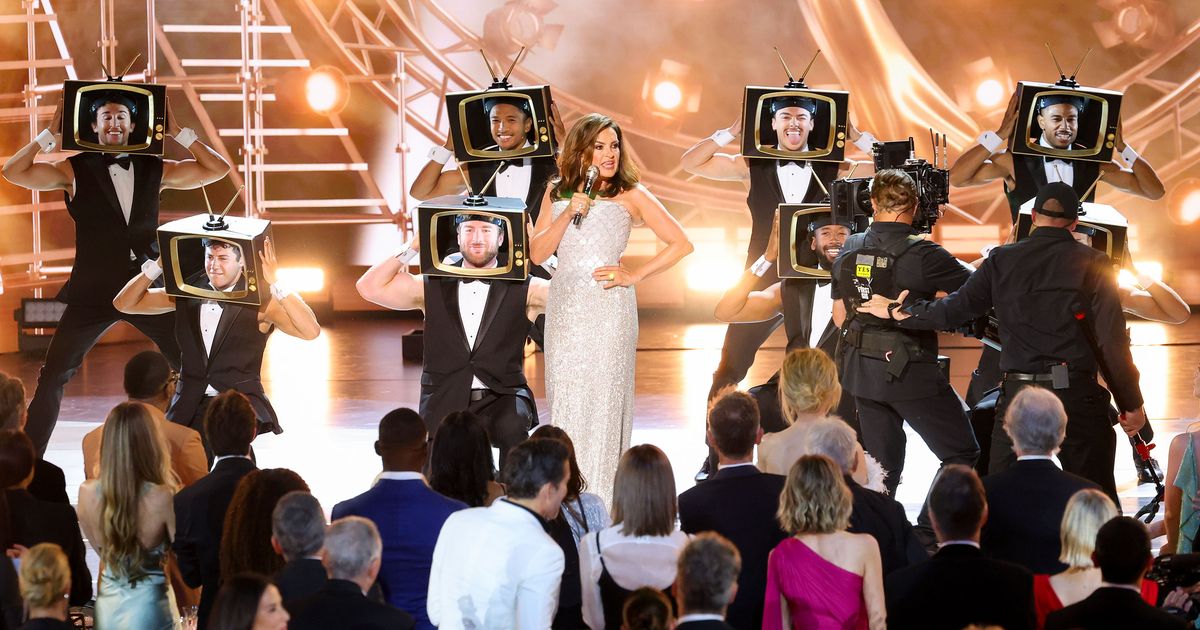
That benign neglect came through in Sunday’s mess of a telecast. Pressured to keep the run time to slightly more than two hours (minus nearly a full hour of commercials), clips of nominated shows were kept to a minimum, winners were under constant threat of being played off if their speeches ran even a few seconds long, and montage packages were basically nonexistent. “The show was just really underwhelming,” one veteran TV-industry insider told me. “It just didn’t seem to ever hit its stride and felt disjointed for the entire broadcast.” And while host Mariska Hargitay gave it her all, the show’s writers and producers repeatedly failed her with sketches and song parodies reviewers rightly called “baffling,” and “regrettable,” as well as a broadcast defined by what criticAlan Sepinwall described as “terrible production choice after terrible production choice.” As entertainment journalist and author Mark Harrisposted, “This is why you don’t hand awards shows over to people who think that awards, clips, and speeches are the show’s necessary evil.”
In fairness, not everyone in Hollywood agrees with the social-media and critical consensus. “I thought it was fine,” one industry insider texted me on Wednesday. “Mariska was a good sport.” And Variety executive editor for TV Michael Schneider, who broke the news about the Emmys heading to Prime Video, insists the buzz at Monday’s Emmys after-parties wasn’t nearly as negative as the online response. “People thought Mariska acquitted herself pretty well, considering this is not her thing,” he says. “I felt like people were more down onNate Bargatze last year. That kind of pissed people off. This year everyone felt like it was pretty harmless.” And while the ratings were not great— Nielsen says 6.3 million viewers watched on TV, down 17 percent from last year’s show on CBS — they weren’t a complete disaster in the linear TV landscape of 2026. (Another 500,000 viewers tuned in through other platforms, mainly Peacock.)
But the reality is, ABC’s season premiere of Dancing With the Stars reached more viewers on television than the Emmys this year — and absolutely walloped NBC’s telecast among viewers under 50. That’s proof viewers will still watch live entertainment events on network TV but maybe just aren’t that interested in the cut-rate, rushed awards show that the TV Academy has been offering in recent years. After all, if it’s obvious the people making and airing the Emmys don’t really care all that much about making an amazing show, why should audiences at home show up?
It’s depressing that an event honoring the best of television won’t be seen on an actual TV network anymore, but then it’s even sadder that most of those same networks air so little scripted TV to begin with. With the arrival of the NBA last season, NBC now feels more like the NBC Sports Channel than the home of Must-See TV. ABC is launching exactly zero new TV shows this fall. And CBS, despite producing more hours of scripted programming than its rivals, keeps cutting back on that offering and is now out of the late-night business. Leaving broadcast TV for a streamer such as Prime Video isn’t giving up on broadcast TV as much as it is the Academy acknowledging that the center of the television universe is now on streaming.
It’s also likely a reflection of the fact that the broadcast networks didn’t have much of an interest in stepping up to keep the Emmys. Like other industry reporters, I’d been hearing talk for years that there was little chance the “wheel” arrangement would be renewed. It probably wasn’t an accident Variety’s report didn’t mention any other possible suitors for the Emmy rights: I’m guessing there weren’t any, at least not any serious enough to note.
The industry insider I spoke to, who has been involved in event-acquisition discussions over the years, said he would not be surprised to learn that there weren’t many bidders for the Emmys. “It just doesn’t really move the needle,” he explains. “The shows are expensive and ultimately not really what people want. They want dramas, comedies, docs, movies, library shows — not award shows.” He calls a show like the Emmys “nice to have” but not one that will help lure or keep subscribers. “The existential problem for all of the award shows is that with social media, you see these people all the time. There is nothing special about ‘Hollywood’s big night’ because you see them at home, getting coffee, with their kids, etc. I’m not even sure they should be televised anymore.”
So why is Amazon’s Prime Video, which has taken home very few gold statuettes from the Academy in recent years, rolling the dice on the Emmys? Ad dollars. Unlike Netflix or HBO Max, which still make most of their money from subscriptions, Amazon — like Google’s YouTube, future home of the Oscars — is built around advertising income (and, of course, e-commerce) at every level. It’s one reason Prime Video in particular has made massive investments in live events like Thursday Night Football. Certain big advertisers, like car-makers and movie studios, crave programming that is watched immediately rather than whenever viewers feel like it, because they have products (like new film releases) that need immediate exposure to consumers. While Amazon is not commenting on the Emmy reports, it’s not a stretch to think the company views the Emmys as a relatively low-stakes way to expand that event footprint and pick up some premium advertisers who still want to reach the kinds of viewers who watch awards shows.
Still unresolved, however, is whether Amazon will treat the Emmys like a new crown jewel in its events portfolio or if it ends up serving as a sort of foster home for a wayward awards show nobody else really wanted. To that point, we don’t know yet exactly how much Amazon will pay the TV Academy for the rights or what sort of production budget the show will have. But the company certainly hasn’t scrimped on its production of the Academy of Country Music Awards, which it firstbegan streaming in 2022. Similarly, the Actor Awards (formerly known as the SAG Awards), has undergone a major upgrade since shifting from TNT to Netflix in 2024, with improvements to its set and an overall classier vibe. The track record on streamers taking over awards shows is at least encouraging.
Even if the budget for the Emmys stays flat, there are other upsides to ditching broadcast and having a stable home. “There’s an advantage in it being in the same place every year, which is that viewers can grow accustomed to knowing, Okay, that’s where the Emmys are — they’re on Amazon Prime,” says the industry vet. And here, Amazon is in some ways superior to Netflix: Thanks to its aggressive bundling of non-Amazon-owned platforms, many consumers watch HBO’s The Gilded Age on Prime Video and not in the HBO Max app. There’s a logic to the everything store for television playing host to the show that honors all of television.
Prime Video will also give the Emmys a chance to reach an international audience in a way that wasn’t possible under the old order. Unlike the Oscars, which has global reach through numerous country-specific licensing deals, the Emmys don’t get shown everywhere: A BBC story about this year’s telecast noted it wasn’t available to watch in the U.K. Prime Video will likely beam the Emmys to all or most of the dozens of countries it reaches. And if it opts to put the power of the full Amazon platform behind it, it will be impossible to miss for anyone interacting with Amazon’s various tentacles (basically, everyone). Will the Alexa integrations be unbearable? Probably. But, as another TV exec told me, “It’s a good thing if you have one platform that can invest in the Emmys.”
It’s also possible that Amazon will allow — and maybe even encourage — Emmy producers to make a show for people who actually want to watch an awards show, as opposed to squeezing the ceremony into a two-hour box that must end at precisely 11 p.m. ET. Amazon doesn’t have to worry about affiliates screaming if the show bleeds into their late local newscasts, nor FCC overlord Brendan Carr having a meltdown over an unbleeped John Mulaney bit. That could lead to next year’s ceremony being hosted by a comedian willing to take some chances. It could also mean an end to the dumb decisions the Academy has made to satisfy the clock-watchers at the networks. This year, for example, HBO’sDTF: St. Louisgot royally F’edwhen four of the big limited-series awards got shifted to a Labor Day weekend ceremony because producers wanted to save time.
And yet, that same insider isn’t sure moving to streaming can save the Emmys, even if it means bringing back some categories or slightly edgier hosting. While the Oscars have the glitz and new titles every year, and the Grammys and Tonys have musical performances, “The job of the Emmys is to just hand out awards, and there’s only so much you can do with that,” he says. While he concedes this year’s telecast “clearly could have been better,” this Hollywood suit argues it “probably” doesn’t matter much where the show ends up airing — even if he thinks there is at least one clear upside for Prime Video. “It’s probably the only way they’ll get close to an Emmy,” he quipped.
Can Amazon Fix a Broken Emmys?
