

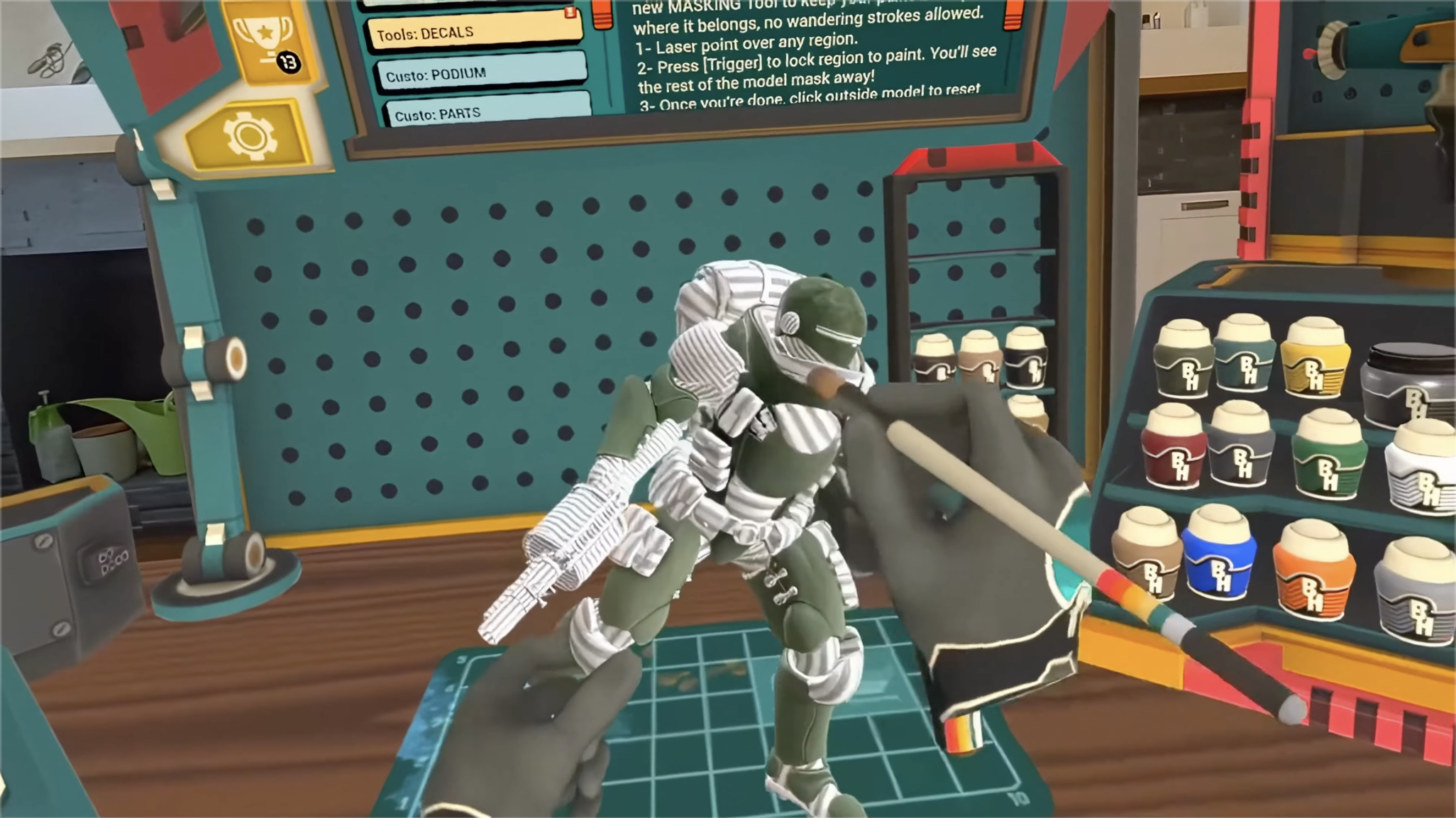
For anyone who has ever stared at a freshly primed, expensive plastic model and felt completely paralyzed about which color scheme to commit to, Soliton Interactive has a simple answer: practice in virtual reality first. BrushHammer: Miniature Painter, the Montreal studio’s mixed reality hobby simulation, launches on Meta Quest on August 26, bringing a full virtual painting workbench into the player’s own physical space — and letting them try, ruin, undo, and retry every creative decision before touching a single real brush.
The game was confirmed for its August 26 release date at the VR Games Showcase on August 13, where it appeared in the pre-show alongside a field of upcoming Meta Quest titles, the only one targeting a hobbyist craft community rather than action gaming.
How Mixed Reality Makes It Work
BrushHammer is not a fully virtual experience — and that distinction matters. Rather than transporting players to a separate digital space, it overlays a virtual hobby workbench directly onto the player’s real surroundings using Meta Quest’s color passthrough system. The Quest 3’s external cameras capture the physical room in stereoscopic full color at approximately 18 pixels per degree, and the Snapdragon XR2 Gen 2 chip runs machine-learning inference to classify what it sees — identifying the desk, floor, and walls through Meta’s Scene API — so that virtual objects appear to rest on actual surfaces rather than floating in mid-air.
The result is a virtual painting desk that sits on a player’s actual desk, with correct depth and perspective. Spatial Anchors, part of Meta’s Presence Platform SDK, allow the workbench layout to persist across sessions, so returning players find their setup exactly where they left it. It is the same underlying technology that lets a Quest app display a virtual keyboard on a real table, but applied to a craft hobby simulation.
This approach also solves something that straight VR does not: the feeling of actually sitting at a workbench. Because the physical room is visible around the virtual tools, BrushHammer creates an intimate, grounded quality — less like visiting a game world, more like having an impossibly well-equipped hobby station materialize on your coffee table.
What the Game Actually Is
Players begin by selecting a miniature from a library of figures, kitbashing it with interchangeable parts and accessories, then painting it using a toolset that mirrors a real-world hobbyist’s bench: shade brushes, dry brushes, airbrushes, spray primer cans, decals, and gloss coatings. Every choice is reversible — players can undo any stroke, try a completely different color scheme, and start over without wasting any material. That reversibility is the functional difference from painting physical models, where a misapplied shade wash can be difficult or impossible to fully correct.
Finished miniatures can be photographed in mixed reality — placed in the player’s actual room, lit by actual ambient light — and shared with friends, tapping directly into the social-display culture that makes communities like Reddit’s r/minipainting and Instagram so active.
Career Mode and What BrushHammer Feels Like
For players who want more structure than an open sandbox, BrushHammer includes a Career Mode that provides exactly the kind of arc that distinguishes a game from a utility. A player starts as a complete beginner — no reputation, basic tools — and works toward the status of legendary painter. Along the way, they accept commissions from clients with specific requests, submit completed models to picky judges for evaluation, and spend earned points in a hobby shop stocked with new brushes, accessories, paints, and workspace upgrades.
The emotional register is deliberately calm. Soliton Interactive positioned BrushHammer explicitly as a cozy experience — a term that, on Steam, appeared in game descriptions 675% more often in 2025 than in 2022 as the genre emerged as one of the clearest trends in the industry. BrushHammer is the cozy game equivalent of the miniature hobby: no leaderboards, no penalties for creative mistakes, no time pressure. The satisfaction comes from the craft itself, not from competition.
Is This a Gateway Into the Real Hobby?
The tabletop miniatures market was valued at $3.8 billion in 2025 and is projected to reach $7.1 billion by 2034 — but the hobby has documented barriers that keep curious newcomers from entering it. Committed hobbyists spend between $350 and $850 annually on miniatures alone, and the startup cost for basic tools and paints runs from roughly $110 to $270. Beyond the financial barrier, there is a well-documented psychological one: beginners frequently describe feeling paralyzed by the fear of ruining a model before they understand even basic techniques.
BrushHammer addresses both barriers directly. At the price of a Meta Quest game, a player can experiment with every major painting technique — wet blending, drybrushing, washing, airbrushing — on any number of models, make every possible mistake, and develop real intuition for color before committing a drop of actual paint. Whether that experience converts VR hobbyists into physical miniature painters — or simply gives existing hobbyists a consequence-free testing environment — it represents something the tabletop gaming industry has not previously had: a digitally mediated on-ramp to a physical craft.
Soliton Interactive is a Montreal indie game studio with prior work including game technology services for Ubisoft and Wargaming. BrushHammer is its first original consumer title targeting the leisure market. The studio put the game through an open public beta on SideQuest beginning June 18, 2026, gathering feedback from miniature hobbyists and Quest owners specifically, and showcased it at Montreal Comiccon in July 2026 and the UploadVR Summer Showcase in June 2026.
Does BrushHammer Work for Non-Hobbyists?
The answer depends on what a reader is looking for. For existing miniature painters — people who already own a collection and paint regularly — BrushHammer’s primary value is as a testing environment. They can plan out a color scheme on a virtual model before applying it to a physical one, avoiding the wasted time and materials of a failed experiment on an actual figure.
For newcomers to the hobby — people curious about miniature painting who have never started because of the cost or the intimidation factor — BrushHammer offers something closer to a risk-free introduction to craft techniques in a format they likely already own access to through their Quest headset.
For Quest owners who want creative, calm experiences rather than action games, BrushHammer sits in the same genre space as Walkabout Mini Golf or Painting VR — experiences designed for relaxed, session-based engagement rather than progression through difficulty.
A Steam version is also planned for PC VR headset owners, though no release date for that version has been announced.
Availability
BrushHammer: Miniature Painter is set to launch on Meta Quest on August 26, 2026. The game is available to wishlist now on the Meta Store.
Frequently Asked Questions
What makes BrushHammer different from other VR painting apps?
Most VR painting applications — such as Vermillion or Open Brush — let players create original 2D or 3D artwork from scratch. BrushHammer is specifically built around the miniature painting hobby: players paint pre-designed model figures using the same tools a physical hobbyist would use — shade wash, airbrush, dry brush, decal application, and varnish coating. The career mode adds a goal structure, moving a player from complete beginner to legendary painter through commissions and judge evaluations, rather than offering an open creative sandbox alone.
How does BrushHammer’s mixed reality actually work on Meta Quest?
The Meta Quest 3 uses external cameras to capture the physical room in full color, then uses depth sensors and machine-learning scene classification to understand the physical environment — walls, surfaces, furniture. BrushHammer anchors its virtual workbench to the player’s actual desk or table, so the painting station appears to physically sit in the room. Virtual miniatures display with correct depth relative to real objects. The earlier Quest 2 lacked color passthrough entirely, making this kind of convincing mixed reality experience impossible on that hardware.
Could BrushHammer serve as a first step into the real miniature painting hobby?
Potentially, yes. The physical hobby has well-documented entry barriers — a startup kit of paints and tools runs $110 to $270, individual models cost $10 to $30 or more, and beginners frequently describe anxiety about ruining expensive figures before they have developed basic technique. BrushHammer lets players develop intuition for color theory, shading, and highlighting in a consequence-free environment, potentially lowering the psychological and financial barriers that prevent interested newcomers from starting the hobby. Whether that translates into physical hobby adoption remains to be seen.
Is there a free trial or beta available before the August launch?
An open beta is available through SideQuest at no cost, and was first made available to the public on June 18, 2026. SideQuest requires creating an account and sideloading the application to a Quest headset. The full game launches on the official Meta Store on August 26, though pricing for the final release has not been announced.
ⓒ 2026 TECHTIMES.com All rights reserved. Do not reproduce without permission.
