

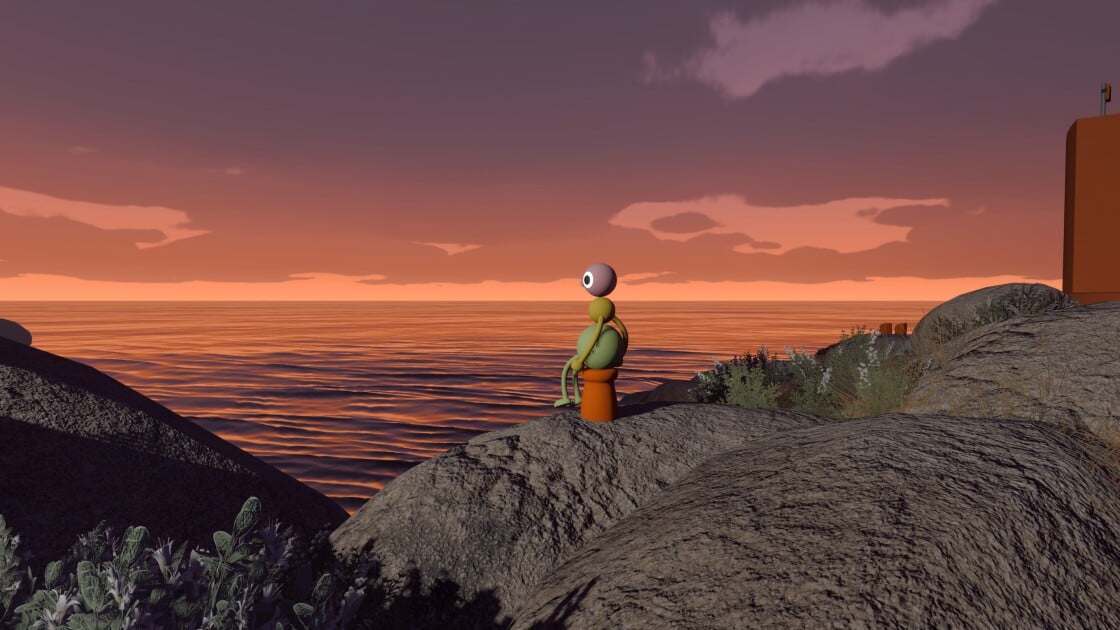
You may not recognize Australian indie developer House House, but chances are you know its viral hit, Untitled Goose Game, a sandbox title where you play as a mischievous goose. However, House House’s latest venture, Big Walk ($19.99; reviewed on PC, also available on macOS, PlayStation 5, and Switch 2), focuses on teamwork, communication, and, dare I say, friendship. It’s unlike anything I’ve played, and thanks to an immaculate combination of clever puzzles, a distinct art style, and an open world that strikes the perfect balance between mundane and mysterious—it’s also one of the best multiplayer games released this year.
What Is Big Walk?
Big Walk arrives at a time when cooperative games have never been more popular. Thanks in part to Lethal Company, Peak, and R.E.P.O, the slightly derogatory “friendslop” genre has risen to prominence. The moniker defines multiplayer games with simple graphics, a reliance on proximity chat, and gameplay centered around social interactions. These parameters ensure that no two play sessions are the same. At a glance, you could say this is true about Big Walk, a game that, at its core, is about walking and talking with your friends.
Big Walk
$19.97at Steam
$19.99Save $0.02
Shop Now
But Big Walk is so much smarter than that. While other games use social interaction to farm funny clips of you and your friends, Big Walk takes the idea and makes it the core gameplay mechanic. In fact, the game relies not just on voice but on all forms of communication to convey information to players. That means you’ll write on signs, use your arms to point and wave, or leverage items and other environmental elements to relay information.
The game is intentional in this approach and uses the same method to explain its rules. For example, when you spawn into the game, you’re tossed into a small playground-like area where you’ll find the control scheme plastered on walls. Likewise, identifiers don’t float over characters, so the only way to figure out who someone is is by speaking with them.
In these opening moments, you’re given the necessary tools and the safe space to organically learn what you can and can’t do before you’re thrust into the meat of the game. This is a great way to get gamers thinking creatively, while easing in non-gamers. In that way, Big Walk reminded me of the Great Plateau at the start of Breath of the Wild, though in this case, it’s far simpler. There are a few items, but each requires only a single button press to activate. Part of the challenge lies in deciding which items to bring on your walk and which to leave behind.
As soon as my friends got a grasp on the mechanics, Big Walk opened into a huge, lush landscape, with colorful structures, including a sculpture garden, sticking out of the brush. One of my friends asked, “Well, what’s the point of this game?” I answered, “To go on a big walk.” And with that, we started walking.
We gawked at the environment, got lost in the inky black night, and carried light-casting orbs over our heads. Big Walk wants you to take your time, absorb the sunset, and enjoy the sound of crashing waves. That’s not to say that there’s no way to participate in mischief. However, Big Walk’s zen-like approach is a stark contrast to Untitled Goose Game’s gameplay.
Gameplay: Fun in the Mundane
As my friends and I started our stroll, I was reminded of my colleague Jordan Minor’s hot take that boring open-world games are good. I don’t mean it in a derogatory way. In Jordan’s essay, he writes, “Often, the most masterful open-world games feel understated and effortless, yet still huge and jam-packed. I’m talking about games like The Legend of Zelda: Breath of the Wild, The Elder Scrolls IV: Oblivion, Far Cry 2, Metal Gear Solid V: The Phantom Pain, and The Witcher 3. In these games, the fun emerges organically, rather than being handed to you.”
Big Walk falls right in step with those titles. Many of the aforementioned structures are puzzles that require all members of your party to participate. I especially like how the game adjusts the puzzles based on the number of players. You can choose to load in an island made for 2, 3, or 4+ players (Big Walk supports up to 12 players in one multiplayer session, as well as crossplay across consoles and PC). The puzzles don’t change dramatically, but they usually add an extra step or are slightly larger to accommodate additional players.
Once you solve a puzzle, you’re rewarded with a trophy that looks almost exactly like a Kong, a popular rubber dog toy. Place enough of those Kong-shaped keys into their matching slots, and you’ll unlock a traditional door key that leads to the next area. On your travels, you’ll come across different colored towers looming over the island. That’s where the gameplay loop reveals itself. You bring these Kong-shaped keys to the tower, you unlock a big key, and you unlock something that helps you traverse the island more easily. This back-and-forth provides just enough information to get you and your friends moving toward a shared goal, but you’re free to complete these puzzles in whatever way you see fit.
Big Walk is constantly unfolding, as if you were unfolding a map and unveiling a world that grows larger with every discovery. It’s daunting at first. When I walked into the map room for the first time, I was completely overwhelmed by the island’s size. However, by the fifth completed tower, we rode a train, hitched a ride on a gondola, and explored underground tunnels.
The puzzles are delightfully unique, too, focusing on you communicating with your friends, and often without words. Sometimes we used signs, gestures, flares, and or relayed sounds to one another. One puzzle completed blinded one of my crew, who then relied on our screaming from the sidelines to cross a path. In another puzzle, one of us was strapped into a headset, listening to determine whether the microphones we were using were pumping sound into both left and right channels. But my favorite was when one of us was trapped in a room with different sounds playing. Using an intercom, the person had to speak the sounds they heard so that we could sort through the nearby speakers to find a match.
Big Walk’s beauty shines brightest during the parts in between the puzzles—those boring bits, when you’re just marching toward something in the distance, vibing to the radio attached to someone’s back, or sitting atop a tower and awaiting the sunrise so you can get a bearing on your surroundings. These moments made Big Walk feel like a digital “third space.” At times, I found myself just shooting the breeze with my friends around the light orbs, plotting out the most efficient paths to keys, and brainstorming puzzle solutions.
Big Walk is meant to be played with the same group of friends from start to finish, and I think that’s important to understanding what makes the game click. While spending the 12 to 20 hours it takes to beat the game with the same group, you start to develop a trust that you could never achieve with random strangers on the internet. By the end of the game, we were communicating in total silence, mind-melding into roles that we had grown accustomed to after approximately 40 puzzle rooms.
Graphics, Sound, and Story
I also love Big Walk’s aesthetic. The juxtaposition of the game’s simple, rounded characters against the realistic vegetation was strange at first, but there’s a genuine charm to the game’s clashing aesthetic. The game isn’t afraid to sit in silence, with music used sparingly, often playing from speakers hidden across the island. And every sound effect, from the click of a switch to the sound of feet clopping against the beach, sounds wonderful.
Recommended by Our Editors
The Best Multiplayer Video Games for 2026
Valve Steam Machine Review: Breezy PC Gaming From Your Couch
The Best PC Games for 2026
Big Walk lacks a story, and that’s fine. However, with each tower cleared, an endgame unfolds. It gets weird. One moment, it felt like I was exploring a sensory gym in the middle of nowhere; the next, I was staring down a monolith straight out of 2001: A Space Odyssey. I couldn’t help but feel strangely emotional as I waved goodbye to my friends in the game’s final moments. I may not have understood what was happening, but as the late film critic Roger Ebert once quipped about Mulholland Drive, “I understand it emotionally, and that’s the important thing.”
Big Walk is a visually simple game, so its PC requirements are fairly reasonable. At minimum, you’ll need a rig outfitted with Windows 10, an AMD Ryzen 5 1600X or Intel Core i7-7700K CPU, 12GB RAM, and either an AMD Radeon R7 370 (2GB), Intel Arc A380 (6GB), or Nvidia GeForce GTX 750 TI (2GB) GPU. The recommended settings require at least Windows 11, an AMD Ryzen 7 3700X or Intel Core i5-10600K CPU, 16GB of RAM, and an AMD Radeon RX 5600 XT (8GB), Intel Arc A750 (8GB), or Nvidia GeForce GTX 1070 (8GB) GPU.
Most notably, Big Walk is also playable on macOS. At a minimum, you’ll need a computer with macOS 15, an M1 processor, and 16GB RAM. For the recommended specs, your setup needs at least an M3 processor.
Performance was solid on my aging rig, which has an Intel Core i7-10700K processor, an Nvidia GeForce RTX 3060 graphics card, and 16GB of DDR5 RAM. Although I ran into occasional connectivity quirks while testing the game, I didn’t encounter many issues when playing with four people.
Big Walk is Steam Deck-verified. It plays wonderfully on the Lenovo Legion Go 2, too.

Can Games Be Too Cinematic for Their Own Good?
Final Thoughts
When I was a college student, my favorite essay was Max Beerbohm’s “Going Out for A Walk,” a piece about his disdain for walking without a goal. In the essay, he writes, “pending a time when no people wish me to go and see them, and I have no wish to go and see anyone, and there is nothing whatever for me to do off my own premises, I never will go out for a walk.” At the time, I couldn’t agree more. But neither Sir Beerbohm nor I could ever have predicted Big Walk’s draw.
Big Walk is one of the most inventive and creative games I’ve played, and proves that House House’s brand of avant-garde gameplay is far more than a goose-shaped fluke. While it’s true that not everyone might jibe with the intentional quiet, lack of direction, or simplistic aesthetic, those who do will find one of the most original games released in 2026.
About Our Expert
Zackery Cuevas
Writer, Hardware
Experience
I’m a PCMag reviewer and ISF-certified TV calibrator focused on computer accessories, laptops, gaming monitors, and video games. I’ve been writing, playing, and complaining about games for as long as I remember, but it wasn’t until recently that I’ve been able to shout my opinions directly at a larger audience. My work has appeared on iMore, Windows Central, Android Central, and TWICE, and I have a diverse portfolio of editing work under my belt from my time spent at Scholastic and Oxford University Press. I also have a few book-author credits under my belt—I’ve contributed to the sci-fi anthology Under New Suns, and I’ve even written a Peppa Pig book.
Areas of Expertise
Latest By Zackery Cuevas
- Razer Huntsman V3 Pro TKL 8K Review: A Tournament-Ready Classic Levels Up
- The Best Wireless Keyboards for 2026
- Alienware 34 280Hz QD-OLED (AW3426DW) Review: Penta Tandem Powers This Winning Ultrawide
- The Best Keyboards for 2026
- The Best Co-Op Game of the Year Might Be This Stunning, Anime-Inspired Switch 2 Exclusive
- More from Zackery Cuevas
