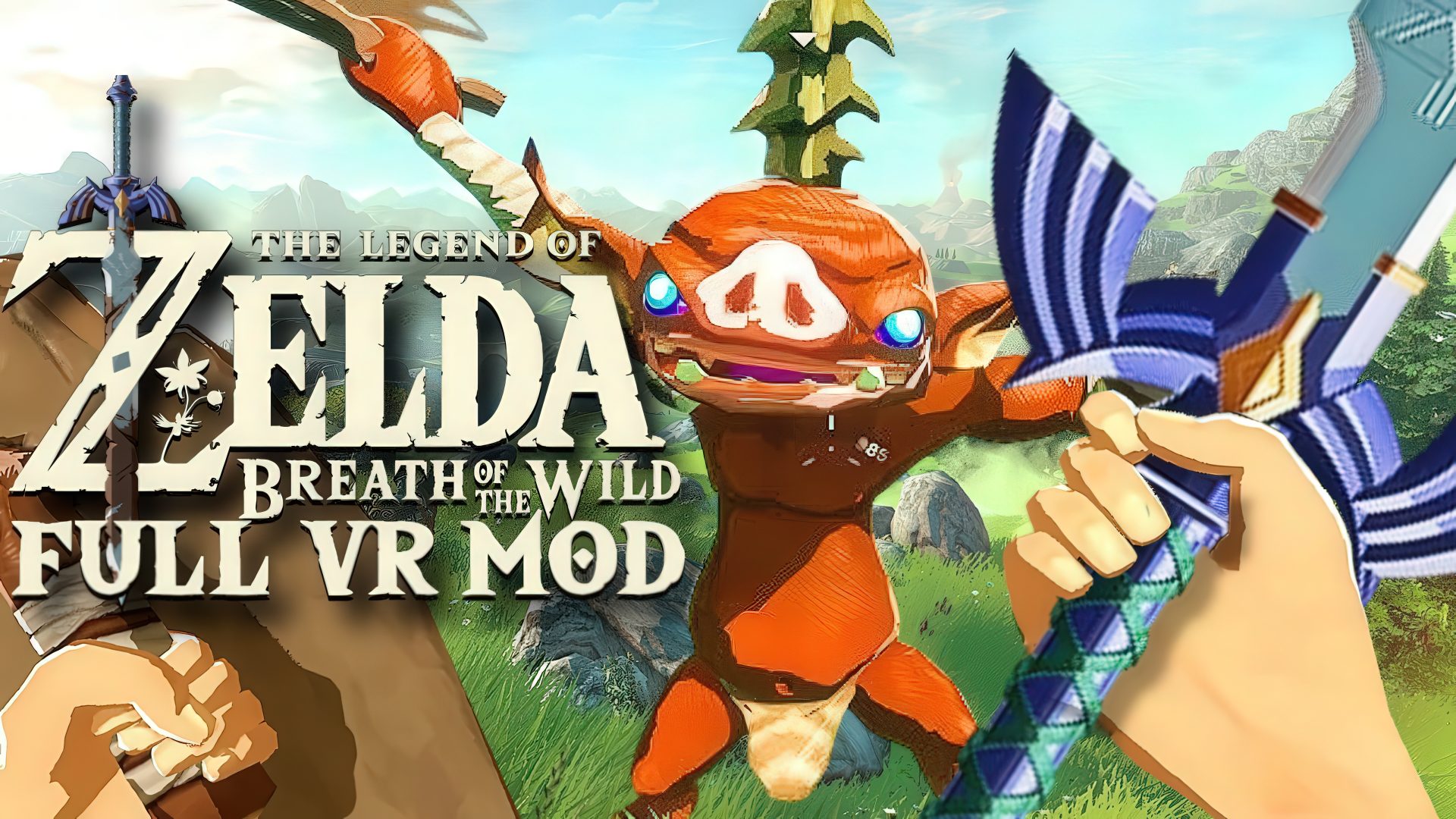
Modder Crementif has released a new version of the BetterVR mod, greatly improving the experience of The Legend of Zelda: Breath of the Wild in VR mode and also teasing a Mario Kart 8 VR port.
The first version of BetterVR (running on the Cemu emulator) launched around seven months ago. Since then, it’s had 20 updates, all of which brought substantial improvements, fixes, and polish to the game. And there are more updates to come, too, as the modder is still planning to add the following features:
- Multiplayer support (ported to the new Cemu version, still needs syncing)
- Big performance update, reworking all the stereo rendering, which also fixes a couple of important bugs
- Linux support
- Dual-wielding
Existing features for The Legend of Zelda: Breath of the Wild include:
- Fully stereo-rendered with 6DOF, with full roomscale support. No alternate eye rendering is used.
- Full hands and arms support. You can deck yourself out in all the fanciest clothes.
- Wield weapons, torches, and bokoblin arms in combat.
- Gestures to equip and throw weapons.
- Use motion controls to interact with the world to solve puzzles or start fires.
- Large mod compatibility. BetterVR only modifies the code, not the game data. Most other mods should be compatible.
- Optional third-person mode.
The BetterVR mod currently leverages OpenXR, which is supported on all the major headsets (Valve Index, HTC Vive, Oculus Rift, Meta Quest, Windows Mixed Reality, etc.). However, controller bindings are currently only available for Oculus Touch controllers, though the modder says there are likely ways to configure OpenXR mappings through SteamVR or other applications. One warning: Meta Quest users should use ALVR, Virtual Desktop, or Steam Link instead of Meta/Oculus Link, as Link has “terrible frame interpolation” that will make The Legend of Zelda: Breath of the Wild look as if it ran much worse than it actually does.
For those interested in how BetterVR works, Crementif explained that it uses a Vulkan layer that sneaks in between the Cemu emulator and the user’s graphics card. This lets it capture the game’s final rendered image right before it would normally appear on your screen and redirect it to a VR headset instead.
VR headsets use a system called OpenXR, but it doesn’t play well with the “intercepting” trick used to capture the game’s image. So, Crementif had to build a workaround: pipe the image through a different rendering system (D3D12) that OpenXR can talk to properly.


Of course, capturing a flat image and sticking it in a headset just gives you a flat image in front of your face; it doesn’t make it feel like real 3D. To create a proper stereoscopic 3D VR experience, the modder had to delve into the game’s code (which runs on the Wii U’s PowerPC processor) and rewrite chunks of it. This includes tricks like rendering two slightly different images per frame (one for each eye) before the rest of the game updates, and adjusting things like the camera angle and character hand positions frame-by-frame so everything lines up correctly in VR.
The hardest part wasn’t the VR rendering trick, though: it was reverse-engineering the game’s actual code. This game runs on a custom, largely undocumented engine, so Crementif had to painstakingly figure out how the game works from scratch (with some help from an unofficial, incomplete decompilation project) before they could even start rewriting anything. That reverse-engineering process alone reportedly took thousands of hours.
Hopefully, that kind of dedication and ingenuity is not crushed under Nintendo’s foot, as was the multiplayer mod that got taken down years ago.
About the author: With over two decades of experience in gaming journalism, Alessio Palumbo has led the gaming vertical at Wccftech since August 2015. He started working at a young age for Italian websites like Everyeye.it, Gamestar.it, Nextgame.it, and Multiplayer.it before kickstarting the indie English-language publication Worlds Factory as its founder and Editor in Chief.
In the last decade, he has coordinated the overall output of Wccftech’s gaming section, managed PR relations, assigned reviews, produced daily news coverage, edited gaming content as needed, and delivered game reviews.
Arguably, his trademark content is the long series of exclusive developer interviews that have been cited by Wikipedia and by the biggest news media and gaming publications.
His passion for technology also makes him knowledgeable when it comes to gaming hardware and tech. His favorite genres include RPGs, MMORPGs, and action/adventure games.
Follow Wccftech on Google to get more of our news coverage in your feeds.
Products mentioned