

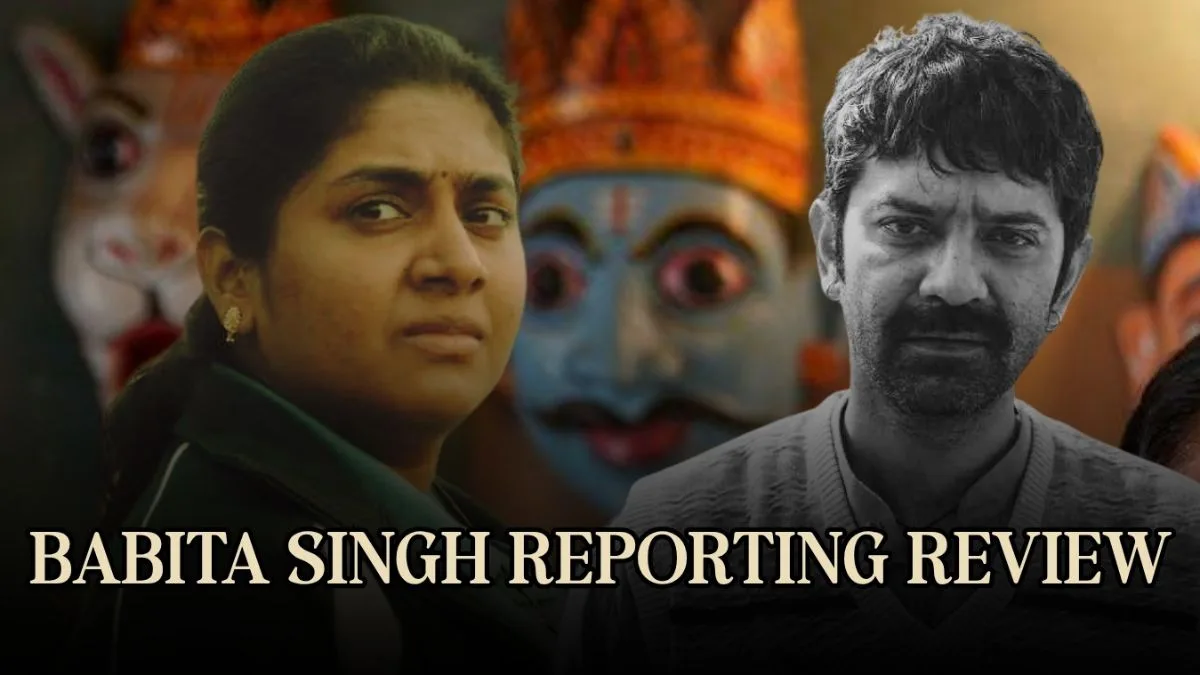
I recently ended up watching ‘Babita Singh Reporting’ on Prime Video, and I would say I was quite satisfied with my choice. It might not be an overhyped film, but it is definitely worth watching. The details will follow later, but what I want to talk about first is how some movies manage to cover such a wide range of genres and themes. Without being too loud, there are films that take you through a journey covering so many things that we witness every day but mostly choose to ignore. For ‘Babita Singh Reporting’, I would say the same.
A suspended lady cop, Babita Singh aka Baby, played by Nimisha Sajayan, takes you on a journey where the story is not just hers, but she is the true protagonist. A suspended police officer, a case to crack, and a protagonist who has to navigate her way through it all. Doesn’t it sound too familiar? Yes, of course. But it isn’t.
For starters, the suspended cop is a woman, and the protagonist is a woman, which has been relatively rare in our film industry. And honestly, that is a wonderful change. Battling her own chaotic life, one that silently chips away at her integrity and individuality, Babita chooses to step up and solve a crime. Not to achieve something for herself, but to seek justice for her long-lost friend, Bansi.
Throughout her journey, there is nothing that comes easy to her. She suffers, struggles, wins over her fears, and single-handedly manages to do everything, whether it is solving a crime or trying to keep her in-laws happy. For a woman, it is never easy. Yet appreciation rarely comes her way because, for centuries, women have been expected to do things without asking for appreciation in return.
Babita is not particularly strong when it comes to being vocal about her own rights and individuality. She sacrifices, forgives, and surrenders. Unlike many films where you see a sudden breakthrough in a woman’s ideology of putting herself first, our protagonist Babita is different.
She represents many women of our era. Someone who wants to prove herself, build a career, and earn respect through it. Yet, she is also someone who does everything to keep her family happy, while nobody actually recognises what she does. There are instances where she takes a step forward and speaks up, and, to be honest, those moments are among the best ones in the film.
Gender discrimination is not new, but ‘Babita Singh Reporting’ captures the minute details of this reality and, in doing so, gives strength to those who need it.
The story brings out another harsh reality of our society through the character of Bansi, played by Barun Sobti. It explores the dilemma of depression and, perhaps more painfully, the inability to share what you are going through when you feel like you have nobody to share it with.
Bansi meets his old friend Babita after years. He comes to meet her at the station when she arrives with her husband. There, he asks her to meet him again in the evening, saying that he needs to talk to her. She doesn’t make it, and the very next day, the news of Bansi’s death comes out. And that is where Babita’s journey begins.
Her investigation to bring justice to her friend is driven by guilt and trauma, and that keeps her going. As she investigates, we come across several characters who thread the story together and gradually make her realise what her friend’s life was really like.
A simple man with very little in his hands, Bansi is rejected and tortured by his own family. And when the truth about his death is finally revealed, you begin to understand that it was not just one person who was responsible. In many ways, the whole society was the culprit.
Coming back to reality, the real world, I would say that even if ‘Babita Singh Reporting’ may seem familiar, and cinematically it is a great piece of work, movies like this need a broader audience.
I personally believe movies are not meant just for entertainment. During our school days, we had chapters in our history textbooks about the history of art and how it affected and played a wide role in shaping the world we live in today. Art and society complement each other. Both are affected, nourished, and built through each other’s participation.
And in the world we live in today, things are changing. Women are finding their voices, mental health is increasingly being accepted as a crucial part of our lives, and crime is becoming quieter, yet more decisive. In such a time, movies like ‘Babita Singh Reporting’ matter. They may not scream their message at you, but they make you look at things that are happening around us. They make you pause, think, and, perhaps, question what we have normalised for far too long.
And maybe that is what good cinema is supposed to do.
- babita singh reporting
- Nimisha Sajayan
