

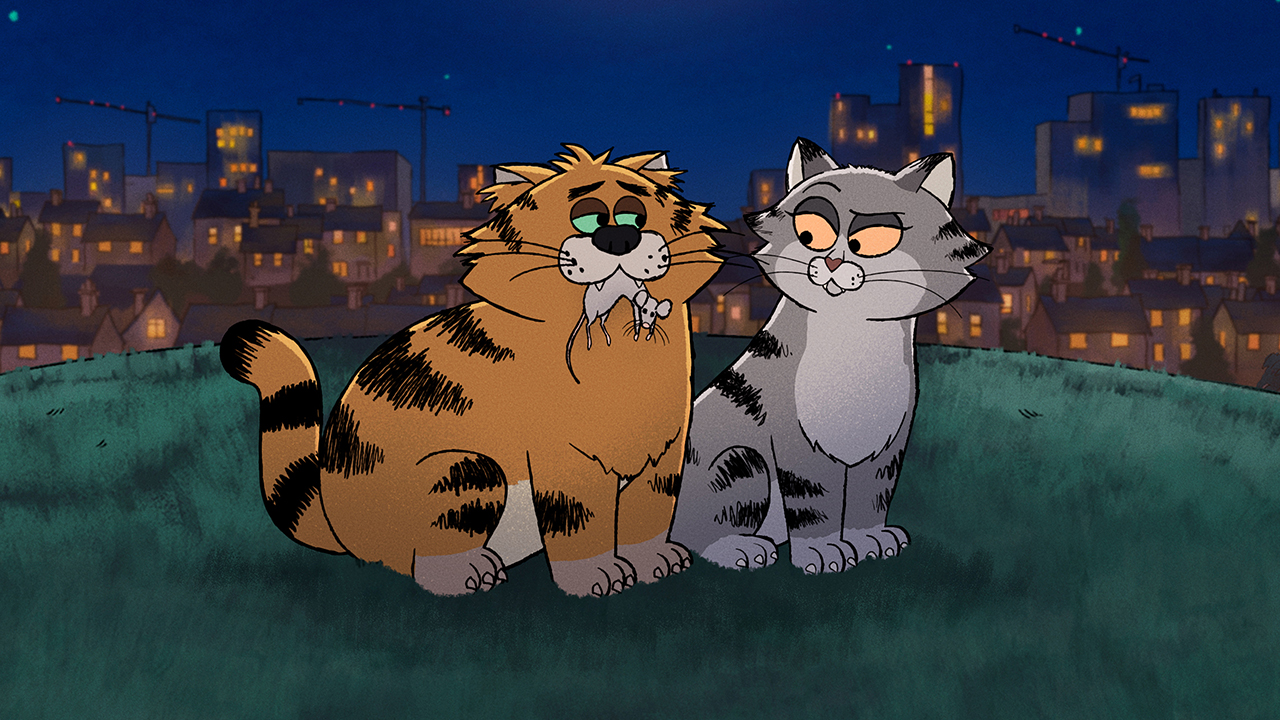
Ricky Gervais has spent the better part of the last two decades mastering the awkward sitcom, mining profound grief for laughs, and delivering buzzy and sometimes controversial stand-up specials. Now, he’s taking his signature brand of cynical, observational humor into the realm of adult animation with <a href="https://comicvibe.com/kpop-demon-hunters-merch-shows-how-netflix-extends-fandom/” title=”KPop Demon Hunters merch shows how Netflix extends fandom”>Netflix’s Alley Cats. Swapping the sleepy human suburbs for the rubbish-strewn backstreets of Britain, the six-episode series follows a clowder of foul-mouthed felines who spend just as much time philosophizing about the absurdities of life as they do scavenging for scraps. It’s a new(ish) medium for the comedy veteran, yet from the very first frame, it is unmistakably a Gervais production, for better and for worse.
If there’s a throughline to this review, it’s that everything will feel very familiar to fans of Gervais’s recent work—particularly After Life—given the cast is almost entirely the same, with the notable exception of Natalie Cassidy coming in to play Gus’s Mum. If you’ve seen After Life, you can almost transplant the character archetypes directly from that show to this.
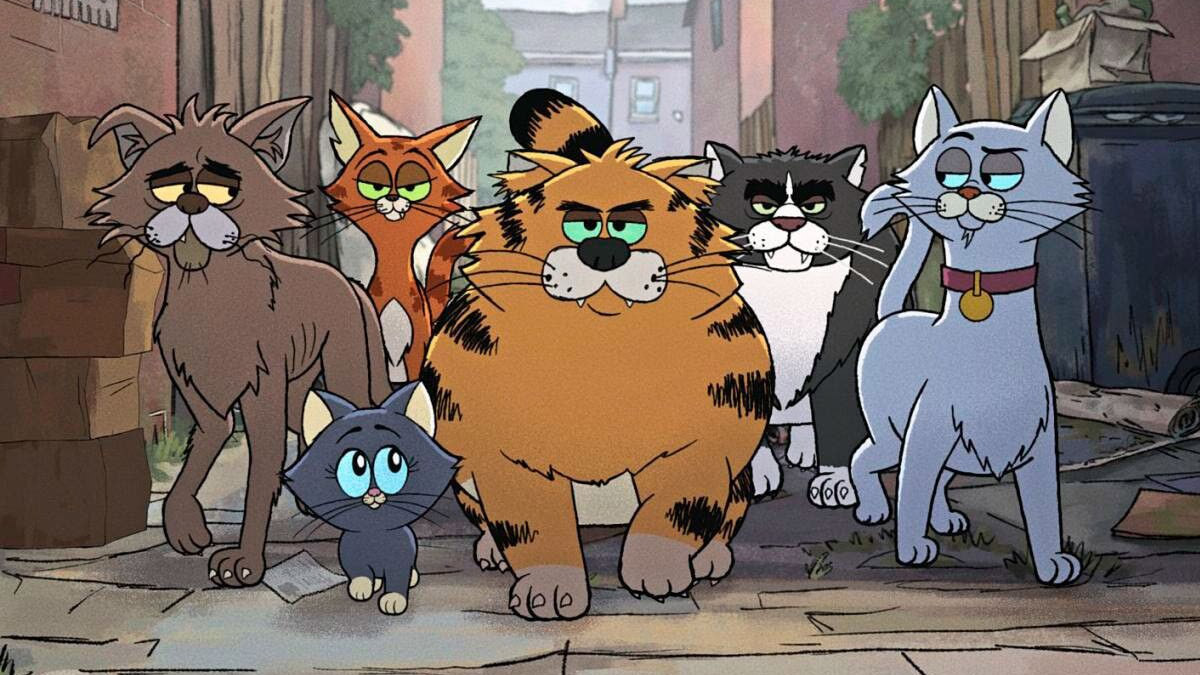
The central narrative follows our gang of cats—Gus, Ponce, Fang, Puke, and Olive—teaming up to help a lost feline dubbed “Kitten” (we never learn their actual name) find their way home. While there are secondary storylines that help you connect with the wider ensemble, such as Gus’s love life playing out in the background, the majority of the six episodes are dedicated to the search for Kitten’s owners.
Each cat has a distinct personality, though, once again, you can probably guess what’s coming. Gus is outspoken and the de facto leader of the group, much like Gervais himself. Ponce, as his name suggests, lives a privileged life with owners who feed and love him. Because the rest of the group are strays, Ponce is presented as the more educated and reasonable voice of the clowder (reminiscent of Tom Basden’s role in After Life). Fang (Andrew Brooke) is the muscle of the group, often serving as the one-liner king (as seen before), while Puke (David Earl) directly channels Earl’s characters from Derek and After Life by being utterly vile and disgusting. Finally, Olive (Diane Morgan) is an enigma with not much going on upstairs, drawing heavily from Morgan’s Philomena Cunk persona. Ultimately, every character aligns closely with their actor’s previous credits. This plays to their comedic strengths, but on the flip side, leaves little room for surprises.
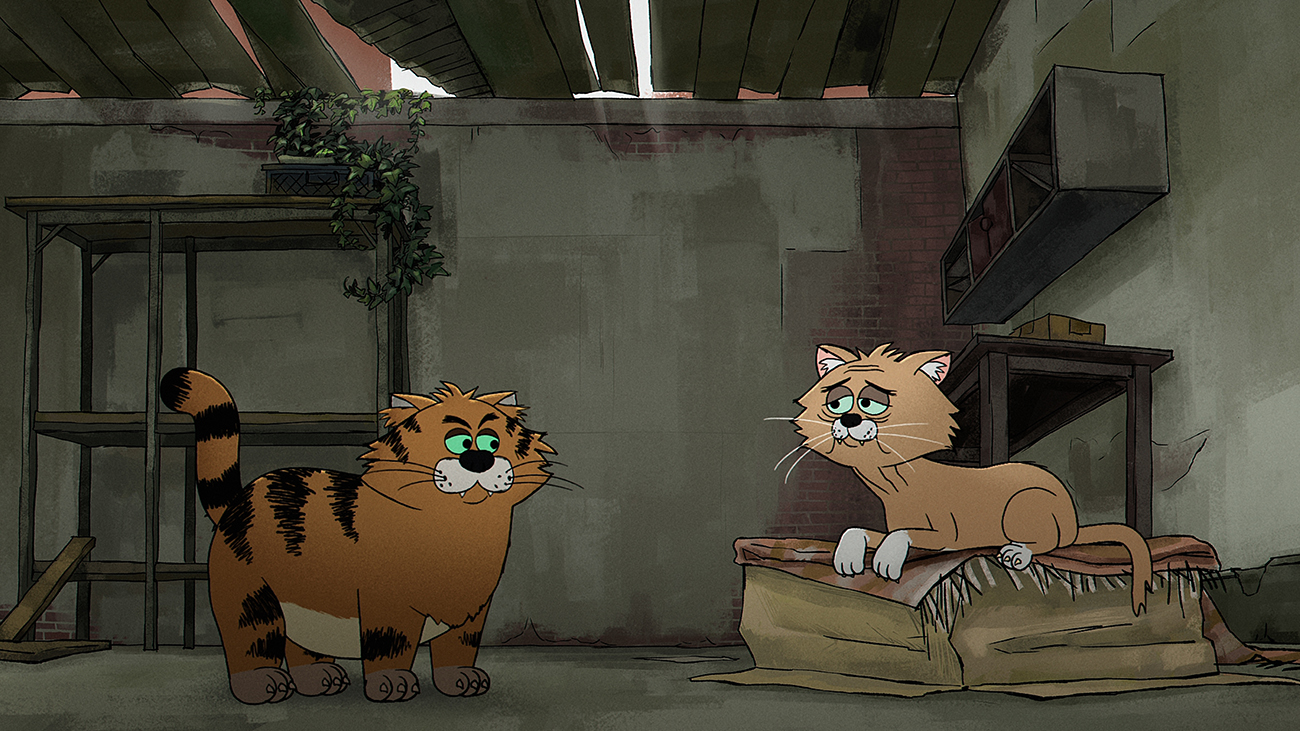
Alley Cats. (L to R) Ricky Gervais as Gus, Natalie Cassidy as Gus’ Mum, Alley Cats. Cr. Courtesy of Netflix
As for Gus’s aforementioned love life, it would be a crime not to mention Kerry Godliman’s turn as Lara. If you enjoyed their dynamic in After Life, you’ll be pleased to know their undeniable chemistry is on full display here. Lara is sharp, entirely unimpressed by Gus’s bravado, and serves as the perfect grounding foil to his more cynical rants.
Throughout the promotional tour for Alley Cats, Gervais has repeatedly referred to the show as a sitcom first and foremost. Nowhere is that clearer than in the opening of each episode, which sees our felines gathered around the television to argue about what’s on screen in true British fashion. Their rants range from dumping on humans for purposefully killing ourselves to mocking a bee for being so lazy that it only produces a single jar of honey in its lifetime. These tangents will feel incredibly familiar to anyone who has consumed Gervais’s work over the past two decades. In fact, they feel like the closest we’ll ever get to a revival of his old XFM radio and podcast days. While some of these discussions drift on a little too long—and with Gervais firmly in the driving seat, you can usually guess exactly where Gus is going to take the joke—they remain undeniably funny.
The series truly excels in its recording, which is its strongest selling point. The cast recorded their lines together in a single room, reacting and bantering in real time, and that conversational fluidity translates perfectly to the screen. There are no awkward pauses; they are literally bickering over one another. This overlapping dialogue must have been a nightmare to animate, but when the characters are chattering away at a rapid pace, the dynamic really works and makes the comedy infinitely sharper.
Fair warning and a final note on the audio: if you’re not a fan of effing and jeffing—and the C-word in particular—the dialogue in these episodes may feel like fingernails on a chalkboard.
Beyond the audio, the animation itself is more than serviceable. Visually, Alley Cats captures a gritty but charmingly stylized version of suburban Britain. The back alleys, overflowing bins, and rain-slicked pavements provide a beautifully muted backdrop that contrasts nicely with the sharp, rapid-fire dialogue. The character designs lean slightly into caricature, giving each feline distinct, exaggerated physical traits that perfectly mirror their voice actors. It’s not necessarily breaking new ground for adult animation, but it’s undeniably charming and suits the sitcom format to a tee.
It wouldn’t be a Gervais joint without a few highly charged emotional moments. Without drifting into spoilers, these beats are sprinkled throughout, though they never smack you in the face quite as hard as After Life or his other live-action works. I came close to welling up once, but the show never quite pushed me over the edge. Whether that’s due to the shorter runtime limiting character connection, the animated medium itself, or a mix of both, is hard to say. Still, Gus’s evolving relationship with Kitten—eventually stepping into a father-figure role—is genuinely the best chracter duo in the show. It delivers a satisfying payoff that perfectly sets up, but by no means requires, future episodes.
Helping to sell those emotional beats is the soundtrack. In typical Gervais fashion, the score is peppered with acoustic, melancholic indie tracks that gently underscore the more poignant moments. It’s a small touch, but it helps elevate the show from feeling like just another crass adult cartoon into something with a bit more soul, anchoring the silliness in genuine warmth.
While this specific brand of comedy won’t be for everyone, it certainly landed for me. The meatier, angrier discussions elicited genuine laugh-out-loud moments evenly across all six episodes. In fact, I’d dare say I haven’t laughed this consistently at a Netflix Original animated show before, not since maybe F is for Family.
With just six short episodes, it’s over very quickly. If you’re a fan of Gervais, it won’t be enough, but if you aren’t—and as I’ve learned from the Ricky Gervais snark subreddit, there are plenty who aren’t—you’ll be pleased it’s over so fast.
This is easily my favorite animated comedy series since F is for Family and BoJack Horseman. Gervais has stated he hopes to make this show forever; knowing Netflix and their struggle to renew any animated series, I’d settle for one or two more!
More on Alley Cats
Browse more stories for this title below.
