

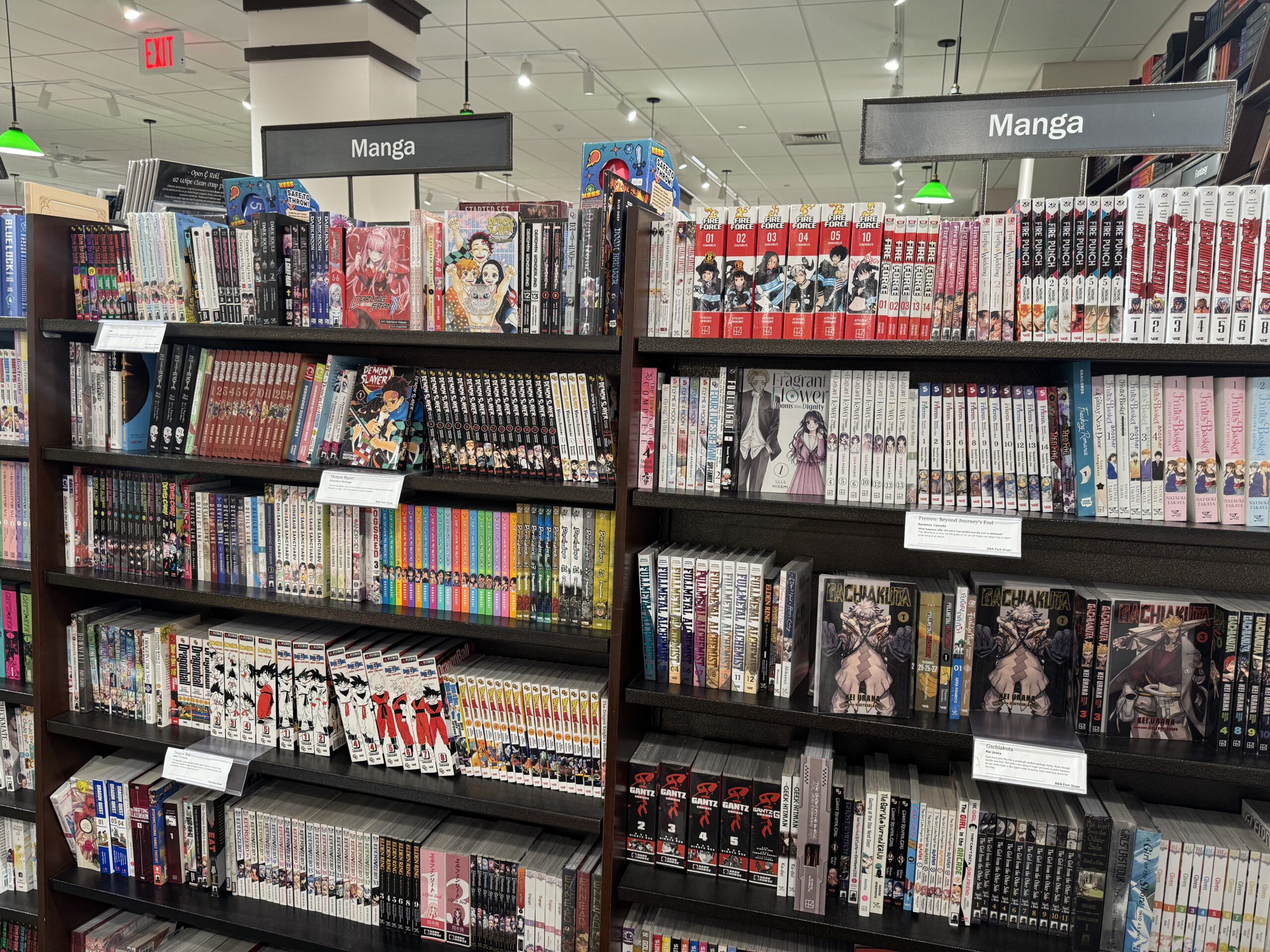
For the manga business, 2025 must have seemed like a bad case of deja vu. After a steady period of dizzying growth in the North American market between 2020 and 2022, during which the Japanese-originating genre had become the dominant sales driver for comics and graphic novels, the segment had entered a three-year stretch of precipitous decline. Here and there, publishers began to ask the unspeakable question: Was the manga boom finally over?
But like a long-running series, there was still another chapter to go. Between 2025 and 2026, manga sales jumped 40% making it the leader in a year of overall growth for comics and graphic novels. But with those sales still well below their post-Covid peak (and with the Japanese market actually shrinking for the first time in years), publishers are still unsure if these boom times are here to stay, or if the manga bubble is still waiting to be popped
Enduring market or flash in the pan?
Although manga’s post-Covid spike was certainly dramatic—the genre saw a 160% jump in sales between 2020 and 2021, according to Circana—the story of its expansion in the American market really goes back to the year 2000. Back then, spurred by an explosion of imported anime on cable TV, the US manga sector grew from an industry of around $50 million in 2002 to more than $200 million in 2007.
But that year, the bankruptcy of the Borders bookstore chain and a subsequent economic recession meant that its swift rise was followed by a vertiginous fall. It slowly began to recover starting in 2012. Kristen McLean, VP of client insights at Circana, credits the subsequent 2020 boom to a perfect storm of factors: ample free time and spare income on one hand, and a renaissance in anime series on Netflix and other streaming services on the other. In that light, McLean sees the downturn of recent years as “a market stabilization” to a more enduring plateau.
“I think the outlook for manga is very strong into 2028,” McLean told PW. “I see this as a core part of the comic market in the US indefinitely.”
While manga has made itself a fixture in a number of different retail channels—including comic shops, dedicated retailers like Manga Spot, and Amazon—McLean is quick to credit one retailer in particular for the recent success.
“Barnes & Noble [is] an incredibly important retail outlet for this because they really were there for emerging fans,” McLean says. “I was in a Barnes & Noble store [around 2023], and they must have had eight verticals of manga at the front of the store at that time.”
The past decade has seen Barnes & Noble break out manga from a subsection of graphic novels to a marquee shelf in its own right. B&N campaign manager Kat Sarfas sees that ubiquity as a key to attracting new readers—not just for her chain, but for the market as a whole.
“Like any bookstore, we are a place for discovery,” Sarfas told PW. “This is a fandom that wants more than anything to connect with other fans.”
Both Sarfas and McLean agree that as the market has recovered in the past year, there’s been a notable difference. “There has been a generational shift and more openness to Asian content and design influence generally,” McLean says. “We’re starting to see more Korean influence coming in: so, manhwa on top of manga, and donghwa from China.”
And subgenres are diversifying, too, away from the action-packed shōnen that has historically been the norm. As Sarfas explains, trends from the broader book world are increasingly percolating into the manga market—and vice versa. Among the more popular manga sub-genres right now are yuri (or girls’ love) titles, as well as a variety of ‘cozy’ interests: cozy fantasies and cozy sci-fi among them.
But if the market is evolving, that raises a new question: Can manga publishers evolve with it?
This year’s Anime NYC Convention, held at the Javits Center in Manhattan August 20–22, was a microcosm of manga fandom in all its diversity. Here, all the cultures and subcultures of manga, manhwa, and anime converged: young cosplayers rubbed shoulders with staid-looking thirtysomethings; fans of all genders thronged the hall in roughly equal number; aspiring artists drew sketches just down the hall from big-time animation studio exhibitors. And increasingly, manga publishers’ slates are looking the same way.
For much of the past 40 years, manga in the U.S. has been dominated by one very big player: Viz Media. Having first entered the American market in the 1980s, and as a subsidiary of two large Japanese publishing houses (Shueisha and Shogakukan), Viz has access to one of the deepest and most formidable libraries of imports and high-selling back-catalogs.
Today, Viz still accounts for more than half of the market’s total sales, on the back of titles including Jujutsu Kaisen, Demon Slayer, and Chainsaw Man. Lately, the publisher has invested heavily in multiple formats to reach and hang on to readers, including two separate digital subscription apps.
“Whether it comes from e-books or print books, we want more people to be reading manga,” media director, publishing sales Sara Anderson told PW.But, she added, “We would like people to stay within the Viz ecosystem.”
But as reader tastes have diversified, newer competitors have capitalized on it. Founded in 2006, Yen Press now accounts for about 10% of the American market, in part due to its newest venture, Ize Press, which publishes physical collections of web-based Korean manhwa.
“I think a lot of [Webtoon] readers were reading manga, but this was their first opportunity to have physical copies available of the product,” Yen Press publisher Kurt Hassler told PW. “Which is why our imprint is actually named [Ize], because it’s materializing the content in a physical way.”
Yen Press isn’t the only publisher moving quickly to tap the manhwa and K-pop vein: at the licensing summit during this year’s Anime NYC, Korean content was the topic of both keynote presentations.
Meanwhile, the early 2020s manga boom saw a revived investment by the stalwart Japanese publisher Kodansha in its U.S. arm. Now also accounting for around 10% of the market, Kodansha’s recent strength has been in its range of genres, audiences, and storytelling methods.
“There are categories growing very quickly in the U.S. that aren’t growing as quickly in Japan,” Ben Applegate, director of publishing services for Kodansha at Penguin Random House told PW.“The two that come to mind are LGBTQIA-interest titles and horror. Both genres are growing in the Japanese market, but growing much more quickly in the U.S.”
Applegate cites as an example Boys Run the Riot, a series by a transgender author, Keito Gaku, about a trans high school boy who starts his own fashion brand. “That was a massive hit for us, especially for a series without an anime supporting it. And that opened the door [for more LGBTQIA books]” Applegate says.
So if manga is, indeed, here to stay, it may well be a genre that’s a lot bigger than the one we’ve grown accustomed to. As McLean says, “That’s the nature of global content right now—it’s blended.”

1 Comment
Pingback: Fortnite Loot Hacker Sprites: All Variants & How to Get Them - Comic Vibe