

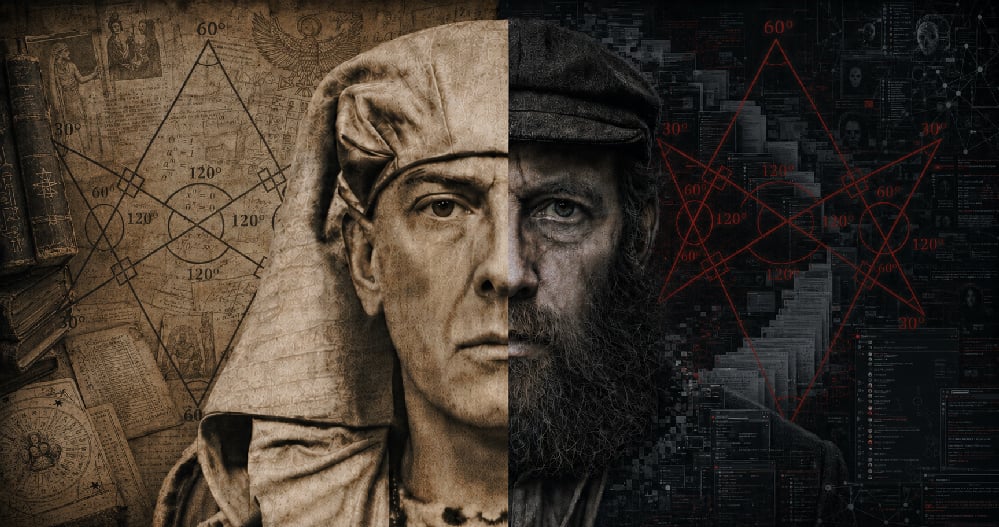
Out-Crowleying Crowley
Aleister Crowley did not create an authentically new spiritual tradition. He created a theatrical personality and an occult collage assembled from Jewish Kabbalah, Christian apocalypticism, Freemasonry, Rosicrucianism, Egyptian religion, Indian Yoga and Tantra, Islamic and Persian imagery, astrology, alchemy, and European ceremonial magic. He then placed himself at the center of this collection as “the Great Beast 666,” prophet of a supposedly new Aeon and authoritative interpreter of traditions whose languages, histories, disciplines, and living custodians he treated as material available for his own self-invention.
Crowley was the prototype of the modern occult edgelord. He converted offense into charisma, confusion into profundity, sexual appetite into sacrament, and public condemnation into evidence of initiatory greatness. His method was fundamentally performative: say something shocking, wrap it in archaic terminology, attach Hebrew letters or Egyptian gods to it, and suggest that anyone who remained unimpressed lacked the spiritual development required to understand. Within this closed system, incoherence could always be renamed mystery, exploitation could be renamed initiation, appetite could be renamed True Will, and theatrical narcissism could be proclaimed the revelation of a new age.
Beastly Appropriation
This article argues that Crowley’s occultism belonged to a wider modern Western pattern of spiritual dispossession and Orientalist appropriation. From the second century of the common era, Christianity had stripped away, condemned, or buried the pre-Christian inheritance of much of the regions of its respective spread. Centuries later, industrial modernity then left many Europeans culturally dislocated and spiritually hungry. Rather than approaching the living traditions of Asia, the Middle East, Africa, and the Jewish Diaspora with humility, however, Western occultists emerging within the Modern Era frequently raided these cultures for symbols from which to manufacture supposedly primordial identities for themselves.
The result was a spiritual colonialism in which the West claimed the authority to extract the “real” meaning of other peoples’ traditions while dismissing those peoples as inferior custodians of their own inheritance. The occultist wanted Kabbalah without Jews, Yoga and Tantra without Indians, Egypt without Egyptians, “Aryan” identity without Iranians, Buddhism without Asian communities, and initiation without submission to any inherited discipline. The original traditions supplied the language, symbols, sacred geography, and metaphysical architecture; the Western appropriator appointed himself their final interpreter.
Crowley’s hostility toward Jiddu Krishnamurti exposes this structure with exceptional clarity. Krishnamurti was a dark-skinned Indian born into a Telugu-speaking Brahmin family. He came from a living Indic cultural world rather than Crowley’s Orientalist reconstruction of one. The Theosophical Society attempted to groom him as the vehicle of its anticipated “World Teacher,” but Krishnamurti eventually repudiated the role, dissolved the organization created around him, returned its property, and rejected the authority of gurus, sects, creeds, and institutionalized spiritual dependency.
Crowley wanted the title Krishnamurti abandoned. During the 1920s, while Annie Besant and Charles Webster Leadbeater promoted Krishnamurti as the prospective World Teacher, Crowley launched his own campaign for recognition as the true World Teacher and Magus of the Aeon. He issued broadsides attacking Besant and the Theosophical Society and characterized Krishnamurti’s elevation as an attempted “usurpation.”¹ The conflict was spectacularly one-sided: Krishnamurti increasingly rejected the throne prepared for him, while Crowley raged that the throne had been stolen from Crowley.
That rivalry provides the central psychological key to Crowley’s Orientalism. Crowley had spent years extracting practices, concepts, and symbols from India, presenting himself as a master of Yoga, Tantra, magical discipline, and Eastern wisdom. Yet when an actual Indian Brahmin teacher received international recognition, Crowley did not respond with intellectual confidence or spiritual detachment. He responded as an aggrieved rival whose imagined office had been occupied by a dark-skinned man.
The racial contempt produced within Crowley’s immediate Thelemic campaign against Krishnamurti was rabid. A notorious passage later incorporated into Magick Without Tears describes Besant as attempting to persuade humanity to accept “a negroid Messiah” and denounces Krishnamurti as a “wretched creature” possessing “the most loathsome moral qualities” and “the most fatuous imbecility.” It then collapses into a salivating catalogue of insults: “Eurasian,” “Negroid,” “mongrel,” “unclean,” “insanitary,” “purulent,” “tuberculous,” “emaciated,” “onanistic,” “sluttish,” and “mangy.”²
Scholarly precision requires noting that current OTO research attributes the three “Schools of Magick” chapters containing this passage to Crowley’s Tunisian associate Gérard Aumont. The explicitly racist pamphlet The Black Messiah, once attributed to Crowley writing under Aumont’s name, is now likewise regarded as Aumont’s own composition.³ The most notorious sentences should therefore not be presented uncritically as Crowley’s personal words.
That attributional correction does not erase the surrounding history. Aumont was writing within Crowley’s immediate Thelemic environment and participating in the same propaganda struggle through which Crowley presented himself against Krishnamurti as the authentic World Teacher. Crowley’s own campaign is documented independently. He declared the Theosophical promotion of Krishnamurti an attempted “usurpation,” attacked Besant as the “Grand Old Procuress,” condemned the operation as “most sinister Black Magic,” and proclaimed his competing authority.⁴ The racial language belongs to the political and spiritual ecology of that campaign even where its precise authorship must be credited to Aumont.
The obscenity of the episode lies in its reversal of reality. Krishnamurti ultimately declared that “Truth is a pathless land,” rejected discipleship, dissolved the Order of the Star, and walked away from the institutional machinery designed to proclaim him the World Teacher.⁵ Crowley called himself the Beast, Magus, Logos of the Aeon, and World Teacher. Krishnamurti surrendered the manufactured messianic office; Crowley advertised himself for it. Krishnamurti dismantled the organization built around his authority; Crowley constructed and controlled initiatory orders. Krishnamurti rejected followers; Crowley demanded recognition of his revelation.
Crowley had imitated Indian religion only to find himself overshadowed by an Indian who rejected the very spectacle Crowley desperately wanted to control. Krishnamurti became more influential by refusing the throne than Crowley became by demanding it. The hatred was transparent. Crowley wanted to be recognized as the Western master of Eastern wisdom, but Krishnamurti’s existence revealed the difference between living cultural inheritance and Orientalist cosplay.
This is where Crowley’s behavior approaches the psychological structure of replacement theology. The appropriator does not merely borrow from another tradition; he claims to possess its truth more completely than the people who inherited it. Christianity declared itself the “true Israel” while dispossessing the Jewish people of their scripture and covenant. Christian Kabbalists claimed to uncover the Christian truth supposedly hidden inside Jewish Kabbalah. European racial occultists proclaimed themselves the authentic Aryans while appropriating the name from India and Iran. Crowley positioned himself as the authoritative master of Eastern wisdom while treating the prominence of a dark-skinned Indian teacher as an intolerable usurpation.
It is tempting to summarize the contradiction by saying that Krishnamurti was actually Aryan while Crowley merely pretended to be. The underlying point is valid, but the terminology requires precision. Krishnamurti was a Brahmin rooted in a living Indian religious and cultural setting; Crowley was not. Yet Brahmin status is not identical with a modern racial category, and Telugu belongs to the Dravidian rather than Indo-Aryan language family. More importantly, Sanskrit ārya and ancient Iranian airya were historical, ethical, linguistic, and cultural self-designations—not the biological white race manufactured by European racial theorists.
Krishnamurti nevertheless stood immeasurably closer to the actual Indic world in which ārya possessed meaning than Crowley, the Thule Society, the Nazis, or any later white occult order. The European “Aryan” was an Orientalist costume: a fantasy through which spiritually displaced Europeans imagined themselves inheritors of Indian and Iranian antiquity while regarding actual Indians and Iranians as inferior.
The same pattern connects Crowleyan occultism with Ariosophy, the Thule milieu, and the racial-esoteric currents surrounding Nazism. There is no reliable evidence that Crowley was himself a member of the Thule Society. The relationship is ideological rather than organizational. These currents emerged from the same European hunger for manufactured antiquity and relied upon the same method: extract symbols from other civilizations, declare their living interpretations corrupted, and install the European occultist as custodian of their supposedly primordial truth.
The Nazi appropriation of the swastika became the supreme emblem of this fraud. The symbol had existed for millennia across Hindu, Buddhist, Jain, Central Asian, Mediterranean, Near Eastern, and even throughout Indigenous cultures in the Americas, carrying associations with auspiciousness, well-being, cosmic movement, prosperity, continuity, and sacred order. The Nazis possessed no secret understanding of its “true” and “racial” meaning. They amputated it from living traditions and transformed an ancient sign of auspiciousness into the banner of a genocide needed to proverbially burn the genetic Library of Alexandria.
If this metaphor seems too obtuse, consider the Islamicate record on why the Caliphate burned the famous repository of knowledge in Late Antiquity. Caliph ʿUmar (584-616) allegedly ordered Alexandria’s books destroyed because writings consistent with the Qurʾān were considered redundant, while writings contradicting it were deemed heretical and dangerous; the burning was therefore portrayed as enforcing the supremacy of revelation and suppressing rival philosophies.
The full story derives from the Egyptian Arab historian Ibn al-Qifṭī (1172 to 1248 CE), who attributes to ʿUmar the argument that books agreeing with the Qurʾān were dispensable and those disagreeing with it should be destroyed (Bar Hebraeus later reproduced this account: Ibn al-Qifṭī, Taʾrīkh al-Ḥukamāʾ, ed. Julius Lippert [Leipzig, 1903], 355; Bar Hebraeus, Chronography, trans. E. A. Wallis Budge; ʿAbd al-Laṭīf al-Baghdādī, al-Ifādah wa-al-Iʿtibār, 1286 AH, 28).
Their atrocities did not make them more Aryan. They made their appropriation more catastrophic and—as the youth of today term it—“cringe.” Violence could not repair the absence of lineage. Murder beneath a stolen symbol did not establish ownership of that symbol. It merely demonstrated what can happen when the counterfeit tradition acquires political power.
The Order of Nine Angles repeats this entire process in a later and even more pathetic form. O9A claims to transcend Crowley, ceremonial magic, established Satanism, Christianity, and modern occultism by presenting itself as older, harder, more pagan, and more genuinely sinister. Yet its planetary correspondences, septenary symbolism, graded initiation, aeonic speculation, Christian inversion, fascist mythology, and obsession with transgression all reveal its dependence upon the same modern Western occult environment.
O9A’s supposed answer to the absence of authentic lineage is escalation. Crowley performed transgression through blasphemy, sexual scandal, narcotics, ritual theater, and cultivated infamy. O9A claims that its initiates enact what Crowley merely represented: criminal “insight roles,” fascist activism, terrorism, predation, sacrifice, and “culling.” Its implicit boast is that Crowley talked while O9A acts.
This is not greater authenticity. It is reactionary atrocity cosplay performed with real victims. O9A remains chained to Crowley as the predecessor it must continually surpass. It must become darker than Crowley, harder than Crowley, more offensive than Crowley, and more willing than Crowley to convert occult theater into human suffering. Its crimes do not prove that its lineage is ancient. They expose how desperately its adherents need to make a fabricated tradition feel real.
The trajectory examined here is therefore one of escalating emptiness. Orientalist appropriation becomes fabricated lineage. Fabricated lineage becomes edgelord performance. Edgelord performance becomes atrocity cosplay. What begins with a white occultist proclaiming himself master of the traditions he borrowed culminates in later poseurs inflicting real suffering beneath borrowed symbols to prove that their performance is serious.
They hate the peoples whose traditions reveal them as borrowers. Crowley’s rivalry with Krishnamurti exposes the entire structure: the white Orientalist wanted Indian wisdom, the title of World Teacher, and the authority to interpret the East—but could not tolerate being overshadowed by an actual Indian who neither needed nor wanted Crowley’s costume.
Crowley hated Krishnamurti because Crowley was not Krishnamurti. He was not Indian, not Brahmin, not rooted in a living Indic culture, not willing to renounce manufactured spiritual authority, and ultimately not capable of achieving Krishnamurti’s influence without demanding recognition of his own greatness.
He hated him because he was not him. O9A’s later edgelords remain trapped within precisely the same compensatory performance.
The Beast Who Never Escaped Christianity
Crowley proclaimed the advent of a new spiritual Aeon beyond Christianity, yet the identity through which he announced this liberation remained thoroughly Christian. He called himself “the Great Beast 666,” taking his defining title from the Book of Revelation and investing it with the emotional power that centuries of Christian demonology had already accumulated around it. Without Christianity, the Beast was not shocking. Without Revelation, 666 carried no apocalyptic menace. Without Christian ideas of sin, Crowley’s blasphemies lost much of their theatrical significance. His allegedly post-Christian identity remained dependent upon Christianity for its vocabulary, antagonists, audience, and emotional charge.
Crowley did not leave Christianity behind. He inverted it. What Christianity called holy, he profaned. What it called sinful, he ritualized. What it feared, he adopted as his persona. What it called the Antichrist, he treated as an initiatory archetype. The values were reversed, but the axis remained unchanged. Crowley continued revolving around the Christian symbolic universe while insisting that moving to its opposite pole constituted escape.
This is not transcendence. It is reaction. A person who builds his entire personality around offending a religion remains psychologically governed by that religion. The transgressor requires the prohibition. The blasphemer requires the sacred object. The self-appointed Beast requires Christians who recognize and fear the Beast. Crowley’s rebellion was therefore structurally adolescent: he needed the parental religion he claimed to have rejected because provoking it supplied his identity.
Crowley himself admitted something remarkably close to this when he wrote:
I did not hate God or Christ, but merely the God and Christ of the people whom I hated.⁶
The statement is revealing because it places personal hatred before theological analysis. Crowley’s revolt against Christianity was not simply the discovery of an independent metaphysical truth. It was inseparable from his hatred of the people and social order associated with the Christianity of his upbringing. His new religious identity emerged through antagonism toward them.
The number 666 demonstrates the derivative character of this performance even more clearly. Revelation presents it as the “number of the Beast” and “the number of a man,” inviting those possessing understanding to calculate it. The strongest historical interpretation identifies the name encoded by the number as נרון קסר (Neron Qesar), “Nero Caesar,” written in Hebrew letters:
נ = 50
ר = 200
ו = 6
ן = 50
ק = 100
ס = 60
ר = 200
The variant reading 616 preserved in some ancient manuscripts strengthens this identification. When Nero’s name is written as נרו קסר (Nero Qesar) without the final nun, the value decreases by fifty:
נ = 50
ר = 200
ו = 6
ק = 100
ס = 60
ר = 200
This is not speculative numerology imposed upon the text centuries later. The two ancient manuscript readings correspond to two recognizable Hebrew spellings of Nero’s name. The number referred to Roman imperial power through a Jewish method of numerical interpretation. It was an encoded political identification, not a mystical birth certificate for an English occultist born eighteen centuries afterward.⁷
Crowley’s grand identity was therefore derivative several times over. The Beast belonged to a Jewish-Christian apocalypse. Its number operated through Hebrew gematria. The historical referent was a Roman emperor. The accumulated terror surrounding the number came from Christian reception. Crowley contributed only the decision to apply all of this to himself.
This is the essence of his method. Crowley encountered an ancient symbol already dense with historical meaning, removed it from its original political and religious setting, placed himself at its center, and announced that the resulting rearrangement revealed his cosmic importance. An anti-imperial cipher became personal branding. Jewish mathematical interpretation became evidence of an English occultist’s destiny. Christian fear became free publicity.
His admirers sometimes interpret the adoption of 666 as an act of psychological liberation from Christian moral conditioning. At the most elementary level, deliberately identifying with the object one has been trained to fear can indeed reduce that fear. But this does not transform Crowley’s personal theater into an ancient revelation. A Victorian declaring himself the Beast may have shocked Victorian Christians; it does not follow that the universe appointed him to inaugurate a new Aeon.
Crowley’s genius was in making private rebellion appear cosmological. Personal conflict with Christianity became the death of the old Aeon. Sexual rebellion became sacramental law. His chosen nickname became an occult office. His preferences became True Will. His book became revelation. His biography became the battlefield of cosmic forces.
This self-magnification required a deliberately inflated vocabulary. Crowley was not merely an author; he was a prophet. He was not merely an organizer; he was the head of initiatory orders. He was not merely interested in comparative religion; he was the master who revealed the correspondence between all religions. He was not merely experimenting with drugs and sex; he was conducting magical operations on behalf of the new Aeon. He was not merely antagonistic toward Christianity; he was the Beast destined to overthrow it.
The structure resembles the internet edgelord who presents offensive behavior as evidence of intellectual independence. The edgelord does not necessarily possess a coherent alternative to what he attacks. His identity is produced through the reaction he provokes. Outrage becomes proof of courage. Social rejection becomes proof of superior perception. The inability of others to understand becomes evidence of his profundity. The more hostile the response, the more important he imagines himself to be.
Crowley perfected this strategy before the internet. Newspaper denunciations enhanced his notoriety. Descriptions of him as “the wickedest man in the world” became part of his mythology. Accusations, scandals, obscenity proceedings, sexual rumors, and tales of forbidden rites expanded his brand. Every attack helped confirm the image he had already constructed.
The problem with this performance is not merely that it was ridiculous. It created a model of charismatic exemption. If Crowley was the Beast, the Magus, the prophet of the Aeon, and the embodiment of True Will, then ordinary ethical judgments could be dismissed as remnants of the dying Christian order. Conduct that appeared selfish, exploitative, manipulative, or abusive could be redescribed as magical initiation. Resistance could be interpreted as spiritual weakness. Harm could be absorbed into the mythology of ordeal.
The Crowlian “Do what thou wilt” might not necessarily have been seen as equivalent to “do whatever you feel like doing.” Within Thelema, True Will was supposedly meant to signify the discovery and fulfillment of one’s proper course rather than impulsive gratification… and yet this distinction quickly slouched into convenient self-justification for lack of discipline and interial consistency when the person declaring his True Will also claims to be the unique prophet authorized to explain it. Crowley could identify his own desire with cosmic necessity while classifying opposition as ignorance, restriction, or failure to comprehend the Law. The self-justifying ego-worship removed all checks and balances part and parcel to true initiatic lineage and oversight.
The system thus risked making Crowley unfalsifiable. If a ritual succeeded, it demonstrated his magic. If it failed, the initiate had misunderstood. If a statement was clear, it revealed his wisdom. If it was incomprehensible, it concealed an initiatory mystery. If his behavior appeared liberating, it confirmed the new Aeon. If it appeared destructive, the observer remained trapped in obsolete morality. If followers prospered, Crowley had awakened them. If they collapsed, they had failed the ordeal.
This is not a minor biographical defect. It is the mechanism through which edgelord performance becomes authoritarian. The leader creates a symbolic world in which every possible outcome validates him. No evidence can disprove his authority because all evidence is reinterpreted through the authority being questioned. Confusion becomes depth. Contradiction becomes paradox. Cruelty becomes instruction. Dependence becomes discipleship.
Crowley’s continued bondage to Christianity also anticipates the later development of modern Satanism and O9A. Anton LaVey claimed Satan as a symbol of individualism and rebellion, but remained dependent upon the Christian Devil for name recognition, ritual theater, and cultural power. Even the very logo of his “church” is decorated in the five Hebrew letters for Livyaṯān (Leviathan)– a term which simply means “whale” in Hebrew, the antique Jewish apocalyptic deployment of the term notwithstanding.
The O9A claimed to move beyond conventional Satanism, yet continued employing Satanic and anti-Christian forms as instruments of transgression. Each movement announced its independence by intensifying its reaction to Christianity.
The dependence becomes more obvious with every attempted escalation. Crowley called himself the Beast. LaVey institutionalized Satanic inversion. O9A accused previous Satanists of merely playing and insisted that authentic transgression required actual ordeals, criminality, and dangerous action. But the structure never changed. Each new movement remained governed by the tradition it opposed and the predecessor it attempted to surpass.
Crowley’s Beast was therefore not the beginning of a genuinely new Aeon. It was the beginning of a modern escalation cycle. Once one occult celebrity had claimed the ultimate Christian monster as his identity, later poseurs needed something more extreme. Merely calling oneself evil eventually ceased to shock. Drawing inverted symbols ceased to shock. Sexual transgression ceased to shock. Ritual blasphemy ceased to shock. The edgelord’s economy demanded constant escalation.
O9A’s atrocity doctrine emerged as the logical parody of that economy. If Crowley merely called himself the Beast, the later initiate would behave beastly. If Crowley performed blasphemies, the later initiate would commit crimes. If Crowley shocked Christians through ritual theater, the later initiate would shock everyone through actual injury. The victim would become proof that the transgression was no longer symbolic.
Yet this escalation never escaped the original dependency. O9A remained chained to Crowley just as Crowley remained chained to Christianity. Crowley needed Christianity in order to be the Beast. O9A needed Crowley in order to present itself as more authentically sinister than the Beast. Each rebel remained psychologically governed by the father he claimed to have surpassed.
The result is an inheritance composed almost entirely of reaction. Christianity supplies the apocalypse. Jewish gematria supplies the number. Rome supplies Nero. Crowley supplies the theatrical Beast. Modern Satanism supplies the institutionalized inversion. O9A supplies the atrocity cosplay. At every stage, the movement claims independence while displaying another layer of dependence.
Crowley did not discover the Beast. He auditioned for it. O9A did not transcend Crowley. It turned his audition into a criminal hazing ritual.
Zero to the Zero Power: Crowley’s Mathematical Ignorance Masqueraded As Mystical Profundity
Aleister Crowley used the mathematical expression 00 = 0(zero to the zero power equals zero) as part of his philosophical framework 0=2, blending esoteric poorly-informed and appropriated Kabbalah and a hodgepodge of various cherry-picked Eastern or “Oriental” concepts.
While rigorous mathematics often treats 00 as 1 or undefined depending on context, Crowley’s symbolic approach viewed numbers as qualitative, spiritual substances rather than strict quantitative tools
Crowley’s treatment of zero provides a miniature example of his entire intellectual method. He took a technical problem, removed it from the discipline capable of explaining it, treated contextual ambiguity as an absolute contradiction, and then presented the resulting confusion as evidence of an unfathomable occult mystery. The audience’s unfamiliarity with mathematics did the rest. What Crowley did not understand could be advertised as something reason itself was incapable of understanding.
Crowley’s broader metaphysics of zero is distributed throughout his writings, including The Book of Lies, Magick Without Tears, and the formula he presented as (0=2). Zero represented nothingness, the unmanifest, Nuit, boundless possibility, and the condition from which apparent duality emerges. Such symbolic use of zero is not inherently illegitimate. Mathematics has long supplied metaphors for philosophy, and nothing prevents a religious author from using zero poetically. The problem begins when mathematical notation is invoked as though mathematics itself proves the metaphysical doctrine.
The expression 00, zero raised to the zero power, is often presented in elementary education as undefined or indeterminate. That can make it appear paradoxical:
If one carelessly substitutes zero into both statements, the first appears to produce (00=1), while the second appears to produce (00=0). The unwary reader may conclude that mathematics has broken down and that zero has opened a portal into metaphysical Nothingness.
The apparent contradiction disappears as soon as the conditions governing the two rules are stated correctly:
a0=1 qquad text{for } aneq0
The first rule excludes a base of zero. The second excludes an exponent of zero. Neither rule, standing alone, determines (0^0). There is no contradiction because the two propositions were never defined over the same complete set of inputs. The mystery was produced by omitting the restrictions.
This is precisely the distinction explained through the classroom example in George Dimitriadis’s “Jimmy Asked a Dangerous Question: What Is (00)?” The question appears dangerous only while the rules are presented incompletely. Once their domains are restored, the supposed logical collision vanishes.⁸
Calculus introduces a different issue. When mathematicians call (00) an “indeterminate form,” they are not saying that the expression is metaphysically incomprehensible. They are describing the behavior of limits. If two functions both approach zero in such a way that one becomes a base and the other an exponent, knowledge that the resulting expression has the form (00) is not enough to determine the limit.
But another expression with the same apparent (0^0) form can approach a different value. Consider:
As (xto0^+), both (f(x)) and (g(x)) approach zero. Yet:
[
f(x)^{g(x)}
left(e^{-1/x}right)^x
not (1) and not (0).
A third choice can produce still another answer. If:
[
f(x)^{g(x)}
left(e^{-c/x}right)^x
This is not mathematical failure. It is mathematical precision. Calculus refuses to pretend that incomplete information determines a unique limit. The designation “indeterminate form” is not a surrender before an unknowable abyss. It is an instruction to continue calculating.
Outside limits, mathematicians frequently define:
00=1.
This convention is especially useful in combinatorics, set theory, algebra, discrete mathematics, and formal power series. It preserves general identities, eliminates unnecessary exceptions, and corresponds naturally to counting problems.
Suppose (A) and (B) are empty sets. How many functions exist from (A) to (B)? Exactly one: the empty function. A function assigns each element of its domain an element of its codomain. Because the domain contains no elements, there are no assignments to make and no possible violation of the definition. The empty assignment is unique. Since the number of functions from a set containing (m) elements to one containing (n) elements is generally (n^m), the empty case gives:
Combinatorics provides an even simpler intuition. How many ways are there to choose zero items from zero available items? One. Choose nothing. The empty selection is not one possibility among several; it is the single possible selection.
The same reasoning appears in the empty product. Multiplication assigns (1) as its identity element because multiplying a number by (1) leaves it unchanged. A product containing no factors is consequently defined as (1), just as a sum containing no terms is defined as (0). Since exponentiation can be understood as a product of repeated factors, a product containing zero copies of zero is naturally treated as the empty product:
Polynomial notation also becomes unnecessarily cumbersome if (0^0) is not allowed to equal (1). Consider:
P(x)=a_0x^0+a_1x^1+a_2x^2+cdots
At (x=0), the constant term must remain:
This works cleanly because the (x^0) term equals (1), including when (x=0). Refusing the convention would require the constant term to be separated artificially from the general expression.
Nothing in this discussion requires every mathematical context to adopt one universal treatment. Elementary arithmetic may leave (00) undefined to prevent careless extension of exponent rules. Calculus classifies (00) as an indeterminate form when discussing limits. Combinatorics and algebra commonly define it as (1). These are not mutually contradictory dogmas. They are context-sensitive definitions selected for different mathematical purposes.
Crowley’s mistake was to treat contextual variation as evidence that reason had confronted the ineffable. He mistook “the information presently given does not determine the limit” for “the human mind cannot fathom this expression.” He converted a warning against premature conclusion into a warrant for mystical grandiosity.
This distinction is devastating to the edgelord performance because the mathematics is not even exceptionally advanced. One does not need to penetrate the secret chambers of number theory. One needs only to state the domains of two exponent rules, distinguish a number from the limiting form of a function, and understand why certain mathematical conventions are useful.
Crowley instead treated notation as theater. Zero looked mysterious. Exponentiation looked technical. The juxtaposition of Nothing with Nothing sounded metaphysical. By invoking (00), he could appear to stand at the border where mathematics dissolved into magic. But he had not traveled beyond mathematics. He had stopped before understanding it.
The pattern is identical to his use of Kabbalah, Tantra, Yoga, Egyptian religion, and comparative symbolism. Take something technical and historically situated. Remove its restrictions and native context. Present the resulting ambiguity as a revelation. Then appoint oneself the interpreter uniquely capable of explaining what ordinary specialists allegedly cannot comprehend.
In mathematics, the specialists can expose the trick immediately. The rules were applied outside their domains. The limit lacks sufficient information. The convention varies by context. There is no cosmic paradox.
Crowley’s supposed abyss was a missing footnote.
The episode also illustrates why cultivated obscurity is so useful to occult authority. If the audience does not understand the mathematics, the author’s confusion may resemble sophistication. A clear mathematician says, “The answer depends upon the structure in which the expression occurs.” The occult performer says, “Behold the inconceivable marriage of Nothing with Nothing.” The first explains. The second mesmerizes.
This does not mean mathematics is devoid of philosophical depth. Zero transformed mathematics. Infinity raises genuinely profound conceptual problems. The relationship between nothingness, possibility, absence, and creation has occupied mathematicians, philosophers, theologians, and mystics for centuries. But the existence of legitimate depth does not validate every mystical claim made with mathematical symbols.
A metaphor can be meaningful without being a proof. Crowley could have said that (00) poetically represented the emergence of unity from apparent nothingness. That would have been an occult metaphor subject to philosophical interpretation. Instead, he treated the mathematics itself as though it had encountered an absolutely unfathomable contradiction that authenticated his doctrine.
It did not.
The expression (00) does not prove Crowley’s cosmology. It proves only that mathematical notation must be interpreted within a defined context. In the very disciplines Crowley attempted to invoke as witnesses, (0^0) is not an unknowable monster. It is either left undefined for a stated reason, treated as an indeterminate limiting form requiring additional information, or defined as (1) because doing so produces the most coherent structure.
Crowley did not reveal what mathematicians were too timid to confront. He failed to understand what mathematicians had already taken care to distinguish. The supposed profundity existed only so long as his audience knew even less mathematics than he did.
That is not mastery of the Abyss. It is bluffing at the blackboard.
Aryan Cosplay: From Orientalist Occultism to the Thule Society and Nazism
Crowley’s Orientalism did not arise in isolation. It belonged to a much broader European attempt to compensate for cultural and spiritual alienation by constructing invented lineages from fragments of other peoples’ traditions. Christianity had spent centuries condemning, suppressing, absorbing, or recasting Europe’s pre-Christian religions. Industrial modernity then weakened inherited communities without replacing them with an equally compelling sacred order. Many Europeans consequently found themselves longing for an antiquity they could no longer access through a continuous living tradition.
India, Iran, Egypt, Tibet, the Islamic world, and Jewish mysticism appeared to offer what modern Europe believed it had lost: ancient initiatory knowledge, sacred languages, cosmic symbolism, disciplined contemplation, and an integrated relationship between religion and culture. But Western seekers frequently approached these civilizations as colonizers approached territory. They did not ask how a tradition understood itself. They asked what could be extracted from it.
The resulting occultism was Orientalist in the fullest sense. “The East” became an imaginary warehouse of mysteries from which Europeans could select gods, mantras, diagrams, practices, racial myths, and sacred symbols. Historical differences could be ignored because the Western occultist claimed access to a secret unity concealed beneath them. Contradictions between traditions were treated as external misunderstandings. The appropriator alone supposedly perceived their universal esoteric core.
Crowley’s tables of correspondences exemplified this mentality. Egyptian deities, Hebrew letters, planets, Tarot cards, Hindu concepts, bodily organs, perfumes, colors, magical weapons, metals, and mythological figures could be arranged in adjacent columns and declared equivalent. The arrangement created an appearance of enormous learning, but adjacency is not demonstration. Placing an Egyptian god beside a Hebrew letter and a Sanskrit term does not prove that Egyptian priests, Jewish Kabbalists, and Indian sādhus understood them as manifestations of a single system. It proves only that Crowley decided to place them in the same row.
This classificatory power positioned the European occultist above every culture he appropriated. Jews might preserve Kabbalah, Indians might preserve Yoga and Tantra, Egyptians might descend from the civilization whose gods supplied the imagery, and Muslims might preserve Arabic and Persian esoteric literature—but Crowley could claim authority to explain how all of them fit together. The original peoples became local and partial; the Western synthesizer became universal.
This same hierarchy operated within Theosophy, Ariosophy, völkisch mysticism, and the esoteric currents surrounding the Thule Society. There is no reliable evidence that Crowley belonged to the Thule Society, and the argument does not require inventing such a membership. Crowleyan occultism and Thule-associated racial esotericism emerged within the same wider European environment and answered the same cultural anxiety through similar appropriative methods.
Theosophy presented Asian religions through an elaborate system of masters, root races, hidden continents, spiritual evolution, and universal occult laws. Its leaders helped introduce Western audiences to important Indian and Buddhist materials, but they also reorganized those traditions inside a European esoteric framework. The living religions of Asia became evidence for a system whose final architecture was constructed largely by Western interpreters.
Ariosophy racialized that process. Guido von List, Lanz von Liebenfels, and related writers blended Germanic mythology, runic speculation, Theosophy, racial pseudoscience, Christianity, anti-Christianism, and fantasies about ancient priest-kings. Their supposed ancestral religion was not the uninterrupted survival of an ancient Germanic order. It was a modern synthesis created from nationalism, occultism, philology, racial anxiety, and fragments selected from elsewhere.
The Thule Society arose within this völkisch environment. Its name invoked Thule, the legendary northern land described in Greco-Roman geographical literature and later transformed into a fantasy of primordial Nordic civilization. The society linked extreme nationalism, antisemitism, conspiratorial politics, Germanic symbolism, and occult-inflected ideas about ancestry. Its members and associates participated in the political milieu from which the German Workers’ Party emerged and was transformed into the National Socialist German Workers’ Party.⁹
The relationship between esotericism and Nazism should not be reduced to the fantasy that Hitler was a ceremonial magician carrying out secret rituals under orders from an occult lodge. Such stories can inadvertently make Nazism appear supernaturally powerful. The historically significant connection is more ordinary and more disturbing: racial mythology, conspiratorial antisemitism, invented ancestry, sacred national destiny, and appropriated symbols provided a mythic language through which political violence could be imagined as cosmic restoration.
The word Aryan became central to this operation. Sanskrit आर्य (ārya) and ancient Iranian airya were historical self-designations associated with nobility, cultural belonging, ethical refinement, language, and civilization. The cognate terms belonged to actual Indian and Iranian worlds. European philologists initially used “Aryan” primarily in discussions of Indo-Iranian languages and, more expansively, the Indo-European language family. Racial theorists then transformed a linguistic and cultural category into a biological white race.
This conversion was not a recovery of ancient truth. It was an invention. Language families do not constitute biological races. Speaking an Indo-European language does not establish descent from a single pure population. Ancient Indians and Iranians did not formulate a doctrine of Nordic racial supremacy. The white “Aryan” of European racial occultism was a modern character wearing an Eastern name.
The fraud became especially absurd when Europeans used the appropriated title to claim superiority over actual Indians and Iranians. The people whose languages preserved ārya and airya were classified as racially mixed, degenerate, colonized, or inferior, while Germans and other northern Europeans proclaimed themselves the purest representatives of the identity. The borrower declared himself more authentic than the source.
Crowley’s jealousy toward Krishnamurti belongs to the same psychological structure. Crowley wanted the authority of India without being answerable to Indians. He wanted Yoga and Tantra as evidence of his universal mastery, but he could not tolerate a dark-skinned Indian Brahmin becoming the internationally recognized World Teacher. The living representative disrupted the fantasy in which the white synthesizer alone possessed the authority to reveal the East to the world.
The racist campaign against Krishnamurti accordingly presented his prominence as a humiliation of the “manly races.” In the passage incorporated into Magick Without Tears, the Theosophical promotion of a “negroid Messiah” is described as an attempt to drive those races from their “spiritual halidom”—their sacred possession or holy domain.¹⁰ Spiritual authority is imagined as white property, even when the teachings being appropriated are Indian.
The logic is colonial. India may provide the practices, names, sacred texts, and aura of antiquity. An Indian must not possess authority over the European who appropriates them. Iran may provide the word Aryan. Living Iranians must not define it. Jews may provide scripture, Kabbalah, Hebrew names, gematria, angels, demons, and the Temple. Jews must not remain the authoritative custodians of those traditions. The
The Nazi appropriation of the swastika made this process visible to the entire world. The English term swastika derives from Sanskrit स्वस्तिक (svastika), related to svasti: well-being, good fortune, or auspiciousness. Its components are commonly analyzed through su, “good” or “well,” and asti, “it is” or “being,” with the suffix -ka. The term itself announces an auspicious meaning.
The symbol long predates Nazism by thousands of years. It appears across the Indian subcontinent and became especially prominent within Hinduism, Buddhism, and Jainism. It also appears in Central Asia, ancient Iran, the Near East, the Mediterranean, Europe, and numerous other archaeological and cultural settings. Its orientation, ritual placement, and specific meanings differ across traditions, but it frequently signifies auspiciousness, cosmic order, solar movement, prosperity, continuity, sacred presence, or the turning of existence.
The Nazis did not discover the swastika’s “true” racial meaning. They selected the symbol because European racial theorists had already associated it with imagined Aryan migrations and prehistoric racial unity. They rotated and stylized it, placed it within a white circle upon a red field, and converted it into the emblem of a totalitarian racial state.
This transformation was not proof of secret initiation. It was semiotic violence. A symbol of well-being became associated globally with genocide. Living Hindus, Buddhists, Jains, and others who had preserved the sign for centuries were forced to explain that their sacred emblem was not originally Nazi. The appropriator not only stole the symbol; he damaged the ability of its custodians to use it without suspicion.
Here the edgelord becomes the state. The same desire to shock, dominate interpretation, and seize forbidden power that animated smaller occult subcultures acquired armies, police, prisons, propaganda ministries, and extermination camps. The performance no longer remained personal. The regime forced millions of people to inhabit its racial mythology and murdered those assigned the role of contaminant.
Yet atrocity did not make the Nazis more Aryan. It did not give them greater knowledge of the Vedas, the Avesta, Hindu ritual, Iranian religion, Buddhism, Jainism, or the ancient uses of the swastika. It did not create an unbroken Germanic initiatory lineage. The crimes made the cosplay more consequential, not more authentic.
The same principle applies to every later occult movement that mistakes extremity for legitimacy. Wearing the symbol more aggressively does not establish inheritance. Violating a taboo does not establish wisdom. Committing a crime beneath an appropriated emblem does not prove that the criminal understands it. Violence cannot fill a historical void.
The Nazi case exposes the endpoint of counterfeit lineage when it is combined with racial resentment and political power. The movement claims to restore a stolen inheritance, but the inheritance was never its exclusive possession. It claims to return to ancient purity, but its racial categories are modern. It claims to defend civilization, but it destroys living civilizations and peoples. It claims esoteric knowledge, but it misunderstands the symbols displayed upon every uniform and flag.
The connection to replacement theology is unmistakable. The Christian Church claimed to become the authentic Israel by superseding living Jews. Racial occultists claimed to become the authentic Aryans by superseding living Indians and Iranians. Nazi ideology claimed to restore the primordial meaning of the swastika by overriding the traditions that preserved it. In every case, the inheritor is displaced by the appropriator, and the theft is presented as fulfillment.
Antisemitism becomes especially useful within this structure because Jewish continuity contradicts the supersessionist fantasy. Jews remain present to insist that Hebrew means something before the occultist rearranges it, that Kabbalah developed within Judaism, that the Temple belonged to Jewish history, that Revelation emerged from a Jewish apocalyptic environment, and that Christianity did not originate as an autonomous European religion. Jewish survival exposes Western civilization’s dependence upon a people it repeatedly attempted to replace.
The hatred is therefore transparent. The antisemite covets Jewish antiquity while resenting Jewish continuity. He wants Israel’s scripture, Jerusalem’s sanctity, Solomon’s Temple, Hebrew divine names, angelic hierarchies, gematria, Kabbalah, apocalypse, and messianism—but not the Jews who make those appropriations visible. He wants the inheritance while declaring the heirs illegitimate.
The Orientalist racist does the same with Asia. He wants the title Aryan but not the Indians and Iranians. He wants the swastika but not Hinduism, Buddhism, or Jainism. He wants Yoga and Tantra but not Indian teachers. He wants Tibet as a fantasy of hidden masters but not Tibetans as historical people. The hatred follows the theft because the living custodians remain evidence against the counterfeit.
Crowley, the Thule milieu, Ariosophy, and Nazism did not constitute one organization, and they should not be collapsed into a fictitious secret chain of command. Their deeper relationship lies in the shared structure of appropriation: modern Europeans, stripped of continuity and dissatisfied with Christianity, constructed replacement traditions from fragments of the cultures they colonized, racialized, or despised.
Later Satanic and O9A movements inherited this unresolved dependence. They did not descend from an immemorial sinister current. They descended from modern Western people repeatedly attempting to manufacture antiquity by rearranging stolen materials. Their escalating extremity did not repair the fraud.
It merely made the poserism more dangerous.
Magic Without Tears and Hebrew Without Jews
The dependence of modern Western occultism upon Judaism is not hidden. It is written across its diagrams, divine names, alphabets, numerical calculations, angelologies, magical seals, initiatory legends, and sacred geography. Even occult movements that define themselves through hostility toward biblical religion repeatedly return to Hebrew because Hebrew supplies the antiquity, power, and aura of revelation their newly manufactured systems lack.
Crowley’s occult universe was built upon the Kabbalistic Tree of Life. The ten Sefirot, the twenty-two Hebrew letters, the paths connecting the emanations, Hebrew divine names, angelic orders, numerical correspondences, and interpretive techniques of gematria became the organizational framework through which Crowley classified practically everything else. Egyptian deities, Tarot cards, planets, colors, metals, magical weapons, bodily functions, and stages of consciousness were assigned positions within an architecture inherited from Jewish Kabbalah through Christian Kabbalah, Hermeticism, Freemasonry, Rosicrucianism, and the Golden Dawn.
Western occultists often attempt to conceal this dependence through spelling. “Kabbalah” may refer to Jewish tradition, “Cabala” to Christian adaptation, and “Qabalah” to the Hermetic occult system. For this reason, though the Qof is technically correct transliteration for Kabbalah, Jewish and scholarly authors in general have typically opted for the transliteration resembling Kaf (or rather, Kof here), so as to distinguish between the invented Western Occultist “Qabalah” without Jews.
The distinctions can be useful when identifying different historical developments, but changing the first letter does not create an independent origin. Qabalah remains an English transliteration of קבלה (Qabbalah), “reception” or “that which has been received.” The Tree remains the עץ חיים (ʿEtz Ḥayyim), the “Tree of Life.” The Sefirot remain Jewish emanational categories. The letters remain Hebrew. The divine names remain drawn overwhelmingly from Jewish scripture.
Hermetic Qabalah claims universality by asserting that Kabbalistic structures correspond to every authentic tradition. Yet this alleged universality is usually established by taking Jewish categories as a grid and assigning other cultures to them. The Egyptian, Indian, Greek, Persian, and Christian materials do not independently converge upon the Hermetic diagram; the occultist places them there. The resulting system is universal because the compiler has declared his classification universal.
Kabbalah, Masonic Degrees, Sigils, and Satanic Dependence
This is not in any way an argument against comparative theology. Traditions can and even should illuminate one another, and symbolic relationships may reveal legitimate structural parallels. The problem is the replacement of comparison with possession. The Western occultist ceases to say, “I am interpreting these traditions through a Kabbalistic model,” and instead claims to have uncovered the one primordial system of which Jewish Kabbalah is merely a partial or corrupted expression.
Judaism is then simultaneously indispensable and disposable. Its symbols are ancient enough to authorize the occult system, but living Jews must not retain final interpretive authority. Hebrew is treated as a magical code rather than the language of an actual people. Divine names are lifted from Jewish prayer and scripture but detached from Jewish law, covenant, community, and ethical responsibility. Kabbalah becomes “universal wisdom” at precisely the moment it is severed from Jews.
Freemasonry occupies an important place in this history because modern ceremonial orders inherited both its graded initiatory structure and its biblical architecture. It would be historically inaccurate to claim that the thirty-three degrees of the Ancient and Accepted Scottish Rite were directly created by ancient Kabbalists. The high-degree systems developed gradually during the eighteenth century, and the first Supreme Council of the thirty-third degree was established at Charleston in 1801.¹¹
Yet it would be equally misleading to treat this Masonic world as independent of Jewish sacred history. Its rituals and legends revolve around Solomon, the Temple at Jerusalem, its builders, its sacred measurements, the lost word, pillars bearing Hebrew names, biblical kings, priesthood, exile, return, rebuilding, and the recovery of concealed wisdom. Later Masonic, Rosicrucian, Golden Dawn, and occult interpreters made the Kabbalistic dimensions more explicit, mapping degrees, ritual stations, divine names, colors, planets, and spiritual attainments onto the Tree of Life.
The relevant claim is therefore not that “thirty-three” can simply be proven to derive from a single ancient Jewish diagram. It is that the graded initiatory culture inherited by Crowley, OTO, the Golden Dawn, and later Western occultists emerged through institutions saturated with biblical, Solomonic, Temple-centered, Hebraic, Hermetic, and eventually overtly Kabbalistic symbolism. Altering the number or names of the grades does not erase that genealogy.
The OTO did not invent initiation by degrees, and O9A did not escape the system by creating different titles for its own stages. Initiate, External Adept, Internal Adept, Master or Mistress, Grand Master, Immortal, and the stages of O9A’s Seven-Fold Way remain adaptations within the same Western culture of sequential secret attainment. The terminology changes; the initiatory grammar remains recognizable.
This is especially damaging to O9A’s claim of an autonomous “traditional” lineage. A truly independent ancestral tradition should be demonstrable through its own historical communities, ritual continuities, texts, material culture, regional transmission, and vocabulary. O9A instead offers modern documents, retrospective stories, reconfigured planetary correspondences, renamed initiatory degrees, and assertions of secrecy. The absence of evidence is converted into evidence that the tradition was successfully hidden.
Templar legends perform a similar function within Freemasonry and Western esotericism. Some writers claim that the Knights Templar discovered secret Jewish, Essene, or proto-Christian documents beneath the Temple Mount during the Crusades and that this recovered archive transmitted hidden wisdom into later Masonic orders. Such claims remain speculative. No securely documented cache has established the proposed line of transmission.
Yet the legend is revealing even if it is not history. Western occult orders repeatedly imagine their own origins beneath the Jewish Temple. They place their missing documents in Jerusalem, their architects beside Solomon, their secret wisdom among Hebrew texts, and their recovery of initiation inside the ruins of Jewish sacred space. Even their fabricated genealogies confess dependence upon Judaism.
The mythology functions like replacement theology in archaeological form. The later order enters the ruined Temple, retrieves the wisdom supposedly lost by its original people, and emerges as the new custodian of the secret. Jewish defeat becomes the condition of European initiation. The Temple is no longer the center of Jewish covenantal history but the buried vault from which Western fraternities claim their authority.
The same pattern appears in ceremonial magic’s use of “sigils.” The English word sigil derives from the Latin sigillum, meaning a seal, small sign, or stamped image. It does not derive securely from the Hebrew word סגולה (segullah). A segullah originally denotes a valued possession or special treasure, as when Israel is described as God’s treasured people; in later Jewish usage, the term can refer to a protective practice, formula, charm, or action believed to carry spiritual efficacy.¹²
The resemblance between sigil and segullah is conceptually suggestive, and occult writers have sometimes associated them, but responsible etymology must distinguish resemblance from derivation. The Latin lineage of sigil is clear. The stronger argument lies not in forcing a Hebrew etymology but in examining what Western magicians actually placed inside their sigillary tradition.
Those magical seals became crowded with Hebrew. Grimoires attributed to Solomon, seals bearing divine and angelic names, planetary talismans, magical squares, angelic alphabets, names extracted from biblical verses, and diagrams formed from Hebrew letters became basic equipment within European ceremonial magic. Christian and Renaissance magicians did not merely use the Latin word sigillum. They filled their sigilla with Jewish, Christian, Arabic, and Near Eastern sacred materials.
The so-called Key of Solomon and Lesser Key of Solomon are obvious examples. Whatever their actual dates and complicated textual development, they seek authority through the name of the Jewish king. Solomon becomes the master magician capable of commanding spirits through divine names and seals. Western demonology presents itself as Solomonic because attaching the literature to Solomon gives it biblical antiquity.
The actual literary history is much later and more complicated than the pseudonymous attribution suggests. But that only reinforces the argument. European magical texts required a Jewish ancestral authority to legitimate themselves. The authors did not sign their own names and allow their books to stand as new compositions. They attributed the material to Solomon.
The modern occultist may then denounce “Judeo-Christian morality” while performing ceremonies populated by Hebrew names under the imagined authority of a Jewish king. He may claim rebellion against biblical religion while wearing a pentacle derived from Solomonic grimoires. He may speak contemptuously of Jews while pronouncing Adonai, Eheyeh, YHWH, El, Elohim, Shaddai, Tzavaʾot, Metatron, Gavriʾel, Mikhaʾel, and other names taken from Jewish tradition.
Modern Satanism reproduces the contradiction visibly in the Sigil of Baphomet. The Church of Satan’s principal emblem depicts a goat’s head within an inverted pentagram. Around the points appear the Hebrew letters ל ו י ת ן, spelling לויתן (Livyatan), “Leviathan.” The Church of Satan did not create the essential image. Its design descends from earlier French occult imagery, particularly an illustration associated with Stanislas de Guaita and the post-Éliphas Lévi milieu, later standardized and popularized by Anton LaVey’s organization.¹³
The emblem announces rebellion against Judaism and Christianity while surrounding itself with Hebrew. Its monster is biblical. Its name is Jewish. Its apocalyptic development is mediated through Jewish and Christian literature. Its pentagram belongs to a much older history of magical and religious symbolism. Its goat imagery emerged through European occult reinterpretation.
Even the name Baphomet was inherited from Christian accusations against the Knights Templar and later reinvented by European occultists. Éliphas Lévi’s famous nineteenth-century image of the Sabbatic Goat combined animal, human, male, female, alchemical, planetary, and Kabbalistic elements into a visual statement about the union of opposites. LaVey’s later emblem is not identical with Lévi’s full figure, but modern Satanic branding cannot be separated from this earlier occult genealogy.
The goat’s head within the inverted pentagram has also invited anatomical and sexual interpretation. Its horns and ears can resemble the fallopian tubes and ovaries, while the descending face occupies a uterine or vaginal geometry. The emblem can consequently be read as a stylized reproductive diagram and an inversion of conventional patriarchal symbolism.
Esoteric interpreters may further compare its descending pentagram with rearranged or inverted structures of the ʿEtz Ḥayyim, particularly the hidden, abyssal, or mediating symbolism associated with דעת (Daʿat), “Knowledge.” Such readings should not be falsely presented as the one documented intention of the original designer. They are interpretive developments. Yet the very plausibility of these interpretations demonstrates how thoroughly the symbol exists within a sexual, Hebrew, biblical, Kabbalistic, and ceremonial-magical environment.
LaVeyian Satanism claimed to demystify Satan as an emblem of carnality, ego, rebellion, and individualism. But it still needed Christianity’s Devil, Judaism’s Let the Templars, nineteenth-century French occult art, and the inverted pentagram to construct its supposed independence. The more it proclaimed separation, the more its emblem displayed dependence
O9A inherited this entire world while declaring other Satanists insufficiently traditional. Its writers rejected LaVey’s theatrical individualism, criticized Crowleyan ceremonialism, and claimed a harsher ancestral paganism. Yet its own vocabulary, symbols, correspondences, grades, myths, and polemics remained products of modern Western occult culture.
The antisemite within these movements therefore confronts an impossible problem. To remove Judaism completely would require dismantling much of the system. Hebrew letters would have to disappear. Gematria would have to disappear. The Kabbalistic Tree would have to disappear. Solomonic magic, Temple symbolism, many angelic and demonic names, Lebiblical foundation of Satan would have to disappear
What remained would not be the same occult tradition.
Hatred becomes the psychological method of concealing this dependence. The appropriator insists that Jews are corrupt, materialistic, legalistic, spiritually blind, conspiratorial, or hostile to “true” esoteric wisdom. Having declared the living custodians unworthy, he can claim their inheritance without admitting that he borrowed it.
This is why occult antisemitism repeatedly resembles Christian replacement theology. The Christian supersessionist says the Church is the true Israel. The Christian Kabbalist says Christianity possesses the true meaning of Kabbalah. The ceremonial magician says Jewish divine names belong to universal magic rather than Judaism. The Satanist says inversion gives him power over biblical symbols. The O9A ideologue claims a primordial tradition older and deeper than the “Magian” religion from which so much of his symbolic vocabulary derives.
The hostility is not evidence of independence. It is resentment toward the
They want Hebrew without Jews because the Hebrew looks ancient and powerful, while the Jews remain alive to explain that it has a history. They want Kabbalah without Judaism because the diagram supplies metaphysical architecture, while Jewish practice imposes disciplines the appropriator does not want. They want Solomon without Israel because the king authorizes their magic, while Israel exposes the pseudonymous fiction. They want Leviathan without the Bible because the monster gives Satanism a logo, while the Bible reveals where the monster came from.
They hate us because they are not us—and because every Hebrew letter surrounding their supposedly anti-Jewish symbols reminds them of it.
Nine Angles, Seven Points: O9A’s Crowleyan Cosplay
The principal emblem of the Order of Nine Angles exposes the organization’s claims to originality before one reads a single page of its mythology. The supposed symbol of the “Nine Angles” is fundamentally a septagram or heptagram: a seven-pointed star. Its visible geometry is sevenfold. Its planetary correspondences are sevenfold. Its initiatory system is called the Seven-Fold Way. Its Tree of Wyrd is arranged through seven planetary spheres. The “nine” appears only after O9A writers append two further abstractions to a system whose actual structure remains septenary.
The seven classical planetary bodies are the Moon, Venus, Mercury, the Sun, Mars, Jupiter, and Saturn. These seven spheres were inherited from ancient astronomy and astrology and transmitted through Greek, Hellenistic, Jewish, Christian, Persian, Arabic, and European esoteric systems. They did not originate with O9A, nor with Crowley, nor with any supposed rural British cult secretly surviving from pre-Christian antiquity.
O9A’s Tree of Wyrd places these seven planetary bodies within an initiatory map. The initiate supposedly moves through corresponding stages of transformation, encounters the energies or archetypes associated with the spheres, and advances through the organization’s grades. The structure is recognizable as another version of the graded planetary ascent found throughout older Western and Near Eastern esotericism.
The term wyrd gives the system an Anglo-Saxon costume, but changing the label does not change the structure. Calling a diagram the Tree of Wyrd rather than the Tree of Life creates an atmosphere of pagan independence while leaving the basic initiatory grammar intact: a symbolic tree, ordered spheres, connecting paths, ascending grades, planetary correspondences, and a journey from ordinary consciousness toward adeptship.
O9A attempts to distinguish its tree from the Kabbalistic עץ חיים (ʿEtz Ḥayyim) by reducing or rearranging the spheres and replacing Hebrew terminology with language suggestive of Germanic paganism. Yet an intentional rejection of the Tree of Life is still a relationship to the Tree of Life. The new diagram defines itself through opposition to the older one. It remains reactionary in form even when individual correspondences also draw upon other septenary systems.
The heptagram itself long predates Crowley. Seven-pointed stars appear within medieval Christian, Kabbalistic, alchemical, astrological, and ceremonial-magical contexts. The seven points may represent the seven classical planets, seven days, seven metals, seven stages of transformation, seven divine or angelic powers, or other septenary arrangements. The symbol’s antiquity cannot therefore be assigned exclusively to Thelema.
Crowley nevertheless made the heptagram particularly prominent within modern Western occultism through the Star of Babalon. In Thelemic symbolism, the seven-pointed star became connected with Babalon, the seven classical planets, and the initiatory mythology surrounding the Beast, the Scarlet Woman, the Abyss, and the surrender of the adept’s blood into the Cup of Babalon. By the time O9A emerged, the septagram had already been established as a recognizable emblem within modern transgressive occultism.
The historical claim must therefore be stated precisely. O9A did not simply photocopy a symbol invented by Crowley. Crowley did not invent the seven-pointed star. But O9A’s use of a septagram developed inside a post-Crowleyan occult environment in which the symbol had already been popularized, sexualized, and connected with antinomian initiation. O9A appropriated an already appropriated symbol and supplied another mythology around it.
O9A literature attempts to bypass this problem by appealing to older septenary systems such as the Ghāyat al-Ḥakīm, known in Latin as the Picatrix, and other medieval planetary and magical sources. These connections are not impossible. The seven planetary spheres genuinely do belong to a tradition much older than Crowley. But citing an older source for a symbol does not prove an unbroken O9A lineage from that source. It proves that O9A writers knew, or later learned, that older septenary sources existed.
This is a recurring trick within fabricated traditions. A modern writer identifies an ancient parallel and silently transforms resemblance into descent. If an O9A diagram resembles medieval planetary magic, the resemblance becomes evidence that O9A preserved the same secret tradition. If a term can be connected with Old English, the organization becomes the inheritor of an Anglo-Saxon current. If a ritual contains a pre-Christian motif, the ritual is treated as a survival rather than a modern reconstruction.
Historical lineage requires more than symbolic resemblance. It requires evidence of transmission: identifiable teachers and communities, dated documents, ritual continuities, material artifacts, correspondence, witnesses, or some traceable path connecting the old groups and inherited traditions, but secrecy conveniently occupies every place where evidence should stand
The organization’s own mythology attributes its formation to the combination of several obscure traditions, sometimes called Camlad, Noctulians, and the Temple of the Sun, supposedly united under the O9A name. These claims are difficult to verify independently. The public documentary trail becomes substantially clearer only in the later twentieth century, around the writings attributed to “Anton Long” and the individual widely identified by researchers as David Myatt.¹⁴
An invented lineage is most effective when it includes just enough detail to sound recoverable but not enough to be tested. Names are supplied, but records are absent. Locations are suggested, but communities cannot be documented. Teachings are described as ancient, but the surviving texts are modern. Contradictions are explained as initiatory blinds. A failed verification merely proves that the tradition concealed itself successfully.
The “nine angles” operate through a similar inflation. One O9A explanation begins with the seven planets or seven angles, adds the complete system as an eighth, and adds the individual initiate as the ninth. Another connects the number with seven alchemical stages plus two further processes. Other accounts invoke nine emanations, nine cosmic dimensions, or additional mystical interpretations.
Multiplicity of interpretation is not inherently a problem. Symbols can carry many meanings. But in this case the surplus explanations reveal that the visible emblem does not clearly communicate the organization’s defining number. The observer sees seven. The doctrine must explain how seven should be verbally expanded into nine.
O9A did not discover nine angles concealed within the geometry. It began with a septenary symbol and constructed supplementary interpretations to make the name fit. The supposedly primordial name is therefore less an explanation of the symbol than a branding device retroactively imposed upon it.
This would be harmless occult eccentricity if O9A did not use its fabricated antiquity to authorize a violent ideology. The assertion of traditional lineage allows recent doctrines to be presented as ancient ordeals. Criminality becomes the survival of a primordial warrior ethic. Fascism becomes an Aeonic instrument. Predation becomes “culling.” Infiltration becomes an “insight role.” Manipulation becomes sinister strategy.
The antiquity claim does moral work. If O9A admitted that its system was a recent synthesis produced within the postwar British occult and neo-Nazi milieu, its rituals and doctrines could be evaluated as modern inventions by identifiable people. By claiming an inherited sinister tradition, the organization moves responsibility away from its authors and places it upon the imagined authority of an ancient current.
The initiate is encouraged to believe that he is not merely following the writings of a modern British extremist. He is entering an immemorial path tested across centuries. The costume of antiquity converts personal insecurity into chosen destiny. The ordinary recruit becomes the carrier of an Aeonic mission.
Crowley used the same basic device when he claimed that his personal revelation announced a new Aeon. His preferences were no longer merely preferences; they expressed the current of Horus. His symbolism was not merely a modern synthesis; it disclosed the secret unity of traditions. His authority was not merely charismatic; it was cosmological.
O9A simultaneously inherits and attacks this model. Its writers present Crowley as overly ceremonial, theatrical, self-indulgent, insufficiently traditional, or trapped within an older magical formula. Yet they preserve the grandiose structure: world history divided into Aeons, a spiritual elite capable of directing historical change, initiatory grades unavailable to ordinary people, and transgression presented as evidence of evolutionary superiority.
The disagreement is therefore not between authentic tradition and Crowleyan fabrication. It is a dispute between later fabricators and an earlier fabricator over who has the better costume. O9A attempts to win by claiming an older lineage, adopting harsher language, and demanding more dangerous performances from its adherents.
The seven-pointed emblem becomes the perfect symbol of this failure. It is ancient in ultimate geometric form, Crowleyan in significant modern mediation, and O9A only in its latest branding. The organization can point backward toward medieval planetary magic, sideways toward pagan reconstruction, and forward toward its own ideological reinterpretation, but it cannot demonstrate the uninterrupted historical transmission it implies.
O9A’s dependence upon Crowley becomes even more obvious in its need to denounce him. A movement genuinely independent of Crowley would not need him as a constant point of comparison. O9A writers repeatedly define the “sinister tradition” against Crowleyan ceremonialism because Crowley remains one of the fathers whose authority must be overthrown for the new order to appear autonomous.
But a son who builds his identity around proving that he is unlike his father remains governed by his father. Crowley claimed to transcend Christianity while continuing to orbit its Beast. O9A claims to transcend Crowley while continuing to orbit his transgressive occult world. Crowley remained reactionary toward Christianity; O9A remains reactionary toward Crowley.
The dynamic produces a predictable escalation. Crowley wore Egyptianizing costume, used Hebrew and Sanskrit terminology, staged magical rites, proclaimed a new Aeon, and adopted the identity of the Beast. O9A must appear more ancestral, more secret, more dangerous, more pagan, and more willing to convert symbolic violation into material action.
The septagram alone cannot supply this legitimacy because it visibly belongs to a much older and broader magical history. The invented lineage cannot supply it because the documentary evidence does not extend where the mythology claims. The graded system cannot supply it because its structure resembles the modern initiatory culture O9A condemns.
Only extremity remains. If the symbol is borrowed, perhaps blood can make it real. If the lineage is fabricated, perhaps criminal ordeal can make the initiate feel ancient. If Crowley played the Beast, perhaps O9A can surpass him by producing actual beasts.
This is why O9A’s atrocity doctrine cannot be separated from its poserism. The violence is not evidence that the tradition is authentic. The violence compensates psychologically for the knowledge that it is not. The more obvious the borrowed symbol, the greater the pressure to prove seriousness through action.
The emblem says seven. The organization says nine. History says modern. The organization says ancient. Evidence says synthesis. The organization says inheritance. Crowley’s shadow remains visible behind all of it.
O9A attempts to escape that shadow by making the cosplay more extreme. It succeeds only in making the dependence more pathetic.
Atrocity as a Substitute for Lineage
O9A’s central claim to superiority over Crowleyan and LaVeyian occultism is not that its philosophy is more historically grounded, intellectually coherent, or spiritually sophisticated. Its claim is that O9A practitioners are prepared to act. Crowley performed transgression through blasphemy, sexual ritual, narcotics, ceremonial theater, and a cultivated reputation for wickedness. Anton LaVey converted Satan into a theatrical symbol of individualism, carnality, and opposition to Christian morality. O9A dismisses both as insufficient because their transgression allegedly remains symbolic, ritualized, commercialized, or confined to personal indulgence.
The O9A initiate is told that authenticity must be demonstrated through ordeals. These may include isolation, physical hardship, political extremism, infiltration of other organizations, criminal association, military or paramilitary experience, manipulation, and what O9A literature calls “insight roles.” The practitioner temporarily adopts a demanding identity or enters an extreme social environment to acquire experience unavailable through books and ceremonial ritual.
The underlying idea is not inherently absurd. A person cannot understand every dimension of life through reading alone. Genuine initiatory traditions frequently demand fasting, solitude, pilgrimage, poverty, difficult labor, physical discipline, service, confrontation with fear, or extended immersion in unfamiliar environments. Experience can reveal delusions that survive indefinitely within purely intellectual systems.
O9A corrupts this valid principle by confusing intensity with truth and transgression with transformation. An experience does not become spiritually illuminating merely because it is dangerous, illegal, humiliating, or cruel. Terror can traumatize rather than awaken. Criminality can deepen selfishness rather than dissolve it. Infiltration can cultivate dishonesty rather than insight. Violence can reinforce the ego more powerfully than conventional respectability ever did.
The “insight role” becomes especially revealing when it involves participation in extremist politics. O9A writings have encouraged initiates to enter organizations representing radical or socially disruptive ideologies, including neo-Nazi and other violent movements. The role is presented as an ordeal through which the initiate experiences power, conflict, organization, danger, and manipulation from within.
This construction creates permanent deniability. When an O9A-associated individual participates in fascist activism, apologists can claim that the person was merely performing an insight role. When O9A writings praise Nazism, defenders can describe Nazism as a temporary “causal form” used for Aeonic purposes rather than a final doctrine. When adherents commit crimes, the organization’s decentralized nature allows others to deny that any central authority ordered them.
The ideology is therefore both extreme and evasive. It seeks the psychological power of literal Nazism while retaining the occult escape hatch that Nazism is merely a tool. It encourages the initiate to inhabit hatred while pretending that inhabitation necessarily produces detachment from hatred. It treats moral accountability as evidence that outsiders do not understand initiatory strategy.
But a person who repeatedly performs fascism, recruits fascists, spreads fascist propaganda, assists fascist organizations, and directs hatred toward fascism’s selected enemies is not made harmless by calling the activity an ordeal. At some point the mask becomes conduct, the conduct becomes character, and the character creates victims. The distinction between role and identity becomes irrelevant to those harmed.
O9A’s language of “culling” takes the same evasion further. Human beings judged worthless, obstructive, weak, or suitable for elimination may be described as legitimate targets. The language converts murder from an act committed against a person into the removal of defective material. The victim is no longer a conscious being with relationships, history, fear, and intrinsic value. The victim becomes an obstacle in a supposed evolutionary or Aeonic process.
This is the vocabulary of political extermination disguised as initiatory philosophy. States and extremist movements have always renamed their victims before destroying them: vermin, disease, contamination, traitors, parasites, degenerates, enemies of the people. O9A adds an occult layer, but the dehumanizing mechanism remains conventional.
There is nothing spiritually radical about this. The powerful have killed the vulnerable throughout history. Empires have rationalized conquest as civilization. Death squads have called murder purification. Abusers have described cruelty as discipline. Gangs have used violence as initiation. O9A merely places septagrams, planetary language, and Aeonic mythology around one of humanity’s oldest brutalities.
Its violence does not violate the fundamental logic of the world it claims to oppose. It reproduces it. Society already rewards domination, hierarchy, manipulation, predation, and the ability to treat other people as instruments. The murderer does not escape social conditioning by murdering. He acts out one of its most ancient patterns.
The rapist does not transcend conventional morality. He enacts domination in its most ordinary and cowardly form. The terrorist does not become an autonomous individual. He subordinates himself to an ideology, network, or fantasy demanding victims. The fascist does not overcome herd consciousness. He surrenders his individuality to a herd organized around mythic grievance, racial identity, enemies, uniforms, slogans, and obedience.
O9A’s atrocity doctrine is therefore reactionary in two distinct senses. Politically, it gravitates toward reactionary movements built upon hierarchy, racial mythology, authoritarianism, and hatred of emancipatory social change. Psychologically, it exists as a reaction to earlier occultists whom it regards as insufficiently serious.
Crowley becomes the standard O9A must surpass. He called himself the Beast; O9A must behave beastly. He performed blasphemy; O9A must convert violation into crime. He described ordeal; O9A must create victims. He used fascistic, racial, and elitist language; O9A must enter actual extremist movements. He turned transgression into personal mythology; O9A must turn mythology into public danger.
This dependence reveals the insecurity beneath the escalation. A tradition confident in its own historical continuity does not need to prove itself through ever more spectacular offenses. Its authority rests in transmission, practice, community, accumulated interpretation, disciplined transformation, and demonstrable fruits. O9A possesses none of these in a securely documented ancient lineage. It therefore substitutes extremity for continuity.
Violence becomes counterfeit evidence. The recruit may not be able to prove that Camlad or the Noctulians existed as ancestral O9A traditions, but he can prove his willingness to suffer or cause suffering. He may not be able to trace the septagram through an unbroken initiatory chain, but he can place blood upon it. He may not possess deep historical knowledge, but he can commit an act ordinary people fear.
The absence of lineage creates the demand for performance. The more recently constructed the order, the more ancient the language must sound. The thinner the evidence, the more secret the tradition must be declared. The more borrowed the symbolism, the greater the transgression required to claim it. The more ordinary the initiate, the more extreme the identity he must perform.
This is atrocity cosplay, but “cosplay” must not be misunderstood as implying harmlessness. The costume is imaginary; the casualties are not. The initiatory mythology is fabricated; the abuse, rape, terrorism, and murder influenced by that mythology can be real. The perpetrator may be pretending to embody an ancient sinister archetype, but the victim experiences actual injury.
The victim’s reality is precisely what supplies the performer’s desired authentication. A robe, ritual, tattoo, or online declaration can be dismissed as play. A corpse cannot. The atrocity therefore becomes evidence that the initiate has crossed from fantasy into reality. Another person’s suffering is recruited to certify the perpetrator’s occult seriousness.
This is why O9A’s relationship with violent online networks such as 764 and adjacent neo-Nazi, accelerationist, Satanic, and abuse-centered subcultures matters. These networks can transform edgelord aesthetics into systems of coercion. Young or vulnerable participants are drawn through forbidden imagery, escalating challenges, sexualized humiliation, animal abuse, self-harm, gore, threats, blackmail, and demands for increasingly serious offenses.¹⁵
The process follows the logic of radicalizing initiatory ordeal. Each action creates evidence that can be used to demand the next. Shame isolates the victim or recruit from ordinary support. Participation creates complicity. Complicity produces fear of exposure. Fear strengthens dependence upon the network. What begins as transgressive posting can become coerced abuse, exploitation, or violence.
O9A’s decentralized textual culture is exceptionally suited to this environment. There is no single membership roll, headquarters, or universally recognized authority capable of controlling who adopts the name. Texts circulate freely. Autonomous “nexions” can claim inspiration without formal authorization. Individuals can interpret doctrine toward greater extremity while the wider milieu denies organizational responsibility.
This does not mean every person reading O9A material becomes violent, every self-described associate belongs to a coordinated organization, or every crime committed with O9A imagery was centrally directed. The danger lies precisely in the absence of such central control. A diffuse ideology can supply justification, symbolism, identity, and tactical encouragement without issuing conventional orders.
The internet radicalization network needs no ancient lineage. It needs an aesthetic, a library, an enemy, a hierarchy of transgression, and a promise that cruelty makes the participant exceptional. O9A provides all of these. Its lack of historical authenticity may even increase its adaptability because there is no stable tradition capable of restraining reinterpretation.
The edgelord recruit is offered relief from insignificance. He is told that ordinary morality belongs to the herd, empathy is weakness, taboo violation is knowledge, criminality is initiation, and hatred is evidence that he has escaped social conditioning. He can reinterpret personal failure as proof that society fears his potential. Resentment becomes elitism. Isolation becomes election. Predation becomes spiritual evolution.
The mythology conceals the painfully ordinary person beneath it. Without the sinister name, the septagram, the “Dark Gods,” the Aeonic vocabulary, and the violent network, the initiate may be frightened, alienated, sexually frustrated, socially unsuccessful, or desperate for recognition. O9A does not dissolve this ego. It furnishes the ego with a grandiose costume.
The promised overcoming of the self becomes enlargement of the self. The initiate no longer feels insignificant because he imagines himself an agent of cosmic evolution. His grudges become Aeonic insight. His cruelty becomes strength. His inability to form compassionate relationships becomes freedom from sentimentality. His attraction to fascism becomes strategic immersion. His crimes become ordeals.
This is the opposite of genuine initiation. Initiation should expose self-deception, discipline appetite, expand awareness, and transform the initiate’s relationship with others. O9A gives self-deception a mythology, appetite a justification, and domination a sacred name.
The distinction becomes clearest when O9A is compared with traditional Left-Hand Path disciplines. Authentic antinomian practice does not become authentic merely by violating more serious prohibitions. Its purpose is not to accumulate offenses. It uses prohibited substances, social inversion, frightening environments, bodily disciplines, and encounters with impurity to transform consciousness.
The taboo is a means rather than the goal. If the practitioner becomes more egotistical, cruel, deluded, exploitative, and attached to identity, the practice has failed regardless of how shocking it appears. Transgression without transformation is simply misconduct.
O9A reverses the relationship. The shock itself becomes evidence of transformation. The willingness to violate is treated as proof that the initiate has moved beyond conventional humanity. Harm becomes the credential.
Crowley’s theater was pathetic because it mistook scandal for revelation. O9A’s answer is not less pathetic because it adds actual victims. It is morally worse and spiritually emptier. The violence does not supply the substance missing from Crowley’s performance. It exposes the desperation of those trying to out-Crowley Crowley.
The murderer has not solved Crowley’s contradictions. The terrorist has not established O9A’s lineage. The abuser has not discovered the nine angles. The fascist has not become Aryan. The predator has not attained the Left-Hand Path.
They have merely injured somebody while wearing a costume.
Aghora: Transgression Against Disgust, Not Against Victims
The fraudulence of O9A becomes clearest when its “sinister” theatrics are compared with an actual antinomian tradition. Aghora does not require a practitioner to manufacture victims in order to feel powerful. Its transgressions turn inward, attacking the practitioner’s own fear, vanity, caste conditioning, bodily revulsion, and illusion of separateness. Where O9A externalizes its spiritual poverty as cruelty, the Aghorī receives what society rejects into his own presence—and, sometimes, his own body—until the boundary between pure and impure can no longer sustain itself.
Aghora is neither a single organization nor a uniform collection of sensational practices. Its practitioners and lineages differ, and lurid outsiders have often reduced a complex Śaiva discipline to corpses, cremation grounds, intoxicants, sex, and excrement. Yet these disputed or extreme practices must be understood through the tradition’s governing principle: if Śiva is truly all-pervading, nothing can exist outside the divine. The cremation ground, the skull, the dog, the sex worker, the diseased body, the rotting body, and the substance conventionally classified as filth cannot become metaphysically Godless merely because respectable society recoils from them. Aghorī transgression therefore tests whether nonduality is actually lived or merely recited.
The skull-bowl, or kapāla, expresses this discipline with brutal economy. The vessel associated with death becomes the vessel from which nourishment is received. One practitioner interviewed in The Third Face of Shiva calls it “the real sign of the Aghorī” and explains: “We worship it the same way others worship an idol in a temple.”¹⁶ The skull is not principally a theatrical prop advertising menace. It confronts the practitioner with mortality, impurity, impermanence, and the continuity between the body that eats and the body that will be eaten by decay. To carry it while remaining obsessed with superiority would defeat its purpose.
Ramnath, an Aghorī encountered in Calcutta, states the principle without the metaphysical fog Western occultists so often use to disguise an ordinary appetite for domination: “I eat whatever is put in my bowl. Maybe it is feces or human flesh. My guru said—and it’s my experience too—whether it’s chicken or human flesh, they’re both meat. It’s not a question of taste.”¹⁷ The point is not that every Aghorī performs such acts, nor that every sensational report should be accepted uncritically. The point is the direction of the ordeal. The practitioner does not command another person to suffer so that he may feel initiated. He places his own conditioned identity, disgust, and fear at risk. Whatever enters the skull-bowl is received rather than projected onto a designated inferior.
That distinction separates spiritual transgression from reactionary sadism. The Aghorī attacks the mechanism by which human beings are declared untouchable. The O9A recruits that mechanism and gives it occult decorations. One attempts to dissolve the division between purity and pollution; the other needs allegedly polluted people against whom it can define itself. One enters the cremation ground to confront the unreality of ego; the other turns the world into a killing ground so that an insecure ego can pretend to be terrible.
The contrast becomes sharper in Ramnath’s description of his relationship with women in Calcutta’s red-light district. He does not describe them as disposable vehicles of initiatory conquest. “They’re happy to meet a sādhu,” he says, “and there’s no shame in this, I haven’t done anything wrong, I don’t do anything ‘dirty.’ People look down on them but I call them ‘Mother’ and ‘Sister’ … because I respect them. That’s why they’re happy to feed me.”¹⁸ Society supplies the degradation; the Aghorī relationship interrupts it. The meaningful transgression is not proximity to supposedly “fallen” women. It is refusing the contempt through which respectable society constructs them as fallen.
The same principle governs the radical ethical meaning that sexual Tantra can assume. Its authenticity cannot be measured by the conventional beauty, cleanliness, health, caste, profession, or social prestige of a partner. A consenting person whom society calls ugly, disabled, amputated, diseased, infected, filthy, malodorous, sexually disgraced, or untouchable remains a complete manifestation of Śakti—not an initiatory instrument and certainly not human refuse. Sustained, tender, mutually desired intimacy with such a person may constitute a far more profound social transgression than staged blasphemy because it violates the hierarchy of desirability by which society distributes touch, affection, pleasure, and human recognition.
Consent is decisive here. Without consent, care, and mutual presence, the act merely reproduces domination under Tantric vocabulary. The transgressive force lies precisely in meeting the stigmatized person as divine subject rather than occult object: giving time where society gives avoidance, tenderness where it gives disgust, pleasure where it assigns shame, and recognition where it imposes social death. Such intimacy does not become sacred because it is shocking. It becomes sacred insofar as the practitioner encounters another person without retreating behind the inherited categories that make compassion conditional.
Ramnath extends this refusal of hierarchy beyond humanity: “There is nothing in the world that I hate.… I share my food with dogs. If I was worried about these things I couldn’t do my meditation.”¹⁹ This is antinomianism with an intelligible spiritual object. The practitioner is not trying to become more hateful than ordinary society. He is attempting to become incapable of the exclusions upon which ordinary social identity depends. Hatred is not courage here. It is attachment: evidence that the supposedly liberated practitioner remains controlled by the very distinction he claims to have transcended.
O9A reverses every element of this discipline. Its “culling,” coercion, fascist role-playing, degradation, and infiltration do not overcome conventional dualisms; they radicalize them. Strong and weak, master and victim, elect and disposable, Aryan and alien, pure and contaminated—these are not exits from bourgeois and Christian morality. They are some of its oldest hierarchies, stripped of restraint and marketed as initiation. The O9A initiate remains desperately dependent upon inferiors because without people to frighten, manipulate, violate, or despise, there is no identity left beneath the costume.
Aghorī transgression receives pollution into the self; O9A exports injury into others. Aghora challenges the practitioner’s revulsion; O9A cultivates dehumanization. Aghora places the ego in the skull-bowl; O9A places victims there. Aghora seeks the divine where society refuses to see it; O9A seeks disposable bodies where society has already trained its adherents not to see persons. One turns toward the excluded to discover continuity. The other hunts among the vulnerable for raw material from which to fabricate distinction.
This is why committing an atrocity cannot make O9A more authentic than Crowley. Violence may make an appropriator more dangerous, but it cannot make his invented lineage older, his borrowed symbolism original, his racism profound, or his metaphysics coherent. “Doing” the transgression proves nothing when the act is governed by the most conventional impulses imaginable: domination, resentment, misogyny, racial panic, contempt for weakness, and fear of humiliation. An edgelord does not cease being an edgelord when someone bleeds. He merely forces another person to pay the price of his performance.
The authentic antinomian question is not, “What rule can I violate so that others will fear me?” It is, “What being have I been trained not to love, touch, feed, recognize, or see as divine?” The first question produces escalating cosplay because every spectacle eventually loses its shock. The second threatens the social ego at its foundation. It may require sharing food with dogs, receiving alms in a human skull, sitting beside decay, eating what disgust rejects, or extending tenderness toward those whom polite society has sentenced to loneliness. Its danger is not that it licenses cruelty. Its danger is that it may leave the practitioner without anyone beneath him.
That is a threshold O9A cannot cross. Its entire identity depends upon keeping someone beneath it.
Reaction Is Not Transgression
O9A’s central deception is the claim that an act becomes antinomian merely because it is forbidden, shocking, or cruel. It does not. Transgression has spiritual meaning only when it breaks a structure that imprisons consciousness. An act that merely reproduces domination, racial hierarchy, misogyny, humiliation, predation, and contempt for vulnerability is not a revolt against the established order. It is the established order with the restraints removed.
This is why O9A’s supposed advance beyond Crowley is illusory. Crowley largely performed transgression through language, costume, blasphemous self-presentation, sexual experimentation, and the appropriation of religious systems he only partially understood. O9A attempts to out-Crowley Crowley by insisting that transgression must move from symbol into “real life.” Its adherents must supposedly infiltrate extremist movements, adopt “insight roles,” cross criminal boundaries, brutalize themselves and others, and demonstrate a willingness to participate in actual violence. The underlying logic is embarrassingly adolescent: Crowley only talked about being dangerous, whereas we actually do it.
But action does not authenticate a false premise. Committing a crime cannot retroactively create an ancient lineage. Terrorizing someone cannot turn a borrowed septagram into an indigenous O9A revelation. Joining a neo-Nazi organization cannot transform European racial fantasy into Indo-Iranian tradition. Murder cannot make bad metaphysics true. The movement’s actual violence is not evidence that it has transcended Crowleyan theatricality; it is theatricality made materially harmful.
The same distinction applies to its much-advertised “insight roles.” Temporarily assuming a political, criminal, religious, or social identity could conceivably function as a discipline of self-examination. One might enter an unfamiliar community to discover one’s prejudices or live under conditions that unsettle a comfortable identity. O9A instead directs such role-playing toward organizations structured by fascism, racial hatred, criminality, or authoritarian power. The practitioner does not descend into the rejected parts of existence to recognize their humanity. He enters machinery designed to reject, dominate, and destroy other people.
That is not ego dissolution. It is ego enlargement. The initiate acquires secret names, secret grades, secret missions, secret enemies, and the fantasy of belonging to a hidden elite manipulating history from behind the curtain. Even apparent self-sacrifice feeds the same grandiosity. Hardship becomes proof that he is harder than ordinary people; illegality proves that he is beyond ordinary morality; cruelty proves that he possesses a will others lack. Every ordeal returns the initiate to himself as the protagonist of a cosmic drama.
Aghora moves in the opposite direction. Its transgressive discipline strips away the practitioner’s claim to exceptional purity. The skull-bowl does not certify that its bearer belongs to a superior biological caste. The cremation ground does not distinguish the elect from the disposable; it reveals the destination shared by both. Contact with death, refuse, animals, stigmatized people, and forbidden substances makes spiritual sense because it defeats the ego’s effort to define itself through separation. The transgression succeeds when the practitioner becomes less capable of contempt, not more accomplished at expressing it.
O9A therefore fails even by a rigorous Left-Hand Path standard. The point of an antinomian ordeal is not simply to invert conventional morality. Mechanical inversion leaves the original structure intact. If respectable society calls the vulnerable impure and the occultist responds by abusing them, the occultist has accepted society’s classification completely. He merely converts exclusion into permission. Society says that certain lives matter less; the O9A initiate proves his independence by treating those lives as though they matter less. This is obedience masquerading as rebellion.
The same structure governed Crowley’s Orientalism. Europe’s colonial imagination classified Asian religions as mysterious reservoirs of primitive power awaiting Western interpretation. Crowley presented himself as the exceptional European capable of extracting and completing their secrets. He did not escape the colonial hierarchy; he installed himself at its summit. Likewise, racial occultists did not recover an “Aryan” inheritance. They accepted colonial racial categories, severed “Aryan” from the living Indo-Iranian peoples to whom the term historically belonged, and reassigned it to Europeans searching for a more prestigious ancestry.
Nazism turned this resentment into state power. O9A turns it back into esoteric theater. Both compensate for a perceived absence by stealing an origin and then hating those whose existence exposes the theft. The Indian becomes an inferior custodian of wisdom that the European occultist claims to understand more deeply. The Jew becomes the hated bearer of the Hebrew, biblical, Solomonic, Kabbalistic, and apocalyptic materials upon which Western occultism continually depends. The living source must be degraded so that the borrower can imagine himself its fulfillment.
This is replacement theology generalized into occult method. Christianity claimed to supersede Israel while retaining Israel’s scriptures, prophets, messianism, sacred history, and God. European esotericism repeatedly performed the same operation upon Judaism, Egypt, India, Iran, Buddhism, and Tantra. It extracted symbols, renamed them, rearranged them into new grades and correspondences, and announced that the resulting European synthesis disclosed what the originating traditions had failed to understand about themselves.
Crowley’s hostility toward Krishnamurti belongs within this pattern. Krishnamurti was everything Crowley’s Orientalist performance could not manufacture: Indian, born into a Telugu-speaking Brahmin family, publicly associated with a global spiritual movement, and ultimately willing to renounce the exalted office constructed around him. He dissolved the Order of the Star and rejected the authority of organizations claiming to mediate spiritual truth.²⁰ Crowley, by contrast, remained invested in titles, grades, magical succession, initiatory office, and the presentation of himself as a world-historical prophet.
Krishnamurti’s refusal exposed the distinction between spiritual authority and occult branding. He was offered a throne and walked away from it. Crowley desperately proclaimed a throne for himself. The contrast helps explain the bitterness surrounding Krishnamurti in Crowley’s milieu. Yet historical precision matters: the most notorious racist attack describing Krishnamurti as a “negroid Messiah,” published in Magick Without Tears, is attributed by current Ordo Templi Orientis research to Crowley’s associate Gérard Aumont rather than securely to Crowley himself.²¹ It should not be falsely quoted as Crowley’s personal language.
That correction does not remove the passage from its ideological setting. Aumont’s tirade emerged from Crowley’s immediate Thelemic propaganda environment, while Crowley’s own public attack described Krishnamurti’s elevation as a “usurpation,” branded Annie Besant the “Grand Old Procuress,” and condemned the movement as “most sinister Black Magic.”²² The racial slur and Crowley’s campaign are not identical evidence, but they belong to the same struggle over spiritual legitimacy: a Western occult prophet and his circle reacting furiously to an Indian rival whose reach exceeded theirs and whose final renunciation made their hunger for office appear small.
Krishnamurti’s rejection of messianic status was, in fact, a more radical act than Crowley’s assumption of it. Crowley’s “Beast 666” identity remained chained to Christian apocalyptic symbolism. Krishnamurti declared that truth could not be organized into a church, sect, hierarchy, or initiatory order and surrendered the institutional power placed before him. Crowley decorated himself with the enemy religion’s monster; Krishnamurti rejected the machinery that manufactures spiritual masters. One needed the title. The other demonstrated that he could abandon it.
O9A inherits Crowley’s insecurity while discarding even his theatrical wit. It cannot walk away from the order because without the order there is almost nothing there. Its allegedly ancient traditions, secret nexions, sinister dialectics, cosmic Aeons, numerical mysteries, and initiatory grades form a scaffolding around a remarkably ordinary psychological core: the craving to feel exceptional through proximity to evil. The greater the historical emptiness, the more extreme the performance must become.
That escalation is not evidence of depth. It is what happens when depth is absent. A tradition with a living community, textual history, ethical discipline, ritual memory, and demonstrable transmission does not need corpses to prove that it exists. A fabricated order does. Every atrocity becomes an attempt to purchase legitimacy with another person’s suffering. Every escalation says the same thing: Surely this proves we are real.
It proves only that reaction can become lethal. It cannot become tradition.
Conclusion: The Deeper the Cosplay, the Emptier the Tradition
Aleister Crowley did not transcend Christianity. He inverted it, eroticized it, theatricalized it, and then enthroned himself inside its apocalyptic imagination. His identity as “the Great Beast 666” depended upon the Christian monster he claimed to oppose, even though the number itself belongs to an ancient Jewish gematria identifying Nero Caesar. His ceremonial system similarly depended upon Kabbalah, Solomonic magic, Masonic grades, Egyptian motifs, Indian disciplines, and Asian religious concepts extracted from the living traditions that had produced them. Crowley’s supposed rebellion was therefore never independence. It was dependence performed backward.
Even his invocations of mathematics followed this pattern. The expression (0^0) did not reveal an unfathomable metaphysical abyss available only to the initiate. It marked a context-sensitive mathematical expression whose treatment depends upon the problem being solved. In combinatorics and discrete mathematics, it is commonly assigned the value (1); in certain limiting procedures, it appears as an indeterminate form. Crowley transformed a technical distinction into occult atmosphere. Ambiguity became profundity because obscurity was part of the performance.
His Orientalism worked the same way. Religious ideas were detached from their languages, communities, and histories, then reorganized around Crowley as the Western adept supposedly capable of completing them. This was not an isolated eccentricity. It belonged to a larger European crisis of spiritual identity in which occultists, Ariosophists, racial theorists, the Thule milieu, and eventually Nazi ideologues raided Asia and the ancient Near East for the ancestry Christian Europe believed it had lost.
“Aryan” was removed from its Indo-Iranian setting and converted into a white racial costume. The swastika was removed from Hindu, Buddhist, Jain, and other ancient contexts and converted from an auspicious sacred sign into the emblem of racial extermination. Jewish scripture, Hebrew divine names, Kabbalistic diagrams, the Temple of Solomon, and apocalyptic imagery were similarly retained even when living Jews became objects of contempt. The result was not cultural synthesis in any reciprocal sense. It was spiritual replacement: the borrower declared himself the true heir and then vilified the people whose continuing existence revealed him as a borrower.
Crowley’s reaction to Jiddu Krishnamurti makes this contradiction personal. Krishnamurti was an actual Indian born into a Telugu-speaking Brahmin family, not a European performing “Aryan” identity through appropriated imagery. He attracted the international spiritual following that Crowley imagined himself entitled to possess. More devastatingly, Krishnamurti renounced the messianic office prepared for him and dissolved the organization built around it. Crowley could announce himself as the Beast; Krishnamurti could walk away from being proclaimed the World Teacher. The difference between the two was not simply competing doctrine. It was the difference between craving an office and demonstrating freedom from one.
The racism that erupted from Crowley’s immediate Thelemic circle against Krishnamurti exposed the colonial resentment underneath the supposed reverence for Eastern wisdom. The notorious “negroid Messiah” language must be attributed carefully to Gérard Aumont rather than simply placed in Crowley’s mouth. Yet Crowley’s own denunciation of Krishnamurti’s elevation as a “usurpation” and “most sinister Black Magic” confirms the conflict from which that racial invective emerged. The Orientalist adored the East while imagining that its living representatives had no right to outrank him. He wanted India as symbolism, not an Indian as spiritual rival.
The same pathology governs occult antisemitism. Western ceremonial magic cannot remove its Hebrew words, divine names, angels, biblical narratives, Solomonic legends, Kabbalistic correspondences, Temple imagery, and graded initiatory structures without dismantling much of itself. Even where individual etymological claims must be corrected—sigil, for example, derives securely from Latin sigillum, not directly from Hebrew segullah—the broader historical dependence remains unmistakable. Western magical sigils frequently operate inside a symbolic universe saturated with Jewish, Christian, and Near Eastern material.
The Masonic system of degrees was not simply invented by medieval Kabbalists, nor can the Scottish Rite’s thirty-three degrees be reduced to a single Jewish origin. Its historical formation belongs to eighteenth- and early nineteenth-century European Freemasonry, with the first Supreme Council founded in Charleston in 1801. Yet the Biblical Temple, Solomon, Hebrew terminology, and later Kabbalistic interpretation are woven throughout Masonic and post-Masonic esotericism. The Golden Dawn, OTO, Crowleyan systems, and their descendants inherited both the graded structure and the scriptural-symbolic world surrounding it.
The romantic legend that medieval Templars discovered a cache of Essene or other Jewish documents beneath the Temple Mount remains speculation, not established history. But its popularity is revealing. Even Western occultists’ preferred myth of their own hidden origin returns them to Jewish sacred space, Jewish antiquity, and the remains of a Jewish Temple. The imagined lineage cannot tell its own story without placing Jewish knowledge beneath the ground and European initiates above it as discoverers.
LaVey’s Sigil of Baphomet presents the contradiction almost satirically. Its goat head and inverted pentagram derive from earlier French occult imagery, while the surrounding letters spell Livyatan—Leviathan—in Hebrew. Later anatomical or Kabbalistic readings of the image may be interpretive rather than evidence of its designer’s original intention, but the visible Hebrew dependence requires no speculation. A symbol advertised as Satanic independence from biblical religion literally carries a Hebrew biblical monster around its border.
O9A continues this inheritance while pretending to have escaped it. Its principal emblem is a seven-pointed figure associated with its Seven-Fold Way, seven planetary spheres, and Tree of Wyrd. The order may attach nine abstractions or “angles” to its system, but the visible geometry remains septenary. The heptagram long predates both Crowley and O9A; it cannot belong exclusively to either. Yet Crowley’s Star of Babalon supplied a prominent modern occult mediation, making O9A’s emblem less an unprecedented revelation than another adaptation within a Crowley-saturated Western esoteric environment.
Its supposed ancient pedigree fares no better. Claims of inherited traditions called Camlad, the Noctulians, and the Temple of the Sun have not produced an independently verifiable chain of transmission reaching into antiquity. The recoverable public history instead emerges in the late twentieth century around writings attributed to “Anton Long,” widely identified by researchers with David Myatt. The more fragile this historical foundation becomes, the more aggressively O9A advertises secret antiquity, Aeonic destiny, hidden nexions, initiatory severity, and superhuman ruthlessness.
O9A’s atrocities are intended to close this gap between fantasy and fact. If its adherents infiltrate extremist organizations, abuse vulnerable people, promote “culling,” incite terrorism, or participate in networks organized around coercion and degradation, then surely—according to their own circular reasoning—the order must be real. Violence becomes a counterfeit certificate of lineage. The victim’s suffering is offered as documentary proof that the perpetrator belongs to something ancient and formidable.
This is why O9A is not less theatrical than Crowley merely because its influence sometimes produces real injuries. It is more desperately theatrical. Crowley used scandal to authenticate a spiritual persona. O9A uses victims to authenticate a spiritual institution. The escalation from blasphemous costume to atrocity does not resolve the original absence of history, substance, or coherent metaphysics. It merely makes that absence lethal.
Aghora provides the decisive counterexample because it demonstrates what radical transgression can mean inside an actual religious tradition. The Aghorī enters the cremation ground, bears the skull-bowl, receives taboo substances, sits beside those society rejects, shares food with dogs, and confronts what the conditioned ego calls filthy or untouchable. The purpose is not to create more suffering. It is to destroy the practitioner’s investment in the divisions through which suffering is socially justified.
Where a consenting encounter with a stigmatized sex worker, disabled person, diseased body, or person deemed ugly and unclean becomes part of radical Tantric intimacy, its transgressive force lies in recognition rather than exploitation. The practitioner does not use the socially rejected person as a prop for spiritual daring. He or she encounters that person as Śakti: worthy of tenderness, pleasure, patience, and sustained human presence. Without consent and mutuality, there is no liberation—only domination wearing stolen Sanskrit.
The structural contrast could not be clearer. Aghora turns disgust against itself; O9A turns disgust against a victim. Aghora receives impurity; O9A assigns it. Aghora approaches those society dehumanizes and confronts the practitioner’s inability to recognize divinity within them; O9A selects those whom society already devalues and converts their vulnerability into initiatory opportunity. Aghora risks the ego. O9A protects the ego by arming it.
This is the final measure by which the entire Crowley-to-O9A trajectory fails. It mistakes inversion for transcendence, theft for inheritance, secrecy for lineage, obscurity for profundity, racism for identity, cruelty for strength, and action for authenticity. Each new layer of extremity is intended to conceal the absence beneath the previous one. Yet every escalation reveals it more clearly.
Crowley remained chained to Christianity because he required its Beast. European racial occultism remained chained to India and Iran because it required their “Aryans.” Nazi symbolism remained chained to Asian religion because it required the swastika. Western ceremonial magic remained chained to Judaism because it required Hebrew, Kabbalah, Solomon, angels, and the Temple. LaVeyan Satanism remained chained to biblical mythology because it required Leviathan. O9A remains chained to Crowley because it requires his septenary occult vocabulary while pretending that rearrangement amounts to revelation.
These movements do not transcend the traditions they appropriate. They orbit them resentfully. Their hatred of theendence: they hate those people because they are not those people. The antisemitism, anti-Indian racism, colonial contempt, and replacement fantasies are not accidental contradictions within the system. They are the psychological means by which appropriation attempts to forget that it is appropriation
O9A therefore does not outgrow Crowley. It merely out-Crowleys him. It takes the same Orientalist borrowing, Christian inversion, invented authority, numerical mystification, and adolescent hunger for scandal, then raises the cost until other people are made to bleed for it. This does not make the order more Aryan, more ancient, more Satanic, more sinister, or more Left-Hand Path. It makes the fraud more visible.
The deeper O9A digs in its attempt to escape the accusation of cosplay, the deeper it buries itself in cosplay. Beneath the stolen symbols, counterfeit lineages, racial costumes, Hebrew lettering, Crowleyan geometry, and atrocity theater, there is no primordial sinister tradition waiting to be uncovered. There is only reaction: reaction against Christianity by people still governed by Christianity; reaction against Judaism by people still dependent upon Judaism; reaction against Asian traditions by people still scavenging Asian traditions; and reaction against their own historical emptiness by people willing to sacrifice others rather than confront it.
That is not the Left-Hand Path.
It is pathetic reactionarism dressed for ritual.
Endnotes
- Richard Kaczynski, Perdurabo: The Life of Aleister Crowley, rev. and exp. ed. (Berkeley, CA: North Atlantic Books, 2010); Marco Pasi, Aleister Crowley and the Temptation of Politics, trans. Ariel Godwin (Durham, UK: Acumen, 2014). Kaczynski provides the fullest modern biography, while Pasi examines the political dimensions of Crowley’s self-fashioned prophetic identity.
- Edward W. Said, Orientalism (New York: Pantheon Books, 1978), especially 1–28; Hugh B. Urban, Magia Sexualis: Sex, Magic, and Liberation in Modern Western Esotericism (Berkeley: University of California Press, 2006), 109–38. “Orientalism” is used here in Said’s critical sense: the Western production of an imagined East as an object to be classified, possessed, interpreted, and spoken for.
- Crowley’s encounter with Indian religions included genuine study and practice, particularly during his travels in South Asia, but this does not remove the colonial and appropriative structure of his synthesis. See Aleister Crowley, The Confessions of Aleister Crowley: An Autohagiography, ed. John Symonds and Kenneth Grant (London: Routledge & Kegan Paul, 1969); Alex Owen, The Place of Enchantment: British Occultism and the Culture of the Modern (Chicago: University of Chicago Press, 2004), 186–220; and Urban, Magia Sexualis, 109–38.
- Jiddu Krishnamurti was born in Madanapalle in the Madras Presidency to a Telugu-speaking Brahmin family. “Brahmin” should not be converted uncritically into a modern racial designation, and Telugu belongs to the Dravidian language family rather than the Indo-Aryan branch. The comparison in the text concerns the historical absurdity of European racial “Aryan” cosplay beside a living Indian Brahmin—not an endorsement of the racial category itself. See Mary Lutyens, Krishnamurti: The Years of Awakening (New York: Farrar, Straus and Giroux, 1975).
- For Crowley’s attempt to present himself as the authentic World Teacher against the Theosophical promotion of Krishnamurti, see Aleister Crowley, “The Avenger to the Theosophical Society,” in The Works of Aleister Crowley, supplementary broadsides associated with his 1925 World Teacher campaign; and Pasi, Aleister Crowley and the Temptation of Politics.
- Revelation 13:18 presents 666 as the “number of a man.” The interpretation of the number as נרון קסר (Neron Qesar, “Nero Caesar”) is supported by Hebrew gematria and by the ancient manuscript variant 616, which corresponds to a Latinized spelling lacking the final n. See David E. Aune, Revelation 6–16, Word Biblical Commentary 52B (Nashville: Thomas Nelson, 1998), 769–71; and Craig R. Koester, Revelation: A New Translation with Introduction and Commentary, Anchor Yale Bible 38A (New Haven: Yale University Press, 2014), 598–601.
- Crowley explicitly assumed “The Great Beast 666” as a personal and magical identity. See Crowley, Confessions; Aleister Crowley, The Book of the Law: Liber AL vel Legis (York Beach, ME: Weiser, 1976); and Lawrence Sutin, Do What Thou Wilt: A Life of Aleister Crowley (New York: St. Martin’s Press, 2000). Whatever meanings Crowley subsequently assigned it, the persona remained dependent upon the Christian Book of Revelation and its Jewish apocalyptic and gematric background.
- On the contextual treatment of (0^0), including the reasons it is conventionally assigned the value (1) in combinatorics and treated as an indeterminate form in certain limits, see Ronald L. Graham, Donald E. Knuth, and Oren Patashnik, Concrete Mathematics: A Foundation for Computer Science, 2nd ed. (Reading, MA: Addison-Wesley, 1994), 162; and NIST Digital Library of Mathematical Functions, §1.2. The apparent paradox disappears once the distinction between exponentiation as a discrete operation and (0^0) as the form of a limit is observed.
- For the transformation of “Aryan” from an Indo-Iranian and linguistic designation into a European racial fantasy, see Thomas R. Trautmann, Aryans and British India (Berkeley: University of California Press, 1997); Edwin Bryant, The Quest for the Origins of Vedic Culture: The Indo-Aryan Migration Debate (Oxford: Oxford University Press, 2001); and Stefan Arvidsson, Aryan Idols: Indo-European Mythology as Ideology and Science, trans. Sonia Wichmann (Chicago: University of Chicago Press, 2006).
- On Ariosophy, the Thule milieu, and the occult-racial background from which National Socialism selectively drew, see Nicholas Goodrick-Clarke, The Occult Roots of Nazism: Secret Aryan Cults and Their Influence on Nazi Ideology (New York: New York University Press, 1992). This is an argument about ideological genealogy and shared Orientalist-racial structures. It is not a claim that Crowley belonged to the Thule Society, for which there is no credible evidence. On the Nazi appropriation and racial redefinition of the swastika, see Steven Heller, The Swastika: Symbol Beyond Redemption? (New York: Allworth Press, 2000), and Malcolm Quinn, The Swastika: Constructing the Symbol (London: Routledge, 1994).
- On the Jewish and Kabbalistic materials incorporated into Christian Kabbalah and Western ceremonial magic, see Gershom Scholem, Kabbalah (Jerusalem: Keter, 1974); Frances A. Yates, The Occult Philosophy in the Elizabethan Age (London: Routledge & Kegan Paul, 1979); Antoine Faivre, Access to Western Esotericism (Albany: State University of New York Press, 1994); and Wouter J. Hanegraaff, Esotericism and the Academy: Rejected Knowledge in Western Culture (Cambridge: Cambridge University Press, 2012).
- The thirty-three-degree Ancient and Accepted Scottish Rite developed through eighteenth- and early nineteenth-century Masonry; the first Supreme Council was established in Charleston, South Carolina, in 1801. It is therefore too simple to say that its thirty-three degrees were directly “invented by Kabbalah.” The broader Masonic symbolic world, however, is profoundly dependent upon Solomon’s Temple, biblical narrative, Hebrew terminology, and subsequently developed Kabbalistic interpretations. See Arturo de Hoyos, Scottish Rite Ritual Monitor and Guide, 3rd ed. (Washington, DC: Supreme Council, 33°, Southern Jurisdiction, 2010); and Henrik Bogdan, Western Esotericism and Rituals of Initiation (Albany: State University of New York Press, 2007).
- The English sigil derives through Latin sigillum, “seal,” and not securely from Hebrew סגולה (segullah). The correction strengthens rather than weakens the broader argument: the word itself is Latin, while many influential Western magical sigils contain Hebrew letters, Jewish divine names, Solomonic figures, angels, and Kabbalistic correspondences. The modern Sigil of Baphomet derives from nineteenth-century French occult imagery associated with Stanislas de Guaita and the post–Éliphas Lévi milieu. The Church of Satan’s version surrounds the goat-and-pentagram figure with the Hebrew letters לִוְיָתָן (Livyatan, “Leviathan”). See Éliphas Lévi, Dogme et rituel de la haute magie (Paris: Germer Baillière, 1854–56); Stanislas de Guaita, La clef de la magie noire (Paris: Chamuel, 1897); and Ruben van Luijk, Children of Lucifer: The Origins of Modern Religious Satanism (Oxford: Oxford University Press, 2016). Proposed readings of the figure as female reproductive anatomy or as a map of the ʿEtz Ḥayyim through Daʿat should be identified as later interpretations unless independent evidence of original design intent is produced.
- On O9A’s septenary cosmology, Seven-Fold Way, Tree of Wyrd, “insight roles,” claims of inherited nexions, and the disputed identity of “Anton Long,” see Jacob C. Senholt, “Secret Identities in the Sinister Tradition: Political Esotericism and the Convergence of Radical Islam, Satanism, and National Socialism in the Order of Nine Angles,” in The Devil’s Party: Satanism in Modernity, ed. Per Faxneld and Jesper Aa. Petersen (New York: Oxford University Press, 2013), 250–74; George Sieg, “Angular Momentum: From Traditionalist Apoliticism to National Socialist Activism,” International Journal for the Study of New Religions 4, no. 2 (2013): 251–83; and Connell R. Monette, Mysticism in the 21st Century (Wilsonville, OR: Sirius Academic Press, 2013), 85–122. The heptagram itself is much older than Crowley or O9A. The argument is that Crowley’s Star of Babalon furnished an important modern occult mediation, not that Crowley invented seven-pointed geometry.
- For O9A’s encouragement of “culling,” extremist “insight roles,” and the convergence of occult initiation with neo-Nazi activism, see Senholt, “Secret Identities,” and Sieg, “Angular Momentum.” On the coercion of minors and vulnerable people by 764 and related violent online networks—including threats, blackmail, sexual exploitation, self-harm, animal cruelty, and the circulation of gore—see the Federal Bureau of Investigation, “Violent Online Networks Target Vulnerable and Underage Populations Across the United States and Around the Globe,” Public Service Announcement I-030625-PSA, March 6, 2025; and Institute for Strategic Dialogue, “764,” March 27, 2025. The ISD report documents ideological influence from O9A within portions of this network; it should not be read as proving that every 764 participant is a formal O9A initiate.
- Micah Ben David Naziri, The Third Face of Śiva: Tantra and Transgression Among the Sādhus of India (New Dawn Publications, 2009), 21. Naziri records the description of the skull-bowl as the “real sign of the Aghorī” and Ramnath’s explanation: “We worship it the same way others worship an idol in a temple.”
- Naziri, Third Face of Śiva, 20–21. The full recorded statement continues beyond the portion quoted in the article and includes Ramnath’s description of an overpowering desire to drag flesh from a cremation pyre. The statement is evidence of what this particular practitioner said in the documentary material; it should not be generalized into a claim that every Aghorī performs such acts.
- Naziri, Third Face of Śiva, 20. The cited passage comes from Ramnath’s visit to Calcutta’s red-light district as represented in the documentary Living with the Dead. Naziri explicitly notes that the available material does not establish a definitive account of any sexual element in Ramnath’s visit. The passage securely documents his expressed respect toward the women; broader claims about Tantric intimacy require separate evidence.
- Naziri, Third Face of Śiva, 21–22. Ramnath explains that Aghora “blurs the rules of pure and impure” and states: “There is nothing in the world that I hate.… I share my food with dogs. If I was worried about these things I couldn’t do my meditation.” For wider treatments of Aghora, the skull-vow, cremation-ground practice, and radical nonduality, see Robert E. Svoboda, Aghora: At the Left Hand of God (New Delhi: Rupa, 1986); David Gordon White, The Alchemical Body: Siddha Traditions in Medieval India (Chicago: University of Chicago Press, 1996); and Hugh B. Urban, Tantra: Sex, Secrecy, Politics, and Power in the Study of Religion (Berkeley: University of California Press, 2003).
- Jiddu Krishnamurti dissolved the Order of the Star on August 3, 1929, declaring that “Truth is a pathless land” and that no organization should be created to lead or coerce people toward it. See Jiddu Krishnamurti, “Dissolution Speech,” Ommen, Netherlands, August 3, 1929; and Mary Lutyens, Krishnamurti: The Years of Awakening.
- The racist essay “The Black Messiah,” including the attack on Krishnamurti commonly reproduced from the chapters later incorporated into Magick Without Tears, was long attributed by editors and Crowley scholars to Crowley writing through Gérard Aumont. Hymenaeus Beta, Frater Superior of Ordo Templi Orientis, subsequently argued from the surviving French and English documentary evidence that Aumont was the author and that there is “overwhelming evidence” Crowley did not write “The Black Messiah.” See Hymenaeus Beta, “A Note on Gérard Aumont,” Ordo Templi Orientis, April 2018. Because some of the essays may reflect conversations or notes exchanged with Crowley, the correction does not remove them from Crowley’s immediate propaganda milieu; it does prohibit presenting Aumont’s exact racist language as an uncontested quotation from Crowley.
- Aleister Crowley, “The Avenger to the Theosophical Society,” ca. 1925. Crowley calls the World Teacher campaign an “attempted usurpation,” labels it “most sinister Black Magic of the Brothers of the Left-Hand Path,” and attacks Annie Besant as the “Grand Old Procuress.” For the broader campaign in which Crowley presented himself against Krishnamurti as the authentic World Teacher, see Pasi, Aleister Crowley and the Temptation of Politics, and the historical editorial material accompanying Crowley’s World Teacher broadsides.
