

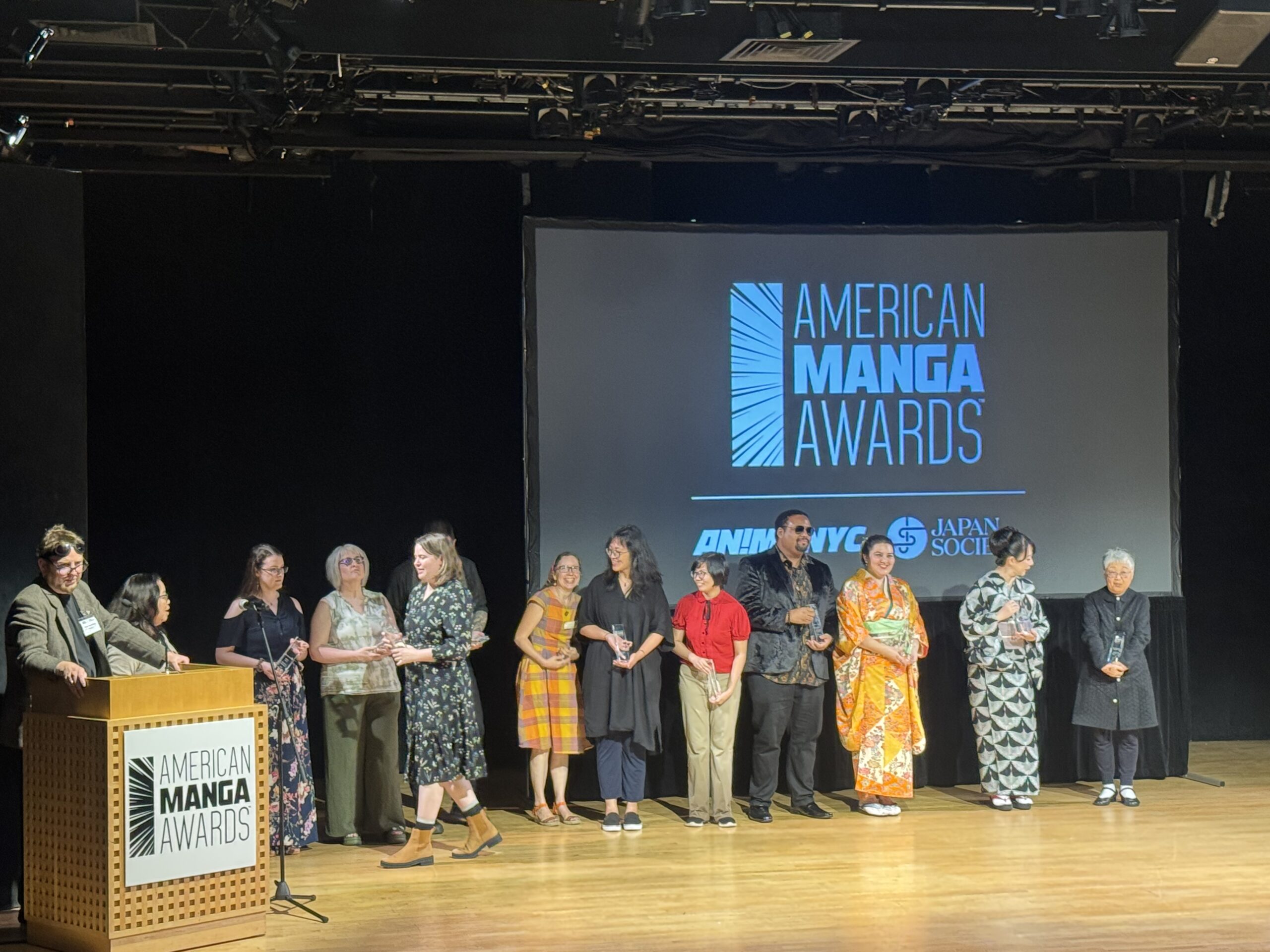
An apocalyptic rainstorm clobbered New York City just about 30 minutes before the third annual American Manga Awards began on Thursday, August 20, which meant that some attendees arrived to the Japan Society in midtown Manhattan dripping wet, despite being armed with umbrellas.
But even the audience members who were still actively air-drying soon forgot the weather as the ceremony kicked off with a celebration of the past, present, and future of manga.
Host Zack Davisson, an Eisner Award–winning manga translator, introduced the evening by acknowledging the work that went into establishing the American Manga Awards, which are the culmination of years of attempts to solidify industry honors for U.S. manga publications.
The first award given out was a unique one, awarded to Shueisha, the Tokyo-based publisher of Shonen Jump and other iconic manga magazines, to celebrate its 100th anniversary. The sheer number of iconic manga published by Shueisha over the years is staggering—Dragon Ball, One Piece, Naruto, Yu Yu Hakusho, Death Note, Jujutsu Kaisen, just to name a few—and the crowd giggled as Japan Foundation director general Hiroyuki Kojima tried to list as many as possible before presenting the award.
“Many of you here in this room may be here because of Shueisha manga,” Kojima said. “For many Americans, I believe, the anime adaptations of those works were their first encounter with Japan, and the beginning of a lifelong appreciation of Japanese culture.”
He then presented the Shueisha Centennial Award to the editorial director Shuhei Hosono, who gave the first acceptance speech of the night. Fittingly for a night honoring not just Japanese manga but also their American translations and publications, many of the speeches were given in multiple formats. Hosono started his speech in accented English, before switching to more energetic Japanese with the help of a translator. Many subsequent speeches also included written statements from the winning manga’s original <a href="https://comicvibe.com/chess-content-creator-gothamchess-joins-basilisk/” title=”Chess Content Creator GothamChess Joins BASILISK”>creators, presented on-screen first in Japanese text and then translated into English.
After thanking the many great manga artists who have worked with Shueisha and their loyal American readers, Hosono used his speech to highlight the publisher’s new Manga Million initiative, which celebrates Shueisha’s centennial by translating 1 million pages of manga into 100 languages across the world, including some in English for the first time.
The next honorary trophy was the American Manga Award of Distinction, presented by American Manga Awards committee member Debra Aoki to manga artist Akiko Higashimura. The prolific creator is best known in the U.S. for works like Princess Jellyfish and Tokyo Tarareba Girls, but other books of hers (including Gintaro-san, Much Obliged and My Mom Is Easily Flustered) are among those Shueisha titles being translated into English for the first time by the Manga Million project.
“I work on a lot of comedy series, and I’m influenced by American comedies,” Higashimura said in her speech, by Sex and the City. It’s like Sex and the City in Japan. I was influenced by New York entertainment, and to have New Yorkers read my title that was influenced by it is really nice.”
After Higashimura took her bow to much applause, it was time for the competitive awards, which were divided into two categories. First up were the professional awards, honoring the technical aspects of publication. The prize for Best Publication Design went to Wendy Chan for the recent boxed set of Fruits Basket, Best Lettering went to Madeleine Jose for her work on Maid To Skate, and Best Translation went to Jan Mitsuko Cash for volume 1 of Magica. Although most of the night focused on celebrating the manga’s stateside success and the cultural exchange it promotes, Cash took the opportunity to “politely stir up the pot” by using her speech to advocate for freelance translators.
“Please double your rates [for translators],” Cash implored the major manga publishers, noting that freelance payments have remained stagnant for the past decade despite rampant inflation.
“Your most prolific freelancers,” she continued in her address to publishers, “suffer from online harassment for the things they work on, work 80-hour weeks, have no health insurance or retirement, but have developed long-term occupational illnesses and live paycheck-to-paycheck. At some point, something has to give. Freelancers are the bedrock of the industry, and the foundation your companies stand on is sagging.”
Cash’s speech was received with a standing ovation, signaling that the ceremony was as much about determining the future of manga as honoring its past history and present success.
Yet another galvanizing speech that evening was delivered by Cocoon creator Machiko Kyo entirelyitor Pancha Diaz, after his work won Best One-Shot
“When Cocoon was published in Japan in 2010, I remember asking my editor, ‘Will this story ever be read in America?’” Kyo said. His uncertainty was understandable, since his standalone manga is about Japanese schoolgirls mobilized to support their nation’s military against American invaders during World War II. But his question was answered as Cocoon gradually built an international audience even before its recent American publication. “I hope that receiving this award will give rise to new questions for me,” Kyo said, “and those in turn will inspire me to continue moving forward through my work.”
One of the night’s final prizes was bestowed an unconventional presenter. The award for Best Continuing Series was presented on-screen by IRyS, a popular streamer who uses an anime-style virtual avatar, also known as a “VTuber.” Just as he did for every other presenter that evening, Davisson read off IRyS’s bio, which described her as “a Nephilim who was once the embodiment of hope in Paradise.”
IRyS announced the winner was the sixth volume of Mokumokuren’s The Summer Hikaru Died, a similarly uncanny work about the unlikely friendship between a teenage boy and a supernatural entity who has taken over the body of his deceased best friend.
Yen Press editor Jacquelyn Li accepted the award on Mokumokuren’s behalf. As she took the stage beneath the onscreen anime avatar, to accept a prize on behalf of the queer-coded supernatural horror series, Li remarked, “These are incredible times we live in.”

1 Comment
Pingback: Onam 2026: Ghajini actress Asin shares rare photos of daughter Arin - Comic Vibe