

Nadia Dubois
August 26, 2026
13 min read
NVIDIA is in the middle of its busiest content push of the year for GeForce NOW. The company confirmed 26 new games are landing on its cloud gaming service throughout August 2026, while simultaneously showing off a new RTX 5080-powered Ultimate tier at QuakeCon 2026 that pushes cloud streaming to 5K resolution at 120 frames per second on ultrawide displays. The timing is not an accident. Console prices just jumped across the board, Xbox hardware costs $100 to $150 more than it did a year ago, and NVIDIA is betting that gamers priced out of new hardware will rent horsepower instead of buying it.
The expansion touches nearly every corner of the gaming platform business at once: game catalogs, handheld hardware, subscription pricing, and the long-running rivalry between Microsoft, Sony, Amazon, and NVIDIA for cloud gaming market share. Here is what actually shipped, what it costs, and why the timing lines up with one of the roughest pricing stretches console buyers have seen in years.
Don’t miss new tech stories on Google
Add Tech Insider once in the Google app and our stories appear in your news suggestions.
The August Games List: 26 Titles Across Three Storefronts
NVIDIA’s own blog post confirms 26 games are joining GeForce NOW during August 2026, with the rollout staggered across four weekly batches rather than a single day-one drop. Eight titles went live in the first week, split as one Xbox/PC Game Pass title, six Steam games, and one Epic Games Store release. The headline additions were Big Walk, a co-op walking game, and Expeditions: Samurai, a tactical role-playing title, both playable immediately from launch day.
The remaining 18 games rolled out in waves through the rest of the month, with the final new title scheduled to arrive by August 30, 2026. A mid-month update on August 20 added 12 more games in a single wave, including Stars Reach, The Sinking City 2, Gallipoli, DIVE or DIE – Children of Rain, Parcel Simulator, and Starvesterckroom, Hell Is Us, The Thaumaturge, and a remastered Tomb Raider IV-VI bundle
NVIDIA also folded in leftovers from July’s wave, which added 15 games including Halo: Campaign Evolved, Call of Duty: Black Ops 6, and both Dino Crisis remasters. One free-to-claim title, Beacon Pines, sat on the Epic Games Store at no cost from August 6 through August 13 and streamed through GeForce NOW during that window, giving subscribers a way to try a paid-catalog game without spending anything beyond their monthly membership.
| Week | Games Added | Storefronts | Notable Titles |
|---|---|---|---|
| Week 1 (Aug 6) | 8 | Steam (6), Xbox/PC Game Pass (1), Epic (1) | Big Walk, Expeditions: Samurai, Beacon Pines (free) |
| Week 2 (Aug 13) | 6 | Steam | Hell Let Loose: Vietnam, Monster Hunter Wilds Prologue Demo |
| Week 3 (Aug 20) | 12 | Steam, Xbox/PC Game Pass | Stars Reach, Hell Is Us, Tomb Raider IV-VI Remastered |
| Week 4 (Aug 30) | Final title | TBD | Closes out the 26-game August total |
| Carried from July | 15 | Mixed | Halo: Campaign Evolved, Call of Duty: Black Ops 6, Dino Crisis, Dino Crisis 2 |
RTX 5080 Ultimate Tier Debuts at QuakeCon 2026
The bigger story sitting underneath the games list is hardware. NVIDIA used its QuakeCon 2026 booth to demo GeForce RTX 5080-powered Ultimate cloud servers running at up to 5K resolution and 120 frames per second on an ultrawide monitor, according to NVIDIA’s own blog. That is a jump from the RTX 4080-class server fleet Ultimate subscribers were streaming from as recently as last September, when NVIDIA began migrating Ultimate members to Blackwell-generation RTX 5080 hardware without raising the price.
Ultimate still costs $19.99 a month or $199.99 a year, unchanged since the RTX 5080 migration started. Subscribers get 8-hour gaming sessions, priority queue access, and a 100-hour monthly playtime cap that NVIDIA introduced on January 1, 2026, with extra 15-hour blocks billed at $5.99 each once that cap is hit. A 24-hour Day Pass runs $7.99 and can be applied toward the first month of a full membership. The mid-tier Priority plan, which replaced the old Founders Edition membership, costs $9.99 a month and tops out at 1080p and 60 frames per second, a meaningful step down from what Ultimate now offers.
The practical upshot for buyers: a laptop or handheld that could never run a 5K display locally can now output that resolution through GeForce NOW, provided the local network connection can sustain the bandwidth. NVIDIA has not published exact bandwidth requirements for the 5K/120fps tier, but historical GeForce NOW guidance has pointed to 45+ Mbps for its highest-fidelity streams, a number worth treating as a floor rather than a guarantee.
Cloud Gaming Meets Handhelds: The Legion Go S Push
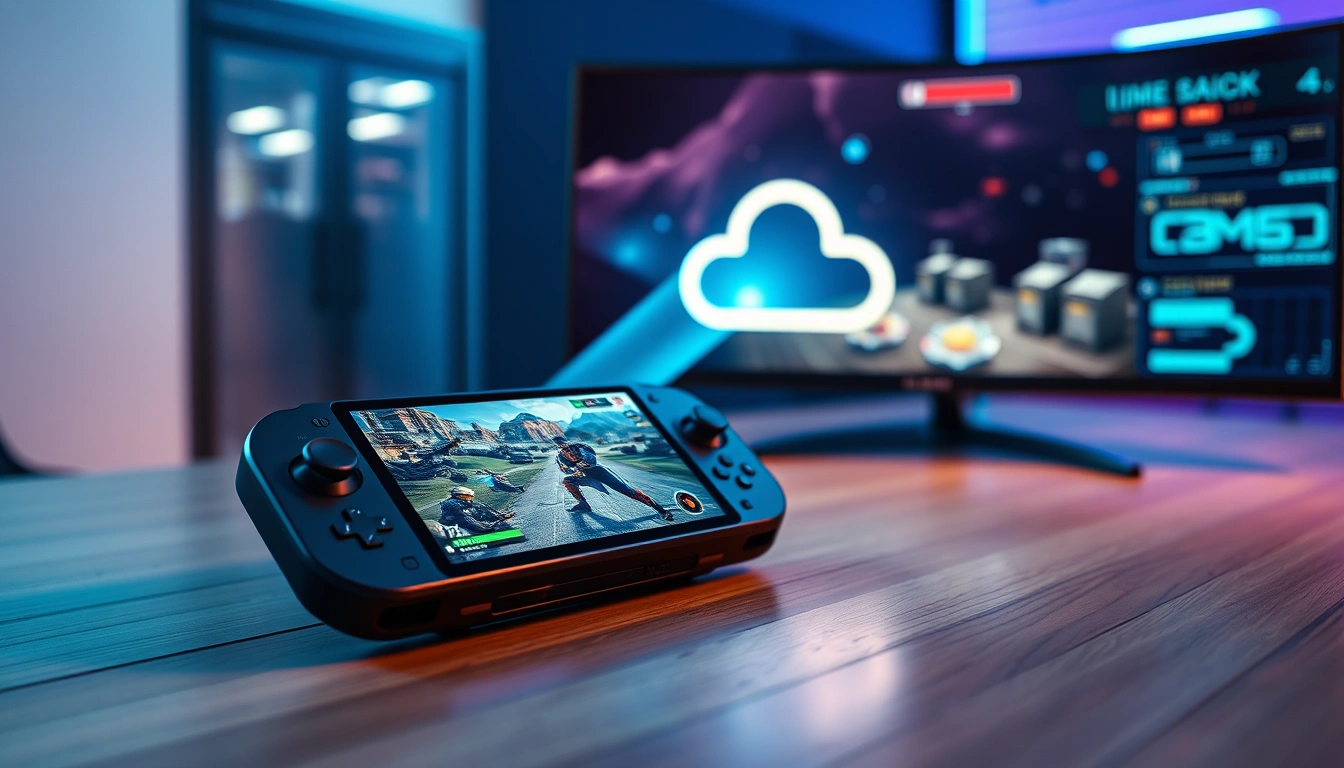
Alongside the resolution bump, NVIDIA demoed the RTX 5080 Ultimate tier running on Lenovo’s Legion Go S handheld at QuakeCon, framing cloud streaming as a way to get desktop-class visuals onto a device with a mobile chipset and a small battery. That pairing matters more than it might look at first glance. Handhelds like the Legion Go S, Steam Deck, and ROG Xbox Ally X are built around power-constrained mobile silicon that cannot touch RTX 5080 performance locally. Streaming from a cloud server sidesteps that ceiling entirely, at the cost of a stable internet connection and a recurring subscription fee instead of a one-time hardware purchase.
NVIDIA has been building toward this for a while. The company’s decade-long partnership with Microsoft already lets players link their Xbox and GeForce NOW accounts for automatic sign-in, collapsing what used to be a two-step login process into one. Combine that with a growing Xbox/PC Game Pass catalog inside GeForce NOW and the pitch to handheld owners becomes straightforward: buy the screen and the controller, rent the GPU.
Why This Matters Now: Console Prices Are Spiking
NVIDIA’s August push lands during the worst stretch of console pricing in recent memory. Microsoft raised US Xbox prices twice in just over a year, with the base console climbing $100 to $499 and the higher-memory model rising $150 to $749, effective in August 2026, according to BBC reporting. Sony and Nintendo have made their own adjustments across the same window. A separate BBC analysis of the broader pricing trend found that a new console purchased today can cost 30% to 40% more than the same model did a year earlier, driven by tariff pressure, memory chip shortages, and rising manufacturing costs.
<a href="https://comicvibe.com/unique-ps5-shooter-with-great-reviews-out-today-on-playstation-store/” title=”Unique PS5 Shooter With Great Reviews Out Today on PlayStation Store”>PlayStation Plus Premium, which bundles Sony’s own cloud streaming tier, saw its own increase on May 20, 2026, rising from $17.99 to $19.99 a month. Xbox Game Pass Ultimate actually moved the opposite direction this year, dropping from $29.99 to $22.99 a month after Microsoft cut the price in April 2026, a rare concession in an otherwise upward pricing environment. Set against that backdrop, GeForce NOW’s flat $19.99 Ultimate price, unchanged through a full GPU generation upgrade, reads as a deliberate contrast NVIDIA is happy to let the market notice.
The Xbox-NVIDIA Alliance Keeps Deepening
The August catalog leans hard on Xbox and PC Game Pass content, a pattern that traces back to the multi-year deal Microsoft and NVIDIA struck to bring first-party and third-party Xbox titles into GeForce NOW’s library. Titles like Halo: Campaign Evolved, Call of Duty: Black Ops 6, Hell Is Us, and The Thaumaturge are streamable through GeForce NOW for subscribers who also hold a PC Game Pass or Game Pass Ultimate account, effectively letting Microsoft’s subscription catalog piggyback on NVIDIA’s cloud infrastructure instead of building out its own server fleet as fast.
That arrangement benefits both sides. Microsoft gets its games in front of GeForce NOW’s install base without shouldering the full hardware cost of scaling Xbox Cloud Gaming servers, while NVIDIA gets a steady supply of AAA content that keeps subscribers renewing instead of churning to a rival service. It also means Xbox’s own cloud streaming tier, still capped around 1080p at 60 frames per second per Microsoft’s public documentation, now competes indirectly with a higher-fidelity version of some of its own games running through GeForce NOW’s Ultimate tier.
GeForce NOW vs Xbox Cloud Gaming vs PS Plus Premium vs Amazon Luna
Four services are now fighting for the same cloud gaming subscriber, and none of them compete on identical terms. GeForce NOW sells GPU horsepower and lets subscribers bring their own game libraries from Steam, Epic, Ubisoft Connect, and other storefronts. Xbox Cloud Gaming is bundled inside Game Pass Ultimate and only streams titles in Microsoft’s own catalog. PS Plus Premium works the same way for PlayStation’s library. Amazon Luna sits somewhere in between, selling both a subscription catalog and individual game purchases that stream through the same infrastructure.
| Service | Top Tier Price | Max Resolution/FPS | Library Model | GPU Generation |
|---|---|---|---|---|
| GeForce NOW Ultimate | $19.99/mo | 5K at 120fps | Bring your own storefront (Steam, Epic, etc.) | RTX 5080 (Blackwell) |
| Xbox Game Pass Ultimate | $22.99/mo | 1080p at 60fps | Microsoft first/third-party catalog | Not publicly disclosed |
| PlayStation Plus Premium | $19.99/mo | 1080p at 60fps | Sony catalog plus PS1/PS2/PSP classics | Not publicly disclosed |
| Amazon Luna+ | $9.99/mo | 1080p at 60fps | Luna catalog plus a la carte purchases | Not publicly disclosed |
On paper, GeForce NOW’s resolution and frame rate ceiling now clears every rival by a wide margin, though that gap only matters for subscribers with a display and internet connection capable of taking advantage of it. For most players streaming to a phone, a Steam Deck, or a hotel Wi-Fi connection, the practical difference between 1080p/60 and 5K/120 shrinks fast. Where GeForce NOW’s model genuinely differs is ownership: subscribers stream games they already own rather than renting access to a curated catalog, which is a fundamentally different value proposition than Game Pass or PS Plus.
Market Impact: Subscription Economics vs Hardware Ownership
Run the math and the pitch gets clearer. A GeForce NOW Ultimate subscription costs $239.88 a year. A single new Xbox console now costs $499 to $749 before a single game is purchased. Even accounting for the 100-hour monthly cap NVIDIA introduced in January, a moderately active player streaming 20 to 25 hours a week stays comfortably under the ceiling most months, meaning the subscription math holds up better for casual-to-moderate players than for hardcore ones who might blow past the cap and start paying $5.99 per extra 15-hour block.
The bigger shift is what this does to the handheld hardware market. Devices like the Legion Go S no longer need a flagship mobile GPU to deliver flagship-tier visuals, which could push handheld makers toward cheaper, more battery-efficient chips instead of chasing raw local performance. That is a meaningful change in a hardware segment where thermal throttling and battery life have been the two biggest complaints since the Steam Deck launched. If cloud streaming keeps closing the visual gap, the calculus for handheld buyers shifts from how powerful the chip is to how good the Wi-Fi is, a tradeoff NVIDIA is clearly counting on.
Historical Context: From Stadia’s Collapse to Cloud Gaming’s Second Act
It is worth remembering how recently cloud gaming looked like a dead end. Google shut down Stadia in January 2023 after failing to build a sustainable subscriber base, and OnLive folded a decade earlier for similar reasons: thin content libraries, inconsistent latency, and a hardware-owning audience that saw little reason to pay twice for the same games. GeForce NOW survived that era by taking a different approach from the start, letting subscribers stream games they already owned on other platforms instead of building a walled-garden storefront that lived or died on exclusive content.
That bring-your-own-library model is now the template every surviving competitor has converged toward in some form. Amazon Luna sells a hybrid of subscription and ownership. Xbox Cloud Gaming rides on top of Game Pass rather than standing alone. What has changed most since the Stadia era is server-side GPU generations moving fast enough that cloud streaming can now output resolutions and frame rates that beat what most consumer hardware can do locally, a reversal that would have looked far-fetched during cloud gaming’s rocky first act a decade ago.
The Hardware Behind the Curtain: What RTX 5080 Cloud Servers Actually Do
NVIDIA’s server-side migration to RTX 5080-class hardware, which began rolling out to Ultimate subscribers on September 10, 2025, replaced the previous RTX 4080-class fleet without changing the subscription price. The RTX 5080 is built on NVIDIA’s Blackwell architecture, the same generation underpinning the company’s current consumer desktop GPU lineup, giving cloud subscribers access to silicon that would cost several hundred dollars to buy outright if they wanted it sitting in their own PC.
What that upgrade buys subscribers in practice is higher frame rate headroom at higher resolutions, better ray tracing performance for supported titles, and lower encode latency on NVIDIA’s side of the stream, which shows up to the player as reduced input lag. None of that eliminates network-side latency, which remains the single biggest variable in cloud gaming quality and depends entirely on a subscriber’s distance from NVIDIA’s nearest data center and the quality of their home connection.
Competitive Response: What Sony, Microsoft, and Amazon Are Doing
None of NVIDIA’s rivals have announced a matching resolution jump. Microsoft’s cloud streaming remains capped around 1080p/60fps according to its own public documentation, even as Game Pass Ultimate’s price dropped to $22.99 a month in April 2026. Sony’s approach with PS Plus Premium leans more on catalog depth, adding classic PS1, PS2, and PSP titles to its streaming tier rather than chasing a resolution war, while its price climbed to $19.99 a month after the May 2026 increase.
Amazon’s position is the most conservative of the four. Luna+ still sits at $9.99 a month with 1080p/60fps streaming, positioning it as the budget option rather than a fidelity leader. That leaves NVIDIA as the only major cloud gaming provider currently marketing a resolution and frame rate ceiling that exceeds what most players’ home displays can even use, a gap that works as much as a marketing signal as a near-term practical upgrade for the bulk of its subscriber base.
Risks and Friction Points for Cloud Gaming’s Growth
The 100-hour monthly playtime cap NVIDIA rolled out on January 1, 2026 remains the biggest point of subscriber friction, and it directly limits how far the cloud-gaming-replaces-a-console argument can stretch for heavy players. A subscriber gaming three hours a night, seven nights a week, blows through 100 hours in roughly five weeks, then starts paying incremental fees on top of the base subscription. Network dependency is the second major risk: a household with unreliable broadband gets none of the benefit NVIDIA demoed at QuakeCon, regardless of which GPU sits in the data center.
There is also a licensing risk that has nothing to do with NVIDIA’s own infrastructure. Because GeForce NOW streams games subscribers already own on other storefronts, the catalog is only as reliable as publisher agreements that can be pulled at any time, a dynamic that has already played out on rival platforms when titles disappear from cloud catalogs with little warning. Subscribers betting on cloud streaming as a full console replacement are effectively betting on publisher goodwill staying intact, not just on NVIDIA’s hardware.
5 Predictions for Cloud Gaming Through Early 2027
- Handheld makers will lean harder into cloud-first designs. Expect at least one major handheld announced in the next two quarters that markets cloud streaming as a primary feature rather than a bonus, trading GPU horsepower for battery life and a lower price point.
- Xbox Cloud Gaming will push past 1080p. With GeForce NOW now streaming at 5K/120fps and Microsoft already leaning on NVIDIA’s infrastructure for parts of its catalog, pressure to raise Xbox Cloud Gaming’s own resolution ceiling will grow through 2027.
- NVIDIA holds the $19.99 Ultimate price through at least one more GPU generation. Two consecutive server upgrades, RTX 4080 to RTX 5080, without a price hike suggests NVIDIA is using flat pricing as a retention tool against console price hikes, and that strategy is unlikely to reverse while consoles keep getting more expensive.
- The 100-hour cap gets adjusted, not removed. Expect NVIDIA to tweak overage pricing or raise the cap modestly rather than eliminate it, since the cap functions as a rate limiter on server costs for the heaviest users.
- More publishers negotiate directly with NVIDIA for day-one cloud availability. The Xbox/PC Game Pass integration pattern seen in August’s catalog will likely extend to more third-party publishers looking to reach handheld and low-end PC audiences without requiring high-end local hardware.
What This Means for Buyers Right Now
For someone deciding between a new console purchase and a cloud subscription this fall, the math has shifted meaningfully in the last twelve months. A $749 Xbox purchase versus a $239.88 annual GeForce NOW Ultimate subscription is no longer a close call for casual players, especially with resolution and frame rate now favoring the cloud option on paper. The tradeoff is dependency: a subscription buys access, not ownership, and a bad month of internet service turns a $19.99 membership into a paperweight in a way a physical console never becomes.
Buyers already invested in a Steam, Epic, or PC Game Pass library get the most immediate value from August’s expansion, since GeForce NOW’s model streams games they already paid for rather than asking them to rebuild a library from scratch. Buyers starting from zero face a more complicated decision between a service that streams existing purchases at higher fidelity and a subscription catalog like Game Pass or PS Plus that bundles new games into the monthly fee itself.
Frequently Asked Questions
How many games is GeForce NOW adding in August 2026?
NVIDIA confirmed 26 new games throughout August 2026, split across four weekly batches, with the final title arriving by August 30.
What resolution does the new RTX 5080 Ultimate tier support?
NVIDIA demoed the RTX 5080-powered Ultimate tier streaming at up to 5K resolution and 120 frames per second on an ultrawide display at QuakeCon 2026.
Did GeForce NOW’s price change with the RTX 5080 upgrade?
No. Ultimate remains $19.99 a month or $199.99 a year, the same price it carried on the previous RTX 4080-class server fleet before the migration that began September 10, 2025.
What is the GeForce NOW 100-hour cap?
Starting January 1, 2026, NVIDIA capped Ultimate members at 100 hours of streaming per month. Extra 15-hour blocks cost $5.99 each once the cap is reached.
Can I play Xbox Game Pass games through GeForce NOW?
Yes, for titles covered under the Microsoft-NVIDIA partnership. Subscribers need both a GeForce NOW membership and an active PC Game Pass or Game Pass Ultimate subscription, and can link accounts for automatic sign-in.
How does GeForce NOW pricing compare to Xbox Game Pass Ultimate and PS Plus Premium?
GeForce NOW Ultimate is $19.99/month, Xbox Game Pass Ultimate is $22.99/month, and PlayStation Plus Premium is $19.99/month as of the May 2026 price increase. Amazon Luna+ is the cheapest at $9.99/month.
Is the Legion Go S the only handheld NVIDIA demoed with RTX 5080 Ultimate?
Lenovo’s Legion Go S was the handheld NVIDIA showcased at QuakeCon 2026 for its RTX 5080 Ultimate demos, though GeForce NOW’s app runs on most Windows and Android-based handhelds, including Steam Deck and ROG Ally devices.
Why are console prices rising in 2026?
Reporting from the BBC points to tariff pressure, memory chip shortages, and rising manufacturing costs as the main drivers, with new consoles now costing 30% to 40% more than they did a year earlier.
Related Coverage
- GeForce NOW Linux App Exits Beta: 2,000+ Games, Ubuntu Only [2026]
- GeForce NOW’s 100-Hour Cap Hits 6% of Players [2026]
- Console Prices Surge: Xbox $799, Switch 2 $499 [2026]
- Xbox August Update Cuts Load Times With Cloud Launch [2026]
- PS Plus Price Hike 2026: Essential $10.99, 12 Games Exit July 21
- Legion Go 2 vs Legion Go S: $700 Gap, 33% Battery [2026]
- RTX 4090 vs RTX 5080: 90W Gap, 12.5% Efficiency Lead [2026]

2 Comments
Pingback: AMC Series Canceled After 1 Season Is Dominating on Streaming Now - Comic Vibe
Pingback: Pimax Dream Air Review: The New Svelte Prince Of Desktop VR Headsets - Comic Vibe