

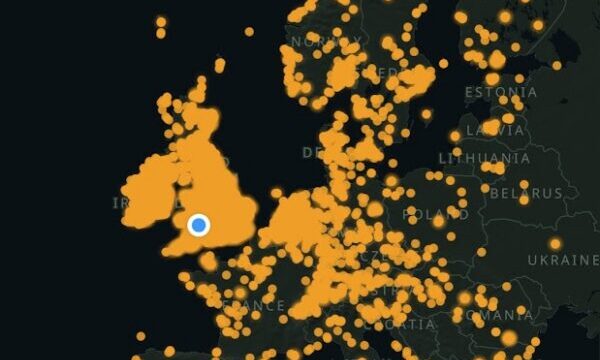
A technology experiment created by a Welsh entrepreneur for a bit of fun at his dining room table has exploded into a global game, attracting more than 20,000 players across 105 countries.

Claim the Earth was built by entrepreneur and founder Gary Piazzon over a few evenings, with no grand launch strategy or expectation that it would become anything more than a novelty for himself and his friends. But what started as a simple idea, allowing people to physically claim tiny pieces of the planet by visiting them, has developed into something significantly bigger.
The browser-based game quietly went live on August 11. After gaining traction on TikTok, participation accelerated dramatically.
Players have now made more than 430,000 individual land claims around the world.
The game passed 100,000 claims on August 19, 200,000 on August 20, 300,000 on August 22 and 400,000 on August 23.
More than 20,000 people have registered or played as guests across 105 countries, with activity spreading from the UK into Germany, Ireland, the Netherlands, Norway, Switzerland, Sweden, France, Spain and Romania. The largest individual holding has reached 5,116 hexagons, equivalent to approximately 220 football pitches.
Almost 320,000 claims have been made in the UK, while more than 75,000 photographs have been captured by players at locations around the world.
The concept behind Claim the Earth is deliberately simple.
The technology divides the Earth’s surface into approximately 1.66 trillion hexagons, each covering around 307 square metres, using H3, the open-
But unlike many digital games, players cannot sit at home and build their territory.
To claim part of the Earth, they have to actually go there. A player’s phone takes m
ultiple GPS readings to establish that they are physically standing within a hexagon before allowing it to be claimed. Each piece of land can only be claimed once.
There is no option to purchase territory, and paying for the game’s optional membership provides no competitive advantage. The fundamental currency is simply being there first.
That mechanic has turned what Piazzon initially regarded as a fun technology project into a real-world race for territory. Some players have walked as far as 20 kilometres in a day, claiming new territory as they travel.
Records established within the game have sometimes lasted less than 24 hours before another player has beaten them.
The speed at which the idea has travelled is perhaps the most striking part of the story.
There was no major international launch behind the project. Piazzon built it at home, launched it quietly and watched as users began discovering and sharing it themselves. TikTok then provided the catalyst, helping the game move rapidly from a small experiment to a global activity.
The UK currently accounts for the majority of activity, with almost 320,000 claims, but communities are continuing to emerge internationally across more than 100 countries.
And the technology is producing consequences that its creator never originally intended.
Players have contacted Piazzon to say that Claim the Earth has encouraged them to get outside, walk further and explore places they would not otherwise have visited. Some have told him that having a reason to leave the house and move has had a positive impact on their mental wellbeing.
Another unexpected development has emerged through photography. Players can attach a photograph taken at the location when making a claim. More than 75,000 images have already been captured.
Collectively, those photographs are beginning to form a crowd-created visual record of everyday locations around the world.
A feature now gives players 30 randomly selected photographs from the archive each day, allowing someone in Wales, for example, to discover an ordinary street, footpath or landscape photographed by another player thousands of miles away.
Where Could it Go Next?
Claim the Earth remains free to play, with an optional Pro membership costing £2.99 a month or £24 annually. The membership provides additional cosmetic, profile and statistical features but deliberately gives subscribers no advantage when claiming territory.
Streaks, player profiles and a feed highlighting notable claims are already being developed around the core concept. But its rapid organic growth raises a much bigger question: could a Welsh entrepreneur’s dining-room experiment become a genuinely global platform?
With almost the entire planet still unclaimed, there is certainly plenty of room left to grow. And with its combination of gaming, geolocation, exploration, photography and physical activity, Claim the Earth has developed into a proposition considerably bigger than the novelty Piazzon originally set out to create.
What started with a Welsh entrepreneur experimenting with technology for a few evenings has become a race involving more than 20,000 people around the world.
To try the game for yourself, visit – https://www.claimthe.earth/

2 Comments
Pingback: Anime India Mumbai 2026: Naruto Director Hayato Date Among Guests, Cosplay Competition, and More - Comic Vibe
Pingback: Fortnite Esports World Cup Viewership Jumps 482% - Comic Vibe