

Nasa.gov
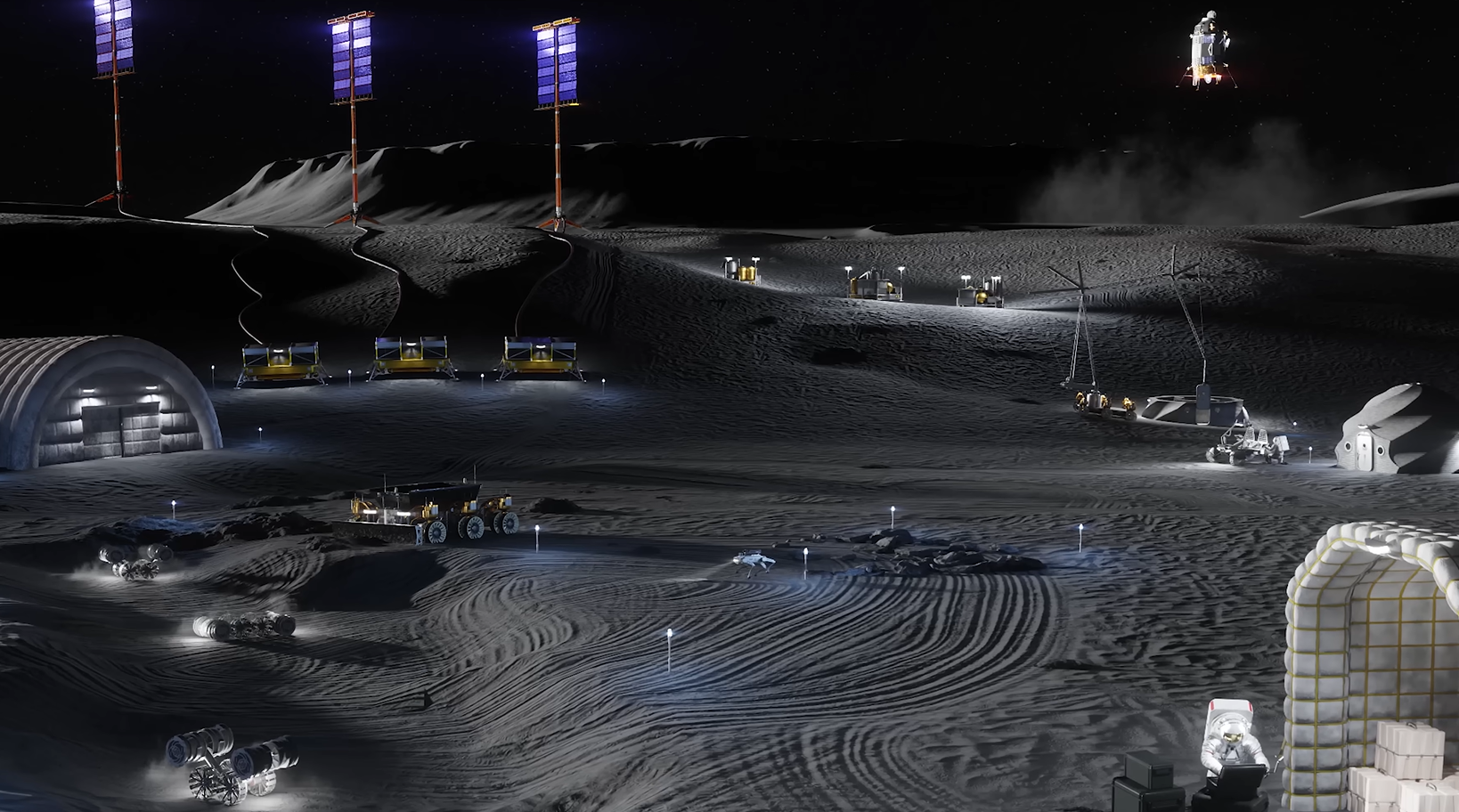
Amazon MGM Studios confirmed this week that Please Save My Earth — the foundational shōjo sci-fi manga in which alien scientists are reborn as Japanese teenagers who slowly recover their memories of a lunar base — will stream exclusively on Prime Video in fall 2027 worldwide. The adaptation will reach viewers in more than 240 countries and territories. The timing could not be more fitting: in March 2026, NASA unveiled a three-phase, $20 billion Moon base plan to build humanity’s first permanent outpost near the lunar South Pole, with three robotic missions targeting launch before the end of this year. Saki Hiwatari imagined an alien scientific station on the Moon in 1986. NASA is now building one.
Alice Hirose — known to international audiences from Bubble and the live-action Silver Spoon — leads the cast as Mokuren, the lunar-base botanist whose past-life memories drive the series’ emotional core. Takahiro Miki, the director whose previous adaptations include Solanin, Blue Spring Ride, and Even If This Love Disappears from the World Tonight, takes the helm. “Whenever I was asked which manga I’d most like to adapt, my answer was always Please Save My Earth,” Miki said in the Amazon MGM Studios press release. “I want to honor the passion that has kept this legendary masterpiece beloved for so many years, while bringing to it the visual beauty and emotional depth that only live-action can achieve.” Screenplay is by Nana Yamamoto; music is by Moshimoss (composer Kosuke Anamizu). THE SEVEN, winner of the Asian Academy Creative Awards VFX Grand Prix, handles visual effects and production, with Kadokawa Daiei Studio serving as production studio.
For readers encountering the title for the first time: Please Save My Earth (Japanese: Boku no Chikyū o Mamotte) is a 21-volume shōjo manga serialized by Saki Hiwatari in Hakusensha’s Hana to Yume magazine from December 1986 to May 1994, with over 16 million copies sold since its debut. It is widely considered — and was called in Manga: The Complete Guide (Ballantine Books, 2007) — “a masterpiece of young-adult science fiction.” A six-episode OVA produced by Production I.G. aired in 1993–1994, with music by Yoko Kanno. Sequel manga have continued the story: Embraced by the Moonlight (2003–2014) and I Sing with the Earth (2015–present). What has never existed until now is a live-action production of any kind — and Amazon is giving it a global stage.
What Please Save My Earth Is Actually About
High school student Alice Sakaguchi moves to Tokyo and immediately acquires two problems: a pair of classmates, Jinpachi and Issei, who keep having recurring dreams about being alien scientists stationed on the Moon, and an eight-year-old neighbor named Rin who takes particular pleasure in tormenting her. When Rin falls from their apartment balcony and miraculously survives, something changes. Rin begins to remember. He was Shion — the most technically brilliant and emotionally damaged of the alien scientists, the one whose grief at losing Mokuren warped the entire crew’s final years on the lunar base and whose accumulated rage is now being channeled through the body of a child into a carefully constructed web of revenge.
Alice, meanwhile, is drawn into Jinpachi and Issei’s search for the other five reincarnated scientists. What begins as a strange shared game — comparing moon dreams, mapping past-life personalities onto present faces — becomes something darker as the recovered memories reveal a tragedy: seven scientists who loved Earth from a distance they could never close, who watched and documented and were forbidden from interfering, who died in the end with their work incomplete. The central dramatic question of Please Save My Earth is not “are these memories real?” — the manga answers that quickly. The question is whether the emotional weight of a complete alien biography can be carried in a living child without destroying the child who carries it.
Alice Hirose plays Mokuren in the past-life sequences — the botanist whose gift for communicating with plants through song was the basis of Rin’s obsession with her, and whose death is the fault that Shion spent his final years unable to forgive. “When filming began and I stepped onto the set, I was absolutely blown away,” Hirose said in the Amazon MGM Studios press release. “This is a work with a devoted fanbase, so we all read the original manga thoroughly and gave it everything we had.” The series operates in a register that is warm and melancholy simultaneously: the moon sequences are luminous and doomed; the present-day sequences are grounded in the particular awkwardness of teenagers who are trying to figure out whether the people they’re becoming have anything to do with the people they apparently were.
Alien Lunar Base, 1986: Now Called the NASA Moon Base Program
The ZKK-101 base in Please Save My Earth is a sealed habitation module on the Moon, staffed by biologists and researchers rather than military or colonial figures. It requires closed-loop life support, protection from micrometeorite impacts and solar radiation, and the management of temperature swings from −173°C (−279°F) at lunar night to +127°C (261°F) at lunar day. It exists for a single purpose: scientific observation of Earth over a sustained period, conducted by people who have developed a profound emotional attachment to the planet they cannot touch.
In March 2026, NASA Administrator Jared Isaacman unveiled a three-phase, $20 billion plan to build a permanent Moon base near the lunar South Pole. By May 2026, the agency had named three initial uncrewed missions: Moon Base I, using a Blue Origin lander targeting the Shackleton Connecting Ridge; Moon Base II, using an Astrobotic Griffin lander to deliver the Astrolab FLIP rover; and Moon Base III on an Intuitive Machines Nova-C lander — all targeting launch before the end of 2026. The base is designed to cover “hundreds of square miles,” according to NASA Moon Base program executive Carlos García-Galán. Artemis IV and V missions, targeting astronaut landings beginning in 2028, are when permanent infrastructure is expected to begin accumulating. The engineering challenges are identical to those the manga’s alien architects solved before 1986: life support, thermal management, micrometeorite shielding, and — significantly — a biological science mission.
The fictional scientists of ZKK-101 were biologists, botanists, and researchers. NASA’s Moon Base science agenda includes exactly this: the agency’s BioMoon mission concept specifically addresses how radiation, reduced gravity, and lunar regolith affect biological organisms across multiple trophic levels. Hiwatari’s scientists were doing what real astronaut-researchers on a permanent Moon base will do: studying life, in a place where life requires extraordinary effort to sustain.
“We are returning to the Moon again, and this time to stay,” Isaacman said at the March 2026 announcement. The alien scientists of Please Save My Earth returned to the Moon, and they stayed until they died. The resonance is not incidental.
What Can Epigenetics Tell Us About Moon-Dream Memory?
The manga’s central premise — that complete episodic memories of an alien life can survive death and reconstitute in a new human body — is a much larger claim than anything epigenetics currently supports. But the conceptual architecture of the claim is now being actively studied, and the scientific gap has been narrowing.
Transgenerational epigenetic inheritance (TEI) is the transmission of molecular marks — DNA methylation patterns, histone modifications, non-coding RNAs — across generations without changes to the underlying DNA sequence. What began as an observation about stress reactivity and behavioral tendencies in animal models has become, over the past decade, a robust and contested field. A preprint published in August 2025 on bioRxiv documented what the authors describe as the first mammalian evidence of transgenerational inheritance of enhanced cognitive learning ability in rodents — mediated by increased neuronal excitability and specific DNA methylation changes in the hippocampi of trained rats that were also present in their offspring. Prof. Isabel Mansuy’s lab at the University of Zurich has separately documented that traumatic stress in mice produces epigenetic changes transmitted through sperm RNA that alter stress reactivity and behavior in subsequent generations without direct trauma exposure. A 2023 Cell paper by Takahashi et al. showed that induced DNA methylation changes at specific promoter regions were stably propagated across multiple generations in transgenic mice.
The gap between what science documents and what the manga depicts is one of information density, not mechanism type. Real TEI transmits stress reactivity and learning aptitudes — molecular signals that alter how the nervous system responds to the world. Please Save My Earth posits that episodic memory — specific relational events, faces, names, the particular emotional texture of a relationship between Mokuren and Shion — can survive and reconstitute. Real epigenetics transmits the shape of trauma; the manga asks whether it could transmit the content.
From an information-theoretic perspective, this is the correct question to ask. Episodic memory is encoded in the brain as patterns of synaptic weights and neural connectivity — dynamic states, not stable chemical marks. For such information to cross the death-rebirth boundary, something would need to function as a substrate-independent information carrier. The manga calls this “Sarches” — a psionic field that exists semi-independently of individual biological substrates, which the alien civilization learned to access. Real neuroscience has no such mechanism. What it does have is a growing body of evidence that biological systems can transmit structured information across generations in ways that Mendelian genetics does not predict. The field is young enough that its ceiling has not been identified.
Mokuren’s Power Over Plants Is a Real Scientific Field Now
Mokuren is a Kiches Sarjalian — a botanical priest-scientist whose defining ability is to make plants grow by singing to them. This is not merely metaphorical: in the manga’s cosmology, plants respond to human bioelectromagnetic signals, and Mokuren’s gift is the ability to generate and modulate those signals through music. In 1986, this was unambiguous science fiction. In 2026, it is an active scientific controversy.
Plant bioacoustics — the study of sound production, reception, and response in plants — was formalized as a research field by Monica Gagliano and colleagues in a 2012 Trends in Plant Science paper. The field documents that plants produce measurable sound waves (typically in the 50–120 Hz range as well as ultrasonic frequencies), respond physiologically to airborne sound, and exhibit differential germination rates and growth patterns in response to acoustic signals. A 2023 study published in Cell confirmed that tomato and tobacco plants emit airborne ultrasonic sounds when stressed by desiccation or cutting — a finding that transformed what had been a contested hypothesis into a documented biological fact.
The scientific debate concerns not whether plants produce and respond to sound — that is now documented — but whether those sounds constitute communication in any meaningful sense, and whether plants can genuinely perceive airborne signals over distances relevant to ecological interaction. A 2024 critical review in Trends in Plant Science concluded that current evidence is not conclusive: the sounds plants emit are high-pitched and low-intensity, propagating only short distances, and most demonstrated plant sensitivity to sound concerns substrate vibrations rather than airborne acoustic communication. The field is real; the question of what it ultimately proves about plant cognition remains open.
Mokuren’s Kiches Sarjalian power — communication with plants via song — is situated precisely on this frontier. The fictional premise is that plant-human bioelectric communication is possible at a much higher information density than real science has yet demonstrated. But the field Hiwatari’s 1986 manga implied — the study of acoustic interactions between plants and living things — did not exist as a formal discipline until Gagliano named it in 2012. The manga anticipated the question by 26 years.
Is There Science Behind Children Who Remember Past Lives?
The disclaimer Hiwatari added to every volume of Please Save My Earth starting from Volume 8 — stating that the story was entirely fictional — was prompted by letters she received from readers who were convinced they had been actual members of the ZKK-101 moon-scientist crew in a previous life. This is a documented case of fiction functioning as an epistemological disruption: the verisimilitude of the moon-dream sequences was sufficient to be integrated by adolescent readers as biographical fact.
Whether that integration reflects something real about human psychology — or about what past-life memories actually are — is the question that the University of Virginia’s Division of Perceptual Studies has been investigating since 1967. The division was founded by psychiatrist Ian Stevenson and has been led by Dr. Jim B. Tucker, whose database contains more than 2,500 systematically documented cases of young children who report memories of previous lives. Cases typically begin between ages two and four; memories typically fade by age seven or eight; approximately 30% of cases include birthmarks or birth defects correlated with claimed previous-life wounds. A 2024 follow-up study in Frontiers in Psychology by Pehlivanova, Cozzolino, and Tucker reported the first observational study of American adults who had been interviewed as children about past-life memory claims — ongoing research aimed at understanding the long-term psychological impact of these experiences.
The Division of Perceptual Studies does not claim to have proven reincarnation. It claims to have documented a phenomenon — children who report specific, often verifiable episodic memories of lives they did not live — that mainstream science has not explained and has largely declined to study. Please Save My Earth‘s central conceit is that this phenomenon is real and mechanistic; the manga depicts the suppressed memories breaking through trauma, being triggered by proximity to others who share the same past-life network, and carrying emotional consequences that persist across the death-rebirth boundary. That framing is more sophisticated than a simple assertion of mystical belief. It is a narrative hypothesis about how reincarnation, if it existed, would actually present in the psychology of the people experiencing it.
Rin and Shion: When Past Selves Overwrite Present Ones
The most psychologically acute element of Please Save My Earth is the case of Rin Kobayashi, who is eight years old when Shion’s memories and personality begin eclipsing his present identity. What the manga depicts — a child whose developing self is increasingly colonized by the complete personality of a dead adult — maps onto something that developmental psychology takes seriously: the fragility of identity coherence in young children.
Identity formation, in Erik Erikson’s model of psychosocial development, is the central task of adolescence — Stage 5, Identity vs. Role Confusion. But an eight-year-old is still in Stage 4 (Industry vs. Inferiority), a period in which the self is being constructed rather than consolidated. The self that Rin has built in eight years is fundamentally more plastic and less defended than the selves of the sixteen-year-olds around him. Hiwatari, perhaps intuitively, made her most catastrophic case of personality overwriting the youngest character — a choice that is developmentally coherent.
The philosophical question the manga raises is one that Derek Parfit examined directly in Reasons and Persons (Oxford University Press, 1984): if a new set of memories, emotions, and personality traits gradually replaces an existing self, at what point (if any) does the original person cease to exist? Parfit’s “psychological continuity” theory of personal identity holds that what matters is overlapping chains of connected psychological states — memories, beliefs, intentions, desires. Under his framework, the gradual replacement of Rin’s psychological continuity by Shion’s is not metaphorical death: it is, depending on how complete the replacement is, a possible candidate for actual death. The manga treats the Rin/Shion arc as a tragedy, not a philosophical puzzle — which is consistent with Parfit’s view that psychological continuity is what matters, even if “personal identity” is not the right concept to apply.
The Amazon live-action adaptation, directed by Takahiro Miki, will need to find a way to dramatize this — the experience of a child whose childhood is being consumed by someone else’s past. Miki has previously demonstrated in Tomorrow I Will Date with Yesterday’s You and Even If This Love Disappears from the World Tonight a facility for rendering time-and-memory paradoxes with emotional clarity rather than conceptual abstraction. The Rin/Shion arc is his most demanding assignment yet.
Environmental Grief in Bubble-Era Japan
To read Please Save My Earth as a product of 1986 Japan is to understand that its title is not romantic. Boku no Chikyū o Mamotte — literally “Please Protect My Earth” — was written at the height of Japan’s economic bubble, a period in which rapid industrialization had produced decades of documented environmental destruction: the Minamata mercury-poisoning disaster that began in the 1950s, the Yokkaichi asthma epidemic from petrochemical pollution, acid rain and urban smog in Japan’s major cities. By the mid-1980s, an ecological counter-consciousness had become visible in Japanese popular culture, including manga.
Alice Sakaguchi, the series’ present-day protagonist, is introduced as a girl who mourns urban pollution and yearns for the clean air of rural Hokkaido, her hometown. The alien scientists’ entire mission was to watch Earth — to document and love it from a distance that forbade intervention. The poignancy is structural: they died without saving it. Their reincarnated selves arrive in a Japan that is actively degrading the world the scientists spent lifetimes observing. The title is a prayer, addressed by the series to the reader, from the scientists to the planet, and from the planet to anyone who might listen.
This environmental subtext is built into the series’ genre identity. Please Save My Earth is credited — alongside Naoko Takeuchi’s Sailor Moon (which began in 1991 and shares the structural elements of reincarnation and Moon-Earth emotional geography, and which lists Please Save My Earth as an influential predecessor) — as a founding text of shōjo sci-fi romance. The franchise’s central emotional claim is that the scientists loved Earth the way a gardener loves a garden: from a careful, reverent distance, unable to touch without damaging.
The character naming scheme enforces this botanical naturalism: all seven moon scientists carry names derived from plant species — Shion (aster), Shukaido (begonia), Enju (pagoda tree), Hiiragi (false holly), and so on. This is not decorative; it is thematic. The scientists’ civilization values organic life; their founding ethical principle is that living things are worth watching, even from 384,400 kilometers (239,000 miles) away. The decision to make Mokuren a botanist and Kiches Sarjalian — someone whose particular sensitivity is to plant consciousness — is the purest expression of what the whole manga believes.
What the Past-Life Boom Told Japan About Itself
Hiwatari added the fictional disclaimer to Vol. 8 of the manga because of letters she received from readers claiming to be genuine reincarnated moon scientists, inspired by the emotional specificity of the moon-dream sequences. Jason Thompson noted in Manga: The Complete Guide that she “did too good a job making it all seem real.”
The social phenomenon the manga contributed to — Japan’s “zensei bumu,” or past-life boom, of the late 1980s and early 1990s — was part of a broader “spiritual boom” documented in Japanese cultural studies, in which reincarnation-adjacent beliefs became widely circulating in a general population that blended Buddhist heritage, folk religion, and New Age influences. ISSP surveys from 2009 found that approximately 40% of Japanese adults across age groups believed in Rinne Tensei (the Buddhist concept of cyclical rebirth), regardless of their religious affiliation. Please Save My Earth was not the cause of this phenomenon, but it was a significant accelerant: its detailed, emotionally coherent depiction of past-life memory was culturally viral in a population already primed to find the concept meaningful.
The Amazon adaptation, streaming in 240+ countries in fall 2027, will introduce this premise to audiences who have no particular Japanese context for it. What remains is the structural claim: that past-life memory, wherever it originates, produces psychological consequences as real as those of any other formative experience — and that a child absorbing an alien biography whole is in meaningful danger of ceasing to exist.
The Sonic Adventure 2 (2001) writer Shiro Maekawa cited Please Save My Earth directly as the inspiration for the scene in which Shadow and Maria look down at Earth from the Space Colony ARK. It was also cited by Bisco Hatori (Ouran High School Host Club) as an important formative work. The franchise’s influence on the manga medium is documented across four decades. Its influence on anyone who arrives at fall 2027 without having read the original is, as yet, unmeasured.
Saki Hiwatari’s response to the Prime Video adaptation announcement: “I’m genuinely surprised that it’s being adapted into a drama in this day and age. Think of it as a festival! Let’s enjoy it together!”
Frequently Asked Questions
What is Please Save My Earth about?
Please Save My Earth follows Alice Sakaguchi, a Japanese high school student who discovers that she and six other young people share vivid recurring dreams of a past life as alien scientists stationed on the Moon to observe Earth. As they recover those memories, the personalities and emotional wounds of their former selves begin to overwrite their present identities — catastrophically so in the case of Rin, Alice’s eight-year-old neighbor, whose past self was the brilliant and ruthless scientist Shion. The story operates simultaneously as a science-fiction mystery, a romance, and a meditation on whether the weight of a complete past life can be carried without destroying the person who carries it.
Why does it matter that NASA is building a Moon base right now?
The manga’s fictional ZKK-101 lunar base — a sealed, permanently habited research station near the Moon’s surface, staffed by biologists conducting long-term Earth observation — is structurally identical to what NASA’s Moon Base program is now designing. Three robotic missions are set to launch by the end of 2026, with permanent crewed infrastructure targeted to begin in 2028–2030. Hiwatari placed biologists and botanists on her fictional lunar base in 1986; NASA’s BioMoon mission concept frames the biological science questions of lunar habitation as primary. The premise the manga invented is the project NASA named as its next major goal.
Is there real science behind the manga’s transgenerational memory concept?
Transgenerational epigenetic inheritance — the transmission of molecular marks across generations through DNA methylation, histone modifications, and non-coding RNAs, without changes to the underlying DNA sequence — is an active and growing field. A 2025 biorxiv preprint documented transgenerational inheritance of enhanced cognitive learning ability in mammalian rodents for the first time, mediated by hippocampal methylation changes. Real science can transmit stress reactivity and learning aptitudes across generations; the manga asks whether episodic memory — the full content of lived experience — could do the same. Current science cannot confirm that. What it can confirm is that the mechanism class the manga posits (biological information crossing the death-rebirth boundary) is no longer speculative in principle.
Who is directing the live-action series, and where can it be streamed?
Takahiro Miki is directing. Miki previously directed live-action adaptations of Solanin, Blue Spring Ride, We Were There, and Even If This Love Disappears from the World Tonight — a body of work focused on memory, time, and emotional precision. The series will stream exclusively on Amazon Prime Video in fall 2027, in more than 240 countries and territories worldwide.
ⓒ 2026 TECHTIMES.com All rights reserved. Do not reproduce without permission.
