

There’s something personally rewarding to “investing” in creative teams.
Let’s take Darcy Van Poelgeest and Ian Bertram as just one instance totally plucked from thin air. If you were only looking for great comics, the pair’s Little Birdand Precious Metal are personal faves, these genre-defining wonders of weird, revelatory storytelling. But across these projects, we’ve also seen the pair grow and develop, creating a kind of lingua franca where good stories feel all the more contextually rich and as artistically groundbreaking as they are just massively personal artifacts. The more we read of this pair, the more they reveal themselves as souls with an utterly infectious love of comics.
With their latest project, The Karman Blade, we see Van Poelgeest and Bertram at or near the peak of their collective might as genuine wizards of the narrative arts.
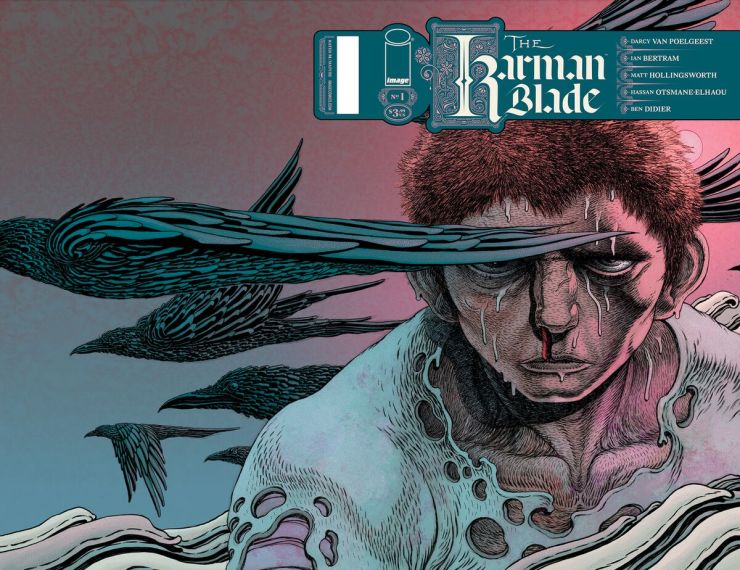
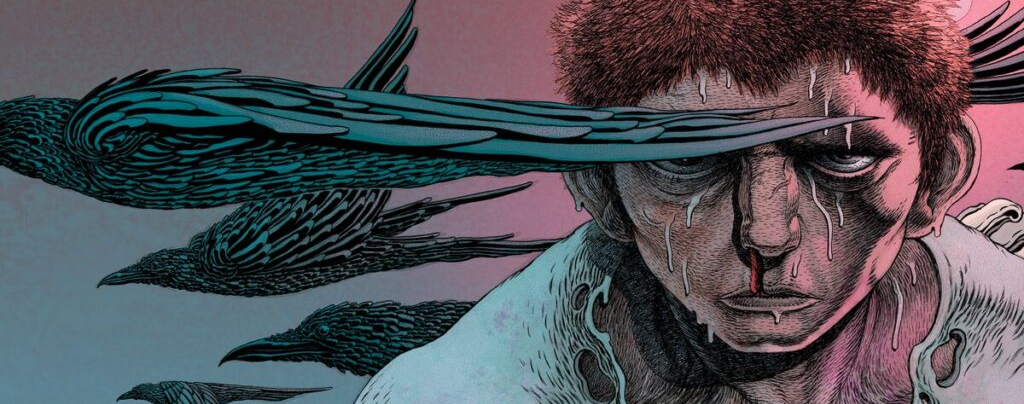
Main cover by Ian Bertram and Matt Hollingsworth. Courtesy of Image Comics.
In The Karman Blade (which doesn’t appear to take place in the “Bird-verse”), we follow Anatta, a young boy grappling with dreams of an enchanted blade that can kill a god. Admittedly, I’ve read this premise before, and the pair tap into certain fantasy tropes and structures right off the bat. It’s to the point that in this debut, Anatta feels a little hollow and somewhat underdeveloped. I already feel like he’ll be little beyond a partially inflated stand-in for the reader in a story about fate and destiny. But where that would be an actual complaint with some other creative teams, these gentlemen exude a deep personal magic and intent that pushes Karman Blade from possibly trite/cliched to something so much grander and potent.
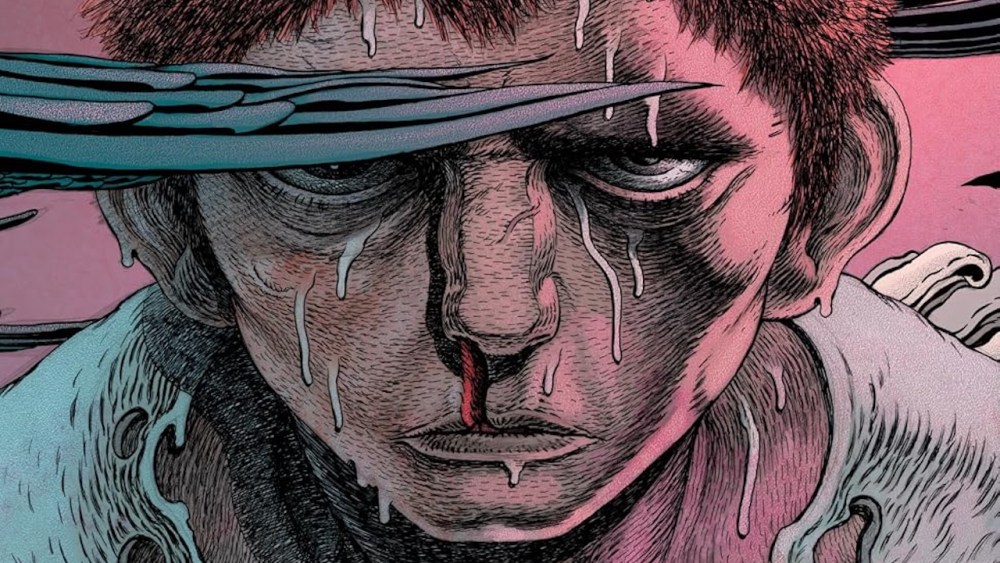
If you’re wanting your jaw to meet floor both readily and routinely, that seems to be Bertram’s existential M.O. He’s used his career to forge a style and technique unlike literally anyone else, and those previous projects with Van Poelgeest have seen him fuse sci-fi, fantasy, and bits of legends like Mœbius and Geof Darrow into an aesthetic that feels ancient in its familiarity and yet dazzles with increasingly new life. And Karman Blade is absolutely a career pinnacle for Bertram, hands down.
Variant cover by Ian Bertram. Courtesy of Image Comics.
I’ve made clear before that discussing Bertram’s art in any context is especially difficult; I’d genuinely rather lead a lecture on particle physics — in Portuguese. Because whatever you do try and say about his work feels woefully ineffective, and as Bertram seems to grow with every new project (really, every new issue), he makes quantifying what he does increasingly complicated. I wish that I could simply stop with, “He’s one of the best working artists today,” and that Karman Blade builds on the “language” of Little Bird and Precious Metal with the utmost care and efficiency.
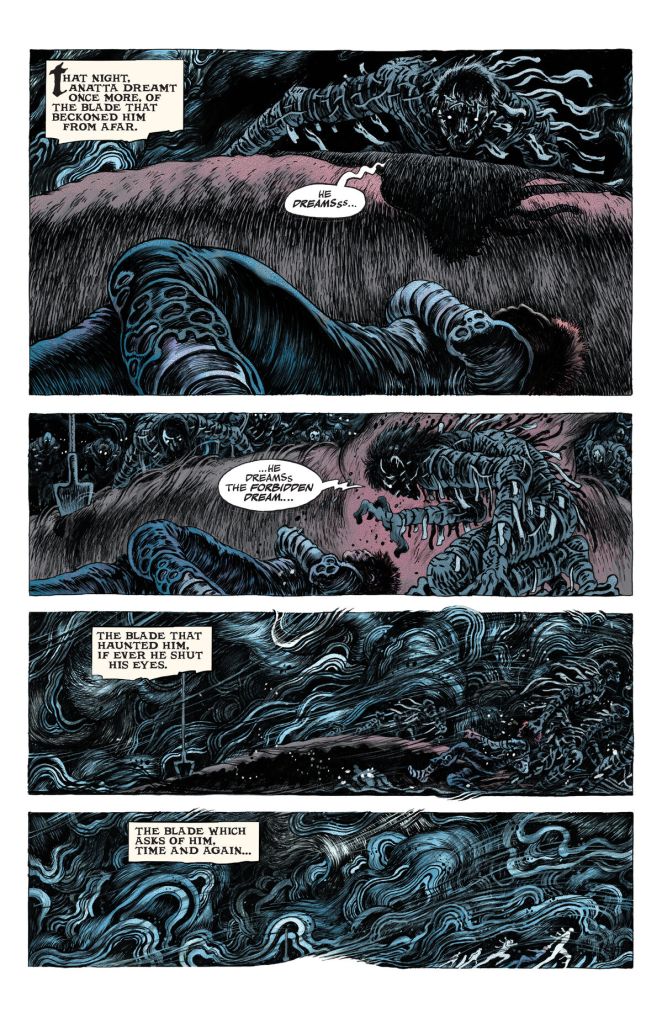
The essence of those previous titles — the stylized exaggeration of human anatomy, the detailed work that smothers you in the weight of the world, the balance of the intimate with the oversized to play with your sense of gravity, the way blood and pain radiate from every pixel in glorious unison — it’s all right there in gorgeous stereo.
Still, what makes Karman Blade so utterly dynamic is the way Bertram frames this world. This is a low-ish fantasy tale (or close enough for the generally awkward act of “genre-ification”). The fact that said tag is only accurate enough is important — Bertram certainly gives us some tent-poles (swords, magical creatures, endless valleys of dirt and death, etc.) without leaning heavily into too many visual cliches. And if they’re here and cliched, well, it’s cause those instances matter.
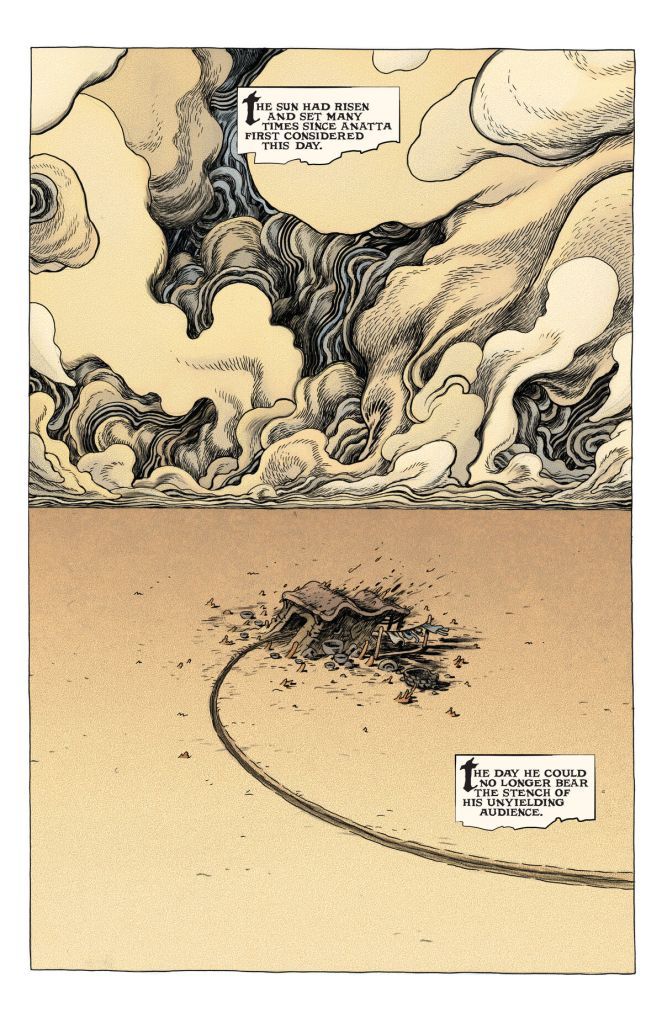
Bertram scratches parts of the brain without bashing us over the heads, truly. Bertram often seems more interested in tapping into feelings and themes over specific constructs that might prove too relatable or predictable. In turn, this freedom, this art between the margins of literary history, seems to have given Bertram a new confidence and an even more insatiable creative drive. He’s always done his own thing, and Karman Blade sees him double down with new strength and charisma.
The character designs of certain creatures, for instance, remain nebulous in the sense that Bertram plucked them from some alt history text that no one’s ever read but him. The body horror he routinely depicts — in this issue, that includes an Anatta dream sequence that burns slow before it strikes with unflinching gore and terror — feels more unrelenting in its campaign while proving even more undeniable. Everything is crisp and clear even when it defies reality, and Bertram’s singular essence holds it all together.
His tendency for stark, attention-snaring detail work is doubly, nay triply sharper than ever, and Bertram lends so much weight to the Karman Blade itself by making it feel rough and cold in our mind’s eye. Heck, even the vaguely psychedelic rolling of a random hilltop just feels like it speaks literal volumes about this world, its contextual significance, and how it operates to feel different in a way that pokes you right in the eyeball with relentless intent.
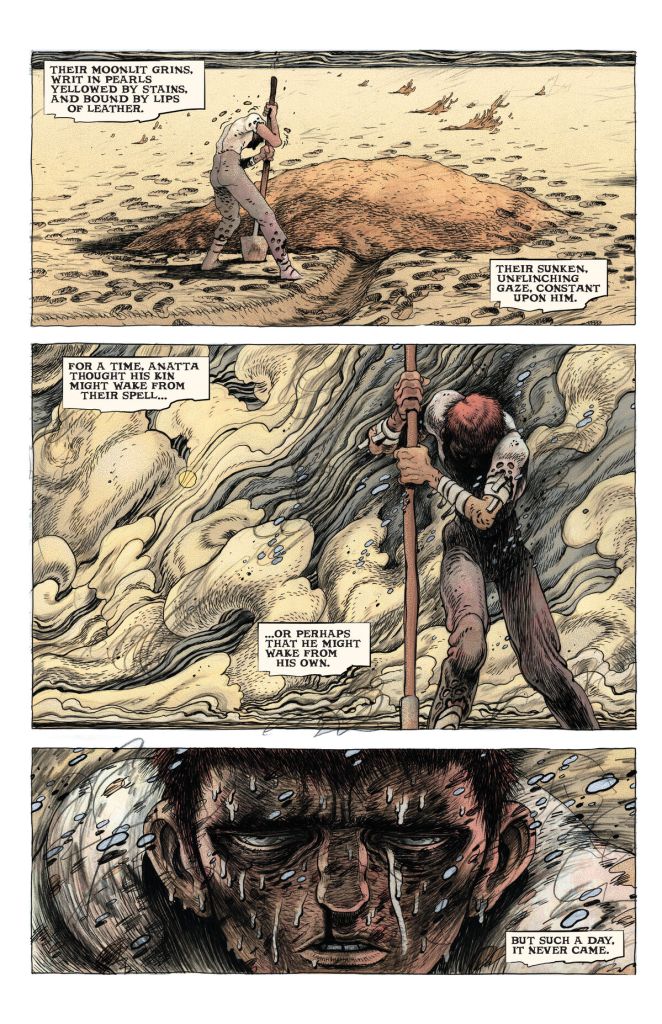
I could go on and on about Bertram’s work (as joined once more by the brilliant colors courtesy of Matt Hollingsworth, who deserves his own series of paragraphs) — and yet none of it captures 1/50th of the charm and prowess in this debut. If you somehow read this book without the narration, or nary an ounce of care for the narrative itself, you’d still have something that stoked a deep nostalgia for similar fantasy fare (think The Dark Crystal) but that achieves a level of impact and integrity far beyond what we’ve seen in these kinds of sagas.
Bertram continues to grow his skills as both a world-builder and storyteller, and Karman Blade reflects so many ideas into a world that you can practically navigate all on your own.
Van Poelgeest’s goal, then, was to recognize the mighty presence cast by his collaborators, and he once more operates in a way where Bertram and the rest of the art team can absolutely flourish. In the pair’s past projects, there was a tendency to build intricate narratives that, while interested in universal ideas like memory and self-perception, relied on this deep, multifaceted history and corresponding lore. Little Bird, for instance, was a delight, but the world’s canon was three to four layers deep.
And, don’t get me wrong: that’s exactly what made those books so exciting — this sense that this charming, alien world had so much more humming below the surface, and that the dizzying joy we felt walking through this strangely wonderful realm was imbued with deeper power and contextual wonders. But I quite like a simpler storyline, one where Anatta will travel through this world backed by poetic narration and with plenty of chances for the visuals to push and pull us every step of the way. That’s not to say things can’t get involved or the lore wont build; rather, we can see the bones of this story right away to foster this unwavering connection.
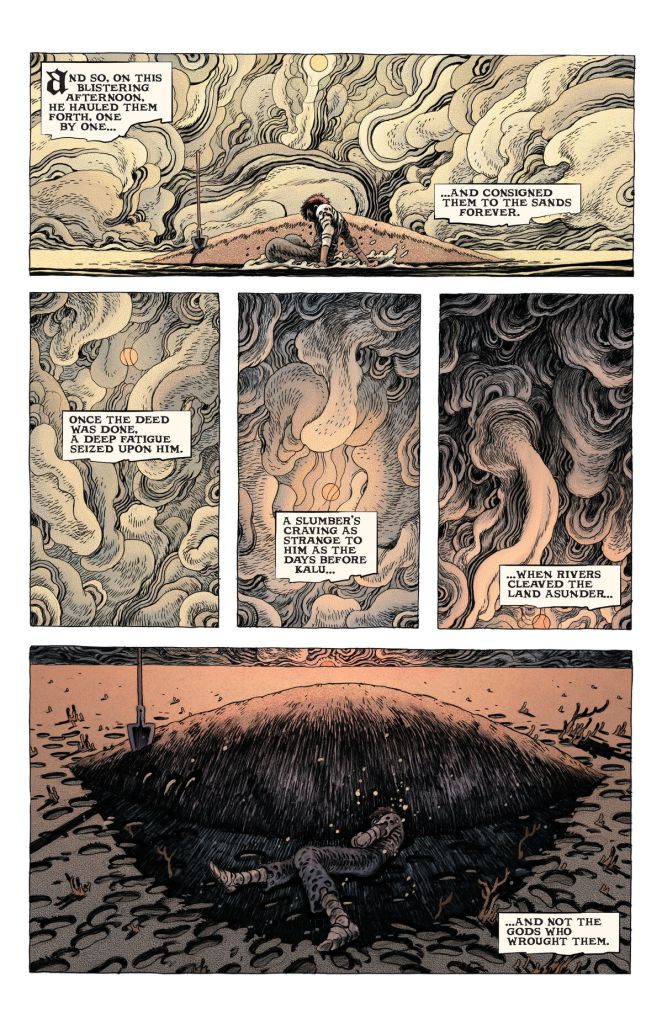
However, as I was reading Karman Blade #1, I thought just as much about Van Poelgeest’s other forthcoming project: The Cutting Garden (with artist Erin Connally). That’s another book where the storyline itself is simple enough; sure, there’s interpersonal history and drama galore, but the focus is on the fallout and not the story’s various layers/structure. To a large-ish extent, this aspect helps “settle” some of my concerns that Karman Blade is a little under-developed at its core, and that it doesn’t have a lot of bells and whistles (beyond those visually, which serve another role in this tale).
There’s this sense that any “simplification” here is done quite deliberately, and that Van Poelgeest wants to boil things down to their essence so that we focus on the journey and the struggle and not what it might mean contextually. That Karman Blade is really an epic — not just in its beauty and power, but in that it tries to be a kind of universal experience in a way some of their other titles weren’t as interested in accomplishing. That it might look different as a way of standing out, but Anatta’s mission to kill evil, free his world, and perhaps find his own place are distinctly Gilgamesh-ian in their scope and also accessibility.
You can see this in other places across Karman Blade #1. Always smooth with a sentence, Van Poelgeest’s narration reaches a new level of theatricality and general resonance (while feeling utterly approachable, too(. I theorize that he’s perhaps going extra grand and romantic with it because (as with Cutting Garden) he’s elevating by simplifying, embracing certain approaches and flourishes that speak to something even deeper within all of us. And because Bertram is smashing people’s brains left and right with every new panel, Van Poelgeest is free to lean into something essential that connects us all. That’s the mark of true collaboration: both “sides” dancing solo while adding so much to the other’s flourishes.
That’s made even more clear with some other events across issue #1, like Anatta’s conversation with his dad (which screams deeply personal without feeling so contrived). Or, the giant wolf companion, something that’s quite cliche but done in a way that feels refreshing in its narrative potential and dramatic possibilities. (There’s a tension already manifested between Anatta and the wolf, and that’s yummy as heck.) They’re moves that feel less inventive because, well, who gives a damn — what we should care about is the way this story reaches out to all of us and tries to move us in a way that goes beyond the confines of “simple” story to become something transcendent and primordial. A pillar in the world to gather around and share tales of heartache and triumph.
It’s still early, obviously, and I don’t want to paint Karman Blade as some modern-day Beowulf. (Not yet…) Still, it feels like there’s already the sturdy bedrock in this place for just such an important tale — one that maybe not be as significant (duuuhhh), but that certainly becomes a thread to unite us all in understanding the world. Or, even just this specific moment in time.
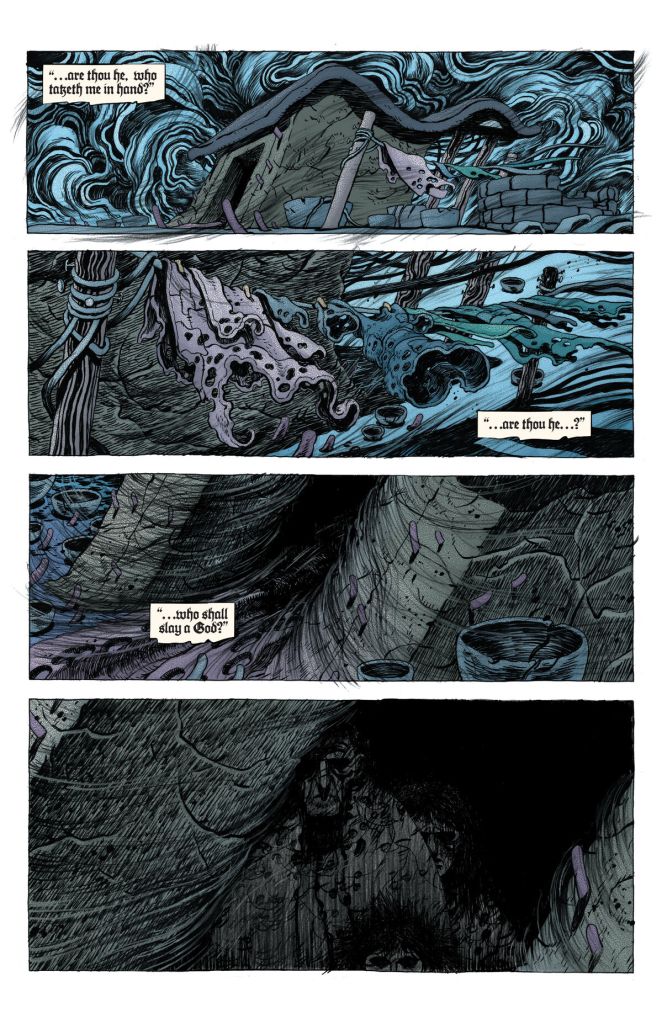
Without being overt at all, Karman Blade is the tale of a young lad picking up his sword to right the world; if you can’t see the real-world connotations of that play out across the nightly news (and your dang mortal soul), maybe re-up your prescription eyewear. A story like this will resonate because even more than the quality and depth of its efforts (which are quite mighty indeed), it tells us who we are, who we want to be, and what that long, strange trip might look like.
But for this long-time super-fan of its creators, Karman Blade is also what happens when you let storytellers speak to you through time and space, and how each new story reminds you that you’re never truly alone if you just follow the narrative. Take the time to invest in Karman Blade, and it’ll cut you in ways both surprising and life-affirming.
The Karman Blade #1 is due out September 9. (FOC is Monday, August 17.)
‘The Karman Blade’ #1 review: Somewhere between a dagger shot and an axe swing
The Karman Blade #1
After successes with ‘Little Bird’ and ‘Precious Metal,’ Van Poelgeest and Bertram reunite for a gritty fantasy tale that goes right for your guts as the pair elevate the unique power of their partnership.
Reader Rating0 Votes
0
Bertram’s art is another master class in world-building and visceral storytelling.
Van Poelgeest achieves a more direct emotionality here that proves more satisfying than ever.
There’s an unassuming quality to this potent tale, a means of getting in ASAP to really feel its true power.
I wonder if our hero, Anatta, will further feel like a stand-in or if he can become a proper lead.
9
Great
Buy Now
Amazon
Up Next:
Ghost Rider: Kushala #1 collects Spirit Rider Infinity Comic this November
Tradewatch: exciting bookshelf editions for the week of 08/19/26

X-Men’s mystical side takes center stage in new ‘X-Orcists’ series November 2026
Comic Books
First ‘Avengers’ #1 preview revealed as Marvel unveils new True Believers Blind Bag covers
Comic Books
Marvel reveals new ‘Midnight’ variant covers ahead of October 2026 launch
Comic Books
“Our love is still strong”: Seth Green and Hugh Sterbakov discuss friendship, superpowers for ‘Freshmen’ 20th anniversary
